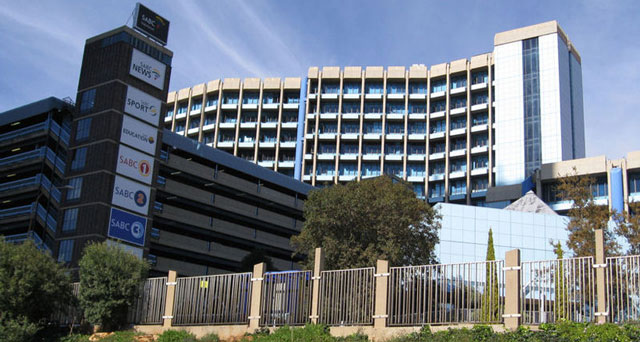
SABC group CEO Lulama Mokhobo has cited “exhaustion”, and not her working relationship with controversial acting chief operating officer Hlaudi Motsoeneng, as the reason she is stepping down just two years into a five-year term at the troubled state-owned broadcaster.
Though Mokhobo admits she had a number of “robust” disagreements with Motsoeneng, she tells TechCentral in an exclusive interview that she believes she has made significant progress in turning the public broadcaster around and that it’s time to make way for a new leader who can take full advantage of the benefits that South Africa’s move to digital terrestrial television offers.
TechCentral broke the news on Monday that Mokhobo had signed a settlement agreement with the board, raising further questions about stability at the long-troubled institution. It’s been speculated that Mokhobo is stepping down because of two centres of power that have emerged at the broadcaster, one in her office and the other in Motsoeneng’s office.
But Mokhobo plays down tensions between her and Motsoeneng. “He is chief operating officer. I am the CEO. We have to work collaboratively. There are times we disagree very vocally, but ultimately the company has to run,” she says.
“I am conservative because I was brought up in a business philosophy of taking due care in all business dealings,” Mokhobo adds. “There are those who are quick to make decisions and to run [with them]. That’s when the arguments get very loud.”
But is Motsoeneng more powerful than Mokhobo, as many commentators have suggested? “No, no, no,” Mokhobo insists, before adding: “It depends on how you define power. There is power that is very much … how do I put it? … I’m strategic. He is out there because he deals every day with the different radio stations and channels. I’m not the sort of leader who hogs the media, and that’s where the perception comes in. Being a leader doesn’t mean that I should be in the media every day. My job is to look at where we are going — financially, we are okay — and our strategy. The perception that I’m never seen or heard and am therefore not exercising my power? No.”
She says companies won’t progress when they’re run by leaders who “agree on everything all the time”.
“We debate the issues until we reach a point that is best for the company. He will be coming from an operational perspective and I’ll be coming from a governance and strategic leadership perspective. You have to convince me how and why. If I have been convinced that is the right thing to do, it gets done.”
And if she’s not convinced? “In many instances I have said ‘no’, and he has accepted a ‘no’.”
She describes her business relationship with Motsoeneng as “healthy”.
What follows is a shortened and edited transcript of TechCentral’s wide-ranging interview with Mokobo.
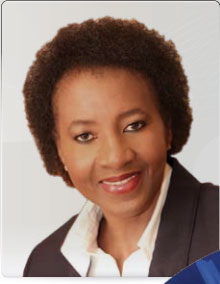
TechCentral: Why are you really stepping down, just two years into your contract?
Mokhobo: Simply exhaustion. When you consider what I found at the organisation, you’ll begin to understand. It was in complete disarray. The board just did not see eye to eye on most things.
The business owed R800m at that point to Nedbank. It was still very much running in austerity, key executives had left the organisation and there were a lot of people in acting positions. In many instances, those people did not come with the requisite skills. Morale was exceptionally low.
There was the Specialised Investigating Unit report, the hangover from that, it had not been closed off yet. There was a litany of problems.
Within all of that, there were projects that were needed to have been done a long time ago, which were just never done: the 24-hour news project, a skills audit (which had been outstanding for years), the editorial policies, which are exceptionally critical, which were supposed to have been reviewed in 2008 (this was never done), and a whole range of other things.
There were serious structural problems and long outstanding cases of disciplinary processes not completed.
Digital migration had stalled.
Under my leadership, the SABC managed to deliver on some of the critical projects: the skills audit was done and by June we knew exactly who we had and we implemented training programmes … and the understanding of how to run a business efficiently and effectively is so much higher now. There is lots of training and development happening on the job.
The 24-hour news channel eventually was launched [on DStv]. The government guarantee did get paid back. At end-January, the SABC had a R1,2bn cash pile.
For the SABC to arrive at that point took real financial prudence, ensuring that money was spent that needed to be spent, and appropriately so.
While doing that, the SABC lost focus on delivering additional fresh content that was absolutely necessary. With austerity, a lot of content was put on ice. But we also have an excellent head of commercial services who … has managed to convince the market to continue investing in the SABC. The money has flowed in.
We have lost some ground on licence fee side of things, largely because of … a loss of credibility from not having the content that people expect. Big things needed to be done on the reputational management part of the business so the public would regain confidence and agree to go back to paying their licences. (Mokhobo says only 36% of households currently pay their licence fees.)
Real work has been done to control costs and to bring the company back to liquidity. There was a time when it was technically insolvent.
The organisation requires specific leadership skills and qualities at a particular time. With the company having been stabilised, it now requires a different leader to take it to a different level. It must be someone who understands the digital future fully and how it can be harnessed.
TechCentral: The Democratic Alliance has proposed chopping up the SABC’s commercial assets and selling them to the highest bidder. Your view of this?
Mokhobo: Democracy is heavily reliant on the public broadcaster. It should be able to give to the public information that really empowers, allowing the public to make informed decisions. If it is chopped up, who will take on the responsibility of driving public value?
It’s an expensive business and requires very big investments in programming that may not deliver revenues.
TechCentral: But is the SABC delivering on its public service mandate? Do people trust the information it conveys?
Mokhobo: It’s a very fine line between providing information to the public and providing sensationalism. It’s a constant battle to be able to create the balance between that which is truly informative and that which borders on sensationalism.
The CEO cannot interfere in what happens in the newsroom. Editorial decisions are purely newsroom decisions. Unless the executive of news asks for advice, I dare not interfere. I believe in sticking to policy.
When the newsroom makes decisions that, in the public perception, creates a negative bias, it is their decision. They must be able to communicate to the public why they’ve taken certain decisions. The newsroom has to continuously work on building its own credibility.
We live in a country with so many different political interests and you will never have 100% of the population happy. There will always be someone who feels there is some or other injustice being done … and they will make their voice heard. But the silent majority are very happy.
The news and operations team went around the country … and they got very positive responses from ordinary people.
The ANC is in government and majority of government ministers are ANC. The ministers and different departments get a lot of airtime. They get airtime not because they are ANC, but because they are government ministers. I believe the SABC is playing its role very well there. The ministers can’t be held to account in the dark. A lot of people don’t read newspapers, but they do listen to the radio.
We’ve had calls from the SACP, the IFP, the DA … we have been accused of all kinds of things. I assume it’s the same in other democratic countries. As a rule, we always listen and if indeed there is an indication there was bias, the news team is mature enough to correct whatever bias that has occurred. They may create an opportunity for a particular individual to come on and put their case forward. That attempt at balance is done consistently.
TechCentral: What about how the SABC is funded? How does this affect the organisation’s ability to deliver on its mandate?
Mokhobo: The public believes the SABC receives government money. The BBC in the UK is 100% funded through licence fees. The SABC has to depend on 82-84% of revenues coming from commercial activity. It’s a strange business model where we have to be so heavily dependent on commercial activity to do what we have to do.
Government support is only for capital expenditure requirements from time to time. We get some grants from the department of education to do educational programmes. Apart from those, there is no money from government.
The persona of the SABC is schizophrenic. It’s a commercial business. It either receives proper government funding, or it’s left to run as a commercial entity.
TechCentral: What about Motsoeneng’s new policy that 70% of the SABC’s bulletins consist of so-called “happy news”? Do you agree with this approach?
Mokhobo: The fact is, the public is tired of the seeing the same gory pictures and of looking at yet another corruption case. There is so much good that is also happening in this country.
We have ordinary citizens that are doing great work. There are so many great things happening in this country, but they never get highlighted. Instead, what we see day in and day out is doom and gloom. The more negative people become, the more they say they’re giving up, leaving the country.
We need to make sure that the public sees both sides of the South African story. The humanitarian efforts in this country are huge. When there’s a tragedy in other countries, South Africa is very quick to send help, to send military to assist. We have to highlight the good things that are happening. If we don’t do that, it’s a disservice to the country.
TechCentral: Did you have sign off on the controversial five-year contract for the supply of 24-hour news and entertainment channels to MultiChoice’s DStv? (The contract specifically prevents the SABC from carrying its channels on any broadcasting platform that uses an encryption system, in effect assisting MultiChoice in its ongoing war with e.tv.)
Mokhobo: The MultiChoice deal was not signed off by me because I was not there. The chief operating officer was mandated by the board to sign off on it. Once the board has made a decision, it gets done.
TechCentral: Where were you?
Mokhobo: I was travelling.
TechCentral: Were you apprised of what was going on?
Mokhobo: No, the final contract had not been brought to me. Hlaudi executed.
TechCentral: Are you happy with the content of that agreement?
Mokhobo: Let’s be realistic. The first contract that was concluded, which I signed off on, provided the SABC with R100m over five years. Indeed, the national treasury had turned down a request for additional funding. “If you’re going to be running this thing at a loss, don’t even talk to us,” they said.
And so, when the room for negotiations with MultiChoice came up, Hlaudi, because he is operations, led that discussion and arrived at what they arrived at. The money is substantial enough to allow the channel to survive.
With the initial contract, within two-and-a-half years the channel would have been in the red, but with the new agreement it stays comfortably afloat to the end of five-year period.
TechCentral: Are you comfortable with the final agreement? Shouldn’t something of this magnitude have been approved by the permanent CEO?
Mokhobo: Hlaudi was acting CEO and when someone acts it’s with full delegated responsibility. Decisions made in my absence are perfectly acceptable. The board was exercising its fiduciary responsibility. They interrogated the document and agreed with it, and therefore they signed off on it. I can’t come back and want to unravel everything.
TechCentral: Would you have signed the contract?
Mokhobo: That’s an unfair question, pass.
I am aware of the controversies around it. As with all contracts, ultimately it becomes clear there must be a review process enforceable by an authority higher than the SABC.
Remember that the 24-hour news channel will be migrated to digital terrestrial television immediately the platform is launched.
TechCentral: Is the SABC right to oppose conditional access in government set-top boxes? What is your position on the inclusion of encryption?
Mokhobo: My position doesn’t matter. But additional expertise was consulted. There were many views on what could or could not happen. There were real concerns about the threat of the public being switched off one way or another.
TechCentral: Who would switch off the SABC?
Mokhobo: Any of the new players. Where there is a war for revenues based on getting eyeballs, the potential for espionage is very large. Therefore, the view was keep it simple, no one can switch off anyone else and that’s it.
TechCentral: Did the SABC agree not to support encryption to ensure greater funding from MultiChoice for its 24-hour news channel?
Mokhobo: I cannot say so. I can’t comment on that. The perception is there, and so it must just be tested. It would be improper to comment on that when the perception has not been tested. It’s an hypothesis. If there is an hypothesis, you need to confirm it.
TechCentral: What advice would you give to your successor?
Mokhobo: Be diligent in managing the finances of the company. Past history has shown that the biggest downfalls for the SABC have occurred because of financial matters. There has to be absolute diligence, while also not strangling the company.
There has to be a taking of certain risks, but those risks must be weighed up thoroughly against the possibility of the company regressing because of the financial decisions that have been made.
I’d encourage my successor to use expert knowledge on how to progress in the new digital environment and not to make emotional decisions. They will have to be calculated in the decisions they make around digital television.
Also, bring bring back enthusiasm among SABC employees. Let’s face it, some of them have seen the company go up and down and up and down and there is emotional fatigue. Something substantial has to be done to get the people to think that they work for a good company and can walk tall and can proudly display SABC branding on their shirts.
The flipside of that is to rebuild the credibility of the organisation from a public and political perspective. A good amount of investment has to be put in in turning around reputation.
In general, my successor must be visionary and be able to look 10-20 years from now and help the company understand its potential beyond the now and find the right funding model for the SABC. — (c) 2014 NewsCentral Media