Close Menu
TechCentralTechCentral

    Subscribe to the newsletter

    Get the best South African technology news and analysis delivered to your e-mail inbox every morning.

    Facebook X (Twitter) YouTube LinkedIn
    WhatsApp Facebook X (Twitter) LinkedIn YouTube
    TechCentralTechCentral
    • News
      Big Microsoft 365 price increases coming next year

      Big Microsoft price increases coming next year

      5 December 2025
      Vodacom to take control of Safaricom in R36-billion deal - Shameel Joosub

      Vodacom to take control of Safaricom in R36-billion deal

      4 December 2025
      Black Friday goes digital in South Africa as online spending surges to record high

      Black Friday goes digital in South Africa as online spending surges to record high

      4 December 2025
      BYD takes direct aim at Toyota with launch of sub-R500 000 Sealion 5 PHEV

      BYD takes direct aim at Toyota with launch of sub-R500 000 Sealion 5 PHEV

      4 December 2025
      'Get it now': Takealot in new instant deliveries pilot

      ‘Get it now’: Takealot in new instant deliveries pilot

      4 December 2025
    • World
      Amazon and Google launch multi-cloud service for faster connectivity

      Amazon and Google launch multi-cloud service for faster connectivity

      1 December 2025
      Google makes final court plea to stop US breakup

      Google makes final court plea to stop US breakup

      21 November 2025
      Bezos unveils monster rocket: New Glenn 9x4 set to dwarf Saturn V

      Bezos unveils monster rocket: New Glenn 9×4 set to dwarf Saturn V

      21 November 2025
      Tech shares turbocharged by Nvidia's stellar earnings

      Tech shares turbocharged by stellar Nvidia earnings

      20 November 2025
      Config file blamed for Cloudflare meltdown that disrupted the web

      Config file blamed for Cloudflare meltdown that disrupted the web

      19 November 2025
    • In-depth
      Jensen Huang Nvidia

      So, will China really win the AI race?

      14 November 2025
      Valve's Linux console takes aim at Microsoft's gaming empire

      Valve’s Linux console takes aim at Microsoft’s gaming empire

      13 November 2025
      iOCO's extraordinary comeback plan - Rhys Summerton

      iOCO’s extraordinary comeback plan

      28 October 2025
      Why smart glasses keep failing - no, it's not the tech - Mark Zuckerberg

      Why smart glasses keep failing – it’s not the tech

      19 October 2025
      BYD to blanket South Africa with megawatt-scale EV charging network - Stella Li

      BYD to blanket South Africa with megawatt-scale EV charging network

      16 October 2025
    • TCS
      TCS+ | How Cloud on Demand helps partners thrive in the AWS ecosystem - Odwa Ndyaluvane and Xenia Rhode

      TCS+ | How Cloud On Demand helps partners thrive in the AWS ecosystem

      4 December 2025
      TCS | MTN Group CEO Ralph Mupita on competition, AI and the future of mobile

      TCS | Ralph Mupita on competition, AI and the future of mobile

      28 November 2025
      TCS | Dominic Cull on fixing South Africa's ICT policy bottlenecks

      TCS | Dominic Cull on fixing South Africa’s ICT policy bottlenecks

      21 November 2025
      TCS | BMW CEO Peter van Binsbergen on the future of South Africa's automotive industry

      TCS | BMW CEO Peter van Binsbergen on the future of South Africa’s automotive industry

      6 November 2025
      TCS | Why Altron is building an AI factory - Bongani Andy Mabaso

      TCS | Why Altron is building an AI factory in Johannesburg

      28 October 2025
    • Opinion
      Your data, your hardware: the DIY AI revolution is coming - Duncan McLeod

      Your data, your hardware: the DIY AI revolution is coming

      20 November 2025
      Zero Carbon Charge founder Joubert Roux

      The energy revolution South Africa can’t afford to miss

      20 November 2025
      It's time for a new approach to government IT spend in South Africa - Richard Firth

      It’s time for a new approach to government IT spend in South Africa

      19 November 2025
      How South Africa's broken Rica system fuels murder and mayhem - Farhad Khan

      How South Africa’s broken Rica system fuels murder and mayhem

      10 November 2025
      South Africa's AI data centre boom risks overloading a fragile grid - Paul Colmer

      South Africa’s AI data centre boom risks overloading a fragile grid

      30 October 2025
    • Company Hubs
      • Africa Data Centres
      • AfriGIS
      • Altron Digital Business
      • Altron Document Solutions
      • Altron Group
      • Arctic Wolf
      • AvertITD
      • Braintree
      • CallMiner
      • CambriLearn
      • CYBER1 Solutions
      • Digicloud Africa
      • Digimune
      • Domains.co.za
      • ESET
      • Euphoria Telecom
      • Incredible Business
      • iONLINE
      • IQbusiness
      • Iris Network Systems
      • LSD Open
      • NEC XON
      • Netstar
      • Network Platforms
      • Next DLP
      • Ovations
      • Paracon
      • Paratus
      • Q-KON
      • SevenC
      • SkyWire
      • Solid8 Technologies
      • Telit Cinterion
      • Tenable
      • Vertiv
      • Videri Digital
      • Vodacom Business
      • Wipro
      • Workday
      • XLink
    • Sections
      • AI and machine learning
      • Banking
      • Broadcasting and Media
      • Cloud services
      • Contact centres and CX
      • Cryptocurrencies
      • Education and skills
      • Electronics and hardware
      • Energy and sustainability
      • Enterprise software
      • Financial services
      • Information security
      • Internet and connectivity
      • Internet of Things
      • Investment
      • IT services
      • Lifestyle
      • Motoring
      • Public sector
      • Retail and e-commerce
      • Satellite communications
      • Science
      • SMEs and start-ups
      • Social media
      • Talent and leadership
      • Telecoms
    • Events
    • Advertise
    TechCentralTechCentral
    Home » In-depth » My memories of Stephen Hawking, a brilliant physicist who defied the odds

    My memories of Stephen Hawking, a brilliant physicist who defied the odds

    By The Conversation15 March 2018
    Twitter LinkedIn Facebook WhatsApp Email Telegram Copy Link
    News Alerts
    WhatsApp
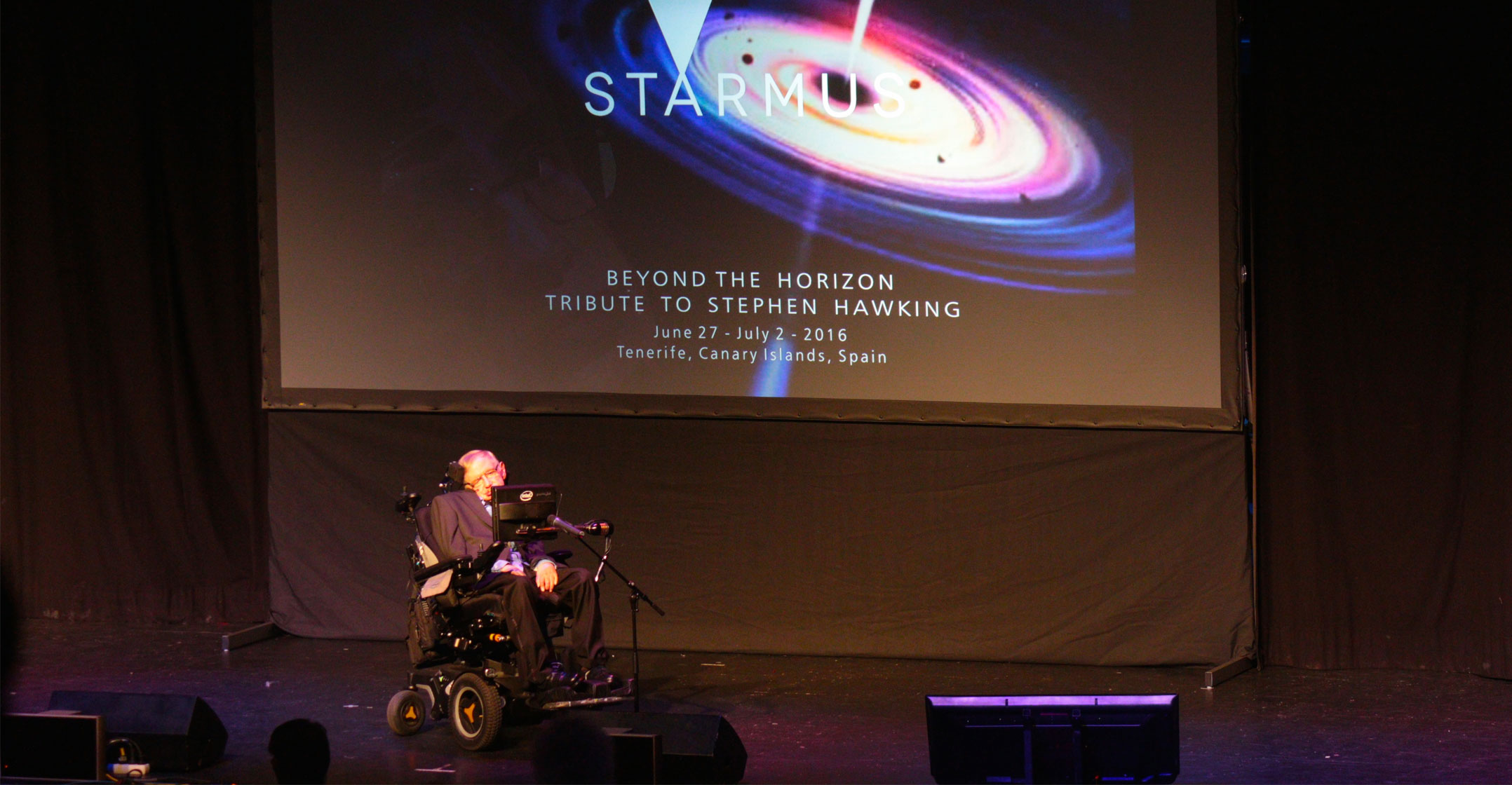
    Stephen Hawking on a stage in 2016. Image c/o Victor R Ruiz

    Soon after I enrolled as a graduate student at Cambridge University in 1964, I encountered a fellow student, two years ahead of me in his studies, who was unsteady on his feet and spoke with great difficulty. This was Stephen Hawking. He had recently been diagnosed with a degenerative disease, and it was thought that he might not survive long enough even to finish his PhD. But he lived to the age of 76, passing away on 14 March 2018.

    It really was astonishing. Astronomers are used to large numbers. But few numbers could be as large as the odds I’d have given against witnessing this lifetime of achievement back then. Even mere survival would have been a medical marvel, but of course he didn’t just survive. He became one of the most famous scientists in the world — acclaimed as a world-leading researcher in mathematical physics, for his best-selling books and for his astonishing triumph over adversity.

    Perhaps surprisingly, Hawking was rather laid back as an undergraduate student at Oxford University. Yet his brilliance earned him a first-class degree in physics, and he went on to pursue a research career at the University of Cambridge. Within a few years of the onset of his disease, he was wheelchair-bound, and his speech was an indistinct croak that could only be interpreted by those who knew him. In other respects, fortune had favoured him. He married a family friend, Jane Wilde, who provided a supportive home life for him and their three children.

    Within a few years of the onset of his disease, he was wheelchair-bound, and his speech was an indistinct croak that could only be interpreted by those who knew him

    The 1960s were an exciting period in astronomy and cosmology. This was the decade when evidence began to emerge for black holes and the Big Bang. In Cambridge, Hawking focused on the new mathematical concepts being developed by the mathematical physicist Roger Penrose, then at University College London, which were initiating a renaissance in the study of Einstein’s theory of general relativity.

    Using these techniques, Hawking worked out that the universe must have emerged from a “singularity” — a point in which all laws of physics break down. He also realised that the area of a black hole’s event horizon — a point from which nothing can escape — could never decrease. In the subsequent decades, the observational support for these ideas has strengthened — most spectacularly with the 2016 announcement of the detection of gravitational waves from colliding black holes.

    Hawking was elected to the Royal Society, Britain’s main scientific academy, at the exceptionally early age of 32. He was by then so frail that most of us suspected that he could scale no further heights. But, for Hawking, this was still just the beginning.

    He worked in the same building as I did. I would often push his wheelchair into his office, and he would ask me to open an abstruse book on quantum theory — the science of atoms, not a subject that had hitherto much interested him. He would sit hunched motionless for hours — he couldn’t even to turn the pages without help. I remember wondering what was going through his mind, and if his powers were failing. But within a year, he came up with his best ever idea — encapsulated in an equation that he said he wanted on his memorial stone.

    Eureka moment

    The great advances in science generally involve discovering a link between phenomena that seemed hitherto conceptually unconnected. Hawking’s “eureka moment” revealed a profound and unexpected link between gravity and quantum theory: he predicted that black holes would not be completely black but would radiate energy in a characteristic way.

    This radiation is only significant for black holes that are much less massive than stars — and none of these have been found. However, “Hawking radiation” had very deep implications for mathematical physics — indeed one of the main achievements of a theoretical framework for particle physics called string theory has been to corroborate his idea.

    Indeed, the string theorist Andrew Strominger from Harvard University (with whom Hawking recently collaborated) said that this paper had caused “more sleepless nights among theoretical physicists than any paper in history”. The key issue is whether information that is seemingly lost when objects fall into a black hole is in principle recoverable from the radiation when it evaporates. If it is not, this violates a deeply believed principle of general physics. Hawking initially thought such information was lost, but later changed his mind.
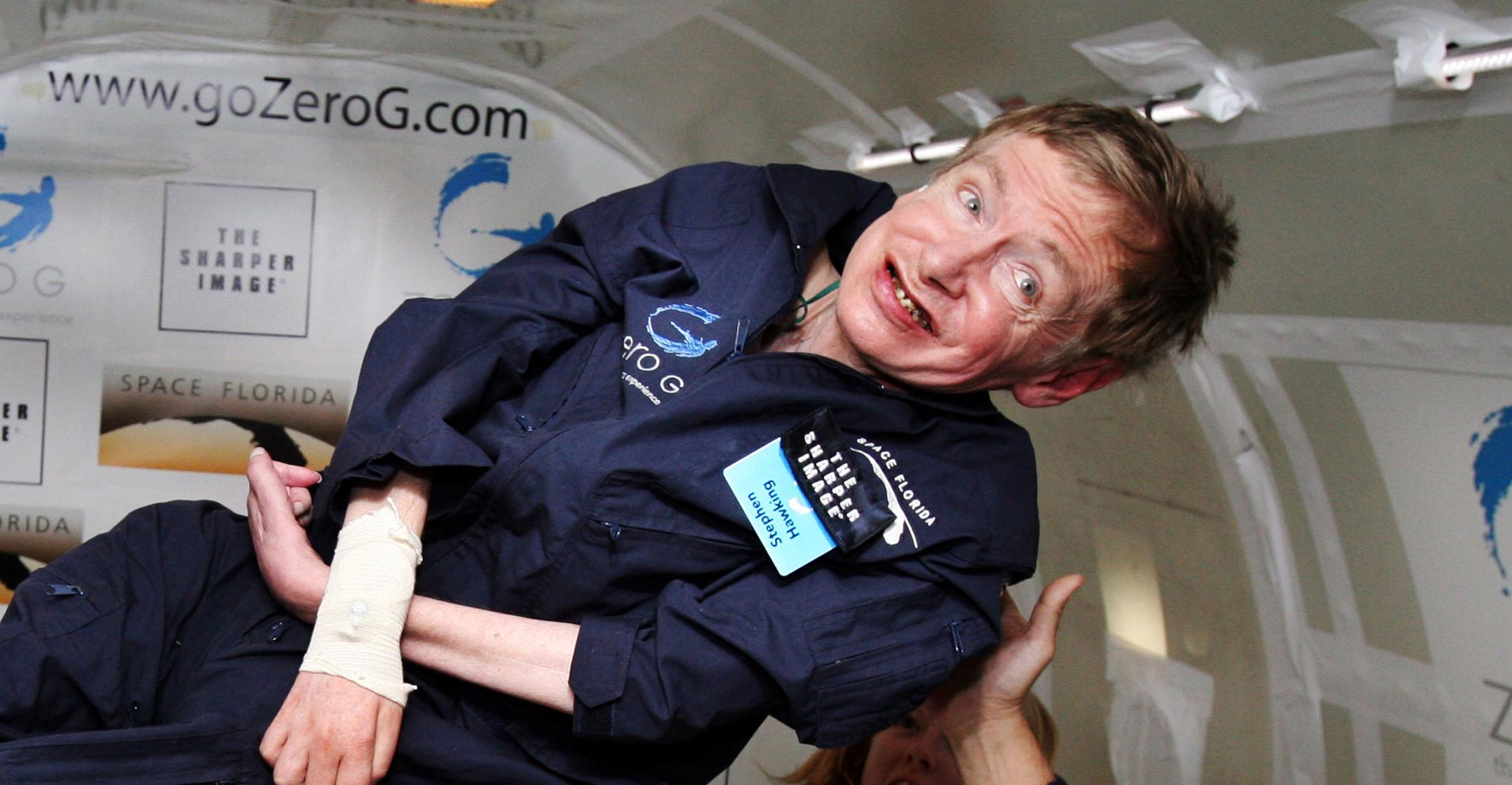
    Hawking enjoys zero-gravity during a flight aboard a modified Boeing 727 aircraft owned by Zero Gravity. Jim Campbell/Aero-News Network

    Hawking continued to seek new links between the very large (the cosmos) and the very small (atoms and quantum theory) and to gain deeper insights into the very beginning of our universe — addressing questions like “was our big bang the only one?”. He had a remarkable ability to figure things out in his head. But he also worked with students and colleagues who would write formulas on a blackboard — he would stare at it, say whether he agreed and perhaps suggest what should come next.

    He was especially influential in his contributions to “cosmic inflation” — a theory that many believe describes the ultra-early phases of our expanding universe. A key issue is to understand the primordial seeds which eventually develop into galaxies. Hawking proposed (as, independently, did the Russian theorist Viatcheslav Mukhanov) that these were “quantum fluctuations” (temporary changes in the amount of energy in a point in space) — somewhat analogous to those involved in “Hawking radiation” from black holes.

    He also made further steps towards linking the two great theories of 20th century physics: the quantum theory of the microworld and Einstein’s theory of gravity and space-time.

    He was saved by technology. He still had the use of one hand; and a computer, controlled by a single lever, allowed him to spell out sentences

    In 1987, Hawking contracted pneumonia. He had to undergo a tracheotomy, which removed even the limited powers of speech he then possessed. It had been more than 10 years since he could write, or even use a keyboard. Without speech, the only way he could communicate was by directing his eye towards one of the letters of the alphabet on a big board in front of him.

    But he was saved by technology. He still had the use of one hand; and a computer, controlled by a single lever, allowed him to spell out sentences. These were then declaimed by a speech synthesiser, with the androidal American accent that thereafter became his trademark.

    His lectures were, of course, pre-prepared, but conversation remained a struggle. Each word involved several presses of the lever, so even a sentence took several minutes to construct. He learnt to economise with words. His comments were aphoristic or oracular, but often infused with wit. In his later years, he became too weak to control this machine effectively, even via facial muscles or eye movements, and his communication — to his immense frustration — became even slower.

    At the time of his tracheotomy operation, he had a rough draft of a book, which he’d hoped would describe his ideas to a wide readership and earn something for his two eldest children, who were then of college age. On his recovery from pneumonia, he resumed work with the help of an editor. When the US edition of A Brief History of Time appeared, the printers made some errors (a picture was upside down), and the publishers tried to recall the stock. To their amazement, all copies had already been sold. This was the first inkling that the book was destined for runaway success, reaching millions of people worldwide.

    And he quickly became somewhat of a cult figure, featuring on popular TV shows ranging from The Simpsons to The Big Bang Theory. This was probably because the concept of an imprisoned mind roaming the cosmos plainly grabbed people’s imagination. If he had achieved equal distinction in, say, genetics rather than cosmology, his triumph probably wouldn’t have achieved the same resonance with a worldwide public.

    Not archetypal

    As shown in the feature film The Theory of Everything, which tells the human story behind his struggle, Hawking was far from being the archetype unworldy or nerdish scientist. His personality remained amazingly unwarped by his frustrations and handicaps. He had robust common sense and was ready to express forceful political opinions.

    However, a downside of his iconic status was that that his comments attracted exaggerated attention even on topics where he had no special expertise — for instance, philosophy, or the dangers from aliens or from intelligent machines. And he was sometimes involved in media events where his “script” was written by the promoters of causes about which he may have been ambivalent.

    Ultimately, Hawking’s life was shaped by the tragedy that struck him when he was only 22. He himself said that everything that happened since then was a bonus. And what a triumph his life has been. His name will live in the annals of science and millions have had their cosmic horizons widened by his best-selling books. He has also inspired millions by a unique example of achievement against all the odds — a manifestation of amazing willpower and determination.The Conversation

    • Written by Martin Rees, emeritus professor of cosmology and astrophysics, University of Cambridge
    • This article was originally published on The Conversation

    Martin Rees Stephen Hawking top
    Subscribe to TechCentral Subscribe to TechCentral
    Share. Facebook Twitter LinkedIn WhatsApp Telegram Email Copy Link
    Previous ArticleUpheaval tests if Musk can lead as well as dream
    Next Article Telecoms M&A forecast to surge in Africa

    Related Posts

    Go higher with Xerox Iridesse

    30 August 2022

    18GW in unplanned breakdowns cripple Eskom

    2 November 2021

    Nersa kicks the Karpowership can down the road

    13 September 2021
    Company News
    AI is not a technology problem - iqbusiness

    AI is not a technology problem – iqbusiness

    5 December 2025
    Telcos are sitting on a data gold mine - but few know what do with it - Phillip du Plessis

    Telcos are sitting on a data gold mine – but few know what do with it

    4 December 2025
    Unlock smarter computing with your surface Copilot+ PC

    Unlock smarter computing with your Surface Copilot+ PC

    4 December 2025
    Opinion
    Your data, your hardware: the DIY AI revolution is coming - Duncan McLeod

    Your data, your hardware: the DIY AI revolution is coming

    20 November 2025
    Zero Carbon Charge founder Joubert Roux

    The energy revolution South Africa can’t afford to miss

    20 November 2025
    It's time for a new approach to government IT spend in South Africa - Richard Firth

    It’s time for a new approach to government IT spend in South Africa

    19 November 2025

    Subscribe to Updates

    Get the best South African technology news and analysis delivered to your e-mail inbox every morning.

    Latest Posts
    Big Microsoft 365 price increases coming next year

    Big Microsoft price increases coming next year

    5 December 2025
    AI is not a technology problem - iqbusiness

    AI is not a technology problem – iqbusiness

    5 December 2025
    Vodacom to take control of Safaricom in R36-billion deal - Shameel Joosub

    Vodacom to take control of Safaricom in R36-billion deal

    4 December 2025
    Black Friday goes digital in South Africa as online spending surges to record high

    Black Friday goes digital in South Africa as online spending surges to record high

    4 December 2025
    © 2009 - 2025 NewsCentral Media
    • Cookie policy (ZA)
    • TechCentral – privacy and Popia

    Type above and press Enter to search. Press Esc to cancel.

    Manage consent

    TechCentral uses cookies to enhance its offerings. Consenting to these technologies allows us to serve you better. Not consenting or withdrawing consent may adversely affect certain features and functions of the website.

    Functional Always active
    The technical storage or access is strictly necessary for the legitimate purpose of enabling the use of a specific service explicitly requested by the subscriber or user, or for the sole purpose of carrying out the transmission of a communication over an electronic communications network.
    Preferences
    The technical storage or access is necessary for the legitimate purpose of storing preferences that are not requested by the subscriber or user.
    Statistics
    The technical storage or access that is used exclusively for statistical purposes. The technical storage or access that is used exclusively for anonymous statistical purposes. Without a subpoena, voluntary compliance on the part of your Internet Service Provider, or additional records from a third party, information stored or retrieved for this purpose alone cannot usually be used to identify you.
    Marketing
    The technical storage or access is required to create user profiles to send advertising, or to track the user on a website or across several websites for similar marketing purposes.
    • Manage options
    • Manage services
    • Manage {vendor_count} vendors
    • Read more about these purposes
    View preferences
    • {title}
    • {title}
    • {title}