Close Menu
TechCentralTechCentral

    Subscribe to the newsletter

    Get the best South African technology news and analysis delivered to your e-mail inbox every morning.

    Facebook X (Twitter) YouTube LinkedIn
    WhatsApp Facebook X (Twitter) LinkedIn YouTube
    TechCentralTechCentral
    • News
      Cabinet approves draft AI policy for public comment

      Cabinet approves draft AI policy for public comment

      6 April 2026
      Icasa data confirms the scale of South Africa's pay-TV collapse

      Icasa data confirms the scale of South Africa’s pay-TV collapse

      6 April 2026
      How AI agents are reshaping banking in South Africa - Lindelani Ramukumba, Absa

      How agentic AI is reshaping banking in South Africa

      5 April 2026
      South Africa's 5G boom is bypassing rural areas: Icasa

      South Africa’s 5G boom is bypassing rural areas: Icasa

      5 April 2026
      WhatsApp is eating South African operators' revenue

      WhatsApp is eating South African operators’ revenue

      4 April 2026
    • World
      DeepSeek V4 to run on Huawei silicon as China builds its own AI stack

      DeepSeek V4 to run on Huawei silicon as China builds its own AI stack

      4 April 2026
      Amazon in talks to buy satellite operator Globalstar

      Amazon in talks to buy satellite operator Globalstar

      2 April 2026

      Apple plans to open Siri to rival AI services

      27 March 2026
      It's official: ads are coming to ChatGPT

      It’s official: ads are coming to ChatGPT

      23 March 2026
      Mystery Chinese AI model revealed to be Xiaomi's

      Mystery Chinese AI model revealed to be Xiaomi’s

      19 March 2026
    • In-depth
      The biggest untapped EV market on Earth is hiding in plain sight

      The biggest untapped EV market on Earth is hiding in plain sight

      1 April 2026
      The R18-billion tech giant hiding in plain sight - Jens Montanana

      The R16-billion tech giant hiding in plain sight

      26 March 2026
      The last generation of coders

      The last generation of coders

      18 February 2026
      Sentech is in dire straits

      Sentech is in dire straits

      10 February 2026
      How liberalisation is rewiring South Africa's power sector

      How liberalisation is rewiring South Africa’s power sector

      21 January 2026
    • TCS
      TCS | MTN's Divysh Joshi on the strategy behind Pi - Divyesh Joshi

      TCS | MTN’s Divyesh Joshi on the strategy behind Pi

      1 April 2026
      Anoosh Rooplal

      TCS | Anoosh Rooplal on the Post Office’s last stand

      27 March 2026
      Meet the CIO | HealthBridge CTO Anton Fatti on the future of digital health

      Meet the CIO | Healthbridge CTO Anton Fatti on the future of digital health

      23 March 2026
      TCS+ | Arctic Wolf unpacks the evolving threat landscape for SA businesses - Clare Loveridge and Jason Oehley

      TCS+ | Arctic Wolf unpacks the evolving threat landscape for SA businesses

      19 March 2026
      TCS+ | Vox Kiwi: a wireless solution promising a fibre-like experience - Theo van Zyl

      TCS+ | Vox Kiwi: a wireless solution promising a fibre-like experience

      13 March 2026
    • Opinion
      The conflict of interest at the heart of PayShap's slow adoption - Cheslyn Jacobs

      The conflict of interest at the heart of PayShap’s slow adoption

      26 March 2026
      South Africa's energy future hinges on getting wheeling right - Aishah Gire

      South Africa’s energy future hinges on getting wheeling right

      10 March 2026
      Hold the doom: the case for a South African comeback - Duncan McLeod

      Apple just dropped a bomb on the Windows world

      5 March 2026
      VC's centre of gravity is shifting - and South Africa is in the frame - Alison Collier

      VC’s centre of gravity is shifting – and South Africa is in the frame

      3 March 2026
      Hold the doom: the case for a South African comeback - Duncan McLeod

      Hold the doom: the case for a South African comeback

      26 February 2026
    • Company Hubs
      • 1Stream
      • Africa Data Centres
      • AfriGIS
      • Altron Digital Business
      • Altron Document Solutions
      • Altron Group
      • Arctic Wolf
      • Ascent Technology
      • AvertITD
      • BBD
      • Braintree
      • CallMiner
      • CambriLearn
      • CYBER1 Solutions
      • Digicloud Africa
      • Digimune
      • Domains.co.za
      • ESET
      • Euphoria Telecom
      • HOSTAFRICA
      • Incredible Business
      • iONLINE
      • IQbusiness
      • Iris Network Systems
      • Kaspersky
      • LSD Open
      • Mitel
      • NEC XON
      • Netstar
      • Network Platforms
      • Next DLP
      • Ovations
      • Paracon
      • Paratus
      • Q-KON
      • SevenC
      • SkyWire
      • Solid8 Technologies
      • Telit Cinterion
      • Telviva
      • Tenable
      • Vertiv
      • Videri Digital
      • Vodacom Business
      • Wipro
      • Workday
      • XLink
    • Sections
      • AI and machine learning
      • Banking
      • Broadcasting and Media
      • Cloud services
      • Contact centres and CX
      • Cryptocurrencies
      • Education and skills
      • Electronics and hardware
      • Energy and sustainability
      • Enterprise software
      • Financial services
      • HealthTech
      • Information security
      • Internet and connectivity
      • Internet of Things
      • Investment
      • IT services
      • Lifestyle
      • Motoring
      • Policy and regulation
      • Public sector
      • Retail and e-commerce
      • Satellite communications
      • Science
      • SMEs and start-ups
      • Social media
      • Talent and leadership
      • Telecoms
    • Events
    • Advertise
    TechCentralTechCentral
    Home » World » Nasa’s Artemis moon rocket launch postponed for weeks

    Nasa’s Artemis moon rocket launch postponed for weeks

    Citing a stubborn fuel leak, the space agency said the debut mission of its moon-to-Mars Artemis programme will be delayed by at least several weeks.
    By Agency Staff5 September 2022
    Twitter LinkedIn Facebook WhatsApp Email Telegram Copy Link
    News Alerts
    WhatsApp
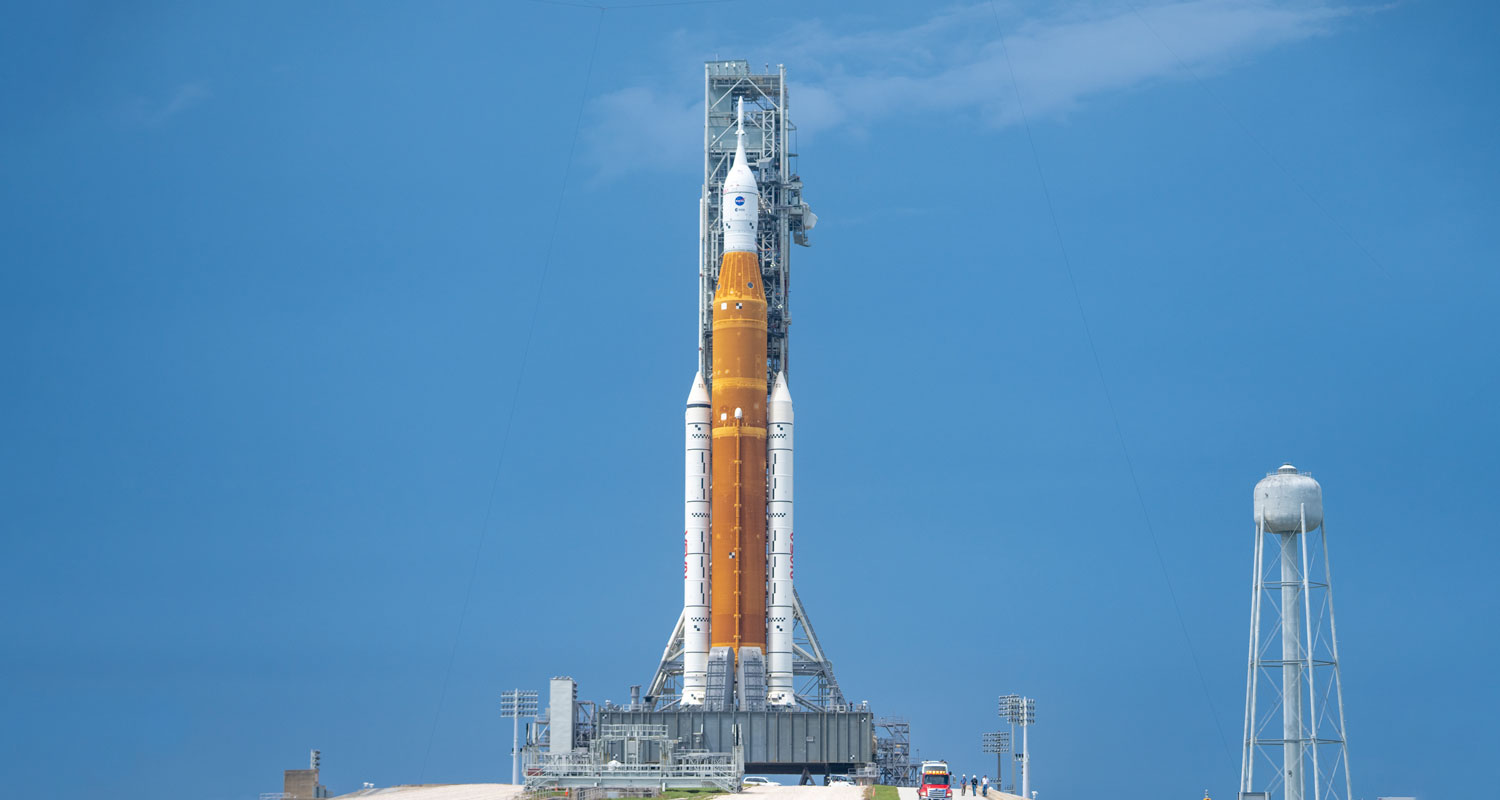
    Artemis I on the Launch Pad. Image: Nasa

    For the second time in a week, Nasa on Saturday aborted an attempt to launch its giant, next-generation rocket ship, citing a stubborn fuel leak that the space agency said could delay the debut mission of its moon-to-Mars Artemis programme by at least several weeks.

    Preflight operations were called off for the day about three hours before the 2.17pm local time liftoff targeted for the 32-storey-tall Space Launch System (SLS) rocket and its Orion capsule from Cape Canaveral, Florida.

    The uncrewed test flight, aimed at launching the capsule out to the moon and back, was to have marked the inaugural voyage of both the SLS and Orion a half century after the last lunar mission of Apollo, forerunner of the Artemis programme.

    A rollback would postpone the next launch attempt at least until mid-October, in part to avoid a scheduling conflict

    The countdown was scrubbed after Kennedy Space Centre technicians made three failed attempts to fix a “large” leak of supercooled liquid hydrogen propellant being pumped into the rocket’s core-stage fuel tanks, agency officials said.

    The initial launch try on Monday was likewise foiled by technical problems, including a different leaky fuel line, a faulty temperature sensor and cracks found in insulation foam.

    Mission managers proceeded with a second launch attempt on Saturday once the earlier issues had been resolved to their satisfaction. And Nasa had reserved another backup launch time, for either Monday or Tuesday, in case a third try was needed.

    But after a review of data from the latest difficulties, Nasa concluded the new hydrogen leak was too tricky and time-consuming to finish troubleshooting and fix on the launchpad before the current launch period allotted to the mission expires on Tuesday.

    ‘Several weeks of work’

    The delay means the earliest opportunity to try again would come during the next launch period that runs from 19-30 September, or during a subsequent October window, an associate Nasa administrator, Jim Free, told reporters at a late-afternoon briefing.

    He said the postponement also would involve rolling the spacecraft back into its assembly building, under Cape Canaveral “range” rules limiting how long a rocket may remain at its launch tower before undergoing a new round of safety checks indoors.

    Mike Sarafin, Nasa’s Artemis mission manager, said efforts to resolve the latest technical snag would entail “several weeks of work”.

    Nasa chief Bill Nelson said earlier in the day that a rollback would postpone the next launch attempt at least until mid-October, in part to avoid a scheduling conflict with the next International Space Station crew due for launch early that month.

    Launch-day delays and malfunctions are not uncommon in the space business, especially for new rockets such as Nasa’s Space Launch System, a complex vehicle with a set of pre-liftoff procedures that have yet to be fully tested and rehearsed by engineers without a hitch.
    On average, the odds of scrubbing a launch on any given day for any reason, including foul weather, are about one in three. “We’re not going to launch until it’s right, and that is standard operating procedure, and will continue to be,” Nelson said at the briefing.

    The last-minute setbacks on the launchpad came at the tail end of a development programme more than a decade in the making, with years of delays and billions of dollars in cost overruns under Nasa’s respective SLS and Orion contracts with Boeing and Lockheed Martin.

    Apart from its technical challenges, Artemis I signals a major turning point for Nasa’s post-Apollo human spaceflight programme, after decades focused on low-Earth orbit with space shuttles and the International Space Station.

    Named for the goddess who was Apollo’s twin sister in ancient Greek mythology, Artemis aims to return astronauts to the moon’s surface as early as 2025, though many experts believe that time frame will likely slip.

    Twelve astronauts walked on the moon during six Apollo missions from 1969 to 1972, the only spaceflights yet to place humans on the lunar surface. But Apollo, born of the US-Soviet space race during the Cold War, was less science-driven than Artemis.

    Although no humans will be aboard, Orion will carry a simulated crew of three – one male and two female mannequins

    The new moon programme has enlisted commercial partners such as SpaceX and the space agencies of Europe, Canada and Japan to eventually establish a long-term lunar base of operations as a stepping stone to even more ambitious human voyages to Mars.

    Getting the SLS-Orion spacecraft launched is a key first step. Its first voyage is intended to put the vehicle through its paces in a rigorous test flight pushing its design limits and aiming to prove the spacecraft suitable to fly astronauts.

    If the mission succeeds, a crewed Artemis II flight around the moon and back could come as early as 2024, to be followed within a few more years with the programme’s first lunar landing of astronauts, one of them a woman, with Artemis III.

    Billed as the most powerful, complex rocket in the world, the SLS represents the biggest new vertical launch system Nasa has built since the Saturn V of the Apollo era.

    Although no humans will be aboard, Orion will carry a simulated crew of three — one male and two female mannequins — fitted with sensors to measure radiation levels and other stresses that real-life astronauts would experience.  — Joey Roulette and Steve Gorman, (c) 2022 Reuters
    Follow TechCentral on Google News Add TechCentral as your preferred source on Google


    Artemis Bill Nelson Nasa Nasa Artemis
    WhatsApp YouTube
    Share. Facebook Twitter LinkedIn WhatsApp Telegram Email Copy Link
    Previous ArticleCovid vaccine you inhale is here
    Next Article Shock increases in UK broadband and mobile prices expected

    Related Posts

    Four astronauts begin humanity's return to the moon - Artemis II

    Four astronauts begin humanity’s return to the moon

    2 April 2026
    Musk hits brakes on Mars mission

    Musk hits brakes on Mars mission

    9 February 2026
    Breaking free from legacy thinking in banks: AI, automation and the agentic operating model - Steve Burke iqbusiness

    Breaking free from legacy thinking in banks: AI, automation and the agentic operating model

    15 January 2026
    Company News
    Synthesis helps financial enterprises transform with new Gemini Enterprise - Digicloud Africa

    Synthesis helps financial enterprises transform with new Gemini Enterprise

    2 April 2026
    The next churn wave is already in your contact centre conversations - CallMiner

    The next churn wave is already in your contact centre conversations

    2 April 2026
    Mining's problem isn't output, it's execution - Workday

    Mining’s problem isn’t output, it’s execution – Workday

    1 April 2026
    Opinion
    The conflict of interest at the heart of PayShap's slow adoption - Cheslyn Jacobs

    The conflict of interest at the heart of PayShap’s slow adoption

    26 March 2026
    South Africa's energy future hinges on getting wheeling right - Aishah Gire

    South Africa’s energy future hinges on getting wheeling right

    10 March 2026
    Hold the doom: the case for a South African comeback - Duncan McLeod

    Apple just dropped a bomb on the Windows world

    5 March 2026

    Subscribe to Updates

    Get the best South African technology news and analysis delivered to your e-mail inbox every morning.

    Latest Posts
    Cabinet approves draft AI policy for public comment

    Cabinet approves draft AI policy for public comment

    6 April 2026
    Icasa data confirms the scale of South Africa's pay-TV collapse

    Icasa data confirms the scale of South Africa’s pay-TV collapse

    6 April 2026
    How AI agents are reshaping banking in South Africa - Lindelani Ramukumba, Absa

    How agentic AI is reshaping banking in South Africa

    5 April 2026
    South Africa's 5G boom is bypassing rural areas: Icasa

    South Africa’s 5G boom is bypassing rural areas: Icasa

    5 April 2026
    © 2009 - 2026 NewsCentral Media
    • Cookie policy (ZA)
    • TechCentral – privacy and Popia

    Type above and press Enter to search. Press Esc to cancel.

    Manage consent

    TechCentral uses cookies to enhance its offerings. Consenting to these technologies allows us to serve you better. Not consenting or withdrawing consent may adversely affect certain features and functions of the website.

    Functional Always active
    The technical storage or access is strictly necessary for the legitimate purpose of enabling the use of a specific service explicitly requested by the subscriber or user, or for the sole purpose of carrying out the transmission of a communication over an electronic communications network.
    Preferences
    The technical storage or access is necessary for the legitimate purpose of storing preferences that are not requested by the subscriber or user.
    Statistics
    The technical storage or access that is used exclusively for statistical purposes. The technical storage or access that is used exclusively for anonymous statistical purposes. Without a subpoena, voluntary compliance on the part of your Internet Service Provider, or additional records from a third party, information stored or retrieved for this purpose alone cannot usually be used to identify you.
    Marketing
    The technical storage or access is required to create user profiles to send advertising, or to track the user on a website or across several websites for similar marketing purposes.
    • Manage options
    • Manage services
    • Manage {vendor_count} vendors
    • Read more about these purposes
    View preferences
    • {title}
    • {title}
    • {title}