
Close Menu
TechCentralTechCentral

    Subscribe to the newsletter

    Get the best South African technology news and analysis delivered to your e-mail inbox every morning.

    Facebook X (Twitter) YouTube LinkedIn
    WhatsApp Facebook X (Twitter) LinkedIn YouTube
    TechCentralTechCentral
    • News
      Big Microsoft 365 price increases coming next year

      Big Microsoft price increases coming next year

      5 December 2025
      Vodacom to take control of Safaricom in R36-billion deal - Shameel Joosub

      Vodacom to take control of Safaricom in R36-billion deal

      4 December 2025
      Black Friday goes digital in South Africa as online spending surges to record high

      Black Friday goes digital in South Africa as online spending surges to record high

      4 December 2025
      BYD takes direct aim at Toyota with launch of sub-R500 000 Sealion 5 PHEV

      BYD takes direct aim at Toyota with launch of sub-R500 000 Sealion 5 PHEV

      4 December 2025
      'Get it now': Takealot in new instant deliveries pilot

      ‘Get it now’: Takealot in new instant deliveries pilot

      4 December 2025
    • World
      Amazon and Google launch multi-cloud service for faster connectivity

      Amazon and Google launch multi-cloud service for faster connectivity

      1 December 2025
      Google makes final court plea to stop US breakup

      Google makes final court plea to stop US breakup

      21 November 2025
      Bezos unveils monster rocket: New Glenn 9x4 set to dwarf Saturn V

      Bezos unveils monster rocket: New Glenn 9×4 set to dwarf Saturn V

      21 November 2025
      Tech shares turbocharged by Nvidia's stellar earnings

      Tech shares turbocharged by stellar Nvidia earnings

      20 November 2025
      Config file blamed for Cloudflare meltdown that disrupted the web

      Config file blamed for Cloudflare meltdown that disrupted the web

      19 November 2025
    • In-depth
      Jensen Huang Nvidia

      So, will China really win the AI race?

      14 November 2025
      Valve's Linux console takes aim at Microsoft's gaming empire

      Valve’s Linux console takes aim at Microsoft’s gaming empire

      13 November 2025
      iOCO's extraordinary comeback plan - Rhys Summerton

      iOCO’s extraordinary comeback plan

      28 October 2025
      Why smart glasses keep failing - no, it's not the tech - Mark Zuckerberg

      Why smart glasses keep failing – it’s not the tech

      19 October 2025
      BYD to blanket South Africa with megawatt-scale EV charging network - Stella Li

      BYD to blanket South Africa with megawatt-scale EV charging network

      16 October 2025
    • TCS
      TCS+ | How Cloud on Demand helps partners thrive in the AWS ecosystem - Odwa Ndyaluvane and Xenia Rhode

      TCS+ | How Cloud On Demand helps partners thrive in the AWS ecosystem

      4 December 2025
      TCS | MTN Group CEO Ralph Mupita on competition, AI and the future of mobile

      TCS | Ralph Mupita on competition, AI and the future of mobile

      28 November 2025
      TCS | Dominic Cull on fixing South Africa's ICT policy bottlenecks

      TCS | Dominic Cull on fixing South Africa’s ICT policy bottlenecks

      21 November 2025
      TCS | BMW CEO Peter van Binsbergen on the future of South Africa's automotive industry

      TCS | BMW CEO Peter van Binsbergen on the future of South Africa’s automotive industry

      6 November 2025
      TCS | Why Altron is building an AI factory - Bongani Andy Mabaso

      TCS | Why Altron is building an AI factory in Johannesburg

      28 October 2025
    • Opinion
      Your data, your hardware: the DIY AI revolution is coming - Duncan McLeod

      Your data, your hardware: the DIY AI revolution is coming

      20 November 2025
      Zero Carbon Charge founder Joubert Roux

      The energy revolution South Africa can’t afford to miss

      20 November 2025
      It's time for a new approach to government IT spend in South Africa - Richard Firth

      It’s time for a new approach to government IT spend in South Africa

      19 November 2025
      How South Africa's broken Rica system fuels murder and mayhem - Farhad Khan

      How South Africa’s broken Rica system fuels murder and mayhem

      10 November 2025
      South Africa's AI data centre boom risks overloading a fragile grid - Paul Colmer

      South Africa’s AI data centre boom risks overloading a fragile grid

      30 October 2025
    • Company Hubs
      • Africa Data Centres
      • AfriGIS
      • Altron Digital Business
      • Altron Document Solutions
      • Altron Group
      • Arctic Wolf
      • AvertITD
      • Braintree
      • CallMiner
      • CambriLearn
      • CYBER1 Solutions
      • Digicloud Africa
      • Digimune
      • Domains.co.za
      • ESET
      • Euphoria Telecom
      • Incredible Business
      • iONLINE
      • IQbusiness
      • Iris Network Systems
      • LSD Open
      • NEC XON
      • Netstar
      • Network Platforms
      • Next DLP
      • Ovations
      • Paracon
      • Paratus
      • Q-KON
      • SevenC
      • SkyWire
      • Solid8 Technologies
      • Telit Cinterion
      • Tenable
      • Vertiv
      • Videri Digital
      • Vodacom Business
      • Wipro
      • Workday
      • XLink
    • Sections
      • AI and machine learning
      • Banking
      • Broadcasting and Media
      • Cloud services
      • Contact centres and CX
      • Cryptocurrencies
      • Education and skills
      • Electronics and hardware
      • Energy and sustainability
      • Enterprise software
      • Financial services
      • Information security
      • Internet and connectivity
      • Internet of Things
      • Investment
      • IT services
      • Lifestyle
      • Motoring
      • Public sector
      • Retail and e-commerce
      • Satellite communications
      • Science
      • SMEs and start-ups
      • Social media
      • Talent and leadership
      • Telecoms
    • Events
    • Advertise
    TechCentralTechCentral
    Home » Sections » Science » New study sheds light on one of physics’ biggest mysteries

    New study sheds light on one of physics’ biggest mysteries

    By The Conversation22 March 2019
    Twitter LinkedIn Facebook WhatsApp Email Telegram Copy Link
    News Alerts
    WhatsApp

    Why do we exist? This is arguably the most profound question there is and one that may seem completely outside the scope of particle physics. But our new experiment at Cern’s Large Hadron Collider has taken us a step closer to figuring it out.

    To understand why, let’s go back in time some 13.8 billion years to the Big Bang. This event produced equal amounts of the matter you are made of and something called antimatter. It is believed that every particle has an antimatter companion that is virtually identical to itself, but with the opposite charge. When a particle and its antiparticle meet, they annihilate each other — disappearing in a burst of light.

    Why the universe we see today is made entirely out of matter is one of the greatest mysteries of modern physics. Had there ever been an equal amount of antimatter, everything in the universe would have been annihilated. Our research has unveiled a new source of this asymmetry between matter and antimatter.

    This is arguably the most profound question there is and one that may seem completely outside the scope of particle physics

    Antimatter was first postulated by Arthur Schuster in 1896, given a theoretical footing by Paul Dirac in 1928, and discovered in the form of anti-electrons, dubbed positrons, by Carl Anderson in 1932. The positrons occur in natural radioactive processes, such as in the decay of potassium-40. This means your average banana (which contains potassium) emits a positron every 75 minutes. These then annihilate with matter electrons to produce light. Medical applications like PET scanners produce antimatter in the same process.

    The fundamental building blocks of matter that make up atoms are elementary particles called quarks and leptons. There are six kinds of quarks: up, down, strange, charm, bottom and top. Similarly, there are six leptons: the electron, muon, tau and the three neutrinos. There are also antimatter copies of these twelve particles that differ only in their charge.

    Mesons

    Antimatter particles should in principle be perfect mirror images of their normal companions. But experiments show this isn’t always the case. Take for instance particles known as mesons, which are made of one quark and one anti-quark. Neutral mesons have a fascinating feature: they can spontaneously turn into their anti-meson and vice versa. In this process, the quark turns into an anti-quark or the anti-quark turns into a quark. But experiments have shown that this can happen more in one direction than the opposite one — creating more matter than antimatter over time.

    Among particles containing quarks, only those including strange and bottom quarks have been found to exhibit such asymmetries — and these were hugely important discoveries. The very first observation of asymmetry involving strange particles in 1964 allowed theorists to predict the existence of six quarks — at a time when only three were known to exist. The discovery of asymmetry in bottom particles in 2001 was the final confirmation of the mechanism that led to the six-quark picture. Both discoveries led to Nobel Prizes.

    Both the strange and bottom quark carry a negative electric charge. The only positively charged quark that in theory should be able to form particles that can exhibit matter-antimatter asymmetry is charm. Theory suggests that if it does, then the effect should be tiny and difficult to detect.

    But the LHCb experiment has now managed to observe such an asymmetry in particles called D-meson — which are comprised of charm quarks — for the first time. This is made possible by the unprecedented amount of charm particles produced directly in the LHC collisions, which I pioneered a decade ago. The result indicates that the chance of this being a statistical fluctuation is about 50 in a billion.

    If this asymmetry is not coming from the same mechanism causing the strange and bottom quark asymmetries, this leaves room for new sources of matter-antimatter asymmetry that can add to the total such asymmetry in the early universe. And that’s important as the few known cases of asymmetry can’t explain why the universe contains so much matter. The charm discovery alone will not be sufficient to fill this gap, but it is an essential puzzle piece in the understanding of the interactions of fundamental particles.

    Over the coming decade, the upgraded LHCb experiment will boost the sensitivity for these kinds of measurements

    The discovery will be followed by an increased number of theoretical works, which help to interpret the result. But more importantly, it will outline further tests to deepen the understanding following our finding — with a number of such tests already ongoing.

    Over the coming decade, the upgraded LHCb experiment will boost the sensitivity for these kinds of measurements. This will be complemented by the Japan-based Belle II experiment, which is just starting to operate. These are exciting prospects for research into matter-antimatter asymmetry.

    Anti-atoms

    Antimatter is also at the heart of a number of other experiments. Whole anti-atoms are being produced at Cern’s Antiproton Decelerator, which feeds a number of experiments conducting high-precision measurements. The AMS-2 experiment aboard the International Space Station is on the lookout for antimatter of cosmic origin. And a number of current and future experiments will tackle the question of whether there is antimatter-matter asymmetry among neutrinos.

    While we still cannot completely solve the mystery of the universe’s matter-antimatter asymmetry, our latest discovery has opened the door to an era of precision measurements that have the potential to uncover yet unknown phenomena. There’s every reason to be optimistic that physics will one day be able to explain why we are here at all.The Conversation

    • Written by Marco Gersabeck, lecturer in physics, University of Manchester
    • This article is republished from The Conversation under a Creative Commons licence
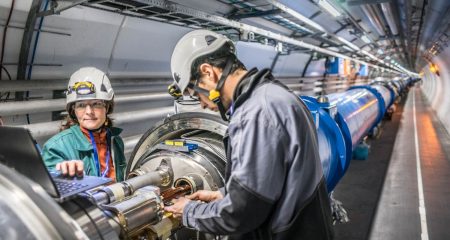

    Cern Large Hadron Collider top
    Subscribe to TechCentral Subscribe to TechCentral
    Share. Facebook Twitter LinkedIn WhatsApp Telegram Email Copy Link
    Previous ArticleFacebook stored millions of user passwords in plain text
    Next Article Uber set to list on NYSE as mega IPO looms

    Related Posts

    As Cern turns 70, it looks for ways to finance next big thing

    As Cern turns 70, it looks for ways to finance next big thing

    29 September 2024
    As Cern turns 70, it looks for ways to finance next big thing

    What comes after the Large Hadron Collider?

    13 May 2024

    Wits researchers pioneer new way to search for dark matter

    28 November 2023
    Company News
    AI is not a technology problem - iqbusiness

    AI is not a technology problem – iqbusiness

    5 December 2025
    Telcos are sitting on a data gold mine - but few know what do with it - Phillip du Plessis

    Telcos are sitting on a data gold mine – but few know what do with it

    4 December 2025
    Unlock smarter computing with your surface Copilot+ PC

    Unlock smarter computing with your Surface Copilot+ PC

    4 December 2025
    Opinion
    Your data, your hardware: the DIY AI revolution is coming - Duncan McLeod

    Your data, your hardware: the DIY AI revolution is coming

    20 November 2025
    Zero Carbon Charge founder Joubert Roux

    The energy revolution South Africa can’t afford to miss

    20 November 2025
    It's time for a new approach to government IT spend in South Africa - Richard Firth

    It’s time for a new approach to government IT spend in South Africa

    19 November 2025

    Subscribe to Updates

    Get the best South African technology news and analysis delivered to your e-mail inbox every morning.

    Latest Posts
    Big Microsoft 365 price increases coming next year

    Big Microsoft price increases coming next year

    5 December 2025
    AI is not a technology problem - iqbusiness

    AI is not a technology problem – iqbusiness

    5 December 2025
    Vodacom to take control of Safaricom in R36-billion deal - Shameel Joosub

    Vodacom to take control of Safaricom in R36-billion deal

    4 December 2025
    Black Friday goes digital in South Africa as online spending surges to record high

    Black Friday goes digital in South Africa as online spending surges to record high

    4 December 2025
    © 2009 - 2025 NewsCentral Media
    • Cookie policy (ZA)
    • TechCentral – privacy and Popia

    Type above and press Enter to search. Press Esc to cancel.

    Manage consent

    TechCentral uses cookies to enhance its offerings. Consenting to these technologies allows us to serve you better. Not consenting or withdrawing consent may adversely affect certain features and functions of the website.

    Functional Always active
    The technical storage or access is strictly necessary for the legitimate purpose of enabling the use of a specific service explicitly requested by the subscriber or user, or for the sole purpose of carrying out the transmission of a communication over an electronic communications network.
    Preferences
    The technical storage or access is necessary for the legitimate purpose of storing preferences that are not requested by the subscriber or user.
    Statistics
    The technical storage or access that is used exclusively for statistical purposes. The technical storage or access that is used exclusively for anonymous statistical purposes. Without a subpoena, voluntary compliance on the part of your Internet Service Provider, or additional records from a third party, information stored or retrieved for this purpose alone cannot usually be used to identify you.
    Marketing
    The technical storage or access is required to create user profiles to send advertising, or to track the user on a website or across several websites for similar marketing purposes.
    • Manage options
    • Manage services
    • Manage {vendor_count} vendors
    • Read more about these purposes
    View preferences
    • {title}
    • {title}
    • {title}