
South African companies are coming under immense pressure to roll out artificial intelligence technology before they get left behind. Google Cloud 2026 AI agent trends shows that organisations are doubling AI spend, with CEOs increasingly taking personal ownership of AI strategy.
Yet the same research reveals that most enterprises are nowhere near ready for agentic AI because their data is fragmented, inconsistent and locked inside ageing systems.
This is the reality that many local organisations are experiencing, and according to Kim Schulze, head of the digital advisory practice at Accelera Digital Group (ADG), the lesson is simple: “You can’t bolt AI onto a broken foundation. If your data is dirty, your AI will be dirty. If your systems are fragmented, your AI will be fragmented.”
Addressing decades of technical debt
While global enterprises are racing toward agentic AI (systems that can plan, act and execute tasks across applications), South African businesses face a more fundamental challenge – decades of technical debt.
The AI agent trends 2026 report highlights that agentic AI relies on clean, governed, connected data. It notes: “The real power comes from giving every employee agents grounded in the company’s own enterprise context – its internal systems, knowledge bases, customer data and past work.” Without that grounding, AI agents simply hallucinate faster.
“South African organisations want AI agents to automate workflows, but many can’t even trust their customer records. Before you dream about autonomous agents, you need to fix the basics, including data quality, governance, integration and system modernisation,” says Schulze.
Dirty data makes AI worse
AI agents do not magically clean up an organisation’s data; they amplify whatever is given to them. If an organisation’s customer relationship management system has duplicates, missing fields, outdated contacts or inconsistent naming conventions, an AI agent will simply automate those errors at scale.
Similarly, if a company’s ERP and finance systems do not talk to each other, an AI agent cannot orchestrate multi‑step workflows, and if business rules are not documented, an AI agent cannot safely take action.
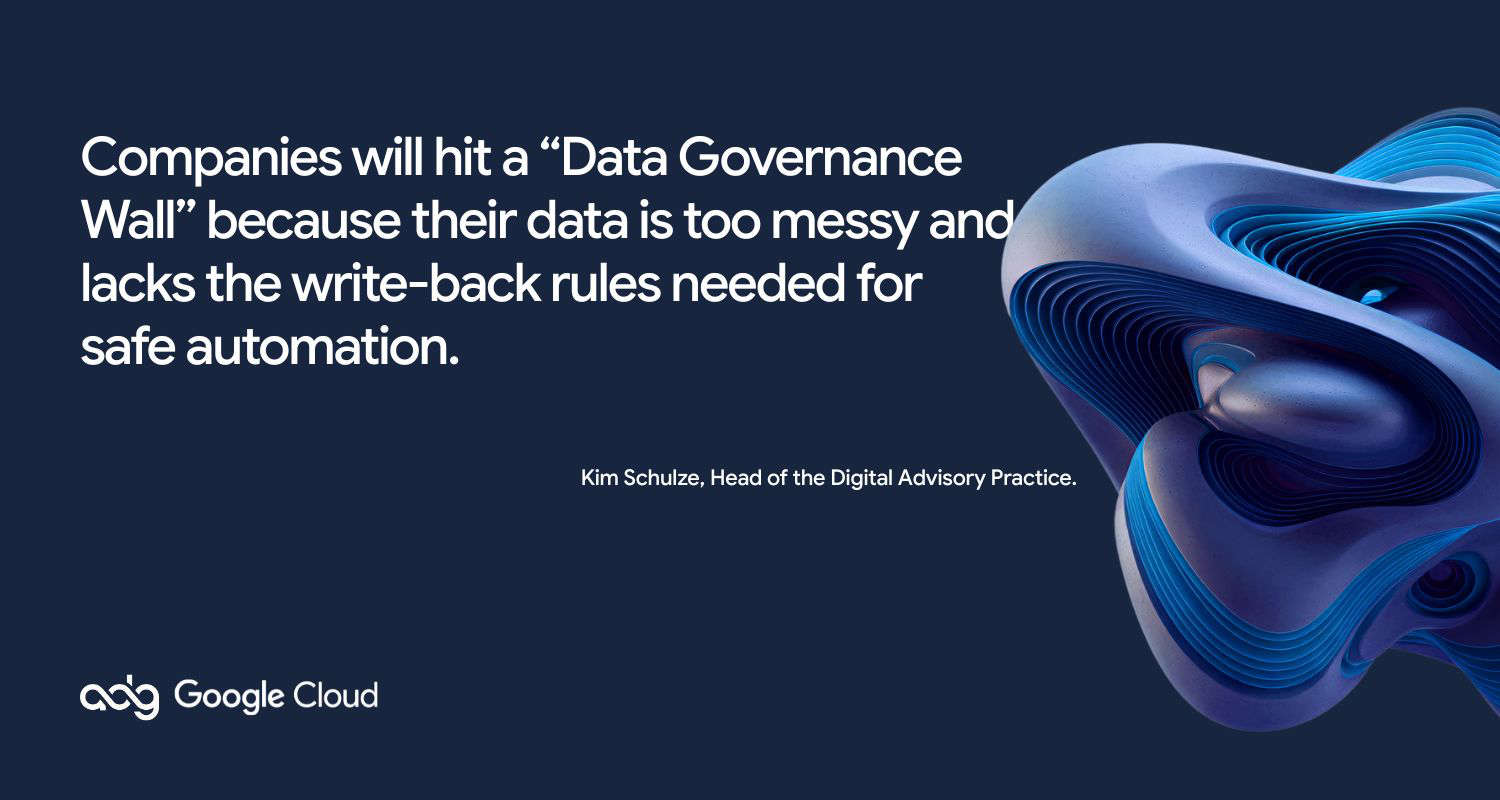
Schulze warns that companies will hit a “data governance wall” because their data is too messy and lacks the write‑back rules needed for safe automation.“AI agents don’t fix inefficiency; they accelerate it. If your processes are broken, AI will break them faster,” says Schulze.
Modernising the core: a board‑level priority
For most global companies, modernising legacy systems is no longer an IT project but a board‑level imperative. Companies must break down monolithic systems into flexible, API‑driven components so AI can actually function.
“Executives are realising that AI is not a layer you sprinkle on top. It is the outcome of a modern, connected, well‑governed digital core. Without that, AI is just lipstick on a legacy pig,” says Schulze.
Organisations aiming to become AI-ready while avoiding unnecessary expenditure on trends should embrace a practical and phased strategy for implementing AI. This approach involves several key steps:
- Data quality assessment: Identify duplicates, inconsistencies, missing fields and structural issues.
- Data governance framework: Define ownership, rules, lineage and write‑back policies that are critical for agentic AI.
- System integration & API enablement: Break down silos so data can flow across the organisation.
- Legacy modernisation road map: Prioritise which systems must be upgraded or replaced to support AI.
- AI‑readiness validation: Ensure the organisation has the clean, connected and governed data required for safe automation.
The risk of doing nothing
While the risk of rushing in is high, the risk of not replacing legacy systems will exceed the risk of change. This is especially true for South African businesses. Those that delay data modernisation will find themselves unable to scale AI, unable to compete and unable to meet customer expectations.
“If you skip the foundational work, your AI project will fail. Not because the technology does not work, but because your data does not. Organisations must navigate through the messy, complex, but essential work of becoming AI‑ready,” says Schulze.
“AI is not magic, it is maths, and maths needs clean inputs, so sort out your data house first, or your AI investment will be a waste of time and money.”
- Read more articles by Accelera Digital Group on TechCentral
- This promoted content was paid for by the party concerned