
Close Menu
TechCentralTechCentral

    Subscribe to the newsletter

    Get the best South African technology news and analysis delivered to your e-mail inbox every morning.

    Facebook X (Twitter) YouTube LinkedIn
    WhatsApp Facebook X (Twitter) LinkedIn YouTube
    TechCentralTechCentral
    • News
      Vuyani Jarana: Mobile coverage masks a deeper broadband failure

      Vuyani Jarana: Mobile coverage masks a deeper broadband failure

      30 January 2026
      SABC Plus to flight Microsoft AI training videos

      SABC Plus to flight Microsoft AI training videos

      30 January 2026
      Fibre ducts

      Fibre industry consolidation in KZN

      30 January 2026
      Watts & Wheels S1E3: 'BYD's Corolla Cross challenger'

      Watts & Wheels S1E3: ‘BYD’s Corolla Cross challenger’

      30 January 2026
      What ordinary South Africans really think of AI

      What ordinary South Africans really think of AI

      30 January 2026
    • World
      Apple acquires audio AI start-up Q.ai

      Apple acquires audio AI start-up Q.ai

      30 January 2026
      SpaceX IPO may be largest in history

      SpaceX IPO may be largest in history

      28 January 2026
      Nvidia throws AI at the weather

      Nvidia throws AI at weather forecasting

      27 January 2026
      Debate erupts over value of in-flight Wi-Fi

      Debate erupts over value of in-flight Wi-Fi

      26 January 2026
      Intel takes another hit - Intel CEO Lip-Bu Tan. Laure Andrillon/Reuters

      Intel takes another hit

      23 January 2026
    • In-depth
      How liberalisation is rewiring South Africa's power sector

      How liberalisation is rewiring South Africa’s power sector

      21 January 2026
      The top-performing South African tech shares of 2025

      The top-performing South African tech shares of 2025

      12 January 2026
      Digital authoritarianism grows as African states normalise internet blackouts

      Digital authoritarianism grows as African states normalise internet blackouts

      19 December 2025
      TechCentral's South African Newsmakers of 2025

      TechCentral’s South African Newsmakers of 2025

      18 December 2025
      Black Friday goes digital in South Africa as online spending surges to record high

      Black Friday goes digital in South Africa as online spending surges to record high

      4 December 2025
    • TCS
      TCS+ | How Cloud On Demand is helping SA businesses succeed in the cloud - Xhenia Rhode, Dion Kalicharan

      TCS+ | Cloud On Demand and Consnet: inside a real-world AWS partner success story

      30 January 2026
      Watts & Wheels S1E3: 'BYD's Corolla Cross challenger'

      Watts & Wheels S1E2: ‘China attacks, BMW digs in, Toyota’s sublime supercar’

      23 January 2026

      TCS+ | Why cybersecurity is becoming a competitive advantage for SA businesses

      20 January 2026
      Watts & Wheels S1E3: 'BYD's Corolla Cross challenger'

      Watts & Wheels: S1E1 – ‘William, Prince of Wheels’

      8 January 2026
      TCS+ | Africa's digital transformation - unlocking AI through cloud and culture - Cliff de Wit Accelera Digital Group

      TCS+ | Cloud without culture won’t deliver AI: Accelera’s Cliff de Wit

      12 December 2025
    • Opinion
      South Africa's skills advantage is being overlooked at home - Richard Firth

      South Africa’s skills advantage is being overlooked at home

      29 January 2026
      Why Elon Musk's Starlink is a 'hard no' for me - Songezo Zibi

      Why Elon Musk’s Starlink is a ‘hard no’ for me

      26 January 2026
      South Africa's new fibre broadband battle - Duncan McLeod

      South Africa’s new fibre broadband battle

      20 January 2026
      AI moves from pilots to production in South African companies - Nazia Pillay SAP

      AI moves from pilots to production in South African companies

      20 January 2026
      South Africa's new fibre broadband battle - Duncan McLeod

      ANC’s attack on Solly Malatsi shows how BEE dogma trumps economic reality

      14 December 2025
    • Company Hubs
      • Africa Data Centres
      • AfriGIS
      • Altron Digital Business
      • Altron Document Solutions
      • Altron Group
      • Arctic Wolf
      • AvertITD
      • Braintree
      • CallMiner
      • CambriLearn
      • CYBER1 Solutions
      • Digicloud Africa
      • Digimune
      • Domains.co.za
      • ESET
      • Euphoria Telecom
      • Incredible Business
      • iONLINE
      • IQbusiness
      • Iris Network Systems
      • LSD Open
      • NEC XON
      • Netstar
      • Network Platforms
      • Next DLP
      • Ovations
      • Paracon
      • Paratus
      • Q-KON
      • SevenC
      • SkyWire
      • Solid8 Technologies
      • Telit Cinterion
      • Tenable
      • Vertiv
      • Videri Digital
      • Vodacom Business
      • Wipro
      • Workday
      • XLink
    • Sections
      • AI and machine learning
      • Banking
      • Broadcasting and Media
      • Cloud services
      • Contact centres and CX
      • Cryptocurrencies
      • Education and skills
      • Electronics and hardware
      • Energy and sustainability
      • Enterprise software
      • Financial services
      • Information security
      • Internet and connectivity
      • Internet of Things
      • Investment
      • IT services
      • Lifestyle
      • Motoring
      • Public sector
      • Retail and e-commerce
      • Satellite communications
      • Science
      • SMEs and start-ups
      • Social media
      • Talent and leadership
      • Telecoms
    • Events
    • Advertise
    TechCentralTechCentral
    Home » Sections » Broadcasting and Media » Should the SABC have discretion to reject a political ad?

    Should the SABC have discretion to reject a political ad?

    Icasa’s complaints committee has heard arguments on the SABC’s refusal to broadcast the DA "flag-burning" election ad.
    By Michael Markovitz19 May 2024
    Twitter LinkedIn Facebook WhatsApp Email Telegram Copy Link
    News Alerts
    WhatsApp
    Michael Markovitz

    Back in the day – sometime in 1993 – I was a 30-something media activist (with an ill-fitting suit). Despite my questionable dress sense, I was selected by anti-apartheid civil society groups and the ANC to be one of the drafters of the Independent Broadcasting Authority (IBA) Bill – a law that would form part of a package of legislation negotiated and agreed to usher in South Africa’s democracy.

    The IBA Act was passed in 1993. It became foundational to our broadcasting framework, and was a radical change from the apartheid state’s total, authoritarian control over broadcast regulation. The act established the IBA with a range of progressive statutory provisions, including community radio licences, quotas for on-air South African content, black empowerment licensing provisions, and a whole new system for regulating party election broadcasts and political advertising during election periods.

    Fast-forward to the looming 2024 elections, and the interpretation of the law on political advertising has now been disputed for the first time. This is after the SABC rejected a political advert from the Democratic Alliance. The television ad itself was offensive to many South Africans. It depicted the burning of our national flag as part of a fear-mongering narrative to depict what would happen if the ANC was returned to power. The flag was then shown to be “made whole” if the ANC was voted out.

    Outrage

    The ad caused widespread outrage as the national flag had become a respected, unifying symbol of our three-decade-old democracy. President Cyril Ramaphosa and government ministers issued strong statements against the ad, with threats of court action. President Ramaphosa said the ad was “treasonous and despicable”. Minister of sport, arts & culture Zizi Kodwa said the ad was “a desecration of a national symbol” and that the government was considering its legal options. Despite all the sound and fury, my view was that, despite the advert being divisive, provocative, in poor taste and offensive, the ad itself constituted lawful political expression.

    Shortly after statements by the president and minister Kodwa, on 9 May 2024 the SABC issued a statement saying it had rejected the ad for reasons that appeared questionable and (as required by law) had notified communications regulator Icasa, the IBA’s successor regulator.

    In response to the rejection of the ad, the DA then submitted a formal complaint to Icasa’s complaints and compliance committee (CCC). On 17 May, oral argument was made by counsel for the SABC and the DA, battling each other over the meaning of the law. With the election just over 10 days away, this is clearly an urgent issue, and Icasa agreed to come back with a decision by early this coming week (starting 20 May).

    Watch the DA ad that the SABC banned from its channels:

    The main disputed clause in question was section 58(1) of the Electronic Communications Act – a provision which had been largely “copied and pasted” from the IBA Act of 1993¹:

    A broadcasting service licensee is not required to broadcast a political advertisement, but if he or she elects to do so, he or she must afford all other political parties, should they so request, a like opportunity. (Author’s emphasis in italics.)

    The intention of the legislature in 1993 was very simple: section 58(1) did not compel broadcasters to carry political ads, but if a broadcaster decided to carry them for one political party, then they had to give other political parties a “like opportunity”. The SABC’s argument for an inherent right to reject political ads would work if section 58(1) ended with a full stop after “advertisement” but it doesn’t.

    As one of the original drafters of this provision 30 years ago, the question is: should the provision have been improved and made clearer over the years? The answer is obviously “yes”. In fact, I have written before that the entire broadcasting framework is outdated and mostly archaic. However, many industry legal experts agree that section 58(1) still does not give SABC an inherent right to refuse to broadcast a political ad, and certainly not for the reasons advanced by the public broadcaster (in the letter to Icasa.)

    The regulations make it even clearer that as long as the content does not breach the law or incite “unlawful, illegal and criminal acts”, then there is no valid reason to reject it. In addition, broadcasters are indemnified from any legal liability for party political adverts broadcast on their platforms.
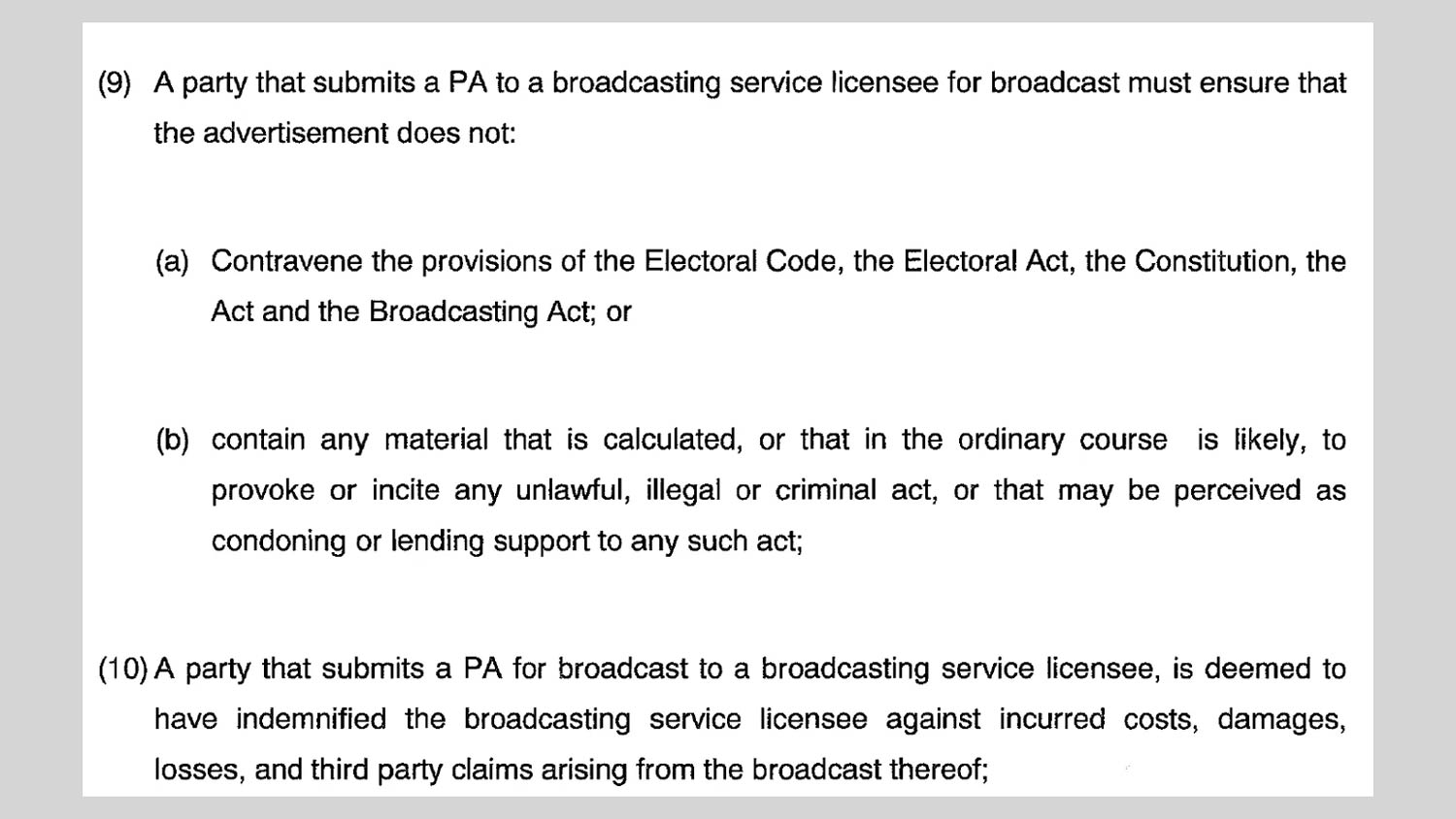
    Source: Icasa’s national and provincial party election broadcasts and political advertisement regulations, 2014

    But during oral argument on 17 May, it became clear that the SABC was not claiming that the ad was unlawful or fell foul of the regulations. It claimed an inherent right to reject the ad because, among other reasons, the SABC was responsible for “nation building” and the DA’s “political advertisement goes against the spirit of nation building”.

    The SABC made a number of other debatable legal arguments, the most striking being that Icasa does not have the remedial power to compel the SABC to broadcast the DA’s ad. Despite agreeing that Icasa had jurisdiction over the dispute, the SABC’s counsel argued that the broadcaster’s decision was an administrative act and only a court of law could order it to broadcast the ad. This position seems to be at odds with the legislation and regulations, which created a very specific framework for political ads during elections, including a dispute resolution process. Why set up this elections-specific framework under Icasa’s jurisdiction if only a court could order remedial action?

    These questions will no doubt be answered soon. I look forward to the Icasa committee’s final decision and the Icasa council’s implementation of the ruling. I also hope that the matter is not ligitated in the courts and can be resolved before the election on 29 May.

    • Michael Markovitz is head of the Gibs Media Leadership Think Tank
    • This article was originally published on Markovitz’s Media Explorations blog on Substack and is republished here with his kind permission

    Footnote
    ¹In 1993 political ads were only allowed on sound (radio) broadcasters. This was later broadened to include political ads on television. Apart from this, section 58(1) of the Electronic Communications Act, 2005 is exactly the same as the original language of section 60(1) of the IBA Act, 1993: “A sound broadcasting licensee shall not be required to broadcast a political advertisement, but if he or she elects to do so, he or she shall afford all other political parties, should they so request, a like opportunity.”

    Read next: The rand is surging ahead of South Africa’s pivotal election


    Cyril Ramphosa IBA Icasa Michael Markovitz SABC Zizi Kodwa
    WhatsApp YouTube Follow on Google News Add as preferred source on Google
    Share. Facebook Twitter LinkedIn WhatsApp Telegram Email Copy Link
    Previous ArticleInvestors are turning bullish on South Africa
    Next Article High-stakes hearings to begin into Vodacom, Vumatel deal

    Related Posts

    Starlink hype vs reality in South Africa

    Starlink hype vs reality in South Africa

    26 January 2026
    Mobile operators face tougher rules on data and billing

    Mobile operators face tougher rules on data and billing

    26 January 2026
    South African digital radio trial is about to go live - Aldred Dreyer

    South African digital radio trial is about to go live

    21 January 2026
    Company News
    Huawei turns 25 in South Africa, celebrates with major device discounts

    Huawei turns 25 in South Africa, celebrates with major device discounts

    30 January 2026
    Phishing has not disappeared, but it has grown up - KnowBe4

    Phishing has not disappeared, but it has grown up

    30 January 2026
    Smartphone affordability: South Africa's new economic divide - PayJoy

    Smartphone affordability: South Africa’s new economic divide

    29 January 2026
    Opinion
    South Africa's skills advantage is being overlooked at home - Richard Firth

    South Africa’s skills advantage is being overlooked at home

    29 January 2026
    Why Elon Musk's Starlink is a 'hard no' for me - Songezo Zibi

    Why Elon Musk’s Starlink is a ‘hard no’ for me

    26 January 2026
    South Africa's new fibre broadband battle - Duncan McLeod

    South Africa’s new fibre broadband battle

    20 January 2026

    Subscribe to Updates

    Get the best South African technology news and analysis delivered to your e-mail inbox every morning.

    Latest Posts
    Vuyani Jarana: Mobile coverage masks a deeper broadband failure

    Vuyani Jarana: Mobile coverage masks a deeper broadband failure

    30 January 2026
    TCS+ | How Cloud On Demand is helping SA businesses succeed in the cloud - Xhenia Rhode, Dion Kalicharan

    TCS+ | Cloud On Demand and Consnet: inside a real-world AWS partner success story

    30 January 2026
    Huawei turns 25 in South Africa, celebrates with major device discounts

    Huawei turns 25 in South Africa, celebrates with major device discounts

    30 January 2026
    SABC Plus to flight Microsoft AI training videos

    SABC Plus to flight Microsoft AI training videos

    30 January 2026
    © 2009 - 2026 NewsCentral Media
    • Cookie policy (ZA)
    • TechCentral – privacy and Popia

    Type above and press Enter to search. Press Esc to cancel.

    Manage consent

    TechCentral uses cookies to enhance its offerings. Consenting to these technologies allows us to serve you better. Not consenting or withdrawing consent may adversely affect certain features and functions of the website.

    Functional Always active
    The technical storage or access is strictly necessary for the legitimate purpose of enabling the use of a specific service explicitly requested by the subscriber or user, or for the sole purpose of carrying out the transmission of a communication over an electronic communications network.
    Preferences
    The technical storage or access is necessary for the legitimate purpose of storing preferences that are not requested by the subscriber or user.
    Statistics
    The technical storage or access that is used exclusively for statistical purposes. The technical storage or access that is used exclusively for anonymous statistical purposes. Without a subpoena, voluntary compliance on the part of your Internet Service Provider, or additional records from a third party, information stored or retrieved for this purpose alone cannot usually be used to identify you.
    Marketing
    The technical storage or access is required to create user profiles to send advertising, or to track the user on a website or across several websites for similar marketing purposes.
    • Manage options
    • Manage services
    • Manage {vendor_count} vendors
    • Read more about these purposes
    View preferences
    • {title}
    • {title}
    • {title}