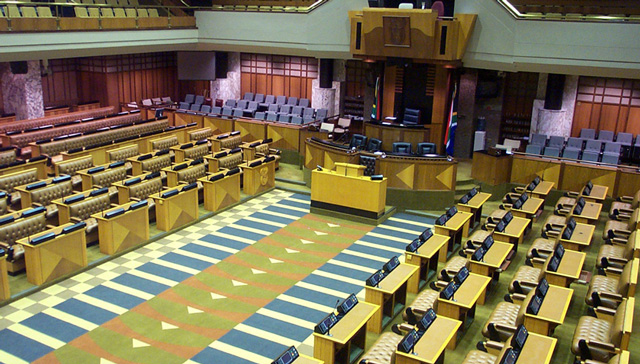
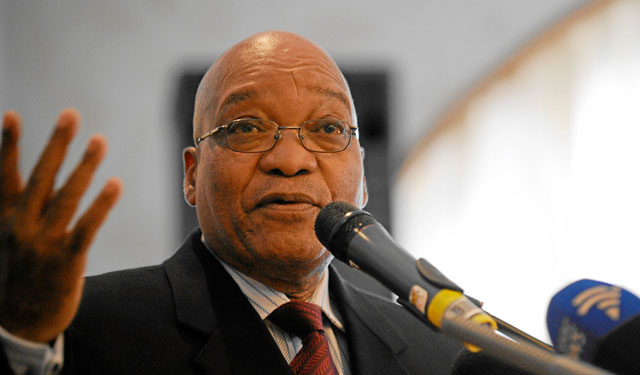
President Jacob Zuma and national assembly speaker Baleka Mbete knew about the security plan ahead of last week’s infamous state of the nation address (Sona) in parliament. They were briefed about protective measures put in place. These measures saw disguised police officers in the national assembly chamber and jammed cellphone signals.
Before the address, Mbete consulted and received advice about security from lieutenant general Elias Mawela, the national joint operational and intelligence structure (Natjoints) chairman. Natjoints handles coordination between intelligence agencies, the military, police and metro police.
Zuma and state security minister David Mahlobo were briefed on preparations; Mahlobo inspected parliament last Thursday morning.
As Mbete, the executive and sources in the intelligence community repeatedly stressed, these meetings and briefings were a normal part of preparations for an event such as the address. What was unusual, however, was the content of the security plan, and its implications.
Cellphone signals are typically jammed to prevent the remote detonation of explosive devices, but this is useful only under specific conditions.
In a statement on Wednesday night and at a briefing on Thursday morning, Mahlobo offered an incoherent explanation for the jamming, relating it to airspace restrictions and the possibility that drone aircraft (which supposedly can be controlled using the same radio frequencies as cellphones) could be used to attack Zuma.
Securing the airspace in this way, Mahlobo said, should only have seen signals disrupted for 30 minutes.
But his explanation fell apart under even the most casual scrutiny. Though cellphone signals were scrambled inside the national assembly chamber, there was no sign of similar interference outside the house. The jamming was also evident some hours earlier than Mahlobo claimed. It was quite easily ended after not only MPs and journalists, but also security operatives complained about it to Mbete, parliamentary officials and members of the government. “Some of us were asking ourselves, if anything happens, how are we going to protect the people we need to protect? Our phones also had no signal,” a state security source told the Mail & Guardian this week.
The same source said, if the jam was linked to the implementation of a no-fly zone, as purported by Mahlobo, there would have been a cellphone network blockage in the entire parliamentary precinct, not only in the chamber where the joint sitting of parliament took place. “There was no way it could be switched off just like that,” the source added.
Mahlobo and other ministers this week presented the signal jamming and the use of plain-clothed police as the result of decisions made by low-ranking officials or simple mistakes. Both actions raise serious legal questions. And both were part of a carefully laid security plan — a plan that assumed the entire city of Cape Town could fall into anarchy.
Efforts at obfuscation of last week’s events failed to obscure the underlying truth: in the run-up to the address, the state was so fixated on plans by the Economic Freedom Fighters to disrupt Zuma’s speech that legal niceties and constitutional obligations were shouldered aside.
The monomania was such that, instead of enhancing security, the measures taken interfered with the ability of some VIP protectors to do their jobs. Yet the entire operation was considered a success because the EFF was thwarted. And that, said defence minister Nosiviwe Mapisa-Nqakula, was the point. “Because people thought they would cause such chaos, we would adjourn,” she told a media briefing on Thursday.
Jammed signals ‘a glitch’
In the same briefing, Mahlobo continued to insist, implausibly, that the jamming of cellphone signals was “a glitch” and a result of “human error”. He refused to provide technical detail. Nor would he elaborate on specific threats requiring extraordinary precaution, instead alluding vaguely to terrorism, cyberterrorism and an increase in global threats, while saying the threats to the address had been “unprecedented”.
“You will never know when it will hit us. Someday someone is going to die in this country,” he said later, while talking about the EFF’s use of makarapas [hard hats] as blunt weapons in parliament.
Officials involved in various levels of planning for the address, many speaking off the record, could not point to any threat identified by intelligence agencies — other than the EFF’s publicly stated intention to ask Zuma questions about upgrades at his Nkandla home, and not to allow their questions to be silenced.
That EFF declaration alone, then, seems to have been behind a security master plan that included:
— A procedure to evacuate Zuma from Cape Town, on the assumption that it could have been impossible to find a location to secure the president anywhere in South Africa’s second-largest city.
— An intelligence operation, possibly using state resources, to predict exactly what the EFF would do.
— Premeditation to escalate a verbal tussle into a physical one because it was considered inconceivable to adjourn proceedings.
— Active targeting of opposition members of parliament before they had broken any rules of the house.
Despite these eyebrow-raising measures, officials from parliament and the executive held firm that there had been nothing extraordinary about preparations for and events on the night of 12 February, with the possible exception of the “accidental” signal jamming.
Those assertions fly in the face of a host of unusual occurrences that night. Security was far tighter than it has been with other state of the nation addresses in the past 21 years. In contrast to two decades of precedent, various groups of people who normally work in parliament could not gain access to the parliamentary precinct without special accreditation. Even high-profile guests were required to obtain and display accreditation; some initially were denied entry into the house.
No water
Once MPs made their way inside, they discovered water was not available; that was quickly and easily reversed after objections were raised by opposition parties.
As the EFF MPs were violently ejected, other MPs were faced by a wall of bodyguards stationed between them and Zuma, who was sitting behind the podium watching the melee.
A day before Zuma delivered his speech, Natjoints released a statement saying “security planning for this event began late last year and the various role players are very satisfied that every little detail has been attended to”.
In recent years, Natjoints was responsible for securing national elections, the 2013 African Cup of Nations tournament and US President Barack Obama’s visit to South Africa. It is involved in combatting rhino poaching and monitoring service delivery strike actions.
On Thursday, Mahlobo also promised that the signal jamming would be further investigated, and that one aim was to determine whether it had been the result of “sabotage”.
Many security experts advise against signal jamming devices in a static and well-guarded location such as parliament, where security sweeps and searches must be implemented in any event to guard against different types of bomb trigger mechanisms. In such cases, the experts say, jamming can do more harm than good as it can interfere with communication between security agents and could hamper emergency service workers in a worst-case scenario.
The state security ministry this week appeared, somewhat confusedly, to claim the authority to jam signals under a mixture of regulations that allow the banning of craft in a specific volume of airspace, or under rules that allow the use of “counterintelligence” apparatus. Those claims notwithstanding, cellphone jamming is illegal in South Africa. The only provision for it in law would fall under a theoretical sequence of events starting with the declaration of a state of emergency.
Zuma, Mbete and Mahlobo are required to uphold the laws of South Africa. In both law and practice, Mbete held an absolute veto over all arrangements for the address, security and otherwise. Mbete this week stressed that, although parliament acts as hosts for the address, it must take into consideration the wishes of the executive, which translates into a practical veto for Zuma on signal jamming.
Other aspects of the security master plan also raise thorny legal issues for those involved. A member of one of the police units active in parliament this week confirmed that the unit was deployed, and would be paid for, as police. Without a formal secondment to the parliamentary security services that has sole responsibility for securing the legislative precinct, that puts the police officers in contravention of a legal requirement to wear their uniforms and display their names while on duty.
Police formed part of what has come to be known as “the waiters” — men dressed in black pants and white shirts who forcefully removed EFF MPs from the chamber.
The waiters were trained to remove people from the chamber; they were given photographs of EFF and DA MPs to ensure they knew who to remove, as reported by City Press.
Although using state resources to spy on political actors can be legal if those actors are thought to be involved in crime or insurrection, doing so is still subject to challenge.
Over the weekend, in a speech in which Mbete referred to Malema as a cockroach, she told ANC North West provincial congress delegates the ANC and its MPs “knew everything” EFF had planned for the address, because they had grown weary of being caught unawares. (She apologised and withdrew the comment on Wednesday.)
“Uyabona [you see], on 21 August, we were caught by surprise [when EFF chanted ‘pay back the money’ to Zuma]. But we can’t be surprised all the time. That’s why we were so ready,” she said and tellingly added: “We knew everything, including what the red overalls discussed. We knew who was going to stand first and what they were going to say.”
EFF members raised concerns after Mbete’s address that the party’s meeting rooms could be bugged.
EFF deputy president Floyd Shivambu told the M&G that Mbete was trying to “play big”: information she had about the opposition party’s plans was public knowledge, not the product of an intelligence-gathering process. “There was nothing secret. Everything we discussed we made public. We all emphasised we were going to do everything within parliamentary rules,” said Shivambu.
Mahlobo on Thursday said security arrangements for last week’s event were not only based on EFF threats: a broad risk assessment was also done. He wouldn’t share the details.
“Our threat analysis is not narrow and drew on a broader threat analysis,” he said. “The world has changed; there are matters of terrorism [and] other activities people are acting on.”
Unknown threats
No one in government or the security cluster could say what other threats there were except the EFF’s plan to demand answers from Zuma.
Raising no legal questions, but extraordinary in its implications, was the part of the plan dealing with Zuma’s possible evacuation from Cape Town.
As first reported by Beeld this week, the presidential jet was put on standby to whisk Zuma to Pretoria on Thursday night should the legislative capital fall into chaos.
Typical security arrangements for Zuma include planning for his removal from an emergency’s immediate vicinity, but do not assume any city or region will fall into anarchy.
But the executive remained unapologetic about security preparations, saying everything (bar the jamming) had gone according to plan.
“If you say Sona shouldn’t have been protected in the manner in which it was, that is unfortunate,” said justice minister Michael Masutha. — © 2015 Mail & Guardian
- First published in the Mail & Guardian. Visit the M&G Online, the smart news source