Close Menu
TechCentralTechCentral

    Subscribe to the newsletter

    Get the best South African technology news and analysis delivered to your e-mail inbox every morning.

    Facebook X (Twitter) YouTube LinkedIn
    WhatsApp Facebook X (Twitter) LinkedIn YouTube
    TechCentralTechCentral
    • News
      MVNOs take centre stage in legislative shake-up - Dominic Cull

      MVNOs take centre stage in legislative shake-up

      8 April 2026
      ICT sector BEE code under the microscope as Starlink circles

      ICT sector BEE code under the microscope as Starlink circles

      8 April 2026
      Why Apple is sitting pretty - AI hype be damned

      Why Apple is sitting pretty – AI hype be damned

      8 April 2026

      A moon mission the world needed

      8 April 2026
      Theft and power cuts hammer SA telecoms operators

      Theft and power cuts hammer SA telecoms operators

      7 April 2026
    • World
      DeepSeek V4 to run on Huawei silicon as China builds its own AI stack

      DeepSeek V4 to run on Huawei silicon as China builds its own AI stack

      4 April 2026
      Amazon in talks to buy satellite operator Globalstar

      Amazon in talks to buy satellite operator Globalstar

      2 April 2026

      Apple plans to open Siri to rival AI services

      27 March 2026
      It's official: ads are coming to ChatGPT

      It’s official: ads are coming to ChatGPT

      23 March 2026
      Mystery Chinese AI model revealed to be Xiaomi's

      Mystery Chinese AI model revealed to be Xiaomi’s

      19 March 2026
    • In-depth
      The biggest untapped EV market on Earth is hiding in plain sight

      The biggest untapped EV market on Earth is hiding in plain sight

      1 April 2026
      The R18-billion tech giant hiding in plain sight - Jens Montanana

      The R16-billion tech giant hiding in plain sight

      26 March 2026
      The last generation of coders

      The last generation of coders

      18 February 2026
      Sentech is in dire straits

      Sentech is in dire straits

      10 February 2026
      How liberalisation is rewiring South Africa's power sector

      How liberalisation is rewiring South Africa’s power sector

      21 January 2026
    • TCS
      TCS+ | Vodacom Business moves to crack the SME tech gap - Andrew Fulton, Sannesh Beharie

      TCS+ | Vodacom Business moves to crack the SME tech gap

      7 April 2026
      TCS | MTN's Divysh Joshi on the strategy behind Pi - Divyesh Joshi

      TCS | MTN’s Divyesh Joshi on the strategy behind Pi

      1 April 2026
      Anoosh Rooplal

      TCS | Anoosh Rooplal on the Post Office’s last stand

      27 March 2026
      Meet the CIO | HealthBridge CTO Anton Fatti on the future of digital health

      Meet the CIO | Healthbridge CTO Anton Fatti on the future of digital health

      23 March 2026
      TCS+ | Arctic Wolf unpacks the evolving threat landscape for SA businesses - Clare Loveridge and Jason Oehley

      TCS+ | Arctic Wolf unpacks the evolving threat landscape for SA businesses

      19 March 2026
    • Opinion
      The conflict of interest at the heart of PayShap's slow adoption - Cheslyn Jacobs

      The conflict of interest at the heart of PayShap’s slow adoption

      26 March 2026
      South Africa's energy future hinges on getting wheeling right - Aishah Gire

      South Africa’s energy future hinges on getting wheeling right

      10 March 2026
      Hold the doom: the case for a South African comeback - Duncan McLeod

      Apple just dropped a bomb on the Windows world

      5 March 2026
      R230-million in the bag for Endeavor's third Harvest Fund - Alison Collier

      VC’s centre of gravity is shifting – and South Africa is in the frame

      3 March 2026
      Hold the doom: the case for a South African comeback - Duncan McLeod

      Hold the doom: the case for a South African comeback

      26 February 2026
    • Company Hubs
      • 1Stream
      • Africa Data Centres
      • AfriGIS
      • Altron Digital Business
      • Altron Document Solutions
      • Altron Group
      • Arctic Wolf
      • Ascent Technology
      • AvertITD
      • BBD
      • Braintree
      • CallMiner
      • CambriLearn
      • CYBER1 Solutions
      • Digicloud Africa
      • Digimune
      • Domains.co.za
      • ESET
      • Euphoria Telecom
      • HOSTAFRICA
      • Incredible Business
      • iONLINE
      • IQbusiness
      • Iris Network Systems
      • Kaspersky
      • LSD Open
      • Mitel
      • NEC XON
      • Netstar
      • Network Platforms
      • Next DLP
      • Ovations
      • Paracon
      • Paratus
      • Q-KON
      • SevenC
      • SkyWire
      • Solid8 Technologies
      • Telit Cinterion
      • Telviva
      • Tenable
      • Vertiv
      • Videri Digital
      • Vodacom Business
      • Wipro
      • Workday
      • XLink
    • Sections
      • AI and machine learning
      • Banking
      • Broadcasting and Media
      • Cloud services
      • Contact centres and CX
      • Cryptocurrencies
      • Education and skills
      • Electronics and hardware
      • Energy and sustainability
      • Enterprise software
      • Financial services
      • HealthTech
      • Information security
      • Internet and connectivity
      • Internet of Things
      • Investment
      • IT services
      • Lifestyle
      • Motoring
      • Policy and regulation
      • Public sector
      • Retail and e-commerce
      • Satellite communications
      • Science
      • SMEs and start-ups
      • Social media
      • Talent and leadership
      • Telecoms
    • Events
    • Advertise
    TechCentralTechCentral
    Home » Sections » Energy and sustainability » Solar power stations in space: The answer to our energy needs?

    Solar power stations in space: The answer to our energy needs?

    By The Conversation20 November 2020
    Twitter LinkedIn Facebook WhatsApp Email Telegram Copy Link
    News Alerts
    WhatsApp

    It sounds like science-fiction: giant solar power stations floating in space that beam down enormous amounts of energy to Earth. And for a long time, the concept – first developed by Russian scientist Konstantin Tsiolkovsky in the 1920s – was mainly an inspiration for writers.

    A century later, however, scientists are making huge strides in turning the concept into reality. The European Space Agency has realised the potential of these efforts and is now looking to fund such projects, predicting that the first industrial resource we will get from space is “beamed power”.

    Climate change is the greatest challenge of our time, so there’s a lot at stake. From rising global temperatures to shifting weather patterns, the impacts of climate change are already being felt around the globe. Overcoming this challenge will require radical changes to how we generate and consume energy.

    Wind and solar farms only produce energy when the wind is blowing or the sun is shining – but we need electricity around the clock

    Renewable energy technologies have developed drastically in recent years, with improved efficiency and lower cost. But one major barrier to their uptake is the fact that they don’t provide a constant supply of energy. Wind and solar farms only produce energy when the wind is blowing or the sun is shining – but we need electricity around the clock, every day. Ultimately, we need a way to store energy on a large scale before we can make the switch to renewable sources.

    A possible way around this would be to generate solar energy in space. There are many advantages to this. A space-based solar power station could orbit to face the sun 24 hours a day. The Earth’s atmosphere also absorbs and reflects some of the sun’s light, so solar cells above the atmosphere will receive more sunlight and produce more energy.

    Key challenge

    But one of the key challenges to overcome is how to assemble, launch and deploy such large structures. A single solar power station may have to be as much as 10 square kilometres in area – equivalent to 1 400 football fields. Using lightweight materials will also be critical, as the biggest expense will be the cost of launching the station into space on a rocket.

    One proposed solution is to develop a swarm of thousands of smaller satellites that will come together and configure to form a single, large solar generator. In 2017, researchers at the California Institute of Technology outlined designs for a modular power station, consisting of thousands of ultralight solar cell tiles. They also demonstrated a prototype tile weighing just 280g/m2, similar to the weight of card.

    Recently, developments in manufacturing, such as 3D printing, are also being looked at for this application. At the University of Liverpool, we are exploring new manufacturing techniques for printing ultralight solar cells on to solar sails. A solar sail is a foldable, lightweight and highly reflective membrane capable of harnessing the effect of the sun’s radiation pressure to propel a spacecraft forward without fuel. We are exploring how to embed solar cells on solar sail structures to create large, fuel-free solar power stations.
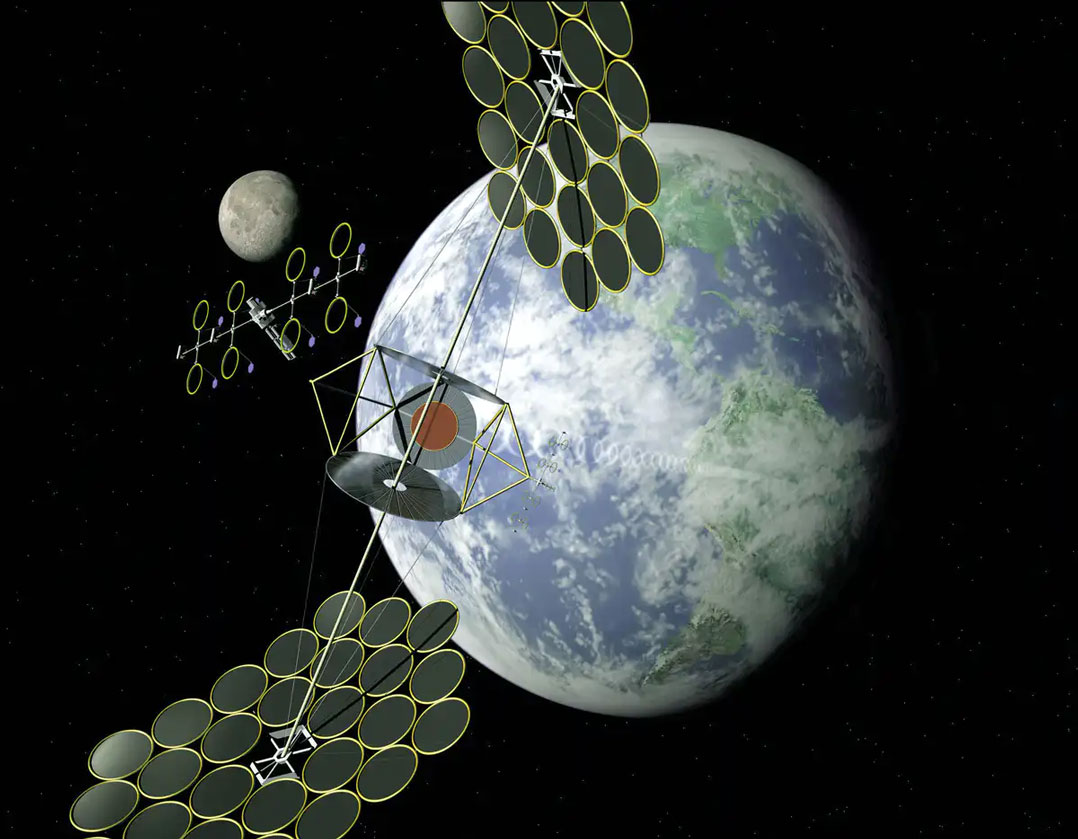
    Artist’s conception of a solar power satellite, dubbed the Integrated Symmetrical Concentrator SPS concept. Image: Nasa

    These methods would enable us to construct the power stations in space. Indeed, it could one day be possible to manufacture and deploy units in space from the International Space Station or the future lunar gateway station that will orbit the moon. Such devices could in fact help provide power on the moon.

    The possibilities don’t end there. While we are currently reliant on materials from Earth to build power stations, scientists are also considering using resources from space for manufacturing, such as materials found on the moon.

    Another major challenge will be getting the power transmitted back to Earth. The plan is to convert electricity from the solar cells into energy waves and use electromagnetic fields to transfer them down to an antenna on the Earth’s surface. The antenna would then convert the waves back into electricity. Researchers led by the Japan Aerospace Exploration Agency have already developed designs and demonstrated an orbiter system which should be able to do this.

    There is still a lot of work to be done, but the aim is that solar power stations in space will become a reality in the coming decades

    There is still a lot of work to be done in this field, but the aim is that solar power stations in space will become a reality in the coming decades. Researchers in China have designed a system called Omega, which they aim to have operational by 2050. This system should be capable of supplying 2GW of power into Earth’s grid at peak performance, which is a huge amount. To produce that much power with solar panels on Earth, you would need more than six million of them.

    Smaller solar power satellites, like those designed to power lunar rovers, could be operational even sooner.

    Across the globe, the scientific community is committing time and effort to the development of solar power stations in space. Our hope is that they could one day be a vital tool in our fight against climate change.The Conversation
    Written by Amanda Jane Hughes, lecturer, department of mechanical, materials and aerospace engineering, University of Liverpool, and Stefania Soldini, lecturer in aerospace engineering, University of Liverpool

    • This article is republished from The Conversation under a Creative Commons licence

    Follow TechCentral on Google News Add TechCentral as your preferred source on Google


    top
    WhatsApp YouTube
    Share. Facebook Twitter LinkedIn WhatsApp Telegram Email Copy Link
    Previous ArticleGet Adobe Creative Cloud for Teams for less until 3 December
    Next Article Watch | TechCentral Webinar: Dell Technologies Data Center-as-a-Service

    Related Posts

    18GW in unplanned breakdowns cripple Eskom

    2 November 2021

    Nersa kicks the Karpowership can down the road

    13 September 2021

    If you think South African load shedding is bad, try Zimbabwe’s

    13 September 2021
    Company News
    The new storefront is a conversation - conversational commerce - CM.com

    The new storefront is a conversation

    8 April 2026
    In a volatile world, application portability is everything - LSD Open Deon Stroebel

    In a volatile world, application portability is everything

    8 April 2026
    Maidar Secure, Strike48 bring agentic AI to the SOC

    Maidar Secure, Strike48 bring agentic AI to the SOC

    7 April 2026
    Opinion
    The conflict of interest at the heart of PayShap's slow adoption - Cheslyn Jacobs

    The conflict of interest at the heart of PayShap’s slow adoption

    26 March 2026
    South Africa's energy future hinges on getting wheeling right - Aishah Gire

    South Africa’s energy future hinges on getting wheeling right

    10 March 2026
    Hold the doom: the case for a South African comeback - Duncan McLeod

    Apple just dropped a bomb on the Windows world

    5 March 2026

    Subscribe to Updates

    Get the best South African technology news and analysis delivered to your e-mail inbox every morning.

    Latest Posts
    MVNOs take centre stage in legislative shake-up - Dominic Cull

    MVNOs take centre stage in legislative shake-up

    8 April 2026
    ICT sector BEE code under the microscope as Starlink circles

    ICT sector BEE code under the microscope as Starlink circles

    8 April 2026
    Why Apple is sitting pretty - AI hype be damned

    Why Apple is sitting pretty – AI hype be damned

    8 April 2026

    A moon mission the world needed

    8 April 2026
    © 2009 - 2026 NewsCentral Media
    • Cookie policy (ZA)
    • TechCentral – privacy and Popia

    Type above and press Enter to search. Press Esc to cancel.

    Manage consent

    TechCentral uses cookies to enhance its offerings. Consenting to these technologies allows us to serve you better. Not consenting or withdrawing consent may adversely affect certain features and functions of the website.

    Functional Always active
    The technical storage or access is strictly necessary for the legitimate purpose of enabling the use of a specific service explicitly requested by the subscriber or user, or for the sole purpose of carrying out the transmission of a communication over an electronic communications network.
    Preferences
    The technical storage or access is necessary for the legitimate purpose of storing preferences that are not requested by the subscriber or user.
    Statistics
    The technical storage or access that is used exclusively for statistical purposes. The technical storage or access that is used exclusively for anonymous statistical purposes. Without a subpoena, voluntary compliance on the part of your Internet Service Provider, or additional records from a third party, information stored or retrieved for this purpose alone cannot usually be used to identify you.
    Marketing
    The technical storage or access is required to create user profiles to send advertising, or to track the user on a website or across several websites for similar marketing purposes.
    • Manage options
    • Manage services
    • Manage {vendor_count} vendors
    • Read more about these purposes
    View preferences
    • {title}
    • {title}
    • {title}