Close Menu
TechCentralTechCentral

    Subscribe to the newsletter

    Get the best South African technology news and analysis delivered to your e-mail inbox every morning.

    Facebook X (Twitter) YouTube LinkedIn
    WhatsApp Facebook X (Twitter) LinkedIn YouTube
    TechCentralTechCentral
    • News
      Usaasa's 30-year run nears its end - Communications minister Solly Malatsi. Image c/o DCDT

      Usaasa’s 30-year run nears its end

      23 April 2026
      South Africa planning big overhaul of public sector IT - State IT Agency Sita

      South Africa planning big overhaul of public sector IT

      23 April 2026
      Charge to switch on first N3 off-grid EV stations in May - Joubert Roux

      Charge to switch on first N3 off-grid EV stations in May

      23 April 2026
      Middle-class South Africa is ditching streaming for AI

      Middle-class South Africa is ditching streaming for AI

      23 April 2026
      Mythos forces South African banks onto high alert - Graham Lee

      Mythos forces South African banks onto high alert

      23 April 2026
    • World
      More organic compounds detected on Mars - Nasa Curiosity rover

      More organic compounds detected on Mars

      21 April 2026
      Adobe bets on AI agents to fend off cheaper rivals

      Adobe bets on AI agents to fend off cheaper rivals

      16 April 2026
      Google poised to lose ad crown to Meta

      Google poised to lose ad crown to Meta

      14 April 2026
      Grand Theft Data - hackers hit Rockstar Games - Grand Theft Auto

      Grand Theft Data – hackers hit Rockstar Games

      14 April 2026
      UK PM Keir Starmer declares war on doomscrolling

      UK PM Keir Starmer declares war on doomscrolling

      13 April 2026
    • In-depth
      Africa switches on as Europe dims the lights

      Africa switches on as Europe dims the lights

      9 April 2026
      The biggest untapped EV market on Earth is hiding in plain sight

      The biggest untapped EV market on Earth is hiding in plain sight

      1 April 2026
      The R18-billion tech giant hiding in plain sight - Jens Montanana

      The R16-billion tech giant hiding in plain sight

      26 March 2026
      The last generation of coders

      The last generation of coders

      18 February 2026
      Sentech is in dire straits

      Sentech is in dire straits

      10 February 2026
    • TCS

      TCS+ | ‘The ISP for ISPs’: Vox’s shift to wholesale aggregator

      20 April 2026
      TCS | Werner Lindemann on how AI is rewriting the infosec rulebook

      TCS | Werner Lindemann on how AI is rewriting the infosec rulebook

      15 April 2026
      TCS | Donovan Marsh on AI and the future of filmmaking

      TCS | Donovan Marsh on AI and the future of filmmaking

      7 April 2026
      TCS+ | Vodacom Business moves to crack the SME tech gap - Andrew Fulton, Sannesh Beharie

      TCS+ | Vodacom Business moves to crack the SME tech gap

      7 April 2026
      TCS | MTN's Divysh Joshi on the strategy behind Pi - Divyesh Joshi

      TCS | MTN’s Divyesh Joshi on the strategy behind Pi

      1 April 2026
    • Opinion
      The conflict of interest at the heart of PayShap's slow adoption - Cheslyn Jacobs

      The conflict of interest at the heart of PayShap’s slow adoption

      26 March 2026
      South Africa's energy future hinges on getting wheeling right - Aishah Gire

      South Africa’s energy future hinges on getting wheeling right

      10 March 2026
      Hold the doom: the case for a South African comeback - Duncan McLeod

      Apple just dropped a bomb on the Windows world

      5 March 2026
      R230-million in the bag for Endeavor's third Harvest Fund - Alison Collier

      VC’s centre of gravity is shifting – and South Africa is in the frame

      3 March 2026
      Hold the doom: the case for a South African comeback - Duncan McLeod

      Hold the doom: the case for a South African comeback

      26 February 2026
    • Company Hubs
      • 1Stream
      • Africa Data Centres
      • AfriGIS
      • Altron Digital Business
      • Altron Document Solutions
      • Altron Group
      • Arctic Wolf
      • Ascent Technology
      • AvertITD
      • BBD
      • Braintree
      • CallMiner
      • CambriLearn
      • CYBER1 Solutions
      • Digicloud Africa
      • Digimune
      • Domains.co.za
      • ESET
      • Euphoria Telecom
      • HOSTAFRICA
      • Incredible Business
      • iONLINE
      • IQbusiness
      • Iris Network Systems
      • Kaspersky
      • LSD Open
      • Mitel
      • NEC XON
      • Netstar
      • Network Platforms
      • Next DLP
      • Ovations
      • Paracon
      • Paratus
      • Q-KON
      • SevenC
      • SkyWire
      • Solid8 Technologies
      • Telit Cinterion
      • Telviva
      • Tenable
      • Vertiv
      • Videri Digital
      • Vodacom Business
      • Wipro
      • Workday
      • XLink
    • Sections
      • AI and machine learning
      • Banking
      • Broadcasting and Media
      • Cloud services
      • Contact centres and CX
      • Cryptocurrencies
      • Education and skills
      • Electronics and hardware
      • Energy and sustainability
      • Enterprise software
      • Financial services
      • HealthTech
      • Information security
      • Internet and connectivity
      • Internet of Things
      • Investment
      • IT services
      • Lifestyle
      • Motoring
      • Policy and regulation
      • Public sector
      • Retail and e-commerce
      • Satellite communications
      • Science
      • SMEs and start-ups
      • Social media
      • Talent and leadership
      • Telecoms
    • Events
    • Advertise
    TechCentralTechCentral
    Home » Sections » Science » South Africa’s MeerKAT uncovers two rare giant radio galaxies

    South Africa’s MeerKAT uncovers two rare giant radio galaxies

    By The Conversation19 January 2021
    Twitter LinkedIn Facebook WhatsApp Email Telegram Copy Link
    News Alerts
    WhatsApp
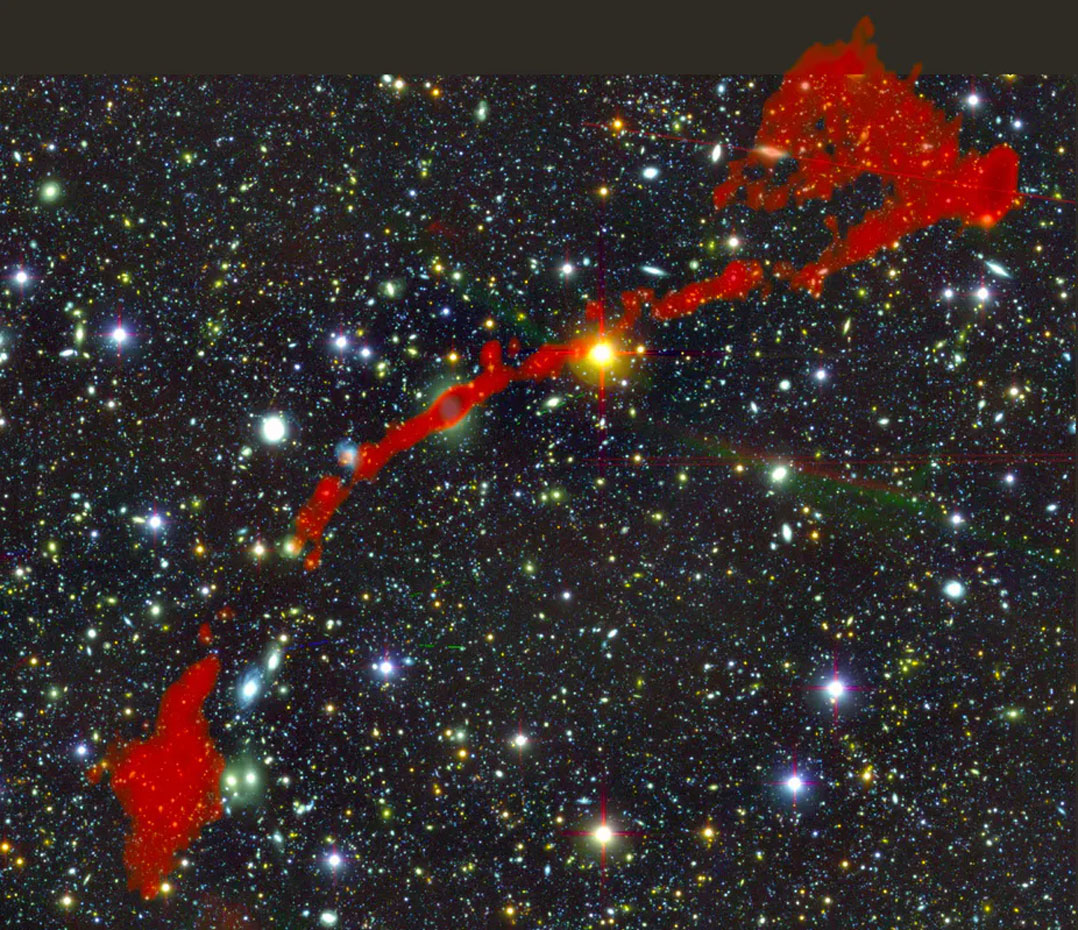
    The two giant radio galaxies found with the MeerKAT telescope. In the background is the sky as seen in optical light. Overlaid in red is the radio light from the enormous radio galaxies, as seen by MeerKAT. I Heywood (Oxford/Rhodes/Sarao)

    Two giant radio galaxies have been discovered with South Africa’s powerful MeerKAT telescope, located in the Karoo. Radio galaxies get their name from the fact that they release huge beams, or “jets”, of radio light. These happen through the interaction between charged particles and strong magnetic fields related to supermassive black holes at the galaxies’ hearts.

    These giant galaxies are much bigger than most of the others in the universe and are thought to be quite rare. Although millions of radio galaxies are known to exist, only around 800 giants have been found. This population of galaxies was previously hidden from us by radio telescopes’ limitations. But the MeerKAT has allowed new discoveries because it can detect faint, diffuse light which previous telescopes were unable to do.

    Our discovery, published in the Monthly Notices of the Royal Astronomical Society, gives astronomers further clues about how galaxies have changed and evolved throughout cosmic history. It’s also a way to understand how galaxies may continue to change and evolve – and even to work out how old radio galaxies can get.

    The giant radio galaxies were spotted in new radio maps of the sky created by one of the most advanced surveys of distant galaxies

    The giant radio galaxies were spotted in new radio maps of the sky created by one of the most advanced surveys of distant galaxies. The team working on it has included astronomers from around the world including South Africa, the UK, Italy and Australia. Called the International Gigahertz Tiered Extragalactic Exploration (Mightee) survey, it involves data collected by South Africa’s impressive MeerKAT radio telescope. MeerKAT consists of 64 antennae and dishes and started collecting science data in early 2018. It will ultimately be incorporated into the Square Kilometre Array, an intergovernmental radio telescope project spearheaded by Australia and South Africa.

    Jets and lobes

    The galaxies in question are several billion light years away. The discovery of enormous jets and lobes in the Mightee map allowed us confidently to identify the objects as giant radio galaxies.

    Their discovery means that a clearer understanding of the evolutionary pathways of galaxies is beginning to emerge. This is tantalising evidence that a large population of faint, very extended giant radio galaxies may exist. This may help us understand how radio galaxies become so huge and what sort of havoc supermassive black holes can wreak on their galaxies.

    Many galaxies have supermassive black holes in their midst. When large amounts of interstellar gas start to orbit and fall in towards the black hole, the black hole becomes “active”: Huge amounts of energy are released from this region of the galaxy.
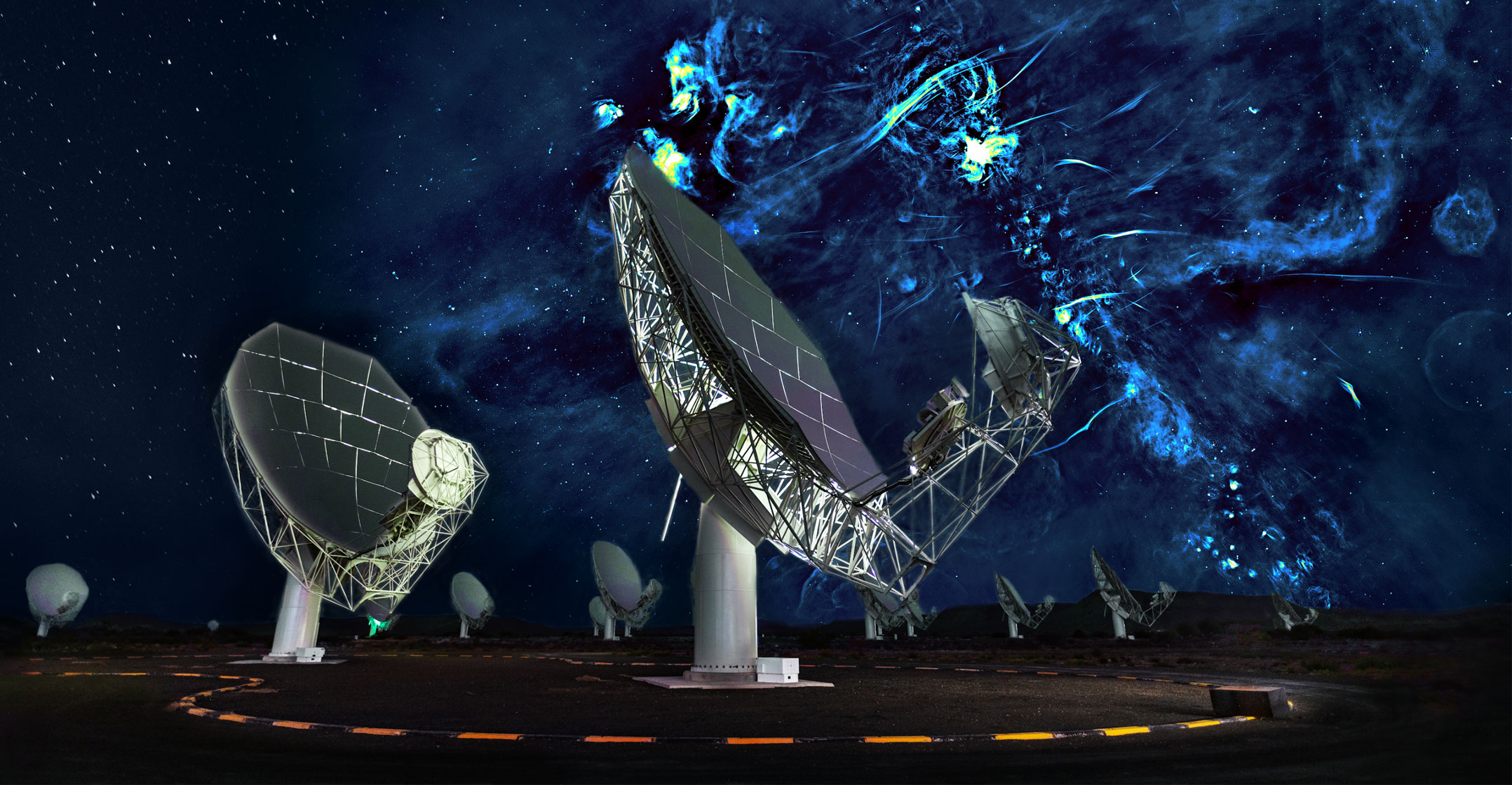
    A radio image of the centre of the Milky Way with a portion of the MeerKAT telescope array in the foreground

    In some active galaxies, charged particles interact with the strong magnetic fields near the black hole and release huge beams, or “jets”, of radio light. The radio jets of these so-called “radio galaxies” can be many times larger than the galaxy itself and can extend vast distances into intergalactic space. Think of them like jets of water from a whale’s blowhole, a thin column extending into a cloudy plume at the end.

    We found these giant radio galaxies in a region of sky that’s about four times the area of the full moon. Based on what we currently know about the density of giant radio galaxies in the sky, the probability of finding two of them in a region this size is extremely small – only 0.0003%. So, it’s possible that giant radio galaxies – those that emit the beams, or jets of light described above – may actually be more common than we previously thought.

    These aren’t the first radio galaxies astronomers have discovered. Many hundreds of thousands have already been identified. But only around 800 have radio jets bigger than 700 kilo-parsecs in size, or around 22 times the size of the Milky Way. These truly enormous systems are called “giant radio galaxies”.

    MeerKAT is the best of its kind in the world because of the telescope’s unprecedented sensitivity to faint and diffuse radio light

    Our new discoveries are more than two mega-parsecs across: about 6.5 million light years or about 62 times the size of the Milky Way. Yet they are fainter than others of the same size. That’s what makes them harder to see.

    We suspect that many more galaxies like these should exist, because of the way we think galaxies should grow and change over their lifetimes. And that’s one question we hope this discovery can help to answer: How old are giant radio galaxies and how did they get so enormous?

    Now, telescope technology is making it possible to put these and other theories to the test. MeerKAT is the best of its kind in the world because of the telescope’s unprecedented sensitivity to faint and diffuse radio light. This capability is what made it possible for us to detect the giant radio galaxies. We could see features that haven’t been noticed before: large-scale radio jets coming from the central galaxies, as well as fuzzy cloud-like lobes at the end of the jets.

    Mystery

    The fact that only very few radio galaxies are so gigantic has always been a bit of a mystery. It is thought that the giants are the oldest radio galaxies, which have existed for long enough (several hundred million years) for their radio jets to grow outwards to these enormous sizes. If this is true, then many more giant radio galaxies should exist than are currently known. And that’s important because radio jets can influence the star formation of their host galaxy. Essentially, they might “kill” their galaxy by blowing out all the gas and preventing the formation of new stars.

    The Mightee survey continues, and we hope to uncover more of these giant galaxies as it progresses. We also expect to find many more with the Square Kilometre Array: Construction of this transcontinental telescope is due to start in South Africa and Australia in 2021 and continue until 2027. Science commissioning observations could begin as early as 2023.

    The Square Kilometre Array is also expected to reveal larger populations of radio galaxies, revolutionising our understanding of galaxy evolution.The Conversation

    • Written by Jacinta Delhaize, Sarao postdoctoral research fellow, University of Cape Town
    • This article is republished from The Conversation under a Creative Commons licence

    Follow TechCentral on Google News Add TechCentral as your preferred source on Google


    Jacinta Delhaize MeetKAT Sarao SKA Square Kilometre Array top
    WhatsApp YouTube
    Share. Facebook Twitter LinkedIn WhatsApp Telegram Email Copy Link
    Previous ArticleUS asks Australia to scrap plan to make tech giants pay for news
    Next Article Naspers spin-off Prosus leads $30-million round in Indian agritech start-up

    Related Posts

    UCT astronomers uncover vast hidden supercluster behind the Milky Way

    UCT astronomers uncover vast hidden supercluster behind the Milky Way

    12 March 2026
    A MeerKAT antenna

    MeerKAT detects most powerful natural radio laser ever observed

    19 February 2026
    South Africa's giant SKA telescope clears major technical hurdle

    South Africa’s giant SKA telescope clears major technical hurdle

    8 January 2026
    Company News
    Security by design is the channel's strongest pitch - Othelo Vieira

    Security by design is the channel’s strongest pitch

    23 April 2026
    Your brand is invisible to the AI that's choosing your competitor - Michelle Losco

    Your brand is invisible to the AI that’s choosing your competitor

    23 April 2026
    How AnyDesk is redefining remote access for African enterprises

    How AnyDesk is redefining remote access for African enterprises

    22 April 2026
    Opinion
    The conflict of interest at the heart of PayShap's slow adoption - Cheslyn Jacobs

    The conflict of interest at the heart of PayShap’s slow adoption

    26 March 2026
    South Africa's energy future hinges on getting wheeling right - Aishah Gire

    South Africa’s energy future hinges on getting wheeling right

    10 March 2026
    Hold the doom: the case for a South African comeback - Duncan McLeod

    Apple just dropped a bomb on the Windows world

    5 March 2026

    Subscribe to Updates

    Get the best South African technology news and analysis delivered to your e-mail inbox every morning.

    Latest Posts
    Usaasa's 30-year run nears its end - Communications minister Solly Malatsi. Image c/o DCDT

    Usaasa’s 30-year run nears its end

    23 April 2026
    South Africa planning big overhaul of public sector IT - State IT Agency Sita

    South Africa planning big overhaul of public sector IT

    23 April 2026
    Charge to switch on first N3 off-grid EV stations in May - Joubert Roux

    Charge to switch on first N3 off-grid EV stations in May

    23 April 2026
    Middle-class South Africa is ditching streaming for AI

    Middle-class South Africa is ditching streaming for AI

    23 April 2026
    © 2009 - 2026 NewsCentral Media
    • Cookie policy (ZA)
    • TechCentral – privacy and Popia

    Type above and press Enter to search. Press Esc to cancel.

    Manage consent

    TechCentral uses cookies to enhance its offerings. Consenting to these technologies allows us to serve you better. Not consenting or withdrawing consent may adversely affect certain features and functions of the website.

    Functional Always active
    The technical storage or access is strictly necessary for the legitimate purpose of enabling the use of a specific service explicitly requested by the subscriber or user, or for the sole purpose of carrying out the transmission of a communication over an electronic communications network.
    Preferences
    The technical storage or access is necessary for the legitimate purpose of storing preferences that are not requested by the subscriber or user.
    Statistics
    The technical storage or access that is used exclusively for statistical purposes. The technical storage or access that is used exclusively for anonymous statistical purposes. Without a subpoena, voluntary compliance on the part of your Internet Service Provider, or additional records from a third party, information stored or retrieved for this purpose alone cannot usually be used to identify you.
    Marketing
    The technical storage or access is required to create user profiles to send advertising, or to track the user on a website or across several websites for similar marketing purposes.
    • Manage options
    • Manage services
    • Manage {vendor_count} vendors
    • Read more about these purposes
    View preferences
    • {title}
    • {title}
    • {title}