Close Menu
TechCentralTechCentral

    Subscribe to the newsletter

    Get the best South African technology news and analysis delivered to your e-mail inbox every morning.

    Facebook X (Twitter) YouTube LinkedIn
    WhatsApp Facebook X (Twitter) LinkedIn YouTube
    TechCentralTechCentral
    • News
      AI has started a tech 'supercycle', says Datatec's Jens Montanana

      AI has started a tech ‘supercycle’, says Datatec’s Jens Montanana

      29 October 2026
      Icasa wants your fingerprint before you can get a Sim card

      Icasa wants your fingerprint before you can get a Sim card

      29 October 2026
      South Africa's AI policy team is racing a 30 November deadline

      South Africa’s AI policy team is racing a 30 November deadline

      29 October 2026
      A Finnish supercomputer could help close South Africa's AI computing gap

      A Finnish supercomputer could help close South Africa’s AI computing gap

      29 October 2026
      GoTyme dares rival banks to make instant payments free - Cheslyn Jacobs

      GoTyme dares rival banks to make instant payments free

      29 October 2026
    • World
      Alleged Israeli spy company heavily targeted Starlink users

      How online ads were used to hunt Starlink users

      28 October 2026
      Anthropic's IPO stands alone

      Anthropic’s IPO stands alone

      23 October 2026
      PHP flaws trigger global scramble as hackers pounce

      PHP flaws trigger global scramble as hackers pounce

      22 October 2026
      OpenAI turns the tables on Apple in trade secrets fight

      OpenAI turns the tables on Apple in trade secrets fight

      15 October 2026
      Google's Gemini 4 Argon is finally here

      Google’s Gemini 4 Argon is finally here

      14 October 2026
    • In-depth
      Why investors are souring on Netflix

      Why investors are souring on Netflix

      22 October 2026

      10 days that changed the course of AI

      21 September 2026
      Meta to the AI industry: slow down without us - Mark Zuckerberg

      Meta to the AI industry: slow down without us

      16 September 2026
      Google DeepMind CEO Demis Hassabis. Image: John Sears

      The plan to stop AI from breaking the world

      16 July 2026
      The internet has a Strait of Hormuz problem

      The internet has a Strait of Hormuz problem

      15 July 2026
    • TCS
      TCS+ | Vox on AI, data rules and omnichannel communication for SMEs

      TCS+ | Vox on AI, data rules and omnichannel communication for SMEs

      26 October 2026
      TCS | The Cape Town firm quietly connecting Eskom, Pep and 6 000 ATMs - Réan van Niekerk, Metacom

      TCS | The Cape Town firm quietly connecting Eskom, Pep and 6 000 ATMs

      23 October 2026
      TCS+ | Boards are underestimating the cost of a cyberattack, says Arctic Wolf - Jason Oehley and Andre Den Hond

      TCS+ | Boards are underestimating the cost of a cyberattack, says Arctic Wolf

      22 October 2026
      W&W | LDV's Gerhard Moolman on electric bakkies, fleet orders and 'school fees'

      W&W | LDV’s Gerhard Moolman on electric bakkies and fleets

      9 October 2026
      TCS | Frogfoot sees bigger fibre deals coming - TechCentral Show guests Abraham van der Merwe and Shane Chorley

      TCS | Frogfoot sees bigger fibre deals coming

      8 October 2026
    • Opinion
      AI's boardroom honeymoon is over - Gary Stocks

      AI’s boardroom honeymoon is over

      22 October 2026
      Before South Africa licenses Starlink, it should look at Ukraine - Duncan McLeod

      Before South Africa licenses Starlink, it should look at Ukraine

      21 October 2026
      Nonkqubela Thathakahle Jordan-Dyani

      Why cybersecurity is now a national security issue for South Africa

      15 October 2026
      When a machine can choose, who does it become? Fanie van Rooyen

      When a machine can choose, who does it become?

      9 October 2026
      Let South Africans jailbreak their way to digital sovereignty - Dirk de Vos

      Let South Africans jailbreak their way to digital sovereignty

      5 October 2026
    • Company News
      • 1Stream
      • Africa Data Centres
      • AfriGIS
      • Altron Digital Business
      • Altron Document Solutions
      • Altron Group
      • Arctic Wolf
      • Ascent Technology
      • AvertITD
      • BBD
      • Braintree
      • CallMiner
      • CambriLearn
      • CM.com
      • Contactable
      • CYBER1 Solutions
      • Digicloud Africa
      • Digimune
      • Domains.co.za
      • ESET
      • Euphoria Telecom
      • HOSTAFRICA
      • Incredible Business
      • iONLINE
      • IQbusiness
      • Iris Network Systems
      • Kaspersky
      • LSD Open
      • Mitel
      • NEC XON
      • Netstar
      • Network Platforms
      • Next DLP
      • Ovations
      • Paracon
      • Paratus
      • Publishared
      • Q-KON
      • SevenC
      • SkyWire
      • Solid8 Technologies
      • Telit Cinterion
      • Telviva
      • Tenable
      • Vertiv
      • Videri Digital
      • Vodacom Business
      • Vox
      • Wipro
      • Workday
      • XLink
    • Sections
      • AI and machine learning
      • Banking
      • Broadcasting and media
      • Cloud services
      • Contact centres and CX
      • Cryptocurrencies
      • Education and skills
      • Electronics and hardware
      • Energy and sustainability
      • Enterprise software
      • Fintech and payments
      • HealthTech
      • Information security
      • Internet and connectivity
      • Internet of things
      • Investment
      • IT services
      • Lifestyle
      • Policy and regulation
      • Public sector
      • Retail and e-commerce
      • Satellite communications
      • Science
      • SMEs and start-ups
      • Social media
      • Talent and leadership
      • Telecoms
      • Watts & Wheels
    • Events
    • Advertise
    TechCentralTechCentral
    Home » News » Stephen Elop’s brutal memo to Nokia staff

    Stephen Elop’s brutal memo to Nokia staff

    By Editor9 February 2011
    Twitter LinkedIn Facebook WhatsApp Email Telegram Copy Link
    Get breaking news on WhatsApp

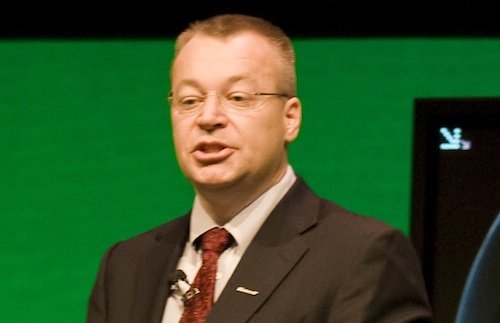
    Nokia CEO Stephen Elop

    In a no-holds-barred memo to Nokia employees this week, new CEO Stephen Elop has lamented the company’s slow response, first to Apple’s iPhone, and then to the rise of Google’s Android, suggesting it is “standing on a burning platform”.

    Elop warns in the memo that there is “intense heat coming from our competitors, more rapidly than we ever expected”.

    The memo comes just days before Elop is due to outline his strategy at a keynote address in London. He will deliver the keenly anticipated presentation this Friday, starting at midday SA time.

    “Nokia, our platform is burning,” Elop writes in the memo, adding that the handset manufacturer, based in Finland, has had a “series of misses” and hasn’t “been delivering innovation fast enough”.

    A local Nokia spokesman declines to comment on the authenticity of Elop’s memo, but several international news websites are quoting unnamed internal Nokia sources vouching for its authenticity.

    On the rise of the iPhone, Elop says in the memo: “Apple demonstrated that if designed well, consumers would buy a high-priced phone with a great experience and developers would build applications. They changed the game, and today Apple owns the high-end range.”

    On the rise of Android, he says: “Android came in at the high-end, [is] now winning the mid-range, and [is] quickly going downstream to phones under €100. Google has become a gravitational force, drawing much of the industry’s innovation to its core.”

    At the low end of the market, where Nokia is particularly strong, Elop warns Chinese manufacturers are emerging as a big threat: “In 2008, MediaTek supplied complete reference designs for phone chipsets, which enabled manufacturers in the Shenzhen region of China to produce phones at an unbelievable pace. By some accounts, this ecosystem now produces more than one third of the phones sold globally, taking share from us in emerging markets.”

    He warns in the memo that Nokia has fallen “years behind” after missing big trends. “The first iPhone shipped in 2007, and we still don’t have a product that is close to their experience. Android came on the scene just over 2 years ago, and this week they took our leadership position in smartphone volumes. Unbelievable.”

    Elop’s full memo, originally published by Engadget and the The Wall Street Journal Online, is pasted below.  — Staff reporter, TechCentral

    • Image: Luca Sartoni
    • Subscribe to our free daily newsletter
    • Follow us on Twitter or on Facebook

    Hello there,

    There is a pertinent story about a man who was working on an oil platform in the North Sea. He woke up one night from a loud explosion, which suddenly set his entire oil platform on fire. In mere moments, he was surrounded by flames. Through the smoke and heat, he barely made his way out of the chaos to the platform’s edge. When he looked down over the edge, all he could see were the dark, cold, foreboding Atlantic waters.

    As the fire approached him, the man had mere seconds to react. He could stand on the platform, and inevitably be consumed by the burning flames. Or, he could plunge 30 meters in to the freezing waters. The man was standing upon a “burning platform,” and he needed to make a choice.

    He decided to jump. It was unexpected. In ordinary circumstances, the man would never consider plunging into icy waters. But these were not ordinary times – his platform was on fire. The man survived the fall and the waters. After he was rescued, he noted that a “burning platform” caused a radical change in his behaviour.

    We too, are standing on a “burning platform,” and we must decide how we are going to change our behaviour.

    Over the past few months, I’ve shared with you what I’ve heard from our shareholders, operators, developers, suppliers and from you. Today, I’m going to share what I’ve learned and what I have come to believe.

    I have learned that we are standing on a burning platform.

    And, we have more than one explosion – we have multiple points of scorching heat that are fuelling a blazing fire around us.

    For example, there is intense heat coming from our competitors, more rapidly than we ever expected. Apple disrupted the market by redefining the smartphone and attracting developers to a closed, but very powerful ecosystem.

    In 2008, Apple’s market share in the $300+ price range was 25 percent; by 2010 it escalated to 61 percent. They are enjoying a tremendous growth trajectory with a 78 percent earnings growth year over year in Q4 2010. Apple demonstrated that if designed well, consumers would buy a high-priced phone with a great experience and developers would build applications. They changed the game, and today, Apple owns the high-end range.

    And then, there is Android. In about two years, Android created a platform that attracts application developers, service providers and hardware manufacturers. Android came in at the high-end, they are now winning the mid-range, and quickly they are going downstream to phones under €100. Google has become a gravitational force, drawing much of the industry’s innovation to its core.

    Let’s not forget about the low-end price range. In 2008, MediaTek supplied complete reference designs for phone chipsets, which enabled manufacturers in the Shenzhen region of China to produce phones at an unbelievable pace. By some accounts, this ecosystem now produces more than one third of the phones sold globally – taking share from us in emerging markets.

    While competitors poured flames on our market share, what happened at Nokia? We fell behind, we missed big trends, and we lost time. At that time, we thought we were making the right decisions; but, with the benefit of hindsight, we now find ourselves years behind.

    The first iPhone shipped in 2007, and we still don’t have a product that is close to their experience. Android came on the scene just over 2 years ago, and this week they took our leadership position in smartphone volumes. Unbelievable.

    We have some brilliant sources of innovation inside Nokia, but we are not bringing it to market fast enough. We thought MeeGo would be a platform for winning high-end smartphones. However, at this rate, by the end of 2011, we might have only one MeeGo product in the market.

    At the midrange, we have Symbian. It has proven to be non-competitive in leading markets like North America. Additionally, Symbian is proving to be an increasingly difficult environment in which to develop to meet the continuously expanding consumer requirements, leading to slowness in product development and also creating a disadvantage when we seek to take advantage of new hardware platforms. As a result, if we continue like before, we will get further and further behind, while our competitors advance further and further ahead.

    At the lower-end price range, Chinese OEMs are cranking out a device much faster than, as one Nokia employee said only partially in jest, “the time that it takes us to polish a PowerPoint presentation.” They are fast, they are cheap, and they are challenging us.

    And the truly perplexing aspect is that we’re not even fighting with the right weapons. We are still too often trying to approach each price range on a device-to-device basis.

    The battle of devices has now become a war of ecosystems, where ecosystems include not only the hardware and software of the device, but developers, applications, ecommerce, advertising, search, social applications, location-based services, unified communications and many other things. Our competitors aren’t taking our market share with devices; they are taking our market share with an entire ecosystem. This means we’re going to have to decide how we either build, catalyse or join an ecosystem.

    This is one of the decisions we need to make. In the meantime, we’ve lost market share, we’ve lost mind share and we’ve lost time.

    On Tuesday, Standard & Poor’s informed that they will put our A long term and A-1 short term ratings on negative credit watch. This is a similar rating action to the one that Moody’s took last week. Basically it means that during the next few weeks they will make an analysis of Nokia, and decide on a possible credit rating downgrade. Why are these credit agencies contemplating these changes? Because they are concerned about our competitiveness.

    Consumer preference for Nokia declined worldwide. In the UK, our brand preference has slipped to 20 percent, which is 8 percent lower than last year. That means only 1 out of 5 people in the UK prefer Nokia to other brands. It’s also down in the other markets, which are traditionally our strongholds: Russia, Germany, Indonesia, UAE, and on and on and on.

    How did we get to this point? Why did we fall behind when the world around us evolved?

    This is what I have been trying to understand. I believe at least some of it has been due to our attitude inside Nokia. We poured gasoline on our own burning platform. I believe we have lacked accountability and leadership to align and direct the company through these disruptive times. We had a series of misses. We haven’t been delivering innovation fast enough. We’re not collaborating internally.

    Nokia, our platform is burning.

    We are working on a path forward — a path to rebuild our market leadership. When we share the new strategy on February 11, it will be a huge effort to transform our company. But, I believe that together, we can face the challenges ahead of us. Together, we can choose to define our future.

    The burning platform, upon which the man found himself, caused the man to shift his behaviour, and take a bold and brave step into an uncertain future. He was able to tell his story. Now, we have a great opportunity to do the same.

    Stephen

    Add TechCentral as a preferred source on GoogleFollow TechCentral on Google NewsGet breaking news on WhatsApp


    Apple Google Nokia Stephen Elop
    WhatsApp YouTube
    Share. Facebook Twitter LinkedIn WhatsApp Telegram Email Copy Link
    Previous ArticleThe Huffington heist
    Next Article Labour to take hard line on Siemens IT deal

    Related Posts

    AI is squeezing Google's search growth - and its cash

    AI is squeezing Google’s search growth – and its cash

    29 October 2026
    The hidden cost of owning a folding phone

    The hidden cost of owning a folding phone

    28 October 2026
    Alleged Israeli spy company heavily targeted Starlink users

    How online ads were used to hunt Starlink users

    28 October 2026
    Company News
    Paratus continues to reshape connectivity in Namibia

    Paratus continues to reshape connectivity in Namibia

    29 October 2026
    Rate hikes threaten a household recovery built on cheaper credit - John Gellatly

    Rate hikes threaten a household recovery built on cheaper credit

    29 October 2026
    Choosing the right AI path for banks and large enterprises - Matthew Barnard BBD

    Choosing the right AI path for banks and large enterprises

    29 October 2026
    Opinion
    AI's boardroom honeymoon is over - Gary Stocks

    AI’s boardroom honeymoon is over

    22 October 2026
    Before South Africa licenses Starlink, it should look at Ukraine - Duncan McLeod

    Before South Africa licenses Starlink, it should look at Ukraine

    21 October 2026
    Nonkqubela Thathakahle Jordan-Dyani

    Why cybersecurity is now a national security issue for South Africa

    15 October 2026

    Subscribe to Updates

    Get the best South African technology news and analysis delivered to your e-mail inbox every morning.

    Latest Posts
    AI has started a tech 'supercycle', says Datatec's Jens Montanana

    AI has started a tech ‘supercycle’, says Datatec’s Jens Montanana

    29 October 2026
    Icasa wants your fingerprint before you can get a Sim card

    Icasa wants your fingerprint before you can get a Sim card

    29 October 2026
    South Africa's AI policy team is racing a 30 November deadline

    South Africa’s AI policy team is racing a 30 November deadline

    29 October 2026
    A Finnish supercomputer could help close South Africa's AI computing gap

    A Finnish supercomputer could help close South Africa’s AI computing gap

    29 October 2026
    © 2009 - 2026 NewsCentral Media
    Built and maintained by Chronon
    • Cookie policy (ZA)
    • TechCentral – privacy and Popia

    Type above and press Enter to search. Press Esc to cancel.

    Manage consent

    TechCentral uses cookies to enhance its offerings. Consenting to these technologies allows us to serve you better. Not consenting or withdrawing consent may adversely affect certain features and functions of the website.

    Functional Always active
    The technical storage or access is strictly necessary for the legitimate purpose of enabling the use of a specific service explicitly requested by the subscriber or user, or for the sole purpose of carrying out the transmission of a communication over an electronic communications network.
    Preferences
    The technical storage or access is necessary for the legitimate purpose of storing preferences that are not requested by the subscriber or user.
    Statistics
    The technical storage or access that is used exclusively for statistical purposes. The technical storage or access that is used exclusively for anonymous statistical purposes. Without a subpoena, voluntary compliance on the part of your Internet Service Provider, or additional records from a third party, information stored or retrieved for this purpose alone cannot usually be used to identify you.
    Marketing
    The technical storage or access is required to create user profiles to send advertising, or to track the user on a website or across several websites for similar marketing purposes.
    • Manage options
    • Manage services
    • Manage {vendor_count} vendors
    • Read more about these purposes
    View preferences
    • {title}
    • {title}
    • {title}
    🇿🇦 Sign up to the TechCentral newsletter