Close Menu
TechCentralTechCentral

    Subscribe to the newsletter

    Get the best South African technology news and analysis delivered to your e-mail inbox every morning.

    Facebook X (Twitter) YouTube LinkedIn
    WhatsApp Facebook X (Twitter) LinkedIn YouTube
    TechCentralTechCentral
    • News
      MultiChoice scraps annual DStv price hikes for 2026 - David Mignot

      MultiChoice scraps annual DStv price hike

      20 February 2026
      What Gen Z really thinks about the tech world it inherited - Tinashe Mazodze

      What Gen Z really thinks about the tech world it inherited

      20 February 2026
      Showmax 'can't continue' in its current form

      Showmax ‘can’t continue’ in its current form

      20 February 2026
      Free Market Foundation slams treasury's proposed gambling tax

      Free Market Foundation slams treasury’s proposed gambling tax

      20 February 2026
      South Africa's dynamic spectrum breakthrough - Paul Colmer

      South Africa’s dynamic spectrum breakthrough

      20 February 2026
    • World
      Prominent Southern African journalist targeted with Predator spyware

      Prominent Southern African journalist targeted with Predator spyware

      18 February 2026
      More drama in Warner Bros tug of war

      More drama in Warner Bros tug of war

      17 February 2026
      Russia bans WhatsApp

      Russia bans WhatsApp

      12 February 2026
      EU regulators take aim at WhatsApp

      EU regulators take aim at WhatsApp

      9 February 2026
      Musk hits brakes on Mars mission

      Musk hits brakes on Mars mission

      9 February 2026
    • In-depth
      How liberalisation is rewiring South Africa's power sector

      How liberalisation is rewiring South Africa’s power sector

      21 January 2026
      The top-performing South African tech shares of 2025

      The top-performing South African tech shares of 2025

      12 January 2026
      Digital authoritarianism grows as African states normalise internet blackouts

      Digital authoritarianism grows as African states normalise internet blackouts

      19 December 2025
      TechCentral's South African Newsmakers of 2025

      TechCentral’s South African Newsmakers of 2025

      18 December 2025
      Black Friday goes digital in South Africa as online spending surges to record high

      Black Friday goes digital in South Africa as online spending surges to record high

      4 December 2025
    • TCS
      Watts & Wheels S1E4: 'We drive an electric Uber'

      Watts & Wheels S1E4: ‘We drive an electric Uber’

      10 February 2026
      TCS+ | How Cloud On Demand is helping SA businesses succeed in the cloud - Xhenia Rhode, Dion Kalicharan

      TCS+ | Cloud On Demand and Consnet: inside a real-world AWS partner success story

      30 January 2026
      Watts & Wheels S1E4: 'We drive an electric Uber'

      Watts & Wheels S1E3: ‘BYD’s Corolla Cross challenger’

      30 January 2026
      Watts & Wheels S1E4: 'We drive an electric Uber'

      Watts & Wheels S1E2: ‘China attacks, BMW digs in, Toyota’s sublime supercar’

      23 January 2026

      TCS+ | Why cybersecurity is becoming a competitive advantage for SA businesses

      20 January 2026
    • Opinion
      A million reasons monopolies don't work - Duncan McLeod

      A million reasons monopolies don’t work

      10 February 2026
      The author, Business Leadership South Africa CEO Busi Mavuso

      Eskom unbundling U-turn threatens to undo hard-won electricity gains

      9 February 2026
      South Africa's skills advantage is being overlooked at home - Richard Firth

      South Africa’s skills advantage is being overlooked at home

      29 January 2026
      Why Elon Musk's Starlink is a 'hard no' for me - Songezo Zibi

      Why Elon Musk’s Starlink is a ‘hard no’ for me

      26 January 2026
      A million reasons monopolies don't work - Duncan McLeod

      South Africa’s new fibre broadband battle

      20 January 2026
    • Company Hubs
      • Africa Data Centres
      • AfriGIS
      • Altron Digital Business
      • Altron Document Solutions
      • Altron Group
      • Arctic Wolf
      • AvertITD
      • Braintree
      • CallMiner
      • CambriLearn
      • CYBER1 Solutions
      • Digicloud Africa
      • Digimune
      • Domains.co.za
      • ESET
      • Euphoria Telecom
      • Incredible Business
      • iONLINE
      • IQbusiness
      • Iris Network Systems
      • LSD Open
      • Mitel
      • NEC XON
      • Netstar
      • Network Platforms
      • Next DLP
      • Ovations
      • Paracon
      • Paratus
      • Q-KON
      • SevenC
      • SkyWire
      • Solid8 Technologies
      • Telit Cinterion
      • Tenable
      • Vertiv
      • Videri Digital
      • Vodacom Business
      • Wipro
      • Workday
      • XLink
    • Sections
      • AI and machine learning
      • Banking
      • Broadcasting and Media
      • Cloud services
      • Contact centres and CX
      • Cryptocurrencies
      • Education and skills
      • Electronics and hardware
      • Energy and sustainability
      • Enterprise software
      • Financial services
      • Information security
      • Internet and connectivity
      • Internet of Things
      • Investment
      • IT services
      • Lifestyle
      • Motoring
      • Public sector
      • Retail and e-commerce
      • Satellite communications
      • Science
      • SMEs and start-ups
      • Social media
      • Talent and leadership
      • Telecoms
    • Events
    • Advertise
    TechCentralTechCentral
    Home » In-depth » Still want a BlackBerry? Hell, yes!

    Still want a BlackBerry? Hell, yes!

    By The Conversation29 January 2015
    Twitter LinkedIn Facebook WhatsApp Email Telegram Copy Link
    News Alerts
    WhatsApp
    The BlackBerry Z3
    The BlackBerry Z3

    BlackBerry, once the must-have device for the sweaty palms of executives and wannabe executives everywhere, has seen its global share of the smartphone market fall to below 1%. So would you still buy this unpopular phone? If you live in parts of Africa, India or Indonesia, the answer is: “Hell, yes!”

    BlackBerry, then Research in Motion (RIM), came to the mobile market in 1999 with the BlackBerry 850 — perhaps more of a high-end pager than a smartphone. In 2002, it launched the 5810, its first device marketed as a phone with e-mail capability. From that point on, the firm rapidly established itself as a market leader with handsets that provided easy access to e-mail through their trademark compact physical Qwerty keypads, becoming essential business tools.

    The term “crackberry” gained currency to described its users’ urge to check their devices, while Barack Obama famously refused to surrender his BlackBerry on becoming president in 2009. However, like once equally mighty phone manufacturers Motorola and Nokia, RIM struggled to respond to Apple’s game-changing iPhone in 2007, which redefined the smartphone as a handset dominated by a large touch screen, extended by downloadable apps, and most importantly as a device for everybody, not just business users.

    The appeal of the BlackBerry — and the company’s large installed base — allowed RIM to boast that in 2010 there were more smartphone subscribers in the US using BlackBerry than using iPhones or Android devices. But BlackBerry’s share of the global smartphone market has tumbled from a high of 20% in 2009 when it was second only to Nokia’s Symbian-based phones, to 14% in 2010, 8% in 2011 and 3% in 2012.

    While this may seem a gloomy outlook for the BlackBerry, outside Europe and the US the true picture is a little more complicated. The most popular smartphone in South Africa for the last four years is the BlackBerry Curve 8520. Indeed, BlackBerry phones (8520, 9320, 9300) dominate the top rankings in a recent survey carried out by Vodacom in South Africa, with 23% of the smartphone market. The same applies to Nigeria, where BlackBerry boasts 40% of the market, and the drama BlackBerry Babes gives some indication of the status the phones command.
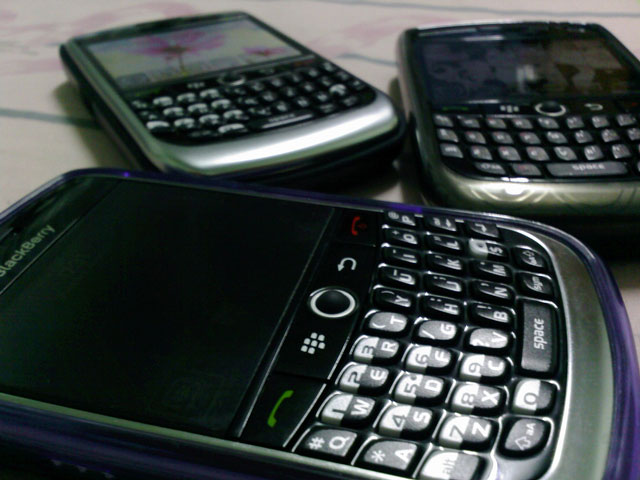
    The BlackBerry Curve range has proved hugely popular in emerging markets
    The BlackBerry Curve range has proved hugely popular in emerging markets

    What is the BlackBerry’s appeal to the developing world? The answer is threefold. First, a BlackBerry is seen as a status symbol, a strong brand that people aspire to own. Second, low-cost mobile data bundles and the fact that BlackBerry users can exchange messages for free using the BlackBerry Messenger (BBM) service makes them affordable and well-suited to less capable mobile networks. Finally, phones are upgraded less frequently in developing countries — South Africa’s most recent chart-topping BlackBerry is three years old.

    The situation in India and Indonesia is slightly different: here the BlackBerry Z3 — a new, low-cost touch-screen model released specifically for the Asian market — is doing very well, despite market share in Indonesia falling from 43% to 3% in three years. In India, the BlackBerry outsells the iPhone by appealing both to the young and trendy and to business workers looking for that white-collar professional look.

    So, BlackBerry’s success for the moment appears to be reliant on its strong brand and affordable products. The fact that its critically important BBM service has been ported to run on Android is also significant as it maintains the customer base without a reliance on handset ownership.

    However, BlackBerry will face a longer term challenge from an influx of cheaper and more capable smartphones arriving from China and the Far East, at which point the question will be whether its brand will be strong enough to ensure survival.

    Recent speculation that Samsung might consider buying BlackBerry has renewed interest in the company’s fortunes. But such a takeover may be motivated more by the value of the firm’s intellectual property portfolio: its proprietary operating system, the BBM instant messaging platform, and the real-time QNX operating system which the firm acquired in 2010. Designed specifically for embedded devices, QNX could be seen as a key property as the “Internet of things” develops — much more so, in fact, than a portfolio of smartphones popular in only a few countries.The Conversation

    • Nigel Linge is professor of computer networking and telecommunications at the University of Salford
    • This article was originally published on The Conversation

    Follow TechCentral on Google News Add TechCentral as your preferred source on Google


    BlackBerry Nigel Linge Research in Motion RIM
    WhatsApp YouTube
    Share. Facebook Twitter LinkedIn WhatsApp Telegram Email Copy Link
    Previous ArticleVidi expands with local content
    Next Article Microsoft confident of more services in SA

    Related Posts

    What Gen Z really thinks about the tech world it inherited - Tinashe Mazodze

    What Gen Z really thinks about the tech world it inherited

    20 February 2026
    From Talkomatic to WhatsApp: the incredible history of instant messaging

    From Talkomatic to WhatsApp: the incredible history of instant messaging

    28 May 2024
    The 20 most influential tech products of all time

    The 20 most influential tech products of all time

    22 May 2024
    Company News
    Service is everyone's problem now - and that's exactly why the Atlassian Service Collection matters

    Service is everyone’s problem now – why the Atlassian Service Collection matters

    20 February 2026
    Customers have new expectations. Is your CX ready? 1Stream

    Customers have new expectations. Is your CX ready?

    19 February 2026
    South Africa's cybersecurity challenge is not a tool problem - Nicholas Applewhite, Trinexia South Africa

    South Africa’s cybersecurity challenge is not a tool problem

    19 February 2026
    Opinion
    A million reasons monopolies don't work - Duncan McLeod

    A million reasons monopolies don’t work

    10 February 2026
    The author, Business Leadership South Africa CEO Busi Mavuso

    Eskom unbundling U-turn threatens to undo hard-won electricity gains

    9 February 2026
    South Africa's skills advantage is being overlooked at home - Richard Firth

    South Africa’s skills advantage is being overlooked at home

    29 January 2026

    Subscribe to Updates

    Get the best South African technology news and analysis delivered to your e-mail inbox every morning.

    Latest Posts
    MultiChoice scraps annual DStv price hikes for 2026 - David Mignot

    MultiChoice scraps annual DStv price hike

    20 February 2026
    What Gen Z really thinks about the tech world it inherited - Tinashe Mazodze

    What Gen Z really thinks about the tech world it inherited

    20 February 2026
    Showmax 'can't continue' in its current form

    Showmax ‘can’t continue’ in its current form

    20 February 2026
    Free Market Foundation slams treasury's proposed gambling tax

    Free Market Foundation slams treasury’s proposed gambling tax

    20 February 2026
    © 2009 - 2026 NewsCentral Media
    • Cookie policy (ZA)
    • TechCentral – privacy and Popia

    Type above and press Enter to search. Press Esc to cancel.

    Manage consent

    TechCentral uses cookies to enhance its offerings. Consenting to these technologies allows us to serve you better. Not consenting or withdrawing consent may adversely affect certain features and functions of the website.

    Functional Always active
    The technical storage or access is strictly necessary for the legitimate purpose of enabling the use of a specific service explicitly requested by the subscriber or user, or for the sole purpose of carrying out the transmission of a communication over an electronic communications network.
    Preferences
    The technical storage or access is necessary for the legitimate purpose of storing preferences that are not requested by the subscriber or user.
    Statistics
    The technical storage or access that is used exclusively for statistical purposes. The technical storage or access that is used exclusively for anonymous statistical purposes. Without a subpoena, voluntary compliance on the part of your Internet Service Provider, or additional records from a third party, information stored or retrieved for this purpose alone cannot usually be used to identify you.
    Marketing
    The technical storage or access is required to create user profiles to send advertising, or to track the user on a website or across several websites for similar marketing purposes.
    • Manage options
    • Manage services
    • Manage {vendor_count} vendors
    • Read more about these purposes
    View preferences
    • {title}
    • {title}
    • {title}