
Close Menu
TechCentralTechCentral

    Subscribe to the newsletter

    Get the best South African technology news and analysis delivered to your e-mail inbox every morning.

    Facebook X (Twitter) YouTube LinkedIn
    WhatsApp Facebook X (Twitter) LinkedIn YouTube
    TechCentralTechCentral
    • News
      DStv drops premium paywall on Fifa World Cup in Canal+-era shift - SuperSport Rendani Ramovha

      DStv drops premium paywall on Fifa World Cup in Canal+-era shift

      17 April 2026
      How a connectivity levy became a tax on telecoms

      How a connectivity levy became a tax on telecoms

      17 April 2026
      Wits project pits African creators against AI music's blind spots

      Wits project pits African creators against AI music’s blind spots

      17 April 2026
      Prosus offloads 4.5% of Delivery Hero to Uber for €270-million

      Prosus offloads 4.5% of Delivery Hero to Uber for €270-million

      17 April 2026
      Numsa digs in for 8% as Eskom wage pact splits unions

      Numsa digs in as Eskom wage pact splits unions

      17 April 2026
    • World
      Adobe bets on AI agents to fend off cheaper rivals

      Adobe bets on AI agents to fend off cheaper rivals

      16 April 2026
      Google poised to lose ad crown to Meta

      Google poised to lose ad crown to Meta

      14 April 2026
      Grand Theft Data - hackers hit Rockstar Games - Grand Theft Auto

      Grand Theft Data – hackers hit Rockstar Games

      14 April 2026
      UK PM Keir Starmer declares war on doomscrolling

      UK PM Keir Starmer declares war on doomscrolling

      13 April 2026
      Big Tech is going nuclear

      Big Tech is going nuclear

      10 April 2026
    • In-depth
      Africa switches on as Europe dims the lights

      Africa switches on as Europe dims the lights

      9 April 2026
      The biggest untapped EV market on Earth is hiding in plain sight

      The biggest untapped EV market on Earth is hiding in plain sight

      1 April 2026
      The R18-billion tech giant hiding in plain sight - Jens Montanana

      The R16-billion tech giant hiding in plain sight

      26 March 2026
      The last generation of coders

      The last generation of coders

      18 February 2026
      Sentech is in dire straits

      Sentech is in dire straits

      10 February 2026
    • TCS
      TCS | Werner Lindemann on how AI is rewriting the infosec rulebook

      TCS | Werner Lindemann on how AI is rewriting the infosec rulebook

      15 April 2026
      TCS | Donovan Marsh on AI and the future of filmmaking

      TCS | Donovan Marsh on AI and the future of filmmaking

      7 April 2026
      TCS+ | Vodacom Business moves to crack the SME tech gap - Andrew Fulton, Sannesh Beharie

      TCS+ | Vodacom Business moves to crack the SME tech gap

      7 April 2026
      TCS | MTN's Divysh Joshi on the strategy behind Pi - Divyesh Joshi

      TCS | MTN’s Divyesh Joshi on the strategy behind Pi

      1 April 2026
      Anoosh Rooplal

      TCS | Anoosh Rooplal on the Post Office’s last stand

      27 March 2026
    • Opinion
      The conflict of interest at the heart of PayShap's slow adoption - Cheslyn Jacobs

      The conflict of interest at the heart of PayShap’s slow adoption

      26 March 2026
      South Africa's energy future hinges on getting wheeling right - Aishah Gire

      South Africa’s energy future hinges on getting wheeling right

      10 March 2026
      Hold the doom: the case for a South African comeback - Duncan McLeod

      Apple just dropped a bomb on the Windows world

      5 March 2026
      R230-million in the bag for Endeavor's third Harvest Fund - Alison Collier

      VC’s centre of gravity is shifting – and South Africa is in the frame

      3 March 2026
      Hold the doom: the case for a South African comeback - Duncan McLeod

      Hold the doom: the case for a South African comeback

      26 February 2026
    • Company Hubs
      • 1Stream
      • Africa Data Centres
      • AfriGIS
      • Altron Digital Business
      • Altron Document Solutions
      • Altron Group
      • Arctic Wolf
      • Ascent Technology
      • AvertITD
      • BBD
      • Braintree
      • CallMiner
      • CambriLearn
      • CYBER1 Solutions
      • Digicloud Africa
      • Digimune
      • Domains.co.za
      • ESET
      • Euphoria Telecom
      • HOSTAFRICA
      • Incredible Business
      • iONLINE
      • IQbusiness
      • Iris Network Systems
      • Kaspersky
      • LSD Open
      • Mitel
      • NEC XON
      • Netstar
      • Network Platforms
      • Next DLP
      • Ovations
      • Paracon
      • Paratus
      • Q-KON
      • SevenC
      • SkyWire
      • Solid8 Technologies
      • Telit Cinterion
      • Telviva
      • Tenable
      • Vertiv
      • Videri Digital
      • Vodacom Business
      • Wipro
      • Workday
      • XLink
    • Sections
      • AI and machine learning
      • Banking
      • Broadcasting and Media
      • Cloud services
      • Contact centres and CX
      • Cryptocurrencies
      • Education and skills
      • Electronics and hardware
      • Energy and sustainability
      • Enterprise software
      • Financial services
      • HealthTech
      • Information security
      • Internet and connectivity
      • Internet of Things
      • Investment
      • IT services
      • Lifestyle
      • Motoring
      • Policy and regulation
      • Public sector
      • Retail and e-commerce
      • Satellite communications
      • Science
      • SMEs and start-ups
      • Social media
      • Talent and leadership
      • Telecoms
    • Events
    • Advertise
    TechCentralTechCentral
    Home » Sections » Social media » From Talkomatic to WhatsApp: the incredible history of instant messaging

    From Talkomatic to WhatsApp: the incredible history of instant messaging

    The evolution of chat apps from the 1960s to today tells a fascinating story of the development of computing.
    By Nkosinathi Ndlovu28 May 2024
    Twitter LinkedIn Facebook WhatsApp Email Telegram Copy Link
    News Alerts
    WhatsApp

    ICQ, a once-dominant instant messaging app developed by Israeli company Mirabilis in 1996, is shutting down for good after 28 years.

    ICQ, which was acquired by America Online in 1998, and then by Russia’s Mail.ru (now VK) in 2010, was for many people of a certain age their first introduction to instant messaging on the internet.

    TechCentral has a look at the history of instant messaging (IM), which goes all the way back to the very early days of computing, to the era of Beatlemania and the space race between the US and the Soviet Union.

    The arrival of the early internet in the 1970s sparked the first big evolution in IM applications

    When instant messaging kicked off in the 1960s (it wasn’t even called that back then), the idea that someone could send an AI-generated animated emoji was completely foreign. Today that’s all possible in apps like Meta Platforms’ WhatsApp, which is used by more than three billion people around the world. (Three billion was the world’s total population in 1960.)

    Back then, however, people didn’t carry high-powered computers in their pockets. Instead, those lucky enough to have access sat at a green-screen terminal sharing the resources of a large mainframe computer costing millions of dollars. They could communicate with each other and get notifications about system operations, like when another user was printing (and hogging limited computing resources) – and not much else.

    The arrival of the early internet in the 1970s sparked the first big evolution in IM applications, allowing people using different computers to hold a conversation, so long as they were connected to the same network.

    Talkomatic

    The first online chat system, called Talkomatic, was developed in 1973 for the Plato computer system by Doug Brown and David R Wooley at the University of Illinois. Up to five people could chat simultaneously using Talkomatic, with each participant “owning” a portion of the screen. The chat looked more like the interaction of five different bulletin boards each broadcasting their signal to the rest of the group.

    The next big revolution in IM came in 1988 with the creation of internet relay chat (IRC). IRC allowed for platforms with multiple chat rooms, or channels, based on user interests – anything from gaming and outdoor to astronomy. It was all mostly text-based, prior to the widespread adoption of graphical user interfaces (GUIs) in the 1990s.

    Advancements in graphics led to the development of GUI-based messaging clients for desktop PCs. PowWow, ICQ and AOL Instant Messenger (AIM) dominated this era of IM. But, towards the end of the decade, the market became fiercely competitive, with a range of software and internet companies muscling in: Excite, Microsoft’s MSN, Ubique and Yahoo.

    Read: It’s official: BBM is dead

    The proliferation of multiple, incompatible chat clients meant users had to run more than one client to keep up with friends, family and colleagues, especially if those people lived in different countries.

    To solve this problem, Mark Spencer of Auburn University created Pidgin in 1998, which made cross-platform IM popular. Instead of requiring unique software to connect with each platform, Pidgin amalgamated them in one platform.

    …article continues below…
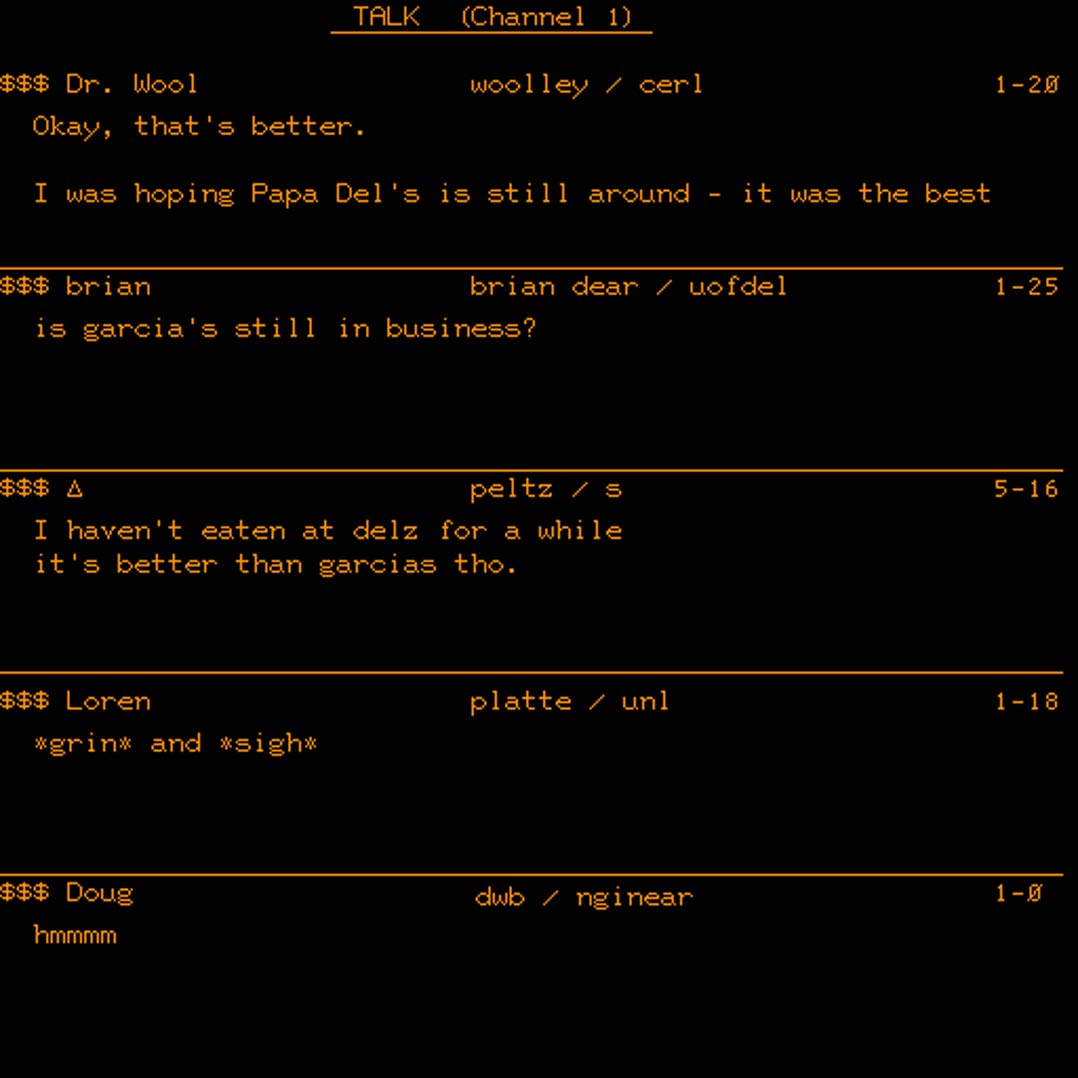
    Talkomatic on the Plato system. Image by Talkomatic co-developer David R Wooley

    Jabber, created in 2000, used open-source standards to overcome the interoperability problem. Jabber’s protocol was later standardised as Extensible Messaging and Presence Protocol (XMPP).

    Video chat was starting to gain traction by the early 2000s, with the launch of Skype in 2003 signifying an uptick in the sophistication of chat clients. But desktop computing was about to face a new challenger as cellphones would soon become powerful and sophisticated enough to run applications previously too compute intensive.

    By the mid-2000s, the mobile revolution was in full swing and an arms race was on between tech companies to build the chat application for the emerging mobile era. In South Africa, Mxit – cleverly engineered to run on basic feature phones – dominated the market for several years. But the device landscape was already changing quickly.

    BlackBerry’s rise was short-lived, as the smartphone revolution shifted the market dynamics again

    First, BlackBerry emerged as a hot-ticket item among South African consumers – a phenomenon that was replicated in a few markets around the world, including Indonesia. Demand soared as operators offered the uncapped BlackBerry Internet Service (BIS), making messaging using BlackBerry Messenger (BBM) virtually free.

    BlackBerry’s rise was short-lived, however, as the smartphone revolution – started in 2007 with the introduction of the first iPhone from Apple – shifted the market dynamics again.

    Ultimately, though, Apple wasn’t successful in capturing the global market with an IM tool of its own: rather, WhatsApp Messenger, later acquired by Facebook (now Meta), emerged from a crowded field as the most popular smartphone-based IM app in most countries, including South Africa.

    WhatsApp’s dominance

    WhatsApp brought with it a value proposition so compelling that it overcame any of the network effects that Mxit and BBM had amassed in the local market: a high-quality, asynchronous chat experience that was also cheap and accessible on any kind of device. A decision by the mobile operators to end the cheap BIS party also contributed to BBM’s demise.

    Today, WhatsApp still dominates in South Africa and many markets around the world – and nothing looks likely to knock it off its perch anytime soon. However, ICQ, BBM and even Mxit looked unstoppable at their peak, only to lose the interest of fickle users when something more compelling came along.  – © 2024 NewsCentral Media

    Read: How WhatsApp beat BBM and Mxit – and what comes next

    Follow TechCentral on Google News Add TechCentral as your preferred source on Google


    AIM BBM BlackBerry Facebook Messenger ICQ Meta Platforms Mirabilis MSN Messenger MXit Plato Talkomatic WeChat WhatsApp
    WhatsApp YouTube
    Share. Facebook Twitter LinkedIn WhatsApp Telegram Email Copy Link
    Previous ArticleTCS+ | Old Mutual’s Nomsa Lewisa on the future of work
    Next Article Post Office debacle shows ANC is out of ideas

    Related Posts

    Google poised to lose ad crown to Meta

    Google poised to lose ad crown to Meta

    14 April 2026
    Big Tech is going nuclear

    Big Tech is going nuclear

    10 April 2026
    Why Apple is sitting pretty - AI hype be damned

    Why Apple is sitting pretty – AI hype be damned

    8 April 2026
    Company News
    Fibre: the backbone of South Africa's digital health ecosystem - Mweb

    Fibre: the backbone of South Africa’s digital health ecosystem

    16 April 2026
    New man to accelerate wholesale connectivity in the DRC - Gaetan Soltesz, FAST Congo

    New man to accelerate wholesale connectivity in the DRC

    15 April 2026
    Avast Business and Avert IT Distribution rewrite the SMB cybersecurity playbook

    Avast Business and Avert IT Distribution rewrite the SMB cybersecurity playbook

    15 April 2026
    Opinion
    The conflict of interest at the heart of PayShap's slow adoption - Cheslyn Jacobs

    The conflict of interest at the heart of PayShap’s slow adoption

    26 March 2026
    South Africa's energy future hinges on getting wheeling right - Aishah Gire

    South Africa’s energy future hinges on getting wheeling right

    10 March 2026
    Hold the doom: the case for a South African comeback - Duncan McLeod

    Apple just dropped a bomb on the Windows world

    5 March 2026

    Subscribe to Updates

    Get the best South African technology news and analysis delivered to your e-mail inbox every morning.

    Latest Posts
    DStv drops premium paywall on Fifa World Cup in Canal+-era shift - SuperSport Rendani Ramovha

    DStv drops premium paywall on Fifa World Cup in Canal+-era shift

    17 April 2026
    How a connectivity levy became a tax on telecoms

    How a connectivity levy became a tax on telecoms

    17 April 2026
    Wits project pits African creators against AI music's blind spots

    Wits project pits African creators against AI music’s blind spots

    17 April 2026
    Prosus offloads 4.5% of Delivery Hero to Uber for €270-million

    Prosus offloads 4.5% of Delivery Hero to Uber for €270-million

    17 April 2026
    © 2009 - 2026 NewsCentral Media
    • Cookie policy (ZA)
    • TechCentral – privacy and Popia

    Type above and press Enter to search. Press Esc to cancel.

    Manage consent

    TechCentral uses cookies to enhance its offerings. Consenting to these technologies allows us to serve you better. Not consenting or withdrawing consent may adversely affect certain features and functions of the website.

    Functional Always active
    The technical storage or access is strictly necessary for the legitimate purpose of enabling the use of a specific service explicitly requested by the subscriber or user, or for the sole purpose of carrying out the transmission of a communication over an electronic communications network.
    Preferences
    The technical storage or access is necessary for the legitimate purpose of storing preferences that are not requested by the subscriber or user.
    Statistics
    The technical storage or access that is used exclusively for statistical purposes. The technical storage or access that is used exclusively for anonymous statistical purposes. Without a subpoena, voluntary compliance on the part of your Internet Service Provider, or additional records from a third party, information stored or retrieved for this purpose alone cannot usually be used to identify you.
    Marketing
    The technical storage or access is required to create user profiles to send advertising, or to track the user on a website or across several websites for similar marketing purposes.
    • Manage options
    • Manage services
    • Manage {vendor_count} vendors
    • Read more about these purposes
    View preferences
    • {title}
    • {title}
    • {title}