
Close Menu
TechCentralTechCentral

    Subscribe to the newsletter

    Get the best South African technology news and analysis delivered to your e-mail inbox every morning.

    Facebook X (Twitter) YouTube LinkedIn
    WhatsApp Facebook X (Twitter) LinkedIn YouTube
    TechCentralTechCentral
    • News
      Big Microsoft 365 price increases coming next year

      Big Microsoft price increases coming next year

      5 December 2025
      Vodacom to take control of Safaricom in R36-billion deal - Shameel Joosub

      Vodacom to take control of Safaricom in R36-billion deal

      4 December 2025
      Black Friday goes digital in South Africa as online spending surges to record high

      Black Friday goes digital in South Africa as online spending surges to record high

      4 December 2025
      BYD takes direct aim at Toyota with launch of sub-R500 000 Sealion 5 PHEV

      BYD takes direct aim at Toyota with launch of sub-R500 000 Sealion 5 PHEV

      4 December 2025
      'Get it now': Takealot in new instant deliveries pilot

      ‘Get it now’: Takealot in new instant deliveries pilot

      4 December 2025
    • World
      Amazon and Google launch multi-cloud service for faster connectivity

      Amazon and Google launch multi-cloud service for faster connectivity

      1 December 2025
      Google makes final court plea to stop US breakup

      Google makes final court plea to stop US breakup

      21 November 2025
      Bezos unveils monster rocket: New Glenn 9x4 set to dwarf Saturn V

      Bezos unveils monster rocket: New Glenn 9×4 set to dwarf Saturn V

      21 November 2025
      Tech shares turbocharged by Nvidia's stellar earnings

      Tech shares turbocharged by stellar Nvidia earnings

      20 November 2025
      Config file blamed for Cloudflare meltdown that disrupted the web

      Config file blamed for Cloudflare meltdown that disrupted the web

      19 November 2025
    • In-depth
      Jensen Huang Nvidia

      So, will China really win the AI race?

      14 November 2025
      Valve's Linux console takes aim at Microsoft's gaming empire

      Valve’s Linux console takes aim at Microsoft’s gaming empire

      13 November 2025
      iOCO's extraordinary comeback plan - Rhys Summerton

      iOCO’s extraordinary comeback plan

      28 October 2025
      Why smart glasses keep failing - no, it's not the tech - Mark Zuckerberg

      Why smart glasses keep failing – it’s not the tech

      19 October 2025
      BYD to blanket South Africa with megawatt-scale EV charging network - Stella Li

      BYD to blanket South Africa with megawatt-scale EV charging network

      16 October 2025
    • TCS
      TCS+ | How Cloud on Demand helps partners thrive in the AWS ecosystem - Odwa Ndyaluvane and Xenia Rhode

      TCS+ | How Cloud On Demand helps partners thrive in the AWS ecosystem

      4 December 2025
      TCS | MTN Group CEO Ralph Mupita on competition, AI and the future of mobile

      TCS | Ralph Mupita on competition, AI and the future of mobile

      28 November 2025
      TCS | Dominic Cull on fixing South Africa's ICT policy bottlenecks

      TCS | Dominic Cull on fixing South Africa’s ICT policy bottlenecks

      21 November 2025
      TCS | BMW CEO Peter van Binsbergen on the future of South Africa's automotive industry

      TCS | BMW CEO Peter van Binsbergen on the future of South Africa’s automotive industry

      6 November 2025
      TCS | Why Altron is building an AI factory - Bongani Andy Mabaso

      TCS | Why Altron is building an AI factory in Johannesburg

      28 October 2025
    • Opinion
      Your data, your hardware: the DIY AI revolution is coming - Duncan McLeod

      Your data, your hardware: the DIY AI revolution is coming

      20 November 2025
      Zero Carbon Charge founder Joubert Roux

      The energy revolution South Africa can’t afford to miss

      20 November 2025
      It's time for a new approach to government IT spend in South Africa - Richard Firth

      It’s time for a new approach to government IT spend in South Africa

      19 November 2025
      How South Africa's broken Rica system fuels murder and mayhem - Farhad Khan

      How South Africa’s broken Rica system fuels murder and mayhem

      10 November 2025
      South Africa's AI data centre boom risks overloading a fragile grid - Paul Colmer

      South Africa’s AI data centre boom risks overloading a fragile grid

      30 October 2025
    • Company Hubs
      • Africa Data Centres
      • AfriGIS
      • Altron Digital Business
      • Altron Document Solutions
      • Altron Group
      • Arctic Wolf
      • AvertITD
      • Braintree
      • CallMiner
      • CambriLearn
      • CYBER1 Solutions
      • Digicloud Africa
      • Digimune
      • Domains.co.za
      • ESET
      • Euphoria Telecom
      • Incredible Business
      • iONLINE
      • IQbusiness
      • Iris Network Systems
      • LSD Open
      • NEC XON
      • Netstar
      • Network Platforms
      • Next DLP
      • Ovations
      • Paracon
      • Paratus
      • Q-KON
      • SevenC
      • SkyWire
      • Solid8 Technologies
      • Telit Cinterion
      • Tenable
      • Vertiv
      • Videri Digital
      • Vodacom Business
      • Wipro
      • Workday
      • XLink
    • Sections
      • AI and machine learning
      • Banking
      • Broadcasting and Media
      • Cloud services
      • Contact centres and CX
      • Cryptocurrencies
      • Education and skills
      • Electronics and hardware
      • Energy and sustainability
      • Enterprise software
      • Financial services
      • Information security
      • Internet and connectivity
      • Internet of Things
      • Investment
      • IT services
      • Lifestyle
      • Motoring
      • Public sector
      • Retail and e-commerce
      • Satellite communications
      • Science
      • SMEs and start-ups
      • Social media
      • Talent and leadership
      • Telecoms
    • Events
    • Advertise
    TechCentralTechCentral
    Home » Editor's pick » Talk takes over typing

    Talk takes over typing

    By The Conversation16 January 2015
    Twitter LinkedIn Facebook WhatsApp Email Telegram Copy Link
    News Alerts
    WhatsApp

    siri-640

    With the recent acquisition by Facebook of voice-recognition company Wit.ai, all four major players in the post-PC market — Apple, Google, Microsoft and Facebook — now have a significant infrastructure for hands-free communication with your device.

    But what will that mean for our communication with our devices? Is voice just another method to talk to your computer, or are we on the cusp of a revolution in computer communication?

    The humble computer mouse was created in the 1960s by engineer Doug Engelbart. The keyboard, through its ancestor the teleprinter, is even older, having been developed in the early 1900s by mechanical engineer Charles Krum and connected to a video display terminal that owes its ancestry to a device developed in the 1930s.

    Despite the age of these devices, they still remain the main input devices for your personal computer on your desk or laptop.

    Sure, they have more buttons, or more colours, or higher resolution, but the basic input mechanism for the average home computer is the same now as it was in 1984 when the Macintosh became the first commercially available computer to provide a graphical user interface and mouse and keyboard input.

    Even the multi-touch screen, made famous by the iPhone and other devices in 2007, could be considered a direct descendant of the mouse, simply moving control of the pointer from an indirect method on your desk to a more direct method on the screen.

    But perhaps that is all about to change, with voice recognition technology finally becoming important to the main players and other technology changing the way we interact with computers.

    Like the mouse and keyboard, voice recognition technology has been around for a number of years. Commercial voice recognition software has been available for computers since the early 1990s.

    But it was only with the advent of technologies such as Apple’s Siri and Google’s Voice Search around 2010 that voice recognition became part of many people’s lives.

    Through a natural language, context-aware interface that is always connected to the Internet, technologies such as Siri allow users to address a vast range of needs while skipping touching their device altogether. Instead, they rely on their voice to set timers, check the weather, find movie times and even query where to hide a body.

    In 2014, Microsoft introduced Cortana, a Siri-like competitor, meaning that all three leading smartphone platforms had voice recognition. Also in 2014, Apple introduced the “Hey Siri” feature in iOS 8, allowing users to “hail” a smartphone from across the room (as long as it’s plugged in) and ask it a question without touching any buttons at all.

    Finally, in 2012 Google released Google Now, an extension to Google Voice Search that provides users with contextual information prior to them requesting it, such as providing traffic information as you leave the office or a list of good restaurants to eat at when you arrive in a new town.

    And it’s widely rumoured that both Google and Apple have plans for voice-recognition technology in their television products as well.

    While these solutions sometimes have a way to go (John Malkovich surely remains the only person in history to get Siri to correctly interpret “Linguica”), they present a starkly different view from the mouse-keyboard combination of old.

    It surely won’t be long before users can have a standard conversation with their device, talking it through a problem rather than frantically tapping the on-screen keyboard or clicking the mouse.

    The revolution extends beyond our voice to other devices as well. It would appear that along with replacing old-fashioned input devices, output devices like the monitor are slowly being phased out.

    Earlier this year, before it acquired Wit.ai, Facebook made news for acquiring pioneering virtual reality company, Oculus VR for a staggering US$2,3bn. The major product of Oculus VR is the Oculus Rift, a virtual reality headset that immerses you fully in a 3D virtual experience.

    Using positional sensors, the Oculus Rift can track your head movements to allow you to look around the environment. The device is still in development. Given the cost of the development kit at around $330, it’s expected that the final product will retail for about $400, bringing virtual reality to the everyday consumer.

    Even if you don’t want full immersion, new output products are making it easier for us to step in and out of a digital world without needing a computer monitor.

    Google Glass, still in development but having been in beta for a number of years, provides a small display that you can view while wearing the glasses. Products such as the new Android Wear watches from Motorola and others, as well as the Pebble smartwatch and upcoming Apple Watch, provide us with small, customised views into the digital world.

    These can all put notifications, music control, sleep and activity monitoring and all the power of those voice-control systems literally at our fingertips, all without the need to use a full input or output device.
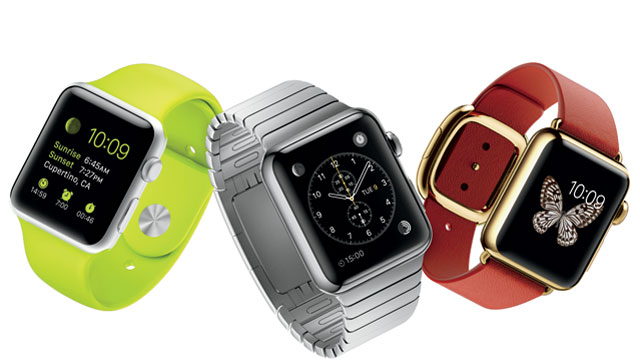
    The upcoming Apple Watch
    The upcoming Apple Watch

    Even in your car, Android Auto and Apple’s CarPlay provide a glanceable, touchscreen and voice-controlled interface to your smartphone to ensure you’re always connected to the cloud.

    Beyond these standard options, input devices and data-gathering devices are continuing to pop up in places that we don’t expect, making it easier to interact with your devices and control your digital world.

    At International CES this year, gadgets using Bluetooth Low Energy for communication with your home network abounded, from a smart chair that helps you work out to a pot for your plants that monitors their vitals and allows you to apply water with a touch of a button.

    These add to items from the last year such as the connected toothbrush that monitors your brushing time and style and reports on how you’re doing and the Vessyl cup, a smart cup that can tell you the calorie and caffeine content of your beverages as well as keep track of your daily water intake.

    No longer are we tied to our keyboard and mouse to look up and record this data. Our devices will now do it for us automatically and let us know when something needs to be changed.

    This trend towards the Internet of Things has been brewing for a number of years, but if CES is any indication, this year shows a real explosion in external input devices that collect data about us and feed it into the cloud.

    It could be argued that the new ways of communicating with your computer are already here, although just beginning.

    Perhaps it won’t be long before we are speaking to our device using natural language while wearing a VR headset and being instantly alerted about the status of our plants and how much activity, sleep and caffeine we’ve had so far today.

    With all of these solutions, perhaps finally the old mouse and keyboard are looking mighty old-fashioned.The Conversation

    • Michael Cowling is senior lecturer and discipline leader for mobile computing and applications at Central Queensland University
    • This article was originally published on The Conversation


    Apple Charles Krum Doug Engelbart Facebook Google Michael Cowling Siri
    Subscribe to TechCentral Subscribe to TechCentral
    Share. Facebook Twitter LinkedIn WhatsApp Telegram Email Copy Link
    Previous ArticleVodacom ‘reverse engineering’ Neotel deal
    Next Article Solar power to reach its zenith

    Related Posts

    What South Africans searched for most in 2025

    What South Africans searched for most in 2025, according to Google

    4 December 2025
    Samsung goes trifold while Apple folds its arms

    Samsung goes trifold while Apple folds its arms

    2 December 2025
    Samsung's first trifold smartphone is here

    Samsung’s first trifold smartphone is here

    2 December 2025
    Company News
    AI is not a technology problem - iqbusiness

    AI is not a technology problem – iqbusiness

    5 December 2025
    Telcos are sitting on a data gold mine - but few know what do with it - Phillip du Plessis

    Telcos are sitting on a data gold mine – but few know what do with it

    4 December 2025
    Unlock smarter computing with your surface Copilot+ PC

    Unlock smarter computing with your Surface Copilot+ PC

    4 December 2025
    Opinion
    Your data, your hardware: the DIY AI revolution is coming - Duncan McLeod

    Your data, your hardware: the DIY AI revolution is coming

    20 November 2025
    Zero Carbon Charge founder Joubert Roux

    The energy revolution South Africa can’t afford to miss

    20 November 2025
    It's time for a new approach to government IT spend in South Africa - Richard Firth

    It’s time for a new approach to government IT spend in South Africa

    19 November 2025

    Subscribe to Updates

    Get the best South African technology news and analysis delivered to your e-mail inbox every morning.

    Latest Posts
    Big Microsoft 365 price increases coming next year

    Big Microsoft price increases coming next year

    5 December 2025
    AI is not a technology problem - iqbusiness

    AI is not a technology problem – iqbusiness

    5 December 2025
    Vodacom to take control of Safaricom in R36-billion deal - Shameel Joosub

    Vodacom to take control of Safaricom in R36-billion deal

    4 December 2025
    Black Friday goes digital in South Africa as online spending surges to record high

    Black Friday goes digital in South Africa as online spending surges to record high

    4 December 2025
    © 2009 - 2025 NewsCentral Media
    • Cookie policy (ZA)
    • TechCentral – privacy and Popia

    Type above and press Enter to search. Press Esc to cancel.

    Manage consent

    TechCentral uses cookies to enhance its offerings. Consenting to these technologies allows us to serve you better. Not consenting or withdrawing consent may adversely affect certain features and functions of the website.

    Functional Always active
    The technical storage or access is strictly necessary for the legitimate purpose of enabling the use of a specific service explicitly requested by the subscriber or user, or for the sole purpose of carrying out the transmission of a communication over an electronic communications network.
    Preferences
    The technical storage or access is necessary for the legitimate purpose of storing preferences that are not requested by the subscriber or user.
    Statistics
    The technical storage or access that is used exclusively for statistical purposes. The technical storage or access that is used exclusively for anonymous statistical purposes. Without a subpoena, voluntary compliance on the part of your Internet Service Provider, or additional records from a third party, information stored or retrieved for this purpose alone cannot usually be used to identify you.
    Marketing
    The technical storage or access is required to create user profiles to send advertising, or to track the user on a website or across several websites for similar marketing purposes.
    • Manage options
    • Manage services
    • Manage {vendor_count} vendors
    • Read more about these purposes
    View preferences
    • {title}
    • {title}
    • {title}