
Close Menu
TechCentralTechCentral

    Subscribe to the newsletter

    Get the best South African technology news and analysis delivered to your e-mail inbox every morning.

    Facebook X (Twitter) YouTube LinkedIn
    WhatsApp Facebook X (Twitter) LinkedIn YouTube
    TechCentralTechCentral
    • News
      MultiChoice scraps annual DStv price hikes for 2026 - David Mignot

      MultiChoice scraps annual DStv price hike

      20 February 2026
      What Gen Z really thinks about the tech world it inherited - Tinashe Mazodze

      What Gen Z really thinks about the tech world it inherited

      20 February 2026
      Showmax 'can't continue' in its current form

      Showmax ‘can’t continue’ in its current form

      20 February 2026
      Free Market Foundation slams treasury's proposed gambling tax

      Free Market Foundation slams treasury’s proposed gambling tax

      20 February 2026
      South Africa's dynamic spectrum breakthrough - Paul Colmer

      South Africa’s dynamic spectrum breakthrough

      20 February 2026
    • World
      Prominent Southern African journalist targeted with Predator spyware

      Prominent Southern African journalist targeted with Predator spyware

      18 February 2026
      More drama in Warner Bros tug of war

      More drama in Warner Bros tug of war

      17 February 2026
      Russia bans WhatsApp

      Russia bans WhatsApp

      12 February 2026
      EU regulators take aim at WhatsApp

      EU regulators take aim at WhatsApp

      9 February 2026
      Musk hits brakes on Mars mission

      Musk hits brakes on Mars mission

      9 February 2026
    • In-depth
      How liberalisation is rewiring South Africa's power sector

      How liberalisation is rewiring South Africa’s power sector

      21 January 2026
      The top-performing South African tech shares of 2025

      The top-performing South African tech shares of 2025

      12 January 2026
      Digital authoritarianism grows as African states normalise internet blackouts

      Digital authoritarianism grows as African states normalise internet blackouts

      19 December 2025
      TechCentral's South African Newsmakers of 2025

      TechCentral’s South African Newsmakers of 2025

      18 December 2025
      Black Friday goes digital in South Africa as online spending surges to record high

      Black Friday goes digital in South Africa as online spending surges to record high

      4 December 2025
    • TCS
      Watts & Wheels S1E4: 'We drive an electric Uber'

      Watts & Wheels S1E4: ‘We drive an electric Uber’

      10 February 2026
      TCS+ | How Cloud On Demand is helping SA businesses succeed in the cloud - Xhenia Rhode, Dion Kalicharan

      TCS+ | Cloud On Demand and Consnet: inside a real-world AWS partner success story

      30 January 2026
      Watts & Wheels S1E4: 'We drive an electric Uber'

      Watts & Wheels S1E3: ‘BYD’s Corolla Cross challenger’

      30 January 2026
      Watts & Wheels S1E4: 'We drive an electric Uber'

      Watts & Wheels S1E2: ‘China attacks, BMW digs in, Toyota’s sublime supercar’

      23 January 2026

      TCS+ | Why cybersecurity is becoming a competitive advantage for SA businesses

      20 January 2026
    • Opinion
      A million reasons monopolies don't work - Duncan McLeod

      A million reasons monopolies don’t work

      10 February 2026
      The author, Business Leadership South Africa CEO Busi Mavuso

      Eskom unbundling U-turn threatens to undo hard-won electricity gains

      9 February 2026
      South Africa's skills advantage is being overlooked at home - Richard Firth

      South Africa’s skills advantage is being overlooked at home

      29 January 2026
      Why Elon Musk's Starlink is a 'hard no' for me - Songezo Zibi

      Why Elon Musk’s Starlink is a ‘hard no’ for me

      26 January 2026
      A million reasons monopolies don't work - Duncan McLeod

      South Africa’s new fibre broadband battle

      20 January 2026
    • Company Hubs
      • Africa Data Centres
      • AfriGIS
      • Altron Digital Business
      • Altron Document Solutions
      • Altron Group
      • Arctic Wolf
      • AvertITD
      • Braintree
      • CallMiner
      • CambriLearn
      • CYBER1 Solutions
      • Digicloud Africa
      • Digimune
      • Domains.co.za
      • ESET
      • Euphoria Telecom
      • Incredible Business
      • iONLINE
      • IQbusiness
      • Iris Network Systems
      • LSD Open
      • Mitel
      • NEC XON
      • Netstar
      • Network Platforms
      • Next DLP
      • Ovations
      • Paracon
      • Paratus
      • Q-KON
      • SevenC
      • SkyWire
      • Solid8 Technologies
      • Telit Cinterion
      • Tenable
      • Vertiv
      • Videri Digital
      • Vodacom Business
      • Wipro
      • Workday
      • XLink
    • Sections
      • AI and machine learning
      • Banking
      • Broadcasting and Media
      • Cloud services
      • Contact centres and CX
      • Cryptocurrencies
      • Education and skills
      • Electronics and hardware
      • Energy and sustainability
      • Enterprise software
      • Financial services
      • Information security
      • Internet and connectivity
      • Internet of Things
      • Investment
      • IT services
      • Lifestyle
      • Motoring
      • Public sector
      • Retail and e-commerce
      • Satellite communications
      • Science
      • SMEs and start-ups
      • Social media
      • Talent and leadership
      • Telecoms
    • Events
    • Advertise
    TechCentralTechCentral
    Home » In-depth » Telkom: the (very) good, not all bad and the ugly

    Telkom: the (very) good, not all bad and the ugly

    By Hilton Tarrant30 May 2018
    Twitter LinkedIn Facebook WhatsApp Email Telegram Copy Link
    News Alerts
    WhatsApp

    In November, at the half-year stage, I highlighted that Telkom was facing crises on a few fronts and that only one part of its business — mobile — was firing on all cylinders (read: Telkom: the good, bad and ugly).

    With full-year numbers available, certain trends are clearer. Some look better, while others have worsened.

    The very good

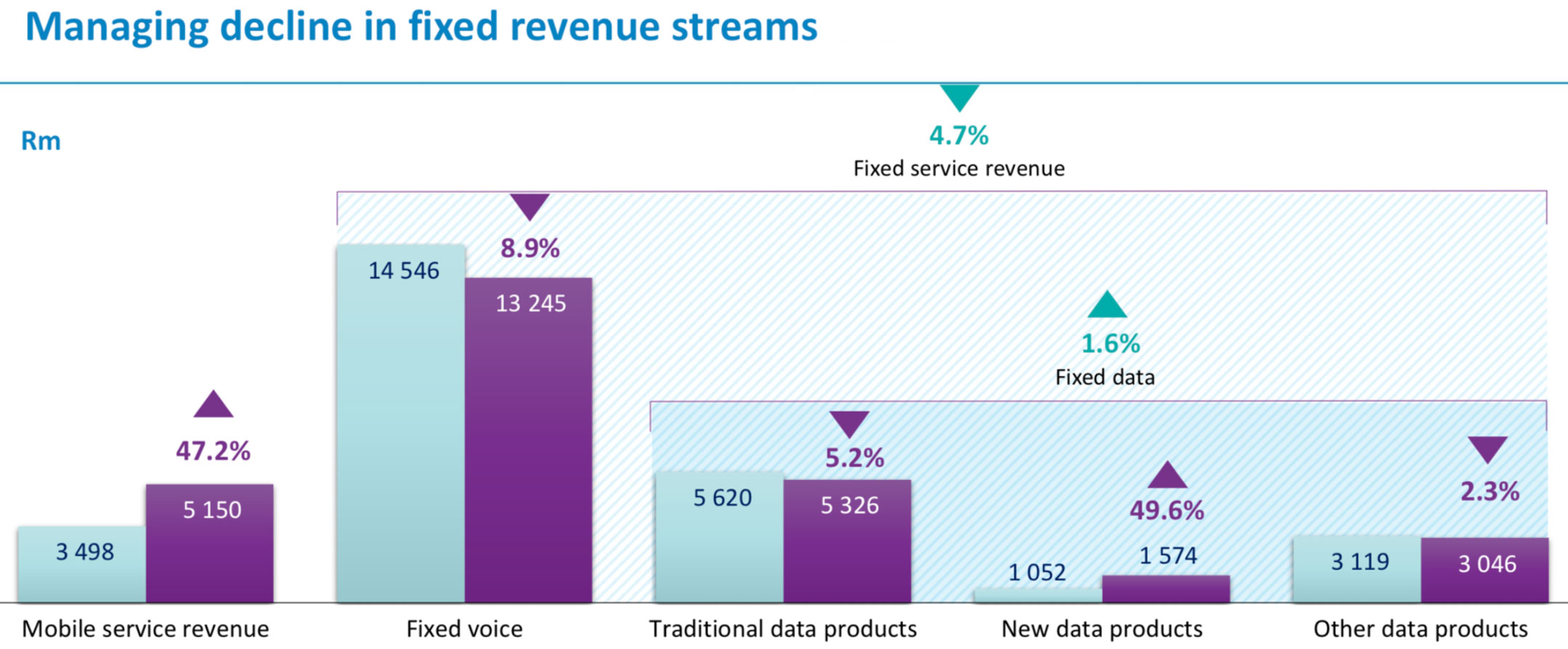
    Still good — actually great — is the performance from its mobile business. Service revenue — data and calls (excluding any device sales) — is up 47% to R5.1bn. This is nearly as much as it generates from so-called “traditional” fixed-line data products (read: ADSL). Importantly, the rate of growth is increasing year on year. Subscribers are up healthily, even though churn in the prepaid base remains stubbornly high, and mobile data is the engine of that growth. One way of looking at it is that Telkom has more mobile subscribers using data only (through dongles and routers) than it has ADSL subscribers (874 000 versus 865 000, respectively). Over half a million of these are high-speed LTE customers.
    Source: Telkom

    The not all bad

    The burning platform — transitioning ADSL customers to its own fibre services — is still on fire. It is making headway, but it is still losing DSL lines at a faster rate than it is connecting fibre lines to customers. In the year since April 2017, it lost 91 005 ADSL customers (excluding internal lines), but in that same period only added 69 696 fibre connections. For every 100 ADSL lines it lost last year, it only gained 77 fibre ones. This situation is exacerbated by the fact that, for now at least, ADSL customers are more profitable than fibre ones. The race to ensure that ADSL customers switch to its fibre network (instead of abandoning Telkom for other providers) is still on. While the “attachment” rate — connected customers out of the total number of passed homes — has improved to 30.7% (from 18% last year), it can improve further. It could be worse.

    The not bad…

    It is holding its own in its Internet service provider business, which provides bandwidth (or uncapped connectivity) to ADSL or fibre customers. In March 2016, only 53% of ADSL (including higher-speed VDSL) customers used Telkom as their ISP. With smarter and more aggressive bundling, the packages became far more compelling. By March 2017, that number was at 69%, which it has held as of March 2018. On the fibre side, it achieved a similar rate (27 000, or 68%) by March last year on a relatively small base of connectivity customers (about 40 000). That has dropped this year to 57% of its 109 336 active fibre lines.

    The ugly

    Fixed-line voice traffic continues its steep decline. In the 2018 financial year, Telkom carried 11% fewer voice minutes on its network than in the previous year. A drop from 13.6m to 12m minutes is significant. In just five years, this number has shrunk by a third, from 18.4m in 2013. But these lines are incredibly lucrative. Each fixed voice line generates average revenue of R361/month. While not a direct comparison, the average revenue per user (Arpu) for its mobile contract customers is just more than half of that (R191.90).

    Telkom has 2.68m fixed access lines, a drop of 9.3% year on year. The problem is that the rate of decline is increasing, not slowing.

    Continuing to manage the decline from traditional revenue to new technologies actively is critical. Telkom itself makes the point that margins in next-generation services are lower: “In some products and services, we need to grow volumes by 2x to 2.5x to compensate for the variance in pricing”.

    Beyond the easy cuts

    All the “easy” cuts have been made. Staff numbers in Telkom are far more realistic. A dogged focus on getting the mobile business to work is paying off. Imagine what this group would look like without a profitable and growing mobile unit!

    But the acquisition of BCX in 2015, which allowed Telkom to compete in the enterprise space, hasn’t yet delivered. Remember that without BCX, Telkom’s group revenue would be somewhere around half of what it is today (BCX reported operating revenue of R21bn of the R41bn total). BCX is of the scale to make a meaningful impact with even modest growth.

    Reversing Telkom’s enterprise business into BCX had the (unintended?) consequence of its public sector revenue dropping by R1.6bn in the past 12 months, mainly because of a drop in fixed-line voice subscriptions from government. Revenue from the large and medium enterprise segments grew by R600m. This means the core of BCX is healthy.

    A lot has been done since the acquisition, but because of the nature of its business, we’ll only start seeing the results of changes implemented in the past year or two in the next 12 months.

    Mobile cannot be Telkom’s only growth engine. Telkom has to get BCX growing.

    • This article was originally published on Moneyweb and is used here with permission

    Follow TechCentral on Google News Add TechCentral as your preferred source on Google


    BCX Telkom top
    WhatsApp YouTube
    Share. Facebook Twitter LinkedIn WhatsApp Telegram Email Copy Link
    Previous ArticleTelkom CIO Len de Villiers retires
    Next Article Big tech shows contempt for new privacy rules

    Related Posts

    Icasa gears up for South Africa's next big spectrum auction - Tshiamo Maluleka-Disemelo

    Icasa gears up for South Africa’s next big spectrum auction

    17 February 2026
    Telkom tops 25 million mobile subscribers as data growth surges - Serame Taukobong

    Telkom tops 25 million mobile subscribers as data growth surges

    16 February 2026
    BCX CEO Jonas Bogoshi to retire after seven years at the helm

    BCX CEO Jonas Bogoshi to retire after seven years at the helm

    16 February 2026
    Company News
    Service is everyone's problem now - and that's exactly why the Atlassian Service Collection matters

    Service is everyone’s problem now – why the Atlassian Service Collection matters

    20 February 2026
    Customers have new expectations. Is your CX ready? 1Stream

    Customers have new expectations. Is your CX ready?

    19 February 2026
    South Africa's cybersecurity challenge is not a tool problem - Nicholas Applewhite, Trinexia South Africa

    South Africa’s cybersecurity challenge is not a tool problem

    19 February 2026
    Opinion
    A million reasons monopolies don't work - Duncan McLeod

    A million reasons monopolies don’t work

    10 February 2026
    The author, Business Leadership South Africa CEO Busi Mavuso

    Eskom unbundling U-turn threatens to undo hard-won electricity gains

    9 February 2026
    South Africa's skills advantage is being overlooked at home - Richard Firth

    South Africa’s skills advantage is being overlooked at home

    29 January 2026

    Subscribe to Updates

    Get the best South African technology news and analysis delivered to your e-mail inbox every morning.

    Latest Posts
    MultiChoice scraps annual DStv price hikes for 2026 - David Mignot

    MultiChoice scraps annual DStv price hike

    20 February 2026
    What Gen Z really thinks about the tech world it inherited - Tinashe Mazodze

    What Gen Z really thinks about the tech world it inherited

    20 February 2026
    Showmax 'can't continue' in its current form

    Showmax ‘can’t continue’ in its current form

    20 February 2026
    Free Market Foundation slams treasury's proposed gambling tax

    Free Market Foundation slams treasury’s proposed gambling tax

    20 February 2026
    © 2009 - 2026 NewsCentral Media
    • Cookie policy (ZA)
    • TechCentral – privacy and Popia

    Type above and press Enter to search. Press Esc to cancel.

    Manage consent

    TechCentral uses cookies to enhance its offerings. Consenting to these technologies allows us to serve you better. Not consenting or withdrawing consent may adversely affect certain features and functions of the website.

    Functional Always active
    The technical storage or access is strictly necessary for the legitimate purpose of enabling the use of a specific service explicitly requested by the subscriber or user, or for the sole purpose of carrying out the transmission of a communication over an electronic communications network.
    Preferences
    The technical storage or access is necessary for the legitimate purpose of storing preferences that are not requested by the subscriber or user.
    Statistics
    The technical storage or access that is used exclusively for statistical purposes. The technical storage or access that is used exclusively for anonymous statistical purposes. Without a subpoena, voluntary compliance on the part of your Internet Service Provider, or additional records from a third party, information stored or retrieved for this purpose alone cannot usually be used to identify you.
    Marketing
    The technical storage or access is required to create user profiles to send advertising, or to track the user on a website or across several websites for similar marketing purposes.
    • Manage options
    • Manage services
    • Manage {vendor_count} vendors
    • Read more about these purposes
    View preferences
    • {title}
    • {title}
    • {title}