Close Menu
TechCentralTechCentral

    Subscribe to the newsletter

    Get the best South African technology news and analysis delivered to your e-mail inbox every morning.

    Facebook X (Twitter) YouTube LinkedIn
    WhatsApp Facebook X (Twitter) LinkedIn YouTube
    TechCentralTechCentral
    • News
      Schreiber suspends home affairs officials over fake AI references - Leon Schreiber

      Schreiber suspends home affairs officials over fake AI references

      30 April 2026
      South Africa headed to the polls in November

      South Africa headed to the polls in November

      30 April 2026
      Google humbles Big Tech's cloud heavyweights

      Google humbles Big Tech’s cloud heavyweights

      30 April 2026
      Logistics start-up Shiprazor pulls in R44-million seed round

      Logistics start-up Shiprazor pulls in R44-million seed round

      30 April 2026
      Why big IT projects in South Africa keep drifting off course

      Why big IT projects in South Africa keep drifting off course

      30 April 2026
    • World
      'It was my idea': Musk claims paternity of OpenAI - Elon Musk

      ‘It was my idea’: Musk claims paternity of OpenAI

      29 April 2026
      Pivotal week for US tech stocks

      Pivotal week for US tech stocks

      28 April 2026
      Worries over OpenAI's growth as Anthropic gains ground - Sam Altman. Shelby Tauber/Reuters

      Worries over OpenAI’s growth as Anthropic gains ground

      28 April 2026
      Taylor Swift trademarks her voice to fight AI fakes

      Taylor Swift trademarks her voice to fight AI fakes

      28 April 2026
      DeepSeek's long-awaited V4 model enters preview

      DeepSeek’s long-awaited V4 model enters preview

      24 April 2026
    • In-depth
      Alfa's electric rebel - Alfa Romeo Junior Elettrica Veloce

      Alfa’s electric rebel

      29 April 2026
      Africa switches on as Europe dims the lights

      Africa switches on as Europe dims the lights

      9 April 2026
      The biggest untapped EV market on Earth is hiding in plain sight

      The biggest untapped EV market on Earth is hiding in plain sight

      1 April 2026
      The R18-billion tech giant hiding in plain sight - Jens Montanana

      The R16-billion tech giant hiding in plain sight

      26 March 2026
      The last generation of coders

      The last generation of coders

      18 February 2026
    • TCS

      TCS+ | ‘The ISP for ISPs’: Vox’s shift to wholesale aggregator

      20 April 2026
      TCS | Werner Lindemann on how AI is rewriting the infosec rulebook

      TCS | Werner Lindemann on how AI is rewriting the infosec rulebook

      15 April 2026
      TCS | Donovan Marsh on AI and the future of filmmaking

      TCS | Donovan Marsh on AI and the future of filmmaking

      7 April 2026
      TCS+ | Vodacom Business moves to crack the SME tech gap - Andrew Fulton, Sannesh Beharie

      TCS+ | Vodacom Business moves to crack the SME tech gap

      7 April 2026
      TCS | MTN's Divysh Joshi on the strategy behind Pi - Divyesh Joshi

      TCS | MTN’s Divyesh Joshi on the strategy behind Pi

      1 April 2026
    • Opinion
      Free calls, dead voice and Shameel Joosub's Spanish ghost - Duncan McLeod

      Free calls, dead voice and Shameel Joosub’s Spanish ghost

      22 April 2026
      The conflict of interest at the heart of PayShap's slow adoption - Cheslyn Jacobs

      The conflict of interest at the heart of PayShap’s slow adoption

      26 March 2026
      South Africa's energy future hinges on getting wheeling right - Aishah Gire

      South Africa’s energy future hinges on getting wheeling right

      10 March 2026
      Free calls, dead voice and Shameel Joosub's Spanish ghost - Duncan McLeod

      Apple just dropped a bomb on the Windows world

      5 March 2026
      R230-million in the bag for Endeavor's third Harvest Fund - Alison Collier

      VC’s centre of gravity is shifting – and South Africa is in the frame

      3 March 2026
    • Company Hubs
      • 1Stream
      • Africa Data Centres
      • AfriGIS
      • Altron Digital Business
      • Altron Document Solutions
      • Altron Group
      • Arctic Wolf
      • Ascent Technology
      • AvertITD
      • BBD
      • Braintree
      • CallMiner
      • CambriLearn
      • Contactable
      • CYBER1 Solutions
      • Digicloud Africa
      • Digimune
      • Domains.co.za
      • ESET
      • Euphoria Telecom
      • HOSTAFRICA
      • Incredible Business
      • iONLINE
      • IQbusiness
      • Iris Network Systems
      • Kaspersky
      • LSD Open
      • Mitel
      • NEC XON
      • Netstar
      • Network Platforms
      • Next DLP
      • Ovations
      • Paracon
      • Paratus
      • Q-KON
      • SevenC
      • SkyWire
      • Solid8 Technologies
      • Telit Cinterion
      • Telviva
      • Tenable
      • Vertiv
      • Videri Digital
      • Vodacom Business
      • Wipro
      • Workday
      • XLink
    • Sections
      • AI and machine learning
      • Banking
      • Broadcasting and Media
      • Cloud services
      • Contact centres and CX
      • Cryptocurrencies
      • Education and skills
      • Electronics and hardware
      • Energy and sustainability
      • Enterprise software
      • Financial services
      • HealthTech
      • Information security
      • Internet and connectivity
      • Internet of Things
      • Investment
      • IT services
      • Lifestyle
      • Motoring
      • Policy and regulation
      • Public sector
      • Retail and e-commerce
      • Satellite communications
      • Science
      • SMEs and start-ups
      • Social media
      • Talent and leadership
      • Telecoms
    • Events
    • Advertise
    TechCentralTechCentral
    Home » In-depth » The 5 most Earth-like planets (so far)

    The 5 most Earth-like planets (so far)

    By The Conversation19 November 2015
    Twitter LinkedIn Facebook WhatsApp Email Telegram Copy Link
    News Alerts
    WhatsApp
    gliese-640
    Artist’s impression of sunset on Gliese one of the most Earth-like exoplanets. ESO/L. Calçada/wikimedia, CC BY-ND

    I’ve lost count of the number of times I’ve read that the “first Earth-like exoplanet” has been discovered. With nearly 2 000 exoplanets found to date, it is no wonder so many of them will resemble our planet in some way. But which exoplanets are similar enough to the Earth that they could actually be habitable?

    Many of the claims about the habitability of exoplanets are greatly exaggerated. The exoplanet GJ1132b was just announced by the MEarth project, as “arguably the most important planet ever found outside the solar system”. While it’s one of the nearest exoplanets yet discovered, it’s hardly Earth-like — situated close to its host star with a scalding surface temperature of several hundred degrees Celsius.

    Similarly, Tau Ceti e and Kepler 186f have both been touted as Earth twins, but there are other exoplanets out there that are rather more Earth-like.

    A good way to estimate how habitable a planet is is the Earth Similarity Index (ESI). This number is calculated from the exoplanet’s radius, density, surface temperature and escape velocity, which is the minimum speed needed to break free from the planet’s surface. For many exoplanets, we don’t have all these measurements, so some of them have to be estimated based on the best available information. The ESI ranges from 0 to 1 and anything with an ESI above 0,8 may be considered “Earth-like”. In our solar system, Mars scores 0,64 (the same as Kepler 186f), while Venus comes in at 0,78 (the same as Tau Ceti e).

    Here are the five top candidates for an Earth-twin, based on their ESI values.

    1. Kepler 438b
    Kepler 438b (ESI=0,88) has the highest ESI of any exoplanet known. Discovered in 2015 around a red dwarf star, significantly smaller and cooler than our sun, it has a radius only 12% larger than Earth’s. It orbits the star, which is 470 light years from Earth, every 35 days and is in its habitable zone, the region around a star which is neither too hot nor too cold for orbiting planets to support liquid water on the surface.

    As with other discoveries by Kepler around faint stars, the planet’s mass has not been measured, but if its composition is rocky, it may be only 1,4 times that of the Earth’s with a surface temperature between 0°C and 60°C. However, the ESI is not a fool-proof method for classifying the Earth-like nature of a planet. It has recently been found that Kepler 438b’s host star regularly sends out powerful flares of radiation, which may render the planet uninhabitable after all.

    2. Gliese 667Cc
    Gliese 667Cc (ESI=0.85) was discovered in 2011 orbiting a red dwarf in the Gliese 667 triple star system, just 24 light years away. It was found by the radial velocity method, which is a measure of the small movement a star makes as it responds to the gravitational tug of the planet. The planet’s mass has been estimated at 3,8 times the Earth’s, but we don’t know its size. This is because the planet does not pass in front of the star, which would allow us to measure the planet’s radius. With an orbital period of 28 days, it sits in the habitable zone of this cool star, with a possible surface temperature of around 5°C.

    3. Kepler 442b
    Kepler 442b(ESI=0,84) is a planet 1,3 times the size of the Earth discovered in 2015. It is orbiting a star cooler than the sun, about 1 100 light years away. Its orbital period of 112 days places it in its star’s habitable zone, but with a surface temperature that could be as low as -40°C. However, by comparison, the temperature on Mars can be -125°C near its poles in the winter. Once again, the exoplanet’s mass is not known, but if it has a rocky composition, it may be only 2,3 times the mass of the Earth.
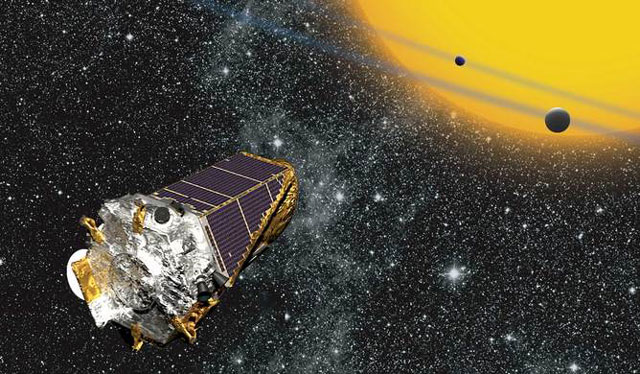
    Artist’s impression of Kepler as it looks at planets transiting distant stars. Nasa Ames/ W Stenzel/wikimedia
    Artist’s impression of Kepler as it looks at planets transiting distant stars. Nasa Ames/ W Stenzel/wikimedia

    4. Kepler 62e & 62f
    These two planets (ESI=0,83 & 0,67) were discovered in 2013 with the Kepler telescope, which spotted their transits in front of their host star. This star, located about 1 200 light years away from us, is somewhat cooler than the sun. With planetary radii of 1,6 and 1,4 times that of the Earth respectively, their orbital periods of 122 and 267 days mean that they both fall within the star’s habitable zone. As with many other planets discovered by Kepler, their masses have not been measured, but are estimated at over 30 times the mass of the Earth in each case. The temperatures of each could permit liquid water to exist on their surfaces, depending on their atmospheric composition.

    5. Kepler 452b
    Kepler 452b (ESI=0,83) was discovered in 2015 and was the first potentially Earth-like planet orbiting in the habitable zone of a star similar to our Sun. The planet’s radius is 1,6 times that of the Earth and it takes 385 days to orbit its star, which is 1 400 light years away. Because the star is too faint to measure its movement due to the gravitational tug by Kepler 452b, the planet’s mass is unknown. However, it has been predicted to be at least five times that of the Earth and the planet’s surface temperature is estimated between -20°C and +10°C.

    As we have seen, even the most Earth-like of these planets may not be able to support life due to the activity of its star, which can be very different to our sun. Others have a size or temperature that is slightly on the extreme side. But given the rate of exoplanet discovery, it is not impossible that we will detect a planet that truly has the same mass and size as the Earth and is in a similar orbit around a sun-like star in the next decade. If not, ESA’s Plato spacecraft, due for launch in 2024, will certainly have a good chance.The Conversation

    • Andrew Norton is professor of astrophysics education at The Open University
    • This article was originally published on The Conversation

    Follow TechCentral on Google News Add TechCentral as your preferred source on Google


    WhatsApp YouTube
    Share. Facebook Twitter LinkedIn WhatsApp Telegram Email Copy Link
    Previous ArticleGoogle Nexus 5X review: pure Android
    Next Article The hacktivists taking on Islamic State

    Related Posts

    Schreiber suspends home affairs officials over fake AI references - Leon Schreiber

    Schreiber suspends home affairs officials over fake AI references

    30 April 2026
    South Africa headed to the polls in November

    South Africa headed to the polls in November

    30 April 2026
    Google humbles Big Tech's cloud heavyweights

    Google humbles Big Tech’s cloud heavyweights

    30 April 2026
    Company News
    The breach is in the database - Ascent Technology Johan Lamberts

    The breach is in the database

    30 April 2026
    Hospitality sector embraces Google Workspace and Gemini to cut admin - Digicloud Africa, Rand Data Systems

    Hospitality sector embraces Google Workspace and Gemini to cut admin

    30 April 2026
    Paratus Mozambique powers 2026 Santa Maria fishing showdown

    Paratus Mozambique powers 2026 Santa Maria fishing showdown

    30 April 2026
    Opinion
    Free calls, dead voice and Shameel Joosub's Spanish ghost - Duncan McLeod

    Free calls, dead voice and Shameel Joosub’s Spanish ghost

    22 April 2026
    The conflict of interest at the heart of PayShap's slow adoption - Cheslyn Jacobs

    The conflict of interest at the heart of PayShap’s slow adoption

    26 March 2026
    South Africa's energy future hinges on getting wheeling right - Aishah Gire

    South Africa’s energy future hinges on getting wheeling right

    10 March 2026

    Subscribe to Updates

    Get the best South African technology news and analysis delivered to your e-mail inbox every morning.

    Latest Posts
    Schreiber suspends home affairs officials over fake AI references - Leon Schreiber

    Schreiber suspends home affairs officials over fake AI references

    30 April 2026
    South Africa headed to the polls in November

    South Africa headed to the polls in November

    30 April 2026
    Google humbles Big Tech's cloud heavyweights

    Google humbles Big Tech’s cloud heavyweights

    30 April 2026
    Logistics start-up Shiprazor pulls in R44-million seed round

    Logistics start-up Shiprazor pulls in R44-million seed round

    30 April 2026
    © 2009 - 2026 NewsCentral Media
    • Cookie policy (ZA)
    • TechCentral – privacy and Popia

    Type above and press Enter to search. Press Esc to cancel.

    Manage consent

    TechCentral uses cookies to enhance its offerings. Consenting to these technologies allows us to serve you better. Not consenting or withdrawing consent may adversely affect certain features and functions of the website.

    Functional Always active
    The technical storage or access is strictly necessary for the legitimate purpose of enabling the use of a specific service explicitly requested by the subscriber or user, or for the sole purpose of carrying out the transmission of a communication over an electronic communications network.
    Preferences
    The technical storage or access is necessary for the legitimate purpose of storing preferences that are not requested by the subscriber or user.
    Statistics
    The technical storage or access that is used exclusively for statistical purposes. The technical storage or access that is used exclusively for anonymous statistical purposes. Without a subpoena, voluntary compliance on the part of your Internet Service Provider, or additional records from a third party, information stored or retrieved for this purpose alone cannot usually be used to identify you.
    Marketing
    The technical storage or access is required to create user profiles to send advertising, or to track the user on a website or across several websites for similar marketing purposes.
    • Manage options
    • Manage services
    • Manage {vendor_count} vendors
    • Read more about these purposes
    View preferences
    • {title}
    • {title}
    • {title}