Close Menu
TechCentralTechCentral

    Subscribe to the newsletter

    Get the best South African technology news and analysis delivered to your e-mail inbox every morning.

    Facebook X (Twitter) YouTube LinkedIn
    WhatsApp Facebook X (Twitter) LinkedIn YouTube
    TechCentralTechCentral
    • News
      MultiChoice scraps annual DStv price hikes for 2026 - David Mignot

      MultiChoice scraps annual DStv price hike

      20 February 2026
      What Gen Z really thinks about the tech world it inherited - Tinashe Mazodze

      What Gen Z really thinks about the tech world it inherited

      20 February 2026
      Showmax 'can't continue' in its current form

      Showmax ‘can’t continue’ in its current form

      20 February 2026
      Free Market Foundation slams treasury's proposed gambling tax

      Free Market Foundation slams treasury’s proposed gambling tax

      20 February 2026
      South Africa's dynamic spectrum breakthrough - Paul Colmer

      South Africa’s dynamic spectrum breakthrough

      20 February 2026
    • World
      Prominent Southern African journalist targeted with Predator spyware

      Prominent Southern African journalist targeted with Predator spyware

      18 February 2026
      More drama in Warner Bros tug of war

      More drama in Warner Bros tug of war

      17 February 2026
      Russia bans WhatsApp

      Russia bans WhatsApp

      12 February 2026
      EU regulators take aim at WhatsApp

      EU regulators take aim at WhatsApp

      9 February 2026
      Musk hits brakes on Mars mission

      Musk hits brakes on Mars mission

      9 February 2026
    • In-depth
      How liberalisation is rewiring South Africa's power sector

      How liberalisation is rewiring South Africa’s power sector

      21 January 2026
      The top-performing South African tech shares of 2025

      The top-performing South African tech shares of 2025

      12 January 2026
      Digital authoritarianism grows as African states normalise internet blackouts

      Digital authoritarianism grows as African states normalise internet blackouts

      19 December 2025
      TechCentral's South African Newsmakers of 2025

      TechCentral’s South African Newsmakers of 2025

      18 December 2025
      Black Friday goes digital in South Africa as online spending surges to record high

      Black Friday goes digital in South Africa as online spending surges to record high

      4 December 2025
    • TCS
      Watts & Wheels S1E4: 'We drive an electric Uber'

      Watts & Wheels S1E4: ‘We drive an electric Uber’

      10 February 2026
      TCS+ | How Cloud On Demand is helping SA businesses succeed in the cloud - Xhenia Rhode, Dion Kalicharan

      TCS+ | Cloud On Demand and Consnet: inside a real-world AWS partner success story

      30 January 2026
      Watts & Wheels S1E4: 'We drive an electric Uber'

      Watts & Wheels S1E3: ‘BYD’s Corolla Cross challenger’

      30 January 2026
      Watts & Wheels S1E4: 'We drive an electric Uber'

      Watts & Wheels S1E2: ‘China attacks, BMW digs in, Toyota’s sublime supercar’

      23 January 2026

      TCS+ | Why cybersecurity is becoming a competitive advantage for SA businesses

      20 January 2026
    • Opinion
      A million reasons monopolies don't work - Duncan McLeod

      A million reasons monopolies don’t work

      10 February 2026
      The author, Business Leadership South Africa CEO Busi Mavuso

      Eskom unbundling U-turn threatens to undo hard-won electricity gains

      9 February 2026
      South Africa's skills advantage is being overlooked at home - Richard Firth

      South Africa’s skills advantage is being overlooked at home

      29 January 2026
      Why Elon Musk's Starlink is a 'hard no' for me - Songezo Zibi

      Why Elon Musk’s Starlink is a ‘hard no’ for me

      26 January 2026
      A million reasons monopolies don't work - Duncan McLeod

      South Africa’s new fibre broadband battle

      20 January 2026
    • Company Hubs
      • Africa Data Centres
      • AfriGIS
      • Altron Digital Business
      • Altron Document Solutions
      • Altron Group
      • Arctic Wolf
      • AvertITD
      • Braintree
      • CallMiner
      • CambriLearn
      • CYBER1 Solutions
      • Digicloud Africa
      • Digimune
      • Domains.co.za
      • ESET
      • Euphoria Telecom
      • Incredible Business
      • iONLINE
      • IQbusiness
      • Iris Network Systems
      • LSD Open
      • Mitel
      • NEC XON
      • Netstar
      • Network Platforms
      • Next DLP
      • Ovations
      • Paracon
      • Paratus
      • Q-KON
      • SevenC
      • SkyWire
      • Solid8 Technologies
      • Telit Cinterion
      • Tenable
      • Vertiv
      • Videri Digital
      • Vodacom Business
      • Wipro
      • Workday
      • XLink
    • Sections
      • AI and machine learning
      • Banking
      • Broadcasting and Media
      • Cloud services
      • Contact centres and CX
      • Cryptocurrencies
      • Education and skills
      • Electronics and hardware
      • Energy and sustainability
      • Enterprise software
      • Financial services
      • Information security
      • Internet and connectivity
      • Internet of Things
      • Investment
      • IT services
      • Lifestyle
      • Motoring
      • Public sector
      • Retail and e-commerce
      • Satellite communications
      • Science
      • SMEs and start-ups
      • Social media
      • Talent and leadership
      • Telecoms
    • Events
    • Advertise
    TechCentralTechCentral
    Home » Top » The Imitation Game: history, drama or myth?

    The Imitation Game: history, drama or myth?

    By The Conversation9 January 2015
    Twitter LinkedIn Facebook WhatsApp Email Telegram Copy Link
    News Alerts
    WhatsApp

    imitation-game-640-1

    The acclaimed new movie The Imitation Game is based on the too-short life of Alan Turing, the British mathematician and “father” of computer science. But how true-to-life is it and what can we learn from it?

    The movie concentrates on the code breaking work of Turing (played by Benedict Cumberbatch) at Bletchley Park in wartime Britain, with glances back to his schooldays in the 1920s and forward to the time leading up to his arrest for homosexuality in 1952.

    It makes brief references to Turing’s theoretical model of a computer — the universal Turing machine in 1936 — and his work on machine intelligence in 1950.

    The science in the movie is mainly about breaking the Enigma cypher used by Nazi Germany’s Enigma machines to encrypt their communications during World War 2.

    This cypher was widely held to be impregnable, although Polish cryptanalysts made breakthroughs before the war and designed machines to implement their methods.

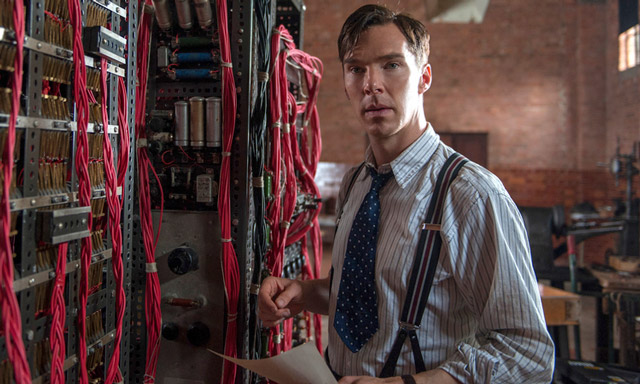
    Turing led the development of much more advanced machines. Each such machine — known as a Bombe — had 36 sets of three vertically aligned saucer-sized wheels, and each such triple representing a possible configuration of the three wheels that lie at the heart of an Enigma machine.

    These 36 triple-wheels corresponded to 36 consecutive positions in cyphertext. Along with a “crib” — a plaintext word or phrase that the message was likely to contain, and which could be tried at various positions in the text — this machine could narrow the search for the correct wheel configuration and often find it.

    The search was helped by a curious weakness of Enigma, which at first glance may seem like a strength: no plaintext letter was ever encyphered as itself.

    A much harder version of Enigma was introduced by the German navy. This was an urgent problem: German U-boat attacks on Allied shipping in the Atlantic were cutting Britain off from essential supplies. Turing worked on naval Enigma because no one else did — it was in the too-hard basket — and he cracked it.

    It is a stirring moment in the movie when the Bombe first operates. Wheels step around, some occasionally, some constantly, clicking and clacking, as the power of abstract mathematics is brought to the defence of Britain.

    The Imitation Game official trailer:

    The movie tells a good story and will build awareness of the significance of what Turing did at Bletchley Park. But it is very much a fictionalised account, and many details and personalities have been distorted or invented. The Alan Turing it presents is more mythical than historical.

    Turing was certainly eccentric and many found him difficult to work with. He generally avoided eye contact. Some have claimed that he probably had Asperger’s syndrome.

    I am not sure that it is as simple as that. Lyn Irvine (writer and wife of Turing’s mentor, Max Newman) wrote:

    But once he had looked directly and earnestly at his companion, in the confidence of friendly talk, his eyes could never again be missed. Such candour and comprehension looked from them, something so civilised that one hardly dared to breathe.

    Turing’s biographer Andrew Hodges wrote:

    More sensitive people at Bletchley were aware of layers of introspection and subtlety of manner that lay beneath the occasional funny stories.

    The movie makes the most of the Aspergers possibility, presenting such a caricature that viewers will confidently diagnose him (though the term itself is not used).

    The intention was noble — to celebrate Turing’s unusual nature, linking his non-ordinariness to his extraordinary achievements — and at times this message comes across very well.

    But it is a pity that they resorted to a stereotype to do it. Shouldn’t supporting diversity be about moving beyond stereotypes? Must people fit into some clearly labelled pigeonhole in order that we may bestow our tolerance upon them?

    The distortions
    For other historical characters, the distortions are often worse.

    The most striking case is the worldly Hugh Alexander (played by Matthew Goode), presented as a hot-headed quick-fisted cad at loggerheads with Turing. One wonders what his relatives and former colleagues make of this portrayal of him.

    Published recollections tell of a man with exceptional interpersonal and leadership skills, who inspired affection and loyalty from all around him and who was thrice honoured by the Queen for his service over his cryptanalytic career (OBE, CBE, CMG).

    He was better equipped to lead others than Turing, and became the unofficial head of Turing’s group some time before taking it over officially.

    The biography by Hodges mentions no animosity, and in fact Alexander was a character witness at Turing’s trial in 1952. Does his contribution not also merit respect and gratitude? Should others be put down, in order to lift Turing up?

    The cartoonish portrayal of military commander Alastair Denniston (played by Charles Dance) raises the same questions.

    Such stock characters make the film a Boy’s Own adventure. Historically, it was a Boy’s Own story in a more literal sense.

    Turing grew up mostly apart from his mother, had a brother and no sisters, went to a boys’ boarding school, attended the all-male King’s College in the University of Cambridge, worked in the male-dominated fields of mathematics and cryptanalysis, and was gay.

    Into this milieu comes mathematics graduate Joan Clarke (played by Keira Knightley). She was a cryptanalyst in Turing’s group, working on Enigma, though she was officially classified as a linguist because the job classifications at Bletchley Park did not allow for the possibility of a female cryptanalyst.

    She was not one of the major figures in Turing’s group (relatively speaking; in absolute terms, small contributions in this group were still major ones to the war effort).

    She and Turing became engaged, though he later broke it off because of his homosexuality. She does much better out of the transition to movie than most of the others, and becomes a key player. The story is more appealing for her presence, though she sometimes comes across as an immigrant from the future.

    Turing’s homosexuality is a significant theme, in the movie as in his life. He was arrested and convicted for it, and died of cyanide poisoning at his own hands two years later. He was 41.
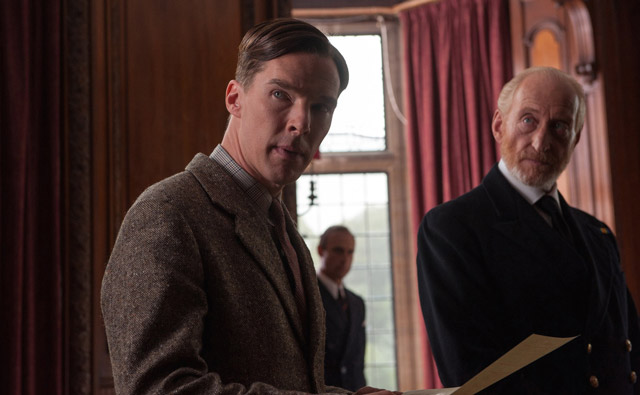
    Alan Turing (Benedict Cumberbatch, left) with Alastair Denniston (Charles Dance)
    Alan Turing (Benedict Cumberbatch, left) with Alastair Denniston (Charles Dance)

    An inquest found it to be suicide, and this is widely accepted today, including in this movie. A few — including his mother and Turing scholar Jack Copeland — have contested the suicide verdict, suggesting that his poisoning may have been a result of carelessness with chemical experiments he was conducting in his home.

    In any case, he was appallingly treated, and the movie adds to a surge of public recognition and appreciation of Turing, including then-British Prime Minister Gordon Brown’s apology in 2009, the Alan Turing Year 2012 and the pardon by the Queen in 2013.

    Hopefully, the movie will inspire audiences to learn more about Turing, rather than taking the movie itself as a history lesson and leaving it at that.

    The departures from history seem to me to be much more than the drama needs, and may contribute to the building of a myth. On one hand, the best myths transcend historical truth. On the other, given his reactions (scepticism, discomfort) to many of the less rational aspects of life, I doubt he would approve.

    So, how will The Imitation Game shape the image of Turing in the public mind? My forecast: more gratitude, and yet more misunderstanding.The Conversation

    • Graham Farr is professor in the faculty of IT at Monash University
    • This article was originally published on The Conversation

    Follow TechCentral on Google News Add TechCentral as your preferred source on Google


    Alan Turing Benedict Cumberbatch The Imitation Game The Imitation Game review
    WhatsApp YouTube
    Share. Facebook Twitter LinkedIn WhatsApp Telegram Email Copy Link
    Previous ArticleEskom 21 days from going broke
    Next Article No quick fix for Eskom mess

    Related Posts

    Automation: First, choose what not to do

    2 September 2021

    Doctor Strange: across the Marvel universe

    6 November 2016

    Could AI be mankind’s undoing?

    7 December 2014
    Company News
    Service is everyone's problem now - and that's exactly why the Atlassian Service Collection matters

    Service is everyone’s problem now – why the Atlassian Service Collection matters

    20 February 2026
    Customers have new expectations. Is your CX ready? 1Stream

    Customers have new expectations. Is your CX ready?

    19 February 2026
    South Africa's cybersecurity challenge is not a tool problem - Nicholas Applewhite, Trinexia South Africa

    South Africa’s cybersecurity challenge is not a tool problem

    19 February 2026
    Opinion
    A million reasons monopolies don't work - Duncan McLeod

    A million reasons monopolies don’t work

    10 February 2026
    The author, Business Leadership South Africa CEO Busi Mavuso

    Eskom unbundling U-turn threatens to undo hard-won electricity gains

    9 February 2026
    South Africa's skills advantage is being overlooked at home - Richard Firth

    South Africa’s skills advantage is being overlooked at home

    29 January 2026

    Subscribe to Updates

    Get the best South African technology news and analysis delivered to your e-mail inbox every morning.

    Latest Posts
    MultiChoice scraps annual DStv price hikes for 2026 - David Mignot

    MultiChoice scraps annual DStv price hike

    20 February 2026
    What Gen Z really thinks about the tech world it inherited - Tinashe Mazodze

    What Gen Z really thinks about the tech world it inherited

    20 February 2026
    Showmax 'can't continue' in its current form

    Showmax ‘can’t continue’ in its current form

    20 February 2026
    Free Market Foundation slams treasury's proposed gambling tax

    Free Market Foundation slams treasury’s proposed gambling tax

    20 February 2026
    © 2009 - 2026 NewsCentral Media
    • Cookie policy (ZA)
    • TechCentral – privacy and Popia

    Type above and press Enter to search. Press Esc to cancel.

    Manage consent

    TechCentral uses cookies to enhance its offerings. Consenting to these technologies allows us to serve you better. Not consenting or withdrawing consent may adversely affect certain features and functions of the website.

    Functional Always active
    The technical storage or access is strictly necessary for the legitimate purpose of enabling the use of a specific service explicitly requested by the subscriber or user, or for the sole purpose of carrying out the transmission of a communication over an electronic communications network.
    Preferences
    The technical storage or access is necessary for the legitimate purpose of storing preferences that are not requested by the subscriber or user.
    Statistics
    The technical storage or access that is used exclusively for statistical purposes. The technical storage or access that is used exclusively for anonymous statistical purposes. Without a subpoena, voluntary compliance on the part of your Internet Service Provider, or additional records from a third party, information stored or retrieved for this purpose alone cannot usually be used to identify you.
    Marketing
    The technical storage or access is required to create user profiles to send advertising, or to track the user on a website or across several websites for similar marketing purposes.
    • Manage options
    • Manage services
    • Manage {vendor_count} vendors
    • Read more about these purposes
    View preferences
    • {title}
    • {title}
    • {title}