

Close Menu
TechCentralTechCentral

    Subscribe to the newsletter

    Get the best South African technology news and analysis delivered to your e-mail inbox every morning.

    Facebook X (Twitter) YouTube LinkedIn
    WhatsApp Facebook X (Twitter) LinkedIn YouTube
    TechCentralTechCentral
    • News
      Big Microsoft 365 price increases coming next year

      Big Microsoft price increases coming next year

      5 December 2025
      Vodacom to take control of Safaricom in R36-billion deal - Shameel Joosub

      Vodacom to take control of Safaricom in R36-billion deal

      4 December 2025
      Black Friday goes digital in South Africa as online spending surges to record high

      Black Friday goes digital in South Africa as online spending surges to record high

      4 December 2025
      BYD takes direct aim at Toyota with launch of sub-R500 000 Sealion 5 PHEV

      BYD takes direct aim at Toyota with launch of sub-R500 000 Sealion 5 PHEV

      4 December 2025
      'Get it now': Takealot in new instant deliveries pilot

      ‘Get it now’: Takealot in new instant deliveries pilot

      4 December 2025
    • World
      Amazon and Google launch multi-cloud service for faster connectivity

      Amazon and Google launch multi-cloud service for faster connectivity

      1 December 2025
      Google makes final court plea to stop US breakup

      Google makes final court plea to stop US breakup

      21 November 2025
      Bezos unveils monster rocket: New Glenn 9x4 set to dwarf Saturn V

      Bezos unveils monster rocket: New Glenn 9×4 set to dwarf Saturn V

      21 November 2025
      Tech shares turbocharged by Nvidia's stellar earnings

      Tech shares turbocharged by stellar Nvidia earnings

      20 November 2025
      Config file blamed for Cloudflare meltdown that disrupted the web

      Config file blamed for Cloudflare meltdown that disrupted the web

      19 November 2025
    • In-depth
      Jensen Huang Nvidia

      So, will China really win the AI race?

      14 November 2025
      Valve's Linux console takes aim at Microsoft's gaming empire

      Valve’s Linux console takes aim at Microsoft’s gaming empire

      13 November 2025
      iOCO's extraordinary comeback plan - Rhys Summerton

      iOCO’s extraordinary comeback plan

      28 October 2025
      Why smart glasses keep failing - no, it's not the tech - Mark Zuckerberg

      Why smart glasses keep failing – it’s not the tech

      19 October 2025
      BYD to blanket South Africa with megawatt-scale EV charging network - Stella Li

      BYD to blanket South Africa with megawatt-scale EV charging network

      16 October 2025
    • TCS
      TCS+ | How Cloud on Demand helps partners thrive in the AWS ecosystem - Odwa Ndyaluvane and Xenia Rhode

      TCS+ | How Cloud On Demand helps partners thrive in the AWS ecosystem

      4 December 2025
      TCS | MTN Group CEO Ralph Mupita on competition, AI and the future of mobile

      TCS | Ralph Mupita on competition, AI and the future of mobile

      28 November 2025
      TCS | Dominic Cull on fixing South Africa's ICT policy bottlenecks

      TCS | Dominic Cull on fixing South Africa’s ICT policy bottlenecks

      21 November 2025
      TCS | BMW CEO Peter van Binsbergen on the future of South Africa's automotive industry

      TCS | BMW CEO Peter van Binsbergen on the future of South Africa’s automotive industry

      6 November 2025
      TCS | Why Altron is building an AI factory - Bongani Andy Mabaso

      TCS | Why Altron is building an AI factory in Johannesburg

      28 October 2025
    • Opinion
      Your data, your hardware: the DIY AI revolution is coming - Duncan McLeod

      Your data, your hardware: the DIY AI revolution is coming

      20 November 2025
      Zero Carbon Charge founder Joubert Roux

      The energy revolution South Africa can’t afford to miss

      20 November 2025
      It's time for a new approach to government IT spend in South Africa - Richard Firth

      It’s time for a new approach to government IT spend in South Africa

      19 November 2025
      How South Africa's broken Rica system fuels murder and mayhem - Farhad Khan

      How South Africa’s broken Rica system fuels murder and mayhem

      10 November 2025
      South Africa's AI data centre boom risks overloading a fragile grid - Paul Colmer

      South Africa’s AI data centre boom risks overloading a fragile grid

      30 October 2025
    • Company Hubs
      • Africa Data Centres
      • AfriGIS
      • Altron Digital Business
      • Altron Document Solutions
      • Altron Group
      • Arctic Wolf
      • AvertITD
      • Braintree
      • CallMiner
      • CambriLearn
      • CYBER1 Solutions
      • Digicloud Africa
      • Digimune
      • Domains.co.za
      • ESET
      • Euphoria Telecom
      • Incredible Business
      • iONLINE
      • IQbusiness
      • Iris Network Systems
      • LSD Open
      • NEC XON
      • Netstar
      • Network Platforms
      • Next DLP
      • Ovations
      • Paracon
      • Paratus
      • Q-KON
      • SevenC
      • SkyWire
      • Solid8 Technologies
      • Telit Cinterion
      • Tenable
      • Vertiv
      • Videri Digital
      • Vodacom Business
      • Wipro
      • Workday
      • XLink
    • Sections
      • AI and machine learning
      • Banking
      • Broadcasting and Media
      • Cloud services
      • Contact centres and CX
      • Cryptocurrencies
      • Education and skills
      • Electronics and hardware
      • Energy and sustainability
      • Enterprise software
      • Financial services
      • Information security
      • Internet and connectivity
      • Internet of Things
      • Investment
      • IT services
      • Lifestyle
      • Motoring
      • Public sector
      • Retail and e-commerce
      • Satellite communications
      • Science
      • SMEs and start-ups
      • Social media
      • Talent and leadership
      • Telecoms
    • Events
    • Advertise
    TechCentralTechCentral
    Home » Sections » Internet and connectivity » Undersea cables: the unseen backbone of the global internet

    Undersea cables: the unseen backbone of the global internet

    Have you ever wondered how an e-mail sent from New York arrives in Cape Town in mere seconds?
    By The Conversation3 April 2024
    Twitter LinkedIn Facebook WhatsApp Email Telegram Copy Link
    News Alerts
    WhatsApp
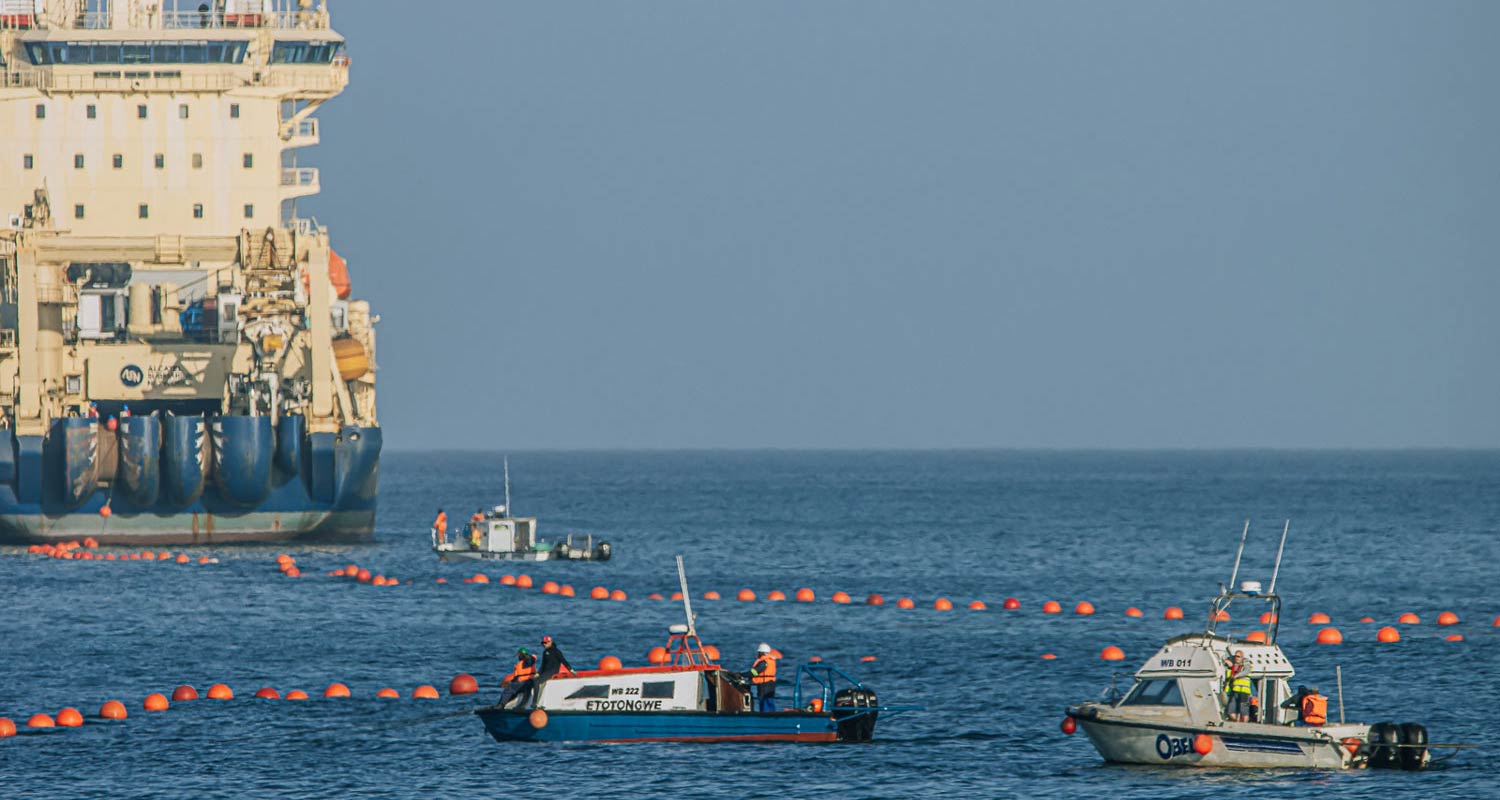
    Google’s high-capacity Equiano communications cable being brought ashore in Namibia recently. Image: Desert Pearl Photography via Paratus Group

    Have you ever wondered how an e-mail sent from New York arrives in Cape Town in mere seconds, or how you can video chat with someone on the other side of the globe with barely a hint of delay?

    Behind these everyday miracles lies an unseen, sprawling web of undersea cables, quietly powering the instant global communications that people have come to rely on.

    Undersea cables, also known as submarine communications cables, are fibre-optic cables laid on the ocean floor and used to transmit data between continents. These cables are the backbone of the global internet, carrying the bulk of international communications, including e-mail, web pages and video calls. More than 95% of all the data that moves around the world goes through these undersea cables.

    About 485 undersea cables totalling over 1.4 million kilometres sit on the the ocean floor

    These cables are capable of transmitting multiple terabits of data per second, offering the fastest and most reliable method of data transfer available today. A terabit per second is fast enough to transmit about a dozen two-hour, 4K HD movies in an instant. Just one of these cables can handle millions of people watching videos or sending messages simultaneously.

    About 485 undersea cables totalling over 1.4 million kilometres sit on the the ocean floor. These cables span the Atlantic and Pacific oceans, as well as strategic passages such as the Suez Canal and isolated areas within oceans.

    Each undersea cable contains multiple optical fibres, thin strands of glass or plastic that use light signals to carry vast amounts of data over long distances with minimal loss. The fibres are bundled and encased in protective layers designed to withstand the harsh undersea environment, including pressure, wear and potential damage from fishing activities or ship anchors. The cables are typically as wide as a garden hose.

    How they’re laid

    The process of laying undersea cables starts with thorough seabed surveys to chart a map in order to avoid natural hazards and minimise environmental impact. Following this step, cable-laying ships equipped with giant spools of fibre-optic cable navigate the predetermined route.

    As the ship moves, the cable is unspooled and carefully laid on the ocean floor. The cable is sometimes buried in seabed sediments in shallow waters for protection against fishing activities, anchors and natural events. In deeper areas, the cables are laid directly on the seabed.

    Along the route, repeaters are installed at intervals to amplify the optical signal and ensure data can travel long distances without degradation. This entire process can take months or even years, depending on the length and complexity of the cable route.

    Read: What felled Microsoft services in SA when subsea cables broke

    Each year, an estimated 100 to 150 undersea cables are cut, primarily accidentally by fishing equipment or anchors. However, the potential for sabotage, particularly by nation states, is a growing concern. These cables, crucial for global connectivity and owned by consortia of internet and telecommunications companies, often lie in isolated but publicly known locations, making them easy targets for hostile actions.

    The vulnerability was highlighted by unexplained failures in multiple cables off the coast of West Africa on 14 March 2024, which led to significant internet disruptions affecting at least 10 nations. Several cable failures in the Baltic Sea in 2023 raised suspicions of sabotage.

    Ships like Orange Marine’s Sophie Germaine are sent out to repair cable breaks when they occur

    The strategic Red Sea corridor has emerged as a focal point for undersea cable threats. A notable incident involved the attack on the cargo ship Rubymar by Houthi rebels. The subsequent damage to undersea cables from the ship’s anchor not only disrupted a significant portion of internet traffic between Asia and Europe but also highlighted the complex interplay between geopolitical conflicts and the security of global internet infrastructure.

    Undersea cables are protected in several ways, starting with strategic route planning to avoid known hazards and areas of geopolitical tension. The cables are constructed with sturdy materials, including steel armour, to withstand harsh ocean conditions and accidental impacts.

    Beyond these measures, experts have proposed establishing “cable protection zones” to limit high-risk activities near cables. Some have suggested amending international laws around cables to deter foreign sabotage and developing treaties that would make such interference illegal.

    Read: How African ISPs routed around broken subsea cables

    The recent Red Sea incident shows that help for these connectivity challenges might lie above rather than below. After cables were compromised in the region, satellite operators used their networks to reroute internet traffic. Undersea cables are likely to continue carrying the vast majority of the world’s internet traffic for the foreseeable future, but a blended approach that uses both undersea cables and satellites could provide a measure of protection against cable cuts.The Conversation

    • The author, Robin Chataut, is assistant professor of cybersecurity and computer science, Quinnipiac University
    • This article is republished from The Conversation under a Creative Commons licence

    Get breaking news alerts from TechCentral on WhatsApp


    Robin Chataut
    Subscribe to TechCentral Subscribe to TechCentral
    Share. Facebook Twitter LinkedIn WhatsApp Telegram Email Copy Link
    Previous ArticleThe rapid rise of freelance tech workers in South Africa
    Next Article Microsoft claims breakthrough in quantum computing
    Company News
    AI is not a technology problem - iqbusiness

    AI is not a technology problem – iqbusiness

    5 December 2025
    Telcos are sitting on a data gold mine - but few know what do with it - Phillip du Plessis

    Telcos are sitting on a data gold mine – but few know what do with it

    4 December 2025
    Unlock smarter computing with your surface Copilot+ PC

    Unlock smarter computing with your Surface Copilot+ PC

    4 December 2025
    Opinion
    Your data, your hardware: the DIY AI revolution is coming - Duncan McLeod

    Your data, your hardware: the DIY AI revolution is coming

    20 November 2025
    Zero Carbon Charge founder Joubert Roux

    The energy revolution South Africa can’t afford to miss

    20 November 2025
    It's time for a new approach to government IT spend in South Africa - Richard Firth

    It’s time for a new approach to government IT spend in South Africa

    19 November 2025

    Subscribe to Updates

    Get the best South African technology news and analysis delivered to your e-mail inbox every morning.

    Latest Posts
    Big Microsoft 365 price increases coming next year

    Big Microsoft price increases coming next year

    5 December 2025
    AI is not a technology problem - iqbusiness

    AI is not a technology problem – iqbusiness

    5 December 2025
    Vodacom to take control of Safaricom in R36-billion deal - Shameel Joosub

    Vodacom to take control of Safaricom in R36-billion deal

    4 December 2025
    Black Friday goes digital in South Africa as online spending surges to record high

    Black Friday goes digital in South Africa as online spending surges to record high

    4 December 2025
    © 2009 - 2025 NewsCentral Media
    • Cookie policy (ZA)
    • TechCentral – privacy and Popia

    Type above and press Enter to search. Press Esc to cancel.

    Manage consent

    TechCentral uses cookies to enhance its offerings. Consenting to these technologies allows us to serve you better. Not consenting or withdrawing consent may adversely affect certain features and functions of the website.

    Functional Always active
    The technical storage or access is strictly necessary for the legitimate purpose of enabling the use of a specific service explicitly requested by the subscriber or user, or for the sole purpose of carrying out the transmission of a communication over an electronic communications network.
    Preferences
    The technical storage or access is necessary for the legitimate purpose of storing preferences that are not requested by the subscriber or user.
    Statistics
    The technical storage or access that is used exclusively for statistical purposes. The technical storage or access that is used exclusively for anonymous statistical purposes. Without a subpoena, voluntary compliance on the part of your Internet Service Provider, or additional records from a third party, information stored or retrieved for this purpose alone cannot usually be used to identify you.
    Marketing
    The technical storage or access is required to create user profiles to send advertising, or to track the user on a website or across several websites for similar marketing purposes.
    • Manage options
    • Manage services
    • Manage {vendor_count} vendors
    • Read more about these purposes
    View preferences
    • {title}
    • {title}
    • {title}