
Close Menu
TechCentralTechCentral

    Subscribe to the newsletter

    Get the best South African technology news and analysis delivered to your e-mail inbox every morning.

    Facebook X (Twitter) YouTube LinkedIn
    WhatsApp Facebook X (Twitter) LinkedIn YouTube
    TechCentralTechCentral
    • News
      South Africa is sleepwalking into another AI policy failure - Celeste Labuschagne

      South Africa is sleepwalking into another AI policy failure

      20 May 2026
      Eskom to go to market for 5.2GW of new nuclear within a year

      Eskom to go to market for 5.2GW of new nuclear within a year

      20 May 2026
      The Mythos hacking threat is looking overblown

      The Mythos hacking threat is looking overblown

      20 May 2026
      Inflation spikes higher - and the worst is still to come

      Inflation spikes higher – and the worst is still to come

      20 May 2026
      MTN to work with police to fight E Cape base station crime - Charles Molapisi MTN South Africa CEO

      MTN to turn its African towers into an AI inference grid

      20 May 2026
    • World
      Vatican confronts the age of artificial intelligence. Edgar Beltrán/The Pillar 

      Vatican confronts the age of artificial intelligence

      19 May 2026
      The walkout that could hit every laptop and AI server - Samsung

      The walkout that could hit every laptop and AI server

      18 May 2026
      Pop star sues Samsung for $15-million - Dua Lipa

      Pop star sues Samsung for $15-million

      11 May 2026
      OpenAI's new audio APIs aim for conversational voice agents

      OpenAI’s new audio APIs aim for conversational voice agents

      8 May 2026
      'It was my idea': Musk claims paternity of OpenAI - Elon Musk

      ‘It was my idea’: Musk claims paternity of OpenAI

      29 April 2026
    • In-depth
      Alfa's electric rebel - Alfa Romeo Junior Elettrica Veloce

      Alfa’s electric rebel

      29 April 2026
      Africa switches on as Europe dims the lights

      Africa switches on as Europe dims the lights

      9 April 2026
      The biggest untapped EV market on Earth is hiding in plain sight

      The biggest untapped EV market on Earth is hiding in plain sight

      1 April 2026
      Datatec is firing on all cylinders - Jens Montanana

      The R16-billion tech giant hiding in plain sight

      26 March 2026
      The last generation of coders

      The last generation of coders

      18 February 2026
    • TCS
      TCS+ | The Up&Up Group on the hidden cost of AI - Jason Harrison

      TCS+ | The Up&Up Group on the hidden cost of AI

      13 May 2026
      Michael Rossouw

      TCS+ | The retirement decision most South Africans get wrong

      6 May 2026
      TCS | The Cape Town start-up listening for TB with AI - Braden van Breda

      TCS | The Cape Town start-up listening for TB with AI

      4 May 2026

      TCS+ | ‘The ISP for ISPs’: Vox’s shift to wholesale aggregator

      20 April 2026
      TCS | Werner Lindemann on how AI is rewriting the infosec rulebook

      TCS | Werner Lindemann on how AI is rewriting the infosec rulebook

      15 April 2026
    • Opinion
      AI won't fix your culture - it will expose it - Jackie Kennedy

      AI won’t fix your culture – it will expose it

      19 May 2026
      Free calls, dead voice and Shameel Joosub's Spanish ghost - Duncan McLeod

      Free calls, dead voice and Shameel Joosub’s Spanish ghost

      22 April 2026
      The conflict of interest at the heart of PayShap's slow adoption - Cheslyn Jacobs

      The conflict of interest at the heart of PayShap’s slow adoption

      26 March 2026
      South Africa's energy future hinges on getting wheeling right - Aishah Gire

      South Africa’s energy future hinges on getting wheeling right

      10 March 2026
      Free calls, dead voice and Shameel Joosub's Spanish ghost - Duncan McLeod

      Apple just dropped a bomb on the Windows world

      5 March 2026
    • Company Hubs
      • 1Stream
      • Africa Data Centres
      • AfriGIS
      • Altron Digital Business
      • Altron Document Solutions
      • Altron Group
      • Arctic Wolf
      • Ascent Technology
      • AvertITD
      • BBD
      • Braintree
      • CallMiner
      • CambriLearn
      • CM Telecom
      • Contactable
      • CYBER1 Solutions
      • Digicloud Africa
      • Digimune
      • Domains.co.za
      • ESET
      • Euphoria Telecom
      • HOSTAFRICA
      • Incredible Business
      • iONLINE
      • IQbusiness
      • Iris Network Systems
      • Kaspersky
      • LSD Open
      • Mitel
      • NEC XON
      • Netstar
      • Network Platforms
      • Next DLP
      • Ovations
      • Paracon
      • Paratus
      • Q-KON
      • SevenC
      • SkyWire
      • Solid8 Technologies
      • Telit Cinterion
      • Telviva
      • Tenable
      • Vertiv
      • Videri Digital
      • Vodacom Business
      • Wipro
      • Workday
      • XLink
    • Sections
      • AI and machine learning
      • Banking
      • Broadcasting and Media
      • Cloud services
      • Contact centres and CX
      • Cryptocurrencies
      • Education and skills
      • Electronics and hardware
      • Energy and sustainability
      • Enterprise software
      • Financial services
      • HealthTech
      • Information security
      • Internet and connectivity
      • Internet of Things
      • Investment
      • IT services
      • Lifestyle
      • Motoring
      • Policy and regulation
      • Public sector
      • Retail and e-commerce
      • Satellite communications
      • Science
      • SMEs and start-ups
      • Social media
      • Talent and leadership
      • Telecoms
    • Events
    • Advertise
    TechCentralTechCentral
    Home » Sections » Internet and connectivity » Vodacom, Maziv deal rewrites South Africa’s open-access rulebook

    Vodacom, Maziv deal rewrites South Africa’s open-access rulebook

    South Africa’s fibre market is entering an "Open Access 2.0" era shaped by scale, behaviour and enforcement.
    By Björn Menden and Thomas Switala18 January 2026
    Twitter LinkedIn Facebook WhatsApp Email Telegram Copy Link
    News Alerts
    WhatsApp
    Vodacom, Maziv deal rewrites South Africa's open-access rulebook - Björn Menden and Thomas Switala
    The authors, Altman Solon’s Björn Menden and Switala Ventures’ Thomas Switala

    When the competition authorities last year finally approved Vodacom’s acquisition of a 30% stake in Maziv – the parent of Vumatel and Dark Fibre Africa – they quietly reshaped the rules of engagement for South Africa’s digital infrastructure market.

    For years, open access has been treated as a policy ideal: shared networks, used on fair and non-discriminatory terms, driving affordability and inclusion. In practice, the market that emerged was fragmented, capital-constrained and uneven. The Maziv decision signalled a pragmatic shift. It recognised that, under the right conditions, scale can enable rather than undermine open access, and that consolidation can serve inclusion rather than simply concentrate power.

    “Open Access 2.0” will not be defined by how many networks exist but by how they behave: who can use them, at what price, with which service levels and under what enforcement regime. The question now is whether regulators, investors and operators can turn this model into one that expands coverage, improves quality and sustains competition – or whether consolidation erodes contestability under the banner of openness.

    It is a structural signal that scale is no longer viewed as inherently incompatible with competition

    South Africa’s digital policy has long placed open access at its core, from SA Connect’s wholesale vision to the attempted Woan (wireless open-access network). The logic was straightforward: shared infrastructure would reduce duplication, lower costs and extend broadband more widely than parallel buildouts ever could.

    In practice, the fixed-line market evolved bottom-up through entrepreneurial fibre network operators such as Vumatel and DFA, which have passed and connected millions of homes and businesses and made fibre broadband a mainstream urban and suburban service. This success came with a structural trade-off. High-income suburbs often host multiple overlapping fibre networks, while many townships, secondary towns and rural areas remain underserved or entirely unserved as capital gravitates towards faster payback.

    Concentrated

    At the wholesale backbone and metro layer, the market is more concentrated. Maziv (via DFA) and Openserve anchor national fibre deployments to mobile towers, enterprises and residential areas, with regional and specialist players filling narrower niches. By late 2024, South Africa had around 6.4 million FTTH homes passed and 2.6 million connected, but only about 5.4 million of those passes were unique, underlining the degree of overbuild in attractive areas and the persistent gaps elsewhere¹.

    Globally, this trajectory is not unusual. In the EU39 region, FTTH/B coverage reached close to 70% of households by 2023², while penetration remained nearer 35%, illustrating that once supply exists, adoption and affordability become the binding constraints. South Africa faces a similar dual challenge: driving higher take-up in fibre-ready suburbs while finding viable models for low-income and low-density areas where the economics are far more fragile.

    TCS | Maziv CEO Dietlof Mare on Vumatel’s big roll-out plans

    Against this backdrop, the approval of Vodacom’s co-controlling stake in Maziv is more than a single transaction. It is a structural signal that scale is no longer viewed as inherently incompatible with competition. Regulators have accepted that large, well-regulated platforms may be better placed to sustain investment, extend coverage and support fibre-hungry use cases such as 5G backhaul and edge data centres.

    Maziv

    Crucially, the conditions attached to the deal go to the heart of open access. Non-discriminatory wholesale access, pricing oversight and mandated coverage in lower-income communities turn consolidation into a conditional privilege. Fewer, stronger networks are acceptable only if they remain genuinely open and use their balance sheets to push deeper into underserved areas. This reframes competition away from the number of networks towards enforceable wholesale behaviour.

    The deal also accelerates convergence. Vodacom now sits across national backhaul, metro rings, last-mile fibre and mobile access, creating opportunities for integrated fibre-wireless planning. At the same time, it raises the stakes for regulatory oversight as 5G and future technologies depend ever more heavily on robust, multi-tenant fibre infrastructure. The combined platform will set the benchmark against which future infrastructure deals – including any potential MTN/Telkom transaction – are judged.

    Future consolidation

    The Maziv transaction opens the door to a broader consolidation wave. Mid-tier fibre players may reassess their options in a market where scale has been legitimised, provided openness is preserved. National backbone operators are likely to play an anchoring role, while regional networks may seek mergers or partnerships simply to remain relevant.

    On the mobile side, consolidation has long been framed as strategically necessary. A future in which Vodacom/Maziv forms one axis and an MTN/Telkom combination emerges on the other is no longer unthinkable, with wholesale fibre platforms acting as critical swing players in how contestable the market remains.

    For policymakers and regulators, the debate shifts from whether consolidation should occur to how it is shaped. Mergers can reduce duplication, unlock synergies and enable more coherent national planning of fibre and 5G, but only if approvals are tied to time-bound obligations on coverage, wholesale pricing trajectories and service quality. Done well, inorganic growth becomes a tool to close investment gaps; done poorly, it entrenches market power and weakens open access in practice.

    Regulators are increasingly favouring fewer, stronger networks operating under clear wholesale obligations

    The emerging model reframes open access as a behavioural and contractual regime rather than a simple structural shorthand. True openness depends less on the number of networks and more on the consistency and enforceability of wholesale terms as capital intensity rises and only a few platforms can sustain national-scale investment.

    Regulators are increasingly favouring fewer, stronger networks operating under clear wholesale obligations over many small networks offering inconsistent or opaque access. Transparent reference offers, cost-based pricing tests and rigorous SLA monitoring are the mechanisms that prevent scale from turning into exclusion. In this context, large platforms can, in practice, deliver more meaningful openness than a fragmented field of localised monopolies.

    Coherent playbook

    A coherent playbook is required. Merger approvals, spectrum assignments and major infrastructure projects should be linked to measurable outcomes: additional homes passed in underserved municipalities, connected schools and clinics, and wholesale price ceilings for entry-level products. At the same time, policy must support mid-tier and regional operators through predictable access to national backbones, streamlined wayleaves and encouragement of wholesale-only models that can interoperate with larger platforms.

    The model carries real risks. Weakly designed or poorly enforced conditions could allow consolidation to harden into harmful concentration, with open-access commitments eroded through opaque pricing, unmonitored SLAs or subtle discrimination that smaller ISPs struggle to challenge.

    Read: Four years later, Vodacom and Maziv have sealed their deal

    Scale also has limits. Even efficient national fibre operators face difficulty justifying standalone investment in deep rural and sparsely populated areas. Without complementary instruments such as targeted subsidies, demand aggregation for public services and stronger incentives for infrastructure sharing, the rural economics problem will persist.

    Finally, convergence brings execution risk. Integrating networks, systems and operating models can absorb management attention that should instead focus on improving wholesale offers and service quality. If openness becomes a compliance afterthought, the promise of Open Access 2.0 will remain unrealised.
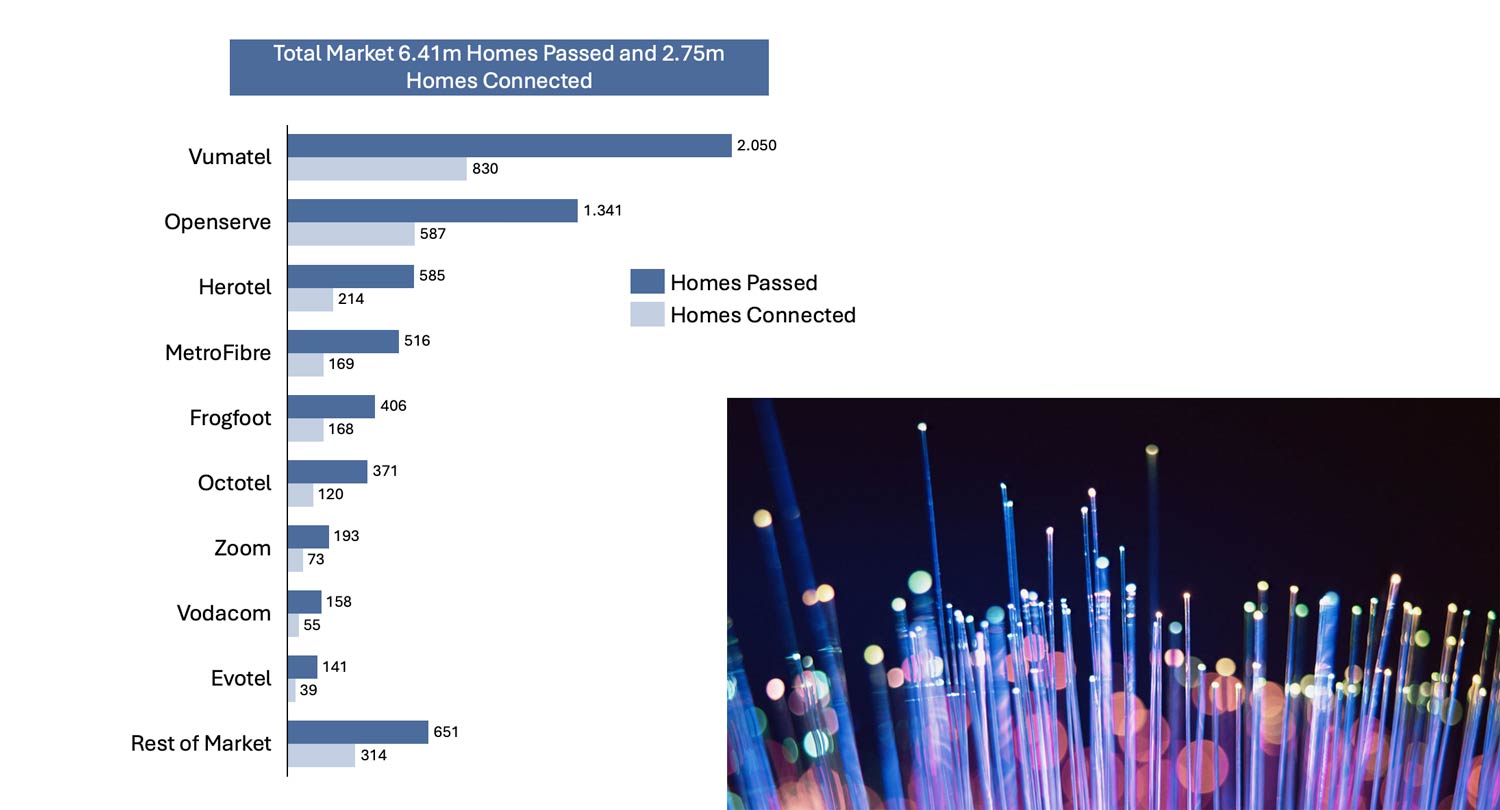
    Fibre network operators market share South Africa
    Source: Altman Solon

    The Maziv/Vodacom transaction marks a strategic inflection point for South Africa’s digital infrastructure. Open access is evolving from a fragmented, policy-driven aspiration into a scaled, market-enabled framework in which consolidation and competition can reinforce each other – but only if scale is carefully earned and tightly governed.

    Whether this becomes South Africa’s true Open Access 2.0 moment will depend on three factors: disciplined enforcement of wholesale obligations, alignment of investment incentives with universal service goals and the willingness to deploy additional instruments where commercial logic falls short. Handled well, scale, openness and innovation can become mutually reinforcing. Handled poorly, consolidation risks entrenching a more concentrated market that falls short of the country’s ambitions for universal, affordable connectivity.

    • The authors are Björn Menden, a partner at Altman Solon, based in Dubai, with a focus on telecoms and digital infrastructure across Africa and the Middle East, and Thomas Switala, managing partner at Switala Ventures, a boutique advisory focused on digital infrastructure and TMT M&A

    ¹ Remgro Capital Market Day, CIVH-Maziv, April 2025
    ² Omdia Fibre Index

    Get breaking news from TechCentral on WhatsApp. Sign up here.

    Follow TechCentral on Google News Add TechCentral as your preferred source on Google


    Björn Menden Dark Fibre Africa DFA Maziv Openserve SA Connect Vodacom Vumatel
    WhatsApp YouTube
    Share. Facebook Twitter LinkedIn WhatsApp Telegram Email Copy Link
    Previous ArticleElon Musk demands billions from OpenAI in explosive lawsuit
    Next Article New Planet Energy and Span Africa launch landmark solar project

    Related Posts

    Setback for Vodacom in Kenya - Shameel Joosub

    Setback for Vodacom in Kenya

    19 May 2026
    Telkom recovering after Cape storms disrupt network

    Telkom recovering after Cape storms disrupt network

    14 May 2026
    Joosub warns of 24 months of pain for phone buyers

    Joosub warns of 24 months of pain for phone buyers

    12 May 2026
    Company News
    Why online learning is the future of education - Mweb

    Why online learning is the future of education

    20 May 2026

    Best payment processing providers in Africa

    20 May 2026
    Network with industry leaders at Pan African DataCentres event

    Network with industry leaders at Pan African DataCentres event

    20 May 2026
    Opinion
    AI won't fix your culture - it will expose it - Jackie Kennedy

    AI won’t fix your culture – it will expose it

    19 May 2026
    Free calls, dead voice and Shameel Joosub's Spanish ghost - Duncan McLeod

    Free calls, dead voice and Shameel Joosub’s Spanish ghost

    22 April 2026
    The conflict of interest at the heart of PayShap's slow adoption - Cheslyn Jacobs

    The conflict of interest at the heart of PayShap’s slow adoption

    26 March 2026

    Subscribe to Updates

    Get the best South African technology news and analysis delivered to your e-mail inbox every morning.

    Latest Posts
    South Africa is sleepwalking into another AI policy failure - Celeste Labuschagne

    South Africa is sleepwalking into another AI policy failure

    20 May 2026
    Eskom to go to market for 5.2GW of new nuclear within a year

    Eskom to go to market for 5.2GW of new nuclear within a year

    20 May 2026
    The Mythos hacking threat is looking overblown

    The Mythos hacking threat is looking overblown

    20 May 2026
    Inflation spikes higher - and the worst is still to come

    Inflation spikes higher – and the worst is still to come

    20 May 2026
    © 2009 - 2026 NewsCentral Media
    • Cookie policy (ZA)
    • TechCentral – privacy and Popia

    Type above and press Enter to search. Press Esc to cancel.

    Manage consent

    TechCentral uses cookies to enhance its offerings. Consenting to these technologies allows us to serve you better. Not consenting or withdrawing consent may adversely affect certain features and functions of the website.

    Functional Always active
    The technical storage or access is strictly necessary for the legitimate purpose of enabling the use of a specific service explicitly requested by the subscriber or user, or for the sole purpose of carrying out the transmission of a communication over an electronic communications network.
    Preferences
    The technical storage or access is necessary for the legitimate purpose of storing preferences that are not requested by the subscriber or user.
    Statistics
    The technical storage or access that is used exclusively for statistical purposes. The technical storage or access that is used exclusively for anonymous statistical purposes. Without a subpoena, voluntary compliance on the part of your Internet Service Provider, or additional records from a third party, information stored or retrieved for this purpose alone cannot usually be used to identify you.
    Marketing
    The technical storage or access is required to create user profiles to send advertising, or to track the user on a website or across several websites for similar marketing purposes.
    • Manage options
    • Manage services
    • Manage {vendor_count} vendors
    • Read more about these purposes
    View preferences
    • {title}
    • {title}
    • {title}