Close Menu
TechCentralTechCentral

    Subscribe to the newsletter

    Get the best South African technology news and analysis delivered to your e-mail inbox every morning.

    Facebook X (Twitter) YouTube LinkedIn
    WhatsApp Facebook X (Twitter) LinkedIn YouTube
    TechCentralTechCentral
    • News
      Africa's most popular phones have a tracking problem

      Africa’s most popular phones have a tracking problem

      24 July 2026
      Vodacom taps UJ, AWS to build its AI talent pipeline - Vodacom Group CEO Shameel Joosub

      Vodacom taps UJ, AWS to build its AI talent pipeline

      24 July 2026
      Intel is back in the game - Intel CEO Lip-Bu Tan. Laure Andrillon/Reuters

      Intel is back in the game

      24 July 2026
      Fat bonuses at Telkom despite group missing own targets - Serame Taukobong

      Fat bonuses at Telkom despite group missing own targets

      23 July 2026
      Massive changes coming to Amazon Prime Video - Jeff Bezos

      Massive changes coming to Amazon Prime Video

      23 July 2026
    • World
      Meta AI will now tell parents if their teen is in crisis

      Meta AI will now tell parents if their teen is in crisis

      17 July 2026
      IBM shares crash 25% as AI upends software spending - Arvind Krishna

      IBM shares crash 25% as AI upends software spending

      15 July 2026
      Jony Ive's first OpenAI device: an AI smart speaker - Jony Ive and Sam Altman

      Jony Ive’s first OpenAI device: an AI smart speaker

      15 July 2026
      Stripe, Advent in talks to buy PayPal for $53-billion

      Stripe, Advent in talks to buy PayPal for $53-billion

      15 July 2026
      Memory crisis sends smartphone market into steep decline

      Memory crisis sends smartphone market into steep decline

      13 July 2026
    • In-depth
      The plan to stop AI from breaking the world - Google DeepMind CEO Demis Hassabis. Image: John Sears

      The plan to stop AI from breaking the world

      16 July 2026
      The internet has a Strait of Hormuz problem

      The internet has a Strait of Hormuz problem

      15 July 2026
      AI boom sparks rally, frenzy and fear

      AI boom sparks rally, frenzy and fear

      11 June 2026
      Every plug-in hybrid on sale in South Africa, ranked by price - Lamborghini Temerario

      Every plug-in hybrid on sale in South Africa, ranked by price

      7 June 2026
      What Wi-Fi 8 will mean for wireless networks

      What Wi-Fi 8 will mean for wireless networks

      1 June 2026
    • TCS
      TCS | How Optasia lends billions to people banks can't see - Salvador Anglada

      TCS | How Optasia lends billions to people banks can’t see

      23 July 2026
      The rands-and-cents case for electric trucks - William Kelly Watts & Wheels with Wills

      The rands-and-cents case for electric trucks

      20 July 2026
      Watts & Wheels S1E7: 'Ferrari's EV breaks the internet'

      Watts & Wheels S1E7: ‘Ferrari’s EV breaks the internet’

      8 July 2026
      TCS | Pick n Pay's Enrico Ferigolli on Penny, the AI that shops for you

      TCS | Pick n Pay’s Enrico Ferigolli on Penny, the AI that shops for you

      2 July 2026
      TCS+ | How Tracker is turning vehicle data into business strategy - Silvia Schollenberger

      TCS+ | How Tracker is turning vehicle data into business strategy

      1 July 2026
    • Opinion
      Selling vapour is corporate suicide in slow motion - Jannie van Zyl

      Selling vapour is corporate suicide in slow motion

      16 July 2026
      Brazil's online gambling crackdown is a lesson for South Africa

      How Amazon outmanoeuvred Starlink in South Africa

      15 July 2026
      The Popia problem with agentic AI - Herman Haasbroek

      The Popia problem with agentic AI

      14 July 2026
      The author, Fanie van Rooyen

      South Africa can still catch the AI wave – here’s how

      7 July 2026
      The author, Fanie van Rooyen

      The AI utopia South Africa can’t afford

      1 July 2026
    • Company Hubs
      • 1Stream
      • Africa Data Centres
      • AfriGIS
      • Altron Digital Business
      • Altron Document Solutions
      • Altron Group
      • Arctic Wolf
      • Ascent Technology
      • AvertITD
      • BBD
      • Braintree
      • CallMiner
      • CambriLearn
      • CM Telecom
      • Contactable
      • CYBER1 Solutions
      • Digicloud Africa
      • Digimune
      • Domains.co.za
      • ESET
      • Euphoria Telecom
      • HOSTAFRICA
      • Incredible Business
      • iONLINE
      • IQbusiness
      • Iris Network Systems
      • Kaspersky
      • LSD Open
      • Mitel
      • NEC XON
      • Netstar
      • Network Platforms
      • Next DLP
      • Ovations
      • Paracon
      • Paratus
      • Q-KON
      • SevenC
      • SkyWire
      • Solid8 Technologies
      • Telit Cinterion
      • Telviva
      • Tenable
      • Vertiv
      • Videri Digital
      • Vodacom Business
      • Vox
      • Wipro
      • Workday
      • XLink
    • Sections
      • AI and machine learning
      • Banking
      • Broadcasting and Media
      • Cloud services
      • Contact centres and CX
      • Cryptocurrencies
      • Education and skills
      • Electronics and hardware
      • Energy and sustainability
      • Enterprise software
      • Financial services
      • HealthTech
      • Information security
      • Internet and connectivity
      • Internet of Things
      • Investment
      • IT services
      • Lifestyle
      • Policy and regulation
      • Public sector
      • Retail and e-commerce
      • Satellite communications
      • Science
      • SMEs and start-ups
      • Social media
      • Talent and leadership
      • Telecoms
      • Watts & Wheels
    • Events
    • Advertise
    TechCentralTechCentral
    Home » Sections » Telecoms » Why voice-first communication matters more in the AI era

    Why voice-first communication matters more in the AI era

    Promoted | As AI reshapes how work gets done, voice is emerging as the most natural way for workers to engage.
    By Mitel6 July 2026
    Twitter LinkedIn Facebook WhatsApp Email Telegram Copy Link
    News Alerts
    WhatsApp

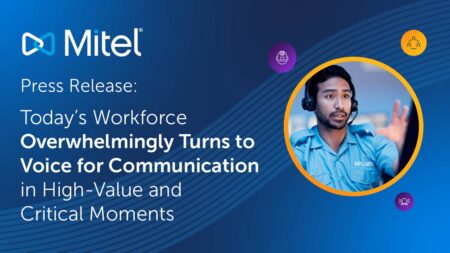
    Why voice-first communication matters more in the AI era - Mitel

    When workers need to act quickly, they continue to rely on voice-centric communications. Findings from Mitel’s recently released “State of Workforce Communication” report show that 79% of workers agree they prioritise voice communications to align quickly when an issue needs rapid action, before using messaging or video to follow up if needed.

    When asked which specific communication method they prefer for urgent or time-critical situations, voice remains the top choice across generations, ranging from 43% of Gen Z workers to 54% of baby boomers. This underscores the continued role of real-time communication in high-stakes work environments where delays can affect service, safety or operational performance.

    The research, conducted by Vanson Bourne on behalf of Mitel, surveyed IT decision makers, desk workers and frontline workers to better understand how workforce communication tools are performing across different roles and work environments.

    Voice is often the fastest, clearest and most trusted way to coordinate when work cannot wait

    That lens is especially important because eight in 10 (80%) workers globally operate in frontline roles, including employees across healthcare, manufacturing, retail, hospitality, financial services and the public sector, where communication gaps can have immediate and material consequences.

    As organisations modernise workplace technology and introduce more AI-enabled tools, the measure of progress should include whether those investments make communication easier in real-world environments, are optimised for the given workforce profile and drive the desired outcome at the point of activity.

    How complexity affects frontline workers

    Despite their central role in service delivery and operations, many frontline employees work in communication environments that were not built for field-based, mobile and time-sensitive work. In practice, that often means more places to look for information and a greater chance that messages get missed in the moments that matter most.

    Desk and frontline workers use an average of seven communication channels, creating a fragmented experience that can make it harder to find information, reach the right person or respond quickly. Among frontline workers, 65% say they waste time switching between multiple tools, while 64% say messages are missed because they are spread across different channels.

    These issues affect more than productivity. Mitel found that 70% of frontline workers say complex or unreliable communication tools make it harder to provide the best possible support to customers, patients or clients. More than a third say communication problems create safety risks for customers, patients or staff.

    phone calls

    “The future of workforce communication is not voice-only, but it must be voice-first in the moments where real-time coordination matters most,” said Martin Bitzinger, senior vice president of product management at Mitel. “For frontline and critical industry workers, voice is often the fastest, clearest and most trusted way to coordinate when work cannot wait. As organisations modernise and adopt AI, they cannot lose sight of creating a flexible communication infrastructure that supports employees, regardless of role or function, to complete tasks and drive outcomes.”

    Voice-first as an operational priority

    Healthcare is one of the clearest examples. In fast-moving clinical environments, workers need to coordinate quickly across care teams, locations and devices. Communication breakdowns can lead to delayed care at critical moments, prolonging the time a patient waits to be admitted or discharged and reducing a hospital’s capacity to serve the next patient in line.

    For healthcare leaders, these are not abstract risks. They translate directly into patient satisfaction, operational costs and safety outcomes. Mitel’s research found that healthcare is among the sectors where communication issues are most likely to create safety risks, and frontline healthcare workers report some of the most acute gaps in whether their needs are considered when communications technology and infrastructure decisions are made. These challenges also extend across other critical industries, including manufacturing, financial services, hospitality and retail.

    “In a crisis, the interface has to disappear. Voice does that,” said Zeus Kerravala, founder and principal analyst at ZK Research. “You don’t train a nurse or a dispatcher to navigate a UI under pressure – you give them a channel that works the moment they need it. That’s why voice remains the only modality that holds up when the stakes are real.”

    Voice as the natural AI interface

    With AI adoption increasing across the enterprise, voice is also emerging as the most natural and efficient way for workers to interact with technology. For frontline workers especially, a voice-first AI user interface can improve user adoption and productivity, reducing the time spent navigating menus, toggling between applications or typing messages.

    Evolving workplace technology strategies should not treat voice as a legacy channel or a fallback, but make it part of the modern communications strategy. This allows it to serve as the interface layer through which AI delivers its greatest value to the workers who need it most.

    “AI has the potential to dramatically impact those workers who have been most underserved by digital transformation, but we must meet them where they are,” said Luiz Domingos, CTO at Mitel. “Whether it is an emergency room nurse or a technician in the field, voice-first AI closes the gap in a way no previous technology has. We believe the app of the future, especially for frontline workers, isn’t a chat window or a dashboard – it’s a conversation.”

    Review the complete State of Workforce Communication report and findings here. To learn more about Mitel’s approach to workforce communications, visit the company’s website.

    Survey methodology

    The study was conducted by Vanson Bourne on behalf of Mitel and gathered insights from 2 000 respondents across five key markets: the US, Canada, Germany, the UK and France. Three respondent types were surveyed: IT decision makers, desk workers and frontline workers from organisations with 500 or more employees, working within a variety of key industries such as healthcare, manufacturing, financial services and the public sector.

    About Mitel
    A global market leader in business communications powering more than two billion business connections, Mitel helps businesses and service providers connect, collaborate and provide innovative services to their customers. Mitel’s innovation and communications experts serve business users in more than 100 countries. For more information, go to www.mitel.com and follow Mitel on LinkedIn.

    • Read more articles by Mitel on TechCentral
    • This promoted content was paid for by the party concerned

    Follow TechCentral on Google News Add TechCentral as your preferred source on Google


    Luiz Domingos Martin Bitzinger Mitel Zeus Kerravala
    WhatsApp YouTube
    Share. Facebook Twitter LinkedIn WhatsApp Telegram Email Copy Link
    Previous ArticleFriendship was the hard part of online school – until now
    Next Article Finding focus: a strategic approach to cybersecurity for SMBs

    Related Posts

    Mitel Workflow Studio wins global remote-work innovation award

    Mitel Workflow Studio wins global remote-work innovation award

    3 July 2026
    Mitel receives 2025 Enterprise Collaboration Product of the Year award

    Mitel receives 2025 Enterprise Collaboration Product of the Year award

    16 March 2026
    Mitel launches Edge platform for mission-critical on-premises communications

    Mitel launches Edge platform for mission-critical on-premises communications

    11 March 2026
    Add A Comment

    Comments are closed.

    Company News
    Why Europe is turning to South Africa for cross-border innovation - BBD Software

    Why Europe is turning to South Africa for cross-border innovation

    24 July 2026
    Green dashboards, stalled change: the CIO's blind spot - Change Logic Marchant van den Heever

    Green dashboards, stalled change: the CIO’s blind spot

    24 July 2026
    Why Africa's cloud needs more than one path - Africa Data Centres

    Why Africa’s cloud needs more than one path

    23 July 2026
    Opinion
    Selling vapour is corporate suicide in slow motion - Jannie van Zyl

    Selling vapour is corporate suicide in slow motion

    16 July 2026
    Brazil's online gambling crackdown is a lesson for South Africa

    How Amazon outmanoeuvred Starlink in South Africa

    15 July 2026
    The Popia problem with agentic AI - Herman Haasbroek

    The Popia problem with agentic AI

    14 July 2026

    Subscribe to Updates

    Get the best South African technology news and analysis delivered to your e-mail inbox every morning.

    Latest Posts
    Africa's most popular phones have a tracking problem

    Africa’s most popular phones have a tracking problem

    24 July 2026
    Vodacom taps UJ, AWS to build its AI talent pipeline - Vodacom Group CEO Shameel Joosub

    Vodacom taps UJ, AWS to build its AI talent pipeline

    24 July 2026
    Intel is back in the game - Intel CEO Lip-Bu Tan. Laure Andrillon/Reuters

    Intel is back in the game

    24 July 2026
    Why Europe is turning to South Africa for cross-border innovation - BBD Software

    Why Europe is turning to South Africa for cross-border innovation

    24 July 2026
    © 2009 - 2026 NewsCentral Media
    Built and maintained by Chronon
    • Cookie policy (ZA)
    • TechCentral – privacy and Popia

    Type above and press Enter to search. Press Esc to cancel.

    Manage consent

    TechCentral uses cookies to enhance its offerings. Consenting to these technologies allows us to serve you better. Not consenting or withdrawing consent may adversely affect certain features and functions of the website.

    Functional Always active
    The technical storage or access is strictly necessary for the legitimate purpose of enabling the use of a specific service explicitly requested by the subscriber or user, or for the sole purpose of carrying out the transmission of a communication over an electronic communications network.
    Preferences
    The technical storage or access is necessary for the legitimate purpose of storing preferences that are not requested by the subscriber or user.
    Statistics
    The technical storage or access that is used exclusively for statistical purposes. The technical storage or access that is used exclusively for anonymous statistical purposes. Without a subpoena, voluntary compliance on the part of your Internet Service Provider, or additional records from a third party, information stored or retrieved for this purpose alone cannot usually be used to identify you.
    Marketing
    The technical storage or access is required to create user profiles to send advertising, or to track the user on a website or across several websites for similar marketing purposes.
    • Manage options
    • Manage services
    • Manage {vendor_count} vendors
    • Read more about these purposes
    View preferences
    • {title}
    • {title}
    • {title}