
South Africa’s banks recorded two branch robberies in 2025. Not two a month – two for the entire year, down from eight in 2024, together yielding just R630 000. In the same 12 months, customers of the country’s biggest banks lodged claims worth R2.4-billion after being defrauded through digital channels.
A typical case starts with a call impersonating the bank or the police, warning that an account is at risk and that money must be moved to a so-called “safe account”, with the criminal staying on the line while the customer adds a beneficiary and approves the payment.
The striking contrast runs through the 2025 Annual Banking Crime Statistics published by the South African Banking Risk Information Centre (Sabric) this week. Almost every category of physical attack on banking infrastructure fell during the year, several steeply. The money, meanwhile, moved decisively to digital fraud – and most of that grew.
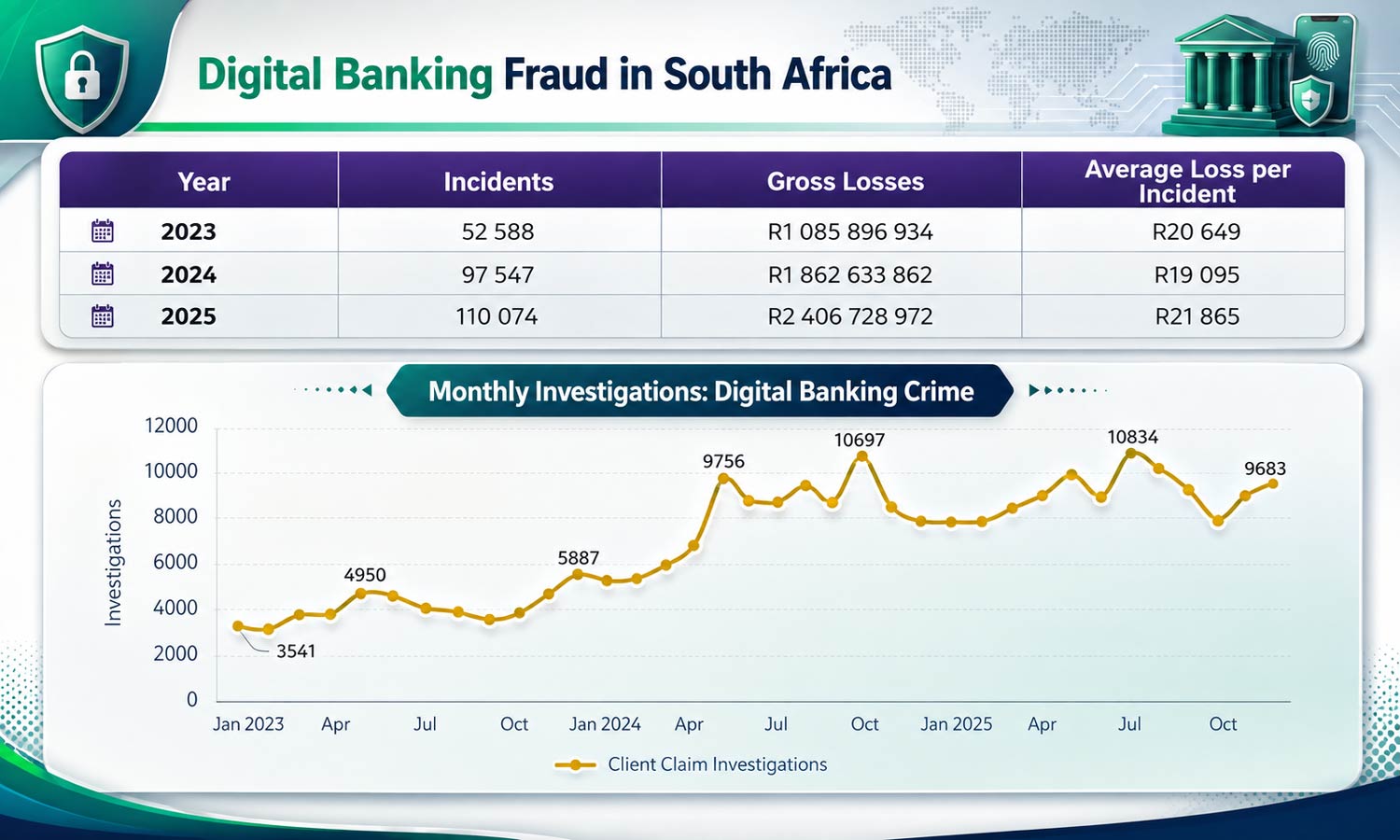
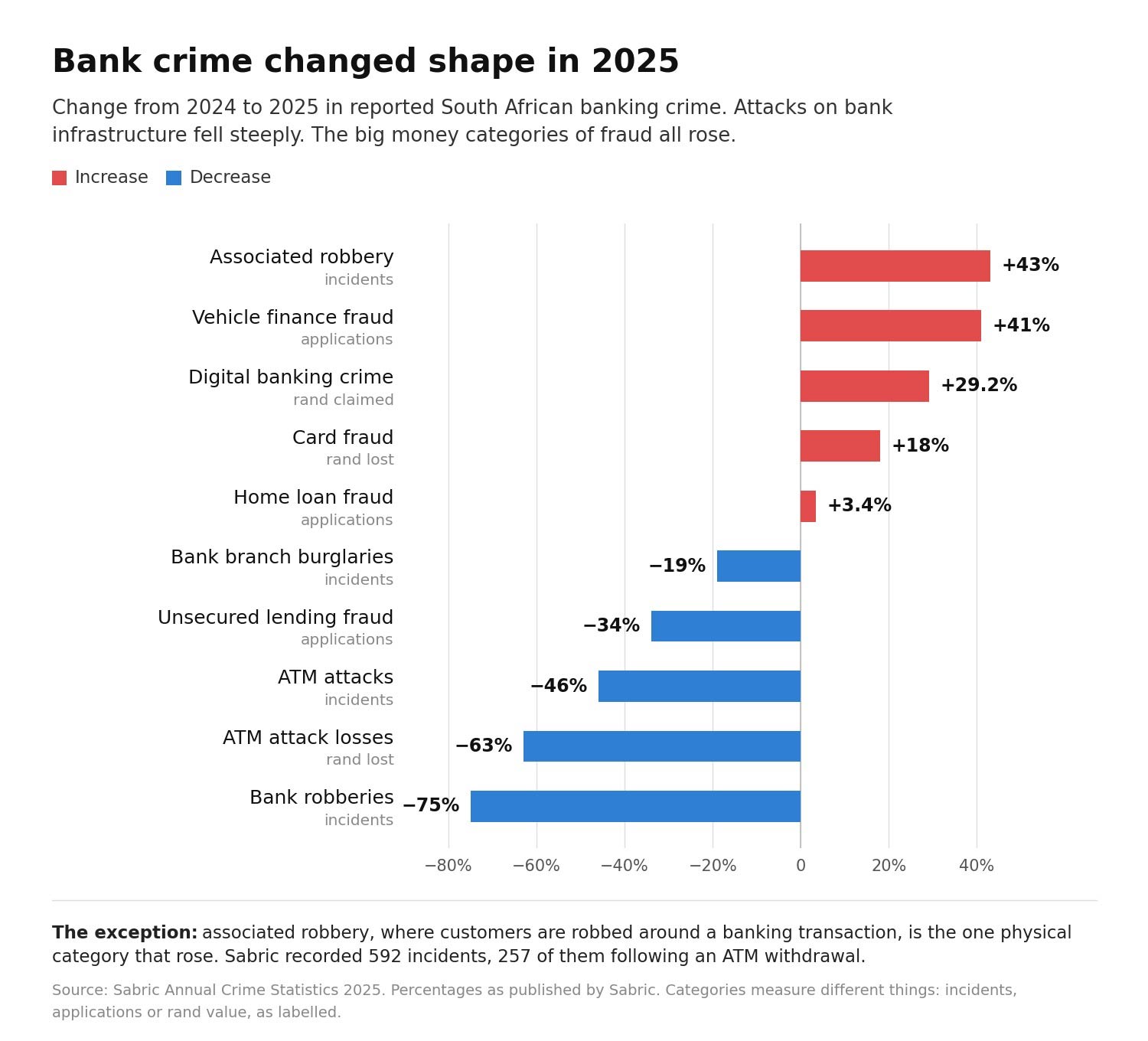
Digital banking crime was the report’s largest line. Client claims reached R2.4-billion across 110 074 investigations, up 29.2% on 2024’s R1.86-billion and more than double the R1.09-billion recorded in 2023. The average loss per case climbed to R21 865 from R19 095, so the money at stake grew far faster than case volumes, up 12.8%. Card fraud on South African-issued cards added R1.75-billion, up 18%, with domestic losses rising 43.3% to R857.5-million.
The physical side of the crime equation moved the other way. Reported ATM attacks fell 46% to 163 incidents, with cash losses down 63% to R10.2-million. Attacks using explosives, the signature method of South African ATM gangs, fell 58% from 254 incidents to 107. In Gauteng, long the epicentre, attacks dropped from 201 to 61 and reported losses from R20.7-million to R2.6-million.
Enforcement
Sabric credits enforcement rather than any change of heart among criminals, singling out Project Big Bang for the identification and arrest of nearly 50 suspects, alongside roller shutter doors, ATM cages and hotspot monitoring in Soweto, Ekurhuleni and high-risk service station sites.
Branch burglaries fell from 27 incidents to 22, though losses rose 52% to R2.2-million as the surviving attacks turned more deliberate, involving underground tunnelling, wall breaches and cutting into ATMs and safes. It extends a trend TechCentral has tracked from the rise in ATM bombings to last year’s finding that cybercriminals were cashing in as attacks fell away.
Read: The AI fraud crisis your bank is not ready for
Banking apps accounted for 97 555 of the 110 074 digital banking investigations, 88.6% of cases and 70.5% of claim value. Computer-based internet banking produced just 9 354 cases but 28.6% of the value, roughly R73 600 a case against about R17 400 for app incidents, a gap Sabric ties to large once-off, supplier and business payments.
Mobile banking carried under 1% of value but the highest number of Sim-swap indicators – a risk TechCentral has reported on extensively – though the report notes Sim-swap activity was less common than in earlier years.
Sabric says this is not evidence of banking systems being breached. “In many cases, the fraud began outside the banking platform, when criminals impersonated trusted organisations, created urgency or guided customers through transactions in real time.”
The app is simply where the transfer is authorised once the customer has been deceived. It is also a point Entersekt fraud analyst Nishan Maharaj argued in a recent piece for TechCentral.
Physical risk to the customer
Unfortunately, the one physical category that grew involves targeting people, not machines. “Associated robbery”, Sabric’s term for robberies committed around a banking transaction, rose 43% from 414 incidents to 592, though the cash taken fell 22% to R6.2-million. Robberies after an ATM withdrawal rose from 154 to 257. Money bomb incidents, where a planted bundle of fake cash lures a victim into a dispute or to another location, more than doubled from 64 to 132.
Onboarding is the other growth area. Reported fraudulent vehicle asset finance applications rose 41% to 71 747, with the value detected and declined before approval up 43.8% to R28.3-billion. That is fraud prevented, not money lost: Sabric excluded 2025 actual losses because investigations remain open. Fraudulent home loan applications rose 3.4% to 4 942, while actual losses were flat at R595.9-million against R599.7-million. Unsecured lending applications fell 34% to 41 148.
Sabric attributes the pattern to synthetic identities, income and employment misrepresentation, first-party fraud and AI-generated supporting documents, and flags cloned vehicles and the manipulation of eNatis records, citing Special Investigating Unit work that recovered R14.7-million and cancelled more than 190 000 fraudulent licences.
One caveat applies throughout: these are figures reported by participating institutions, not a national census. The digital banking data covers Absa, FNB, Nedbank, Standard Bank, Capitec, Bidvest Bank, Discovery Bank, Investec and GoTyme Bank. On contact crime, Sabric warns that police may record associated robberies under broader classifications and that some customers never open a case, so the true total is likely higher. – © 2026 NewsCentral Media
- Subscribe to TechCentral’s daily newsletter
- Get breaking news alerts on WhatsApp