Close Menu
TechCentralTechCentral

    Subscribe to the newsletter

    Get the best South African technology news and analysis delivered to your e-mail inbox every morning.

    Facebook X (Twitter) YouTube LinkedIn
    WhatsApp Facebook X (Twitter) LinkedIn YouTube
    TechCentralTechCentral
    • News
      South Africa planning big overhaul of public sector IT - State IT Agency Sita

      South Africa planning big overhaul of public sector IT

      23 April 2026
      Usaasa's 30-year run nears its end - Communications minister Solly Malatsi. Image c/o DCDT

      Usaasa’s 30-year run nears its end

      23 April 2026
      Charge to switch on first N3 off-grid EV stations in May - Joubert Roux

      Charge to switch on first N3 off-grid EV stations in May

      23 April 2026
      Middle-class South Africa is ditching streaming for AI

      Middle-class South Africa is ditching streaming for AI

      23 April 2026
      Mythos forces South African banks onto high alert - Graham Lee

      Mythos forces South African banks onto high alert

      23 April 2026
    • World
      More organic compounds detected on Mars - Nasa Curiosity rover

      More organic compounds detected on Mars

      21 April 2026
      Adobe bets on AI agents to fend off cheaper rivals

      Adobe bets on AI agents to fend off cheaper rivals

      16 April 2026
      Google poised to lose ad crown to Meta

      Google poised to lose ad crown to Meta

      14 April 2026
      Grand Theft Data - hackers hit Rockstar Games - Grand Theft Auto

      Grand Theft Data – hackers hit Rockstar Games

      14 April 2026
      UK PM Keir Starmer declares war on doomscrolling

      UK PM Keir Starmer declares war on doomscrolling

      13 April 2026
    • In-depth
      Africa switches on as Europe dims the lights

      Africa switches on as Europe dims the lights

      9 April 2026
      The biggest untapped EV market on Earth is hiding in plain sight

      The biggest untapped EV market on Earth is hiding in plain sight

      1 April 2026
      The R18-billion tech giant hiding in plain sight - Jens Montanana

      The R16-billion tech giant hiding in plain sight

      26 March 2026
      The last generation of coders

      The last generation of coders

      18 February 2026
      Sentech is in dire straits

      Sentech is in dire straits

      10 February 2026
    • TCS

      TCS+ | ‘The ISP for ISPs’: Vox’s shift to wholesale aggregator

      20 April 2026
      TCS | Werner Lindemann on how AI is rewriting the infosec rulebook

      TCS | Werner Lindemann on how AI is rewriting the infosec rulebook

      15 April 2026
      TCS | Donovan Marsh on AI and the future of filmmaking

      TCS | Donovan Marsh on AI and the future of filmmaking

      7 April 2026
      TCS+ | Vodacom Business moves to crack the SME tech gap - Andrew Fulton, Sannesh Beharie

      TCS+ | Vodacom Business moves to crack the SME tech gap

      7 April 2026
      TCS | MTN's Divysh Joshi on the strategy behind Pi - Divyesh Joshi

      TCS | MTN’s Divyesh Joshi on the strategy behind Pi

      1 April 2026
    • Opinion
      The conflict of interest at the heart of PayShap's slow adoption - Cheslyn Jacobs

      The conflict of interest at the heart of PayShap’s slow adoption

      26 March 2026
      South Africa's energy future hinges on getting wheeling right - Aishah Gire

      South Africa’s energy future hinges on getting wheeling right

      10 March 2026
      Hold the doom: the case for a South African comeback - Duncan McLeod

      Apple just dropped a bomb on the Windows world

      5 March 2026
      R230-million in the bag for Endeavor's third Harvest Fund - Alison Collier

      VC’s centre of gravity is shifting – and South Africa is in the frame

      3 March 2026
      Hold the doom: the case for a South African comeback - Duncan McLeod

      Hold the doom: the case for a South African comeback

      26 February 2026
    • Company Hubs
      • 1Stream
      • Africa Data Centres
      • AfriGIS
      • Altron Digital Business
      • Altron Document Solutions
      • Altron Group
      • Arctic Wolf
      • Ascent Technology
      • AvertITD
      • BBD
      • Braintree
      • CallMiner
      • CambriLearn
      • CYBER1 Solutions
      • Digicloud Africa
      • Digimune
      • Domains.co.za
      • ESET
      • Euphoria Telecom
      • HOSTAFRICA
      • Incredible Business
      • iONLINE
      • IQbusiness
      • Iris Network Systems
      • Kaspersky
      • LSD Open
      • Mitel
      • NEC XON
      • Netstar
      • Network Platforms
      • Next DLP
      • Ovations
      • Paracon
      • Paratus
      • Q-KON
      • SevenC
      • SkyWire
      • Solid8 Technologies
      • Telit Cinterion
      • Telviva
      • Tenable
      • Vertiv
      • Videri Digital
      • Vodacom Business
      • Wipro
      • Workday
      • XLink
    • Sections
      • AI and machine learning
      • Banking
      • Broadcasting and Media
      • Cloud services
      • Contact centres and CX
      • Cryptocurrencies
      • Education and skills
      • Electronics and hardware
      • Energy and sustainability
      • Enterprise software
      • Financial services
      • HealthTech
      • Information security
      • Internet and connectivity
      • Internet of Things
      • Investment
      • IT services
      • Lifestyle
      • Motoring
      • Policy and regulation
      • Public sector
      • Retail and e-commerce
      • Satellite communications
      • Science
      • SMEs and start-ups
      • Social media
      • Talent and leadership
      • Telecoms
    • Events
    • Advertise
    TechCentralTechCentral
    Home » News » Will physicists ever be bang on?

    Will physicists ever be bang on?

    By Sarah Wild25 September 2013
    Twitter LinkedIn Facebook WhatsApp Email Telegram Copy Link
    News Alerts
    WhatsApp
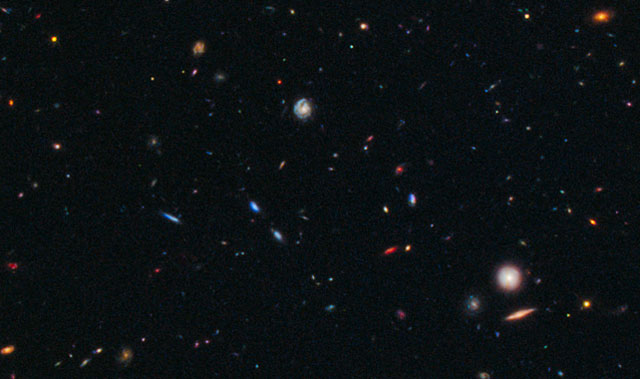
    The Hubble telescope pinpoints the furthest protocluster of galaxies ever seen. Image: Nasa Goddard Photo and Video (CC BY 2.0)
    The Hubble telescope pinpoints the furthest protocluster of galaxies ever seen. Image: Nasa Goddard Photo and Video (CC BY 2.0)

    There was a bang, we think. About 14bn years ago, a tiny singularity — a point smaller than a pinhead and containing all the matter in our universe — exploded. We’re pretty sure. If we accept that the universe started with a bang — an “if” that is infinite and expanding at about 70km per second per megaparsec as you read this — we still don’t know what exploded, what happened in the seconds before it did and where all of that energy came from.

    What was the Big Bang, and can we believe that it happened?

    Although the Big Bang remains a theory, the evidence is mounting that this cataclysmic explosion did occur in our universe and that matter is accelerating away from the scene of the crime.

    The main feathers in this inflationary universe theory’s cap are the cosmic background radiation, which permeates the universe and has been measured. This leftover radiation from the Big Bang is weaker than a microwave’s and raises the temperature of the universe by about three degrees — and empirical proof in 1998 that the universe wasn’t just expanding, it was accelerating.

    But there is still a big question that perplexes scientists and philosophers. To be fair, there are many questions that remain, but this particular question — what was this singularity, and where did the massive amount of energy come from — is a major source of vexation because we can’t “see” what happened at the moment of the Big Bang, this point at which time did not exist, and everything we think we know was contained in a tiny, incredibly dense knot.

    There are theories. And here are some of the ideas about what happened in that moment before everything exploded.

    Creationism
    Creationism is a dirty word in many scientific circles, and science often has the same reputation among creationists. However, creationism is a sprawling and varied concept.

    On one hand are some Christians who — holding to a literal interpretation of the Bible — believe that God created the world in seven days about 10 000 years ago. The Qur’an also says that creation took place over a matter of days, and many Muslims read this literally.

    time-universe-280
    Image: Garlandcannon (CC BY-SA 2.0)

    However, on the other end of the spectrum is the belief that God is responsible for that initial burst of energy that galvanised the Big Bang. One of the main arguments for this is the Law of Conservation of Energy, which states: “Energy can be neither created nor destroyed, only transferred from one state to another.”

    So where did the Big Bang energy come from?

    A supernatural source, they argue.

    One interpretation of this is intelligent design: that the universe was created by an intelligent entity, with agency. Intelligent design is seen as a way to reconcile science with religion, and an omniscient, omnipotent God with the chaotic swirl of universe expansion.

    But many scientists reject the concept of supernatural causes in favour of empirical natural science. Also, not all proponents of intelligent design are religious. Many are secular, and some say that these intelligent designers could be aliens.

    Brane theory
    According to the multiverse theory, our universe is one of many, an argument allegedly supported by convoluted equations. I say allegedly because these equations are the dominion of the few who can read these hifalutin symbols that explain the world.

    Our universe is like a page in a book, a thin membrane (“brane”), one page among many. But in the same way that words on one page cannot slide on to another, so each universe is self-contained and distinct from the other. But if these “branes” do touch, they spark and ignite a new universe, a new “brane”. The brane theory argues that this is where the energy for the Big Bang came from.

    White hole theory
    We are pretty sure that black holes exist: massive stars that have collapsed in on themselves, creating a mass whose gravity is so strong that it sucks surrounding matter and light into it. It is called a “black” hole because not even light can escape from it, and — although it cannot be observed directly — its existence is inferred by the effect it has on surrounding matter and radiation. But where does all this energy go?

    Some theorists suggest that on the other side of a black hole is another universe, and that a star imploding is the initial catalyst for a universe. If we continue with this line of thought, on the other side of our universe is a black hole, sucking matter and energy out of another universe.

    Cyclic
    But maybe the Big Bang singularity already contained the carcass of this universe and with it the detritus of millions of civilisations that lived and advanced and died, and we are caught in a Sisyphus-esque cycle.

    At the moment, the universe is expanding, but perhaps at some point in the future it will begin contracting. The aforementioned cipher of mathematicians allegedly also predicts that this is possible.

    This would hold with the Law of Conservation of Energy – no energy was created, and like a Russian matryoshka doll, the singularity already contained the energy that would explode to become our universe. And after the infinite atoms have returned like homing pigeons to a tiny, incredibly hot, inconceivably dense singularity, they will explode outwards all over again.

    Where to from here?
    Most of the large scientific experiments in the world – from those looking at the circuits of the stars to those divining how bosons behave – are trying to answer this perplexing question.

    The Square Kilometre Array, which will be the largest radio telescope in the world, will be able to detect radiation from the Big Bang, and perhaps tell us how galaxies are formed, among many other things. At the Large Hadron Collider, which is a 27km particle accelerator, scientists are smashing particles together at massive speeds to see whether these can force minuscule atom debris on to another dimension.

    But perhaps the most insightful theory of the origins of the universe comes from Douglas Adams’s Hitchhiker’s Guide to the Galaxy: “There is a theory which states that if ever anybody discovers exactly what the universe is for and why it is here, it will instantly disappear and be replaced by something even more bizarre and inexplicable.

    “There is another theory which states that this has already happened.”  — (c) 2013 Mail & Guardian

    • Visit the Mail & Guardian Online, the smart news source

    Follow TechCentral on Google News Add TechCentral as your preferred source on Google


    Douglas Adams Large Hadron Collider SKA Square Kilometre Array
    WhatsApp YouTube
    Share. Facebook Twitter LinkedIn WhatsApp Telegram Email Copy Link
    Previous ArticleE-tolls: ‘Sanral had other options’
    Next Article Zuma studying Pule report

    Related Posts

    A MeerKAT antenna

    MeerKAT detects most powerful natural radio laser ever observed

    19 February 2026
    South Africa's giant SKA telescope clears major technical hurdle

    South Africa’s giant SKA telescope clears major technical hurdle

    8 January 2026
    SA scientists want Musk’s Starlink out of their space

    SA scientists want Musk’s Starlink out of their space

    2 June 2025
    Company News
    Security by design is the channel's strongest pitch - Othelo Vieira

    Security by design is the channel’s strongest pitch

    23 April 2026
    Your brand is invisible to the AI that's choosing your competitor - Michelle Losco

    Your brand is invisible to the AI that’s choosing your competitor

    23 April 2026
    How AnyDesk is redefining remote access for African enterprises

    How AnyDesk is redefining remote access for African enterprises

    22 April 2026
    Opinion
    The conflict of interest at the heart of PayShap's slow adoption - Cheslyn Jacobs

    The conflict of interest at the heart of PayShap’s slow adoption

    26 March 2026
    South Africa's energy future hinges on getting wheeling right - Aishah Gire

    South Africa’s energy future hinges on getting wheeling right

    10 March 2026
    Hold the doom: the case for a South African comeback - Duncan McLeod

    Apple just dropped a bomb on the Windows world

    5 March 2026

    Subscribe to Updates

    Get the best South African technology news and analysis delivered to your e-mail inbox every morning.

    Latest Posts
    South Africa planning big overhaul of public sector IT - State IT Agency Sita

    South Africa planning big overhaul of public sector IT

    23 April 2026
    Usaasa's 30-year run nears its end - Communications minister Solly Malatsi. Image c/o DCDT

    Usaasa’s 30-year run nears its end

    23 April 2026
    Charge to switch on first N3 off-grid EV stations in May - Joubert Roux

    Charge to switch on first N3 off-grid EV stations in May

    23 April 2026
    Middle-class South Africa is ditching streaming for AI

    Middle-class South Africa is ditching streaming for AI

    23 April 2026
    © 2009 - 2026 NewsCentral Media
    • Cookie policy (ZA)
    • TechCentral – privacy and Popia

    Type above and press Enter to search. Press Esc to cancel.

    Manage consent

    TechCentral uses cookies to enhance its offerings. Consenting to these technologies allows us to serve you better. Not consenting or withdrawing consent may adversely affect certain features and functions of the website.

    Functional Always active
    The technical storage or access is strictly necessary for the legitimate purpose of enabling the use of a specific service explicitly requested by the subscriber or user, or for the sole purpose of carrying out the transmission of a communication over an electronic communications network.
    Preferences
    The technical storage or access is necessary for the legitimate purpose of storing preferences that are not requested by the subscriber or user.
    Statistics
    The technical storage or access that is used exclusively for statistical purposes. The technical storage or access that is used exclusively for anonymous statistical purposes. Without a subpoena, voluntary compliance on the part of your Internet Service Provider, or additional records from a third party, information stored or retrieved for this purpose alone cannot usually be used to identify you.
    Marketing
    The technical storage or access is required to create user profiles to send advertising, or to track the user on a website or across several websites for similar marketing purposes.
    • Manage options
    • Manage services
    • Manage {vendor_count} vendors
    • Read more about these purposes
    View preferences
    • {title}
    • {title}
    • {title}