
Close Menu
TechCentralTechCentral

    Subscribe to the newsletter

    Get the best South African technology news and analysis delivered to your e-mail inbox every morning.

    Facebook X (Twitter) YouTube LinkedIn
    WhatsApp Facebook X (Twitter) LinkedIn YouTube
    TechCentralTechCentral
    • News
      Record R99-million payday for MTN CEO Ralph Mupita

      Record R99-million payday for MTN CEO Ralph Mupita

      29 April 2026
      Alfa's electric rebel - Alfa Romeo Junior Elettrica Veloce

      Alfa’s electric rebel

      29 April 2026
      MTN director traded shares during closed period - Vincent Rague

      MTN director traded shares during closed period

      29 April 2026
      MTN warns gambling is hurting its prepaid business in South Africa - Ferdi Moolman

      MTN warns gambling is hurting its prepaid business in South Africa

      29 April 2026
      Former Nedbank CIO heads to the South Pacific - Ray Naicker

      Former Nedbank CIO heads to the South Pacific

      29 April 2026
    • World
      Pivotal week for US tech stocks

      Pivotal week for US tech stocks

      28 April 2026
      Taylor Swift trademarks her voice to fight AI fakes

      Taylor Swift trademarks her voice to fight AI fakes

      28 April 2026
      DeepSeek's long-awaited V4 model enters preview

      DeepSeek’s long-awaited V4 model enters preview

      24 April 2026
      More organic compounds detected on Mars - Nasa Curiosity rover

      More organic compounds detected on Mars

      21 April 2026
      Adobe bets on AI agents to fend off cheaper rivals

      Adobe bets on AI agents to fend off cheaper rivals

      16 April 2026
    • In-depth
      Africa switches on as Europe dims the lights

      Africa switches on as Europe dims the lights

      9 April 2026
      The biggest untapped EV market on Earth is hiding in plain sight

      The biggest untapped EV market on Earth is hiding in plain sight

      1 April 2026
      The R18-billion tech giant hiding in plain sight - Jens Montanana

      The R16-billion tech giant hiding in plain sight

      26 March 2026
      The last generation of coders

      The last generation of coders

      18 February 2026
      Sentech is in dire straits

      Sentech is in dire straits

      10 February 2026
    • TCS

      TCS+ | ‘The ISP for ISPs’: Vox’s shift to wholesale aggregator

      20 April 2026
      TCS | Werner Lindemann on how AI is rewriting the infosec rulebook

      TCS | Werner Lindemann on how AI is rewriting the infosec rulebook

      15 April 2026
      TCS | Donovan Marsh on AI and the future of filmmaking

      TCS | Donovan Marsh on AI and the future of filmmaking

      7 April 2026
      TCS+ | Vodacom Business moves to crack the SME tech gap - Andrew Fulton, Sannesh Beharie

      TCS+ | Vodacom Business moves to crack the SME tech gap

      7 April 2026
      TCS | MTN's Divysh Joshi on the strategy behind Pi - Divyesh Joshi

      TCS | MTN’s Divyesh Joshi on the strategy behind Pi

      1 April 2026
    • Opinion
      Free calls, dead voice and Shameel Joosub's Spanish ghost - Duncan McLeod

      Free calls, dead voice and Shameel Joosub’s Spanish ghost

      22 April 2026
      The conflict of interest at the heart of PayShap's slow adoption - Cheslyn Jacobs

      The conflict of interest at the heart of PayShap’s slow adoption

      26 March 2026
      South Africa's energy future hinges on getting wheeling right - Aishah Gire

      South Africa’s energy future hinges on getting wheeling right

      10 March 2026
      Free calls, dead voice and Shameel Joosub's Spanish ghost - Duncan McLeod

      Apple just dropped a bomb on the Windows world

      5 March 2026
      R230-million in the bag for Endeavor's third Harvest Fund - Alison Collier

      VC’s centre of gravity is shifting – and South Africa is in the frame

      3 March 2026
    • Company Hubs
      • 1Stream
      • Africa Data Centres
      • AfriGIS
      • Altron Digital Business
      • Altron Document Solutions
      • Altron Group
      • Arctic Wolf
      • Ascent Technology
      • AvertITD
      • BBD
      • Braintree
      • CallMiner
      • CambriLearn
      • Contactable
      • CYBER1 Solutions
      • Digicloud Africa
      • Digimune
      • Domains.co.za
      • ESET
      • Euphoria Telecom
      • HOSTAFRICA
      • Incredible Business
      • iONLINE
      • IQbusiness
      • Iris Network Systems
      • Kaspersky
      • LSD Open
      • Mitel
      • NEC XON
      • Netstar
      • Network Platforms
      • Next DLP
      • Ovations
      • Paracon
      • Paratus
      • Q-KON
      • SevenC
      • SkyWire
      • Solid8 Technologies
      • Telit Cinterion
      • Telviva
      • Tenable
      • Vertiv
      • Videri Digital
      • Vodacom Business
      • Wipro
      • Workday
      • XLink
    • Sections
      • AI and machine learning
      • Banking
      • Broadcasting and Media
      • Cloud services
      • Contact centres and CX
      • Cryptocurrencies
      • Education and skills
      • Electronics and hardware
      • Energy and sustainability
      • Enterprise software
      • Financial services
      • HealthTech
      • Information security
      • Internet and connectivity
      • Internet of Things
      • Investment
      • IT services
      • Lifestyle
      • Motoring
      • Policy and regulation
      • Public sector
      • Retail and e-commerce
      • Satellite communications
      • Science
      • SMEs and start-ups
      • Social media
      • Talent and leadership
      • Telecoms
    • Events
    • Advertise
    TechCentralTechCentral
    Home » Sections » Energy and sustainability » Would load shedding be worse without Covid?

    Would load shedding be worse without Covid?

    By Hilton Tarrant9 September 2020
    Twitter LinkedIn Facebook WhatsApp Email Telegram Copy Link
    News Alerts
    WhatsApp

    There is a perception that load shedding would be far worse were it not for the disruption wrought by the Covid-19 pandemic and lockdown.

    This popular opinion resurfaces every time load shedding rears its head, especially on social media streets. The “theory” is that with the country locked in a recession, demand should “surely” be far lower than normal. Hence, were it not for the pandemic, we would be at stage 6 or even stage 8.

    There are a few problems with this theory, not least of which is the fact that load shedding is the simple result of a mismatch between electricity demand and supply at a given point in time. While the equation itself is simple, the factors influencing the size of this mismatch (or whether there is even one at all) are far more complex. Chief among these is the erratic reliability within Eskom’s coal generating fleet. Many (most) of these power stations are old and to describe maintenance trends over the past decade as “poor” would be charitable.

    With this information, Eskom is able to forecast demand fairly accurately. By definition, planned maintenance can also be correctly forecast

    But Eskom does have an idea of the reliability trend across its fleet.

    It knows, for example, which units are stable and predictable, it knows which are not capable of running at full capacity (with partial load losses), and it knows which are unreliable and likely due for a long list of repairs.

    With this information, Eskom is able to forecast demand fairly accurately. By definition, planned maintenance can also be correctly forecast.

    The two areas where it can get caught out is when the reliability of the fleet craters and those units lost to “unplanned maintenance” spike to above normal levels or where, like last week, demand was higher than forecast.

    Levers

    In this situation, Eskom has a number of levers to pull: It can use pumped-storage schemes to augment supply, it can run its own emergency open cycle gas turbines (OCGTs) or ask independent power producers (IPPs) to also burn diesel, or it can cut demand with load shedding.

    But when in this situation and multiple units trip (by default, unexpectedly!), it is forced to use whatever emergency generation capacity it has (which doesn’t last forever) and then remove demand to balance the power system.

    That’s what happened last week, and is basically the sequence of events every time there is load shedding.

    We know that multiple units tripped last week and that Eskom claimed that demand was higher than expected. But do we know that demand was categorically higher?

    Normally we would have a limited view a week after the fact, when Eskom publishes its weekly System Status Report. This isn’t all that useful in that Eskom only shows the supply and demand picture as at the daily (evening) peak. There’s no information intra-day, and generation availability is aggregated to a weekly level (with only the average percentage of planned maintenance, plant breakdowns and generation capacity).

    Thanks to pressure from the Organisation Undoing Tax Abuse (Outa), which filed a Promotion of Access to Information Act request in April, Eskom has this week started to publish a live view of the power system, which it has catchingly named “System status and other related data”.

    The utility will likely contend that it was going to publish this data anyway, under the new leadership of André de Ruyter. Outa says while this is a good start, it falls far below what other global utilities publish.

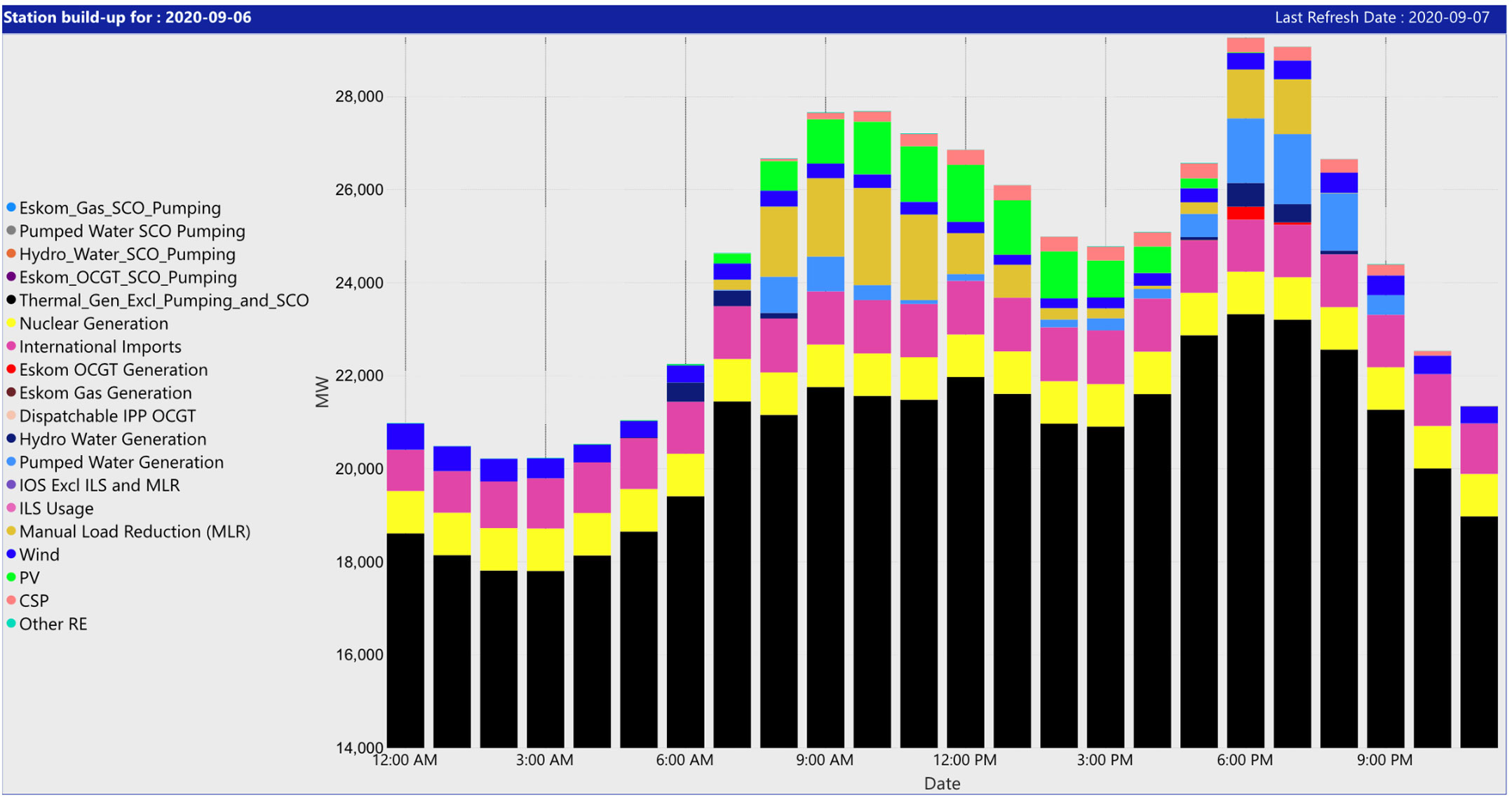
    For the first time, we have a system-level view (but not a power station one) via a series of dashboards showing:

    • Actual and forecast hourly demand (for the past and coming seven days);
    • The supply picture for the most recent full day (in other words, yesterday);
    • The supply picture for the past seven days;
    • Pumped-storage usage for the past seven days;
    • OCGT generation over the past seven days (Eskom and IPPs);
    • Hourly renewable generation for the current and previous month;
    • Weekly unplanned outage picture;
    • Hourly unplanned outage trend for the past 14 days;
    • Generation outages by type (per month); and
    • Monthly emissions data.

    From these dashboards, we now know – definitively – that electricity demand had already started returning to “normal” forecast levels at the start of June.

    The deviation (green line) on the chart shows how much below or above the forecast actual demand has been.

    Source: Eskom

    It is clear that in level-5 lockdown, demand was as much as 10GW below Eskom’s forecast. In level 4 (May), demand had begun its trajectory back to normal as mines and factories re-opened. By the middle of June, demand was firmly exceeding what Eskom had forecast. As forecasting is never exact, this trend will never track the deviation line perfectly. Rather, expect to see it clustered closely to the deviation line for the remainder of the year, which means demand is for all intents and purposes back to “normal” levels.

    (The separate weekly system status reports also show that peak demand was at ±30GW at the end of August, the same level as the same week last year.)

    The big jump in early September was the result of the unexpected cold snap, plus possible pent-up demand from industry operating at lower than normal levels. With far cheaper summer tariffs kicking in on 1 September, this may have yielded additional demand in a year that’s been anything but normal.

    Now, whether demand would be 2GW or 4GW higher in an economy growing at 2%, 3%, 4% or even 5%/year is a separate debate entirely.
    Source: Eskom

    For now, the supply picture (particularly from the problematic coal fleet) has stabilised.

    By lunchtime on Monday, Eskom was only reducing around 700MW of load, which improved to 69MW by 4pm. At these negligible levels, it would be able to cover the shortfall with other reserves. The evening peak was still a problem, but generating capacity remained stronger than it had been for days, resulting in load shedding (unofficially) being terminated earlier than expected. The situation improved further on Tuesday.

    Source: Eskom

    This is a far cry from the 5.2GW of manual load reduction at 5pm on Friday.

    Quite how Eskom managed this level of load reduction while operating under stage-4 load shedding, which seeks to cut up to 4GW of demand, remains a mystery.

    • This article was originally published on Moneyweb and is used here with permission

    Follow TechCentral on Google News Add TechCentral as your preferred source on Google


    Andre de Ruyter Eskom Outa top
    WhatsApp YouTube
    Share. Facebook Twitter LinkedIn WhatsApp Telegram Email Copy Link
    Previous ArticleHuawei to share progress of HarmonyOS amid US tensions
    Next Article How to keep productive while your employees work remotely

    Related Posts

    SA stretches fuel tax relief as oil prices surge

    SA stretches fuel tax relief as oil prices surge

    29 April 2026
    Eskom developing bitcoin mining plan but needs Nersa's nod - Agnes Mlambo

    Eskom developing bitcoin mining plan but needs Nersa’s nod

    22 April 2026
    Eskom to decide fate of older coal stations by September - Dan Marokane

    Eskom to decide fate of older coal stations by September

    22 April 2026
    Company News
    Vodacom Business beefs up advisory board with three key appointments

    Vodacom Business beefs up advisory board with three key appointments

    29 April 2026
    What defines a top software development company today? BBD

    What defines a top software development company today?

    29 April 2026
    AI governance: the key to growth for SA's financial institutions - Fenergo

    AI governance: the key to growth for SA’s financial institutions

    28 April 2026
    Opinion
    Free calls, dead voice and Shameel Joosub's Spanish ghost - Duncan McLeod

    Free calls, dead voice and Shameel Joosub’s Spanish ghost

    22 April 2026
    The conflict of interest at the heart of PayShap's slow adoption - Cheslyn Jacobs

    The conflict of interest at the heart of PayShap’s slow adoption

    26 March 2026
    South Africa's energy future hinges on getting wheeling right - Aishah Gire

    South Africa’s energy future hinges on getting wheeling right

    10 March 2026

    Subscribe to Updates

    Get the best South African technology news and analysis delivered to your e-mail inbox every morning.

    Latest Posts
    Record R99-million payday for MTN CEO Ralph Mupita

    Record R99-million payday for MTN CEO Ralph Mupita

    29 April 2026
    Alfa's electric rebel - Alfa Romeo Junior Elettrica Veloce

    Alfa’s electric rebel

    29 April 2026
    MTN director traded shares during closed period - Vincent Rague

    MTN director traded shares during closed period

    29 April 2026
    MTN warns gambling is hurting its prepaid business in South Africa - Ferdi Moolman

    MTN warns gambling is hurting its prepaid business in South Africa

    29 April 2026
    © 2009 - 2026 NewsCentral Media
    • Cookie policy (ZA)
    • TechCentral – privacy and Popia

    Type above and press Enter to search. Press Esc to cancel.

    Manage consent

    TechCentral uses cookies to enhance its offerings. Consenting to these technologies allows us to serve you better. Not consenting or withdrawing consent may adversely affect certain features and functions of the website.

    Functional Always active
    The technical storage or access is strictly necessary for the legitimate purpose of enabling the use of a specific service explicitly requested by the subscriber or user, or for the sole purpose of carrying out the transmission of a communication over an electronic communications network.
    Preferences
    The technical storage or access is necessary for the legitimate purpose of storing preferences that are not requested by the subscriber or user.
    Statistics
    The technical storage or access that is used exclusively for statistical purposes. The technical storage or access that is used exclusively for anonymous statistical purposes. Without a subpoena, voluntary compliance on the part of your Internet Service Provider, or additional records from a third party, information stored or retrieved for this purpose alone cannot usually be used to identify you.
    Marketing
    The technical storage or access is required to create user profiles to send advertising, or to track the user on a website or across several websites for similar marketing purposes.
    • Manage options
    • Manage services
    • Manage {vendor_count} vendors
    • Read more about these purposes
    View preferences
    • {title}
    • {title}
    • {title}