Close Menu
TechCentralTechCentral

    Subscribe to the newsletter

    Get the best South African technology news and analysis delivered to your e-mail inbox every morning.

    Facebook X (Twitter) YouTube LinkedIn
    WhatsApp Facebook X (Twitter) LinkedIn YouTube
    TechCentralTechCentral
    • News
      Africa Bitcoin Corporation board quits in shareholder clash - Stafford Masie

      Africa Bitcoin Corporation board quits in shareholder clash

      12 October 2026
      Capitec is setting traps for scammers' mule accounts - Andrew Baker

      Capitec is setting traps for scammers’ mule accounts

      12 October 2026
      Sars to pay Microsoft and IBM R2.75-billion in sole-source deals

      Sars to pay Microsoft and IBM R2.75-billion in sole-source deals

      12 October 2026
      Microsoft president says milk faces more regulation than AI - President Cyril Ramaphosa with Microsoft president and vice chairman Brad Smith

      Microsoft president says milk faces more regulation than AI

      12 October 2026
      Xiaomi wants to sell South Africans a lot more than phones - Tianshi Lv

      Xiaomi wants to sell South Africans a lot more than phones

      12 October 2026
    • World
      AI is now holding up the world economy, says IMF

      AI is now propping up the world economy, says IMF

      12 October 2026
      SpaceX takes aim at US wireless carriers with spectrum acquisition

      Starlink is coming for your mobile operator

      9 October 2026
      The AI PC is finally here. It's just very expensive - Jensen Huang, Satya Nadella

      The AI PC is finally here. It’s just very expensive

      8 October 2026
      The memory crunch is making Samsung fabulously rich

      The memory crunch is making Samsung fabulously rich

      8 October 2026
      SpaceX to borrow $40-billion to buy Nvidia chips

      SpaceX to borrow $40-billion to buy Nvidia chips

      7 October 2026
    • In-depth

      10 days that changed the course of AI

      21 September 2026
      Meta to the AI industry: slow down without us - Mark Zuckerberg

      Meta to the AI industry: slow down without us

      16 September 2026
      Google DeepMind CEO Demis Hassabis. Image: John Sears

      The plan to stop AI from breaking the world

      16 July 2026
      The internet has a Strait of Hormuz problem

      The internet has a Strait of Hormuz problem

      15 July 2026
      AI boom sparks rally, frenzy and fear

      AI boom sparks rally, frenzy and fear

      11 June 2026
    • TCS
      W&W | LDV's Gerhard Moolman on electric bakkies, fleet orders and 'school fees'

      W&W | LDV’s Gerhard Moolman on electric bakkies and fleets

      9 October 2026
      TCS | Frogfoot sees bigger fibre deals coming - TechCentral Show guests Abraham van der Merwe and Shane Chorley

      TCS | Frogfoot sees bigger fibre deals coming

      8 October 2026
      Meet the CIO | Vodacom's Mohamed Sami on the agentic future

      Meet the CIO | Vodacom’s Mohamed Sami on the agentic future

      5 October 2026
      Lexi Novitske, general partner at Norrsken22, on the TechCentral Show

      TCS | Norrsken22’s Lexi Novitske on how China is winning African tech

      1 October 2026
      TCS | Dominic White and Adam Ely on AI agents going rogue

      TCS | Dominic White and Adam Ely on AI agents going rogue

      29 September 2026
    • Opinion
      When a machine can choose, who does it become? Fanie van Rooyen

      When a machine can choose, who does it become?

      9 October 2026
      Let South Africans jailbreak their way to digital sovereignty - Dirk de Vos

      Let South Africans jailbreak their way to digital sovereignty

      5 October 2026
      South Africa's next energy crisis is in the accounts department - Craig Holmes

      South Africa’s next energy crisis is in the accounts department

      29 September 2026
      The steam engine lesson AI doomsayers keep missing - Sam Clarke

      The steam engine lesson AI doomsayers keep missing

      28 September 2026
      Let South Africans jailbreak their way to digital sovereignty - Dirk de Vos

      Regulating AI: apply the laws we have first

      21 September 2026
    • Company News
      • 1Stream
      • Africa Data Centres
      • AfriGIS
      • Altron Digital Business
      • Altron Document Solutions
      • Altron Group
      • Arctic Wolf
      • Ascent Technology
      • AvertITD
      • BBD
      • Braintree
      • CallMiner
      • CambriLearn
      • CM.com
      • Contactable
      • CYBER1 Solutions
      • Digicloud Africa
      • Digimune
      • Domains.co.za
      • ESET
      • Euphoria Telecom
      • HOSTAFRICA
      • Incredible Business
      • iONLINE
      • IQbusiness
      • Iris Network Systems
      • Kaspersky
      • LSD Open
      • Mitel
      • NEC XON
      • Netstar
      • Network Platforms
      • Next DLP
      • Ovations
      • Paracon
      • Paratus
      • Publishared
      • Q-KON
      • SevenC
      • SkyWire
      • Solid8 Technologies
      • Telit Cinterion
      • Telviva
      • Tenable
      • Vertiv
      • Videri Digital
      • Vodacom Business
      • Vox
      • Wipro
      • Workday
      • XLink
    • Sections
      • AI and machine learning
      • Banking
      • Broadcasting and Media
      • Cloud services
      • Contact centres and CX
      • Cryptocurrencies
      • Education and skills
      • Electronics and hardware
      • Energy and sustainability
      • Enterprise software
      • Financial services
      • HealthTech
      • Information security
      • Internet and connectivity
      • Internet of Things
      • Investment
      • IT services
      • Lifestyle
      • Policy and regulation
      • Public sector
      • Retail and e-commerce
      • Satellite communications
      • Science
      • SMEs and start-ups
      • Social media
      • Talent and leadership
      • Telecoms
      • Watts & Wheels
    • Events
    • Advertise
    TechCentralTechCentral
    Home » Sections » Satellite communications » The hole in the law above the Karoo
    The hole in the law above the Karoo

    The hole in the law above the Karoo

    By Fanie van Rooyen26 August 2026

    The legal shield around South Africa’s most valuable scientific instrument does not reach the objects most likely to interfere with it.

    The Karoo Central Astronomy Advantage Area (KCAAA), established under the country’s Astronomy Geographic Advantage Act, protects MeerKAT and the Square Kilometre Array-Mid (SKA-Mid) telescope now under construction from ground-based interference. Satellites sit outside it.

    “Satellites are physically geographically located outside the KCAAA while their transmissions enter the protected area,” the South African Radio Astronomy Observatory (Sarao) said in a written response to questions from TechCentral.

    A single satellite transmitting into the main beam can overwhelm faint cosmic signals

    The act does allow the minister to act against spectrum users that “transmit or broadcast into” the zone, including forcing a move to another frequency. But large moving constellations were not what those rules were written for.

    That is what Sarao has asked Icasa to fix.

    In submissions to the communications regulator’s public hearings this month on the draft radio frequency spectrum regulations, it called for enforceable coordination between satellite operators and radio astronomy facilities, and for compatibility assessments covering aggregate interference from whole constellations rather than single satellites.

    “A single satellite transmitting into the main beam can overwhelm faint cosmic signals,” Sarao said. Interference can be orders of magnitude stronger than the signal astronomers are trying to detect. The larger worry is cumulative: thousands of satellites transmitting at once, compounded by unintended electromagnetic radiation leaking from satellite electronics.

    The window is now

    There is no satellite headcount at which radio astronomy tips over, Sarao said, because it depends on frequencies, orbits, power and beam configurations. It pointed to ITU-R studies of the 2 690-2 700MHz band that “demonstrated potentially severe interference to radio astronomy” from constellations far smaller than those now proposed.

    South Africa is not yet routinely measuring satellite interference at MeerKAT. Monitoring “has primarily focused on terrestrial services” and is being extended to space-based sources. The clearest evidence so far comes from elsewhere: SKA Obversatory-supported observations by the Lofar telescope detected unintended emissions from Starlink satellites between 110MHz and 188MHz, inside a protected radio-astronomy band.

    Read: South Africa’s giant SKA telescope clears major technical hurdle

    One mitigation under international discussion stops short of switching satellites off across the whole reserve. Through the International Telecommunication Union, the international community is “engaging with operators to develop technical and regulatory mitigation measures,”, said Adrian Tiplady, Sarao deputy MD for strategy and partnerships. “One of the options is to create nulls (holes) in their coverage around radio telescopes.” Those holes would be far smaller than the protected area, focused on the dishes rather than the Karoo as a whole.

    The window is now, Sarao said, because satellites have long operational lives and their numbers are climbing. “It is much easier to establish effective coordination and mitigation measures as the satellite environment is being developed than to try to retrofit them after millions of devices are already in orbit.”
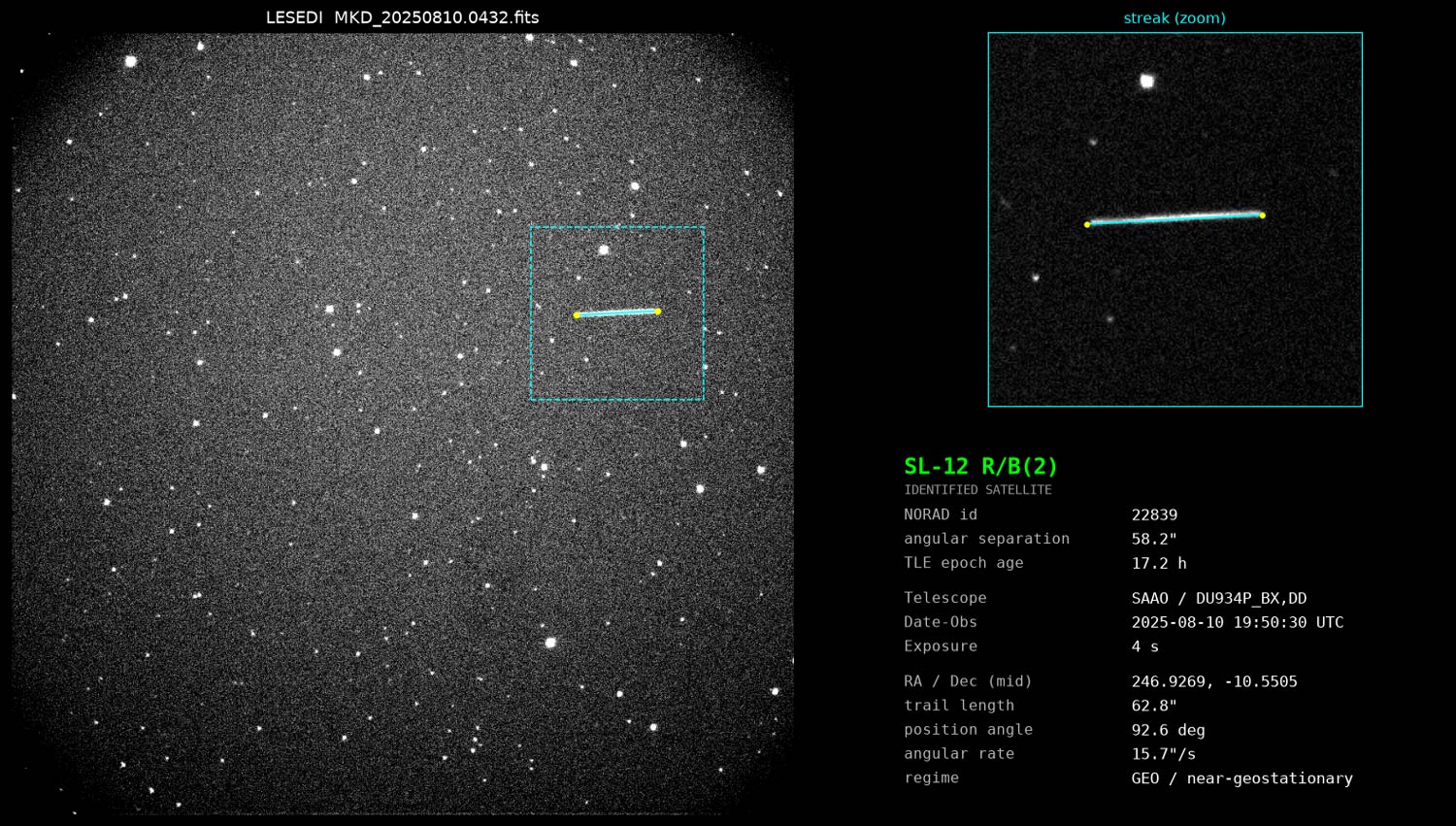
    Streak-detection software written by UCT and SAAO student Enzo Afonso flags trails crossing acquisition frames from the Lesedi telescope at Sutherland, then matches them to catalogued objects. Some are satellites, some are space junk. Credit: SAAO
    Streak-detection software written by UCT and SAAO student Enzo Afonso flags trails crossing acquisition frames from the Lesedi telescope at Sutherland, then matches them to catalogued objects. Some are satellites, some are space junk. Credit: SAAO

    Sutherland faces the optical version. A recent European Southern Observatory study in Astronomy & Astrophysics, by ESO astronomer Olivier Hainaut, models the effect of the more than 1.7 million satellites covered by announced or proposed low-Earth orbit constellation filings. Roughly 14 000 satellites are in orbit today, or about 32 000 counting dead craft and debris. Most of the 1.7 million comes from a single February filing by SpaceX for a million satellites to host AI data centres.

    Nicolas Erasmus, instrumentation scientist and astronomer at the South African Astronomical Observatory, was careful about the headline numbers when asked about them by TechCentral. The 1.7 million refers to systems announced or proposed, not approved and certain to fly. The much-quoted finding that up to 28% of a telescope’s field of view could be lost is, he said, “the peak modelled fraction of pixels affected in a particular 300-second VLT/Fors2 (Very Large Telescope, in Chile) exposure scenario, not 28% of all observations or observing time, and not a measurement at Sutherland”.

    “If even a substantial fraction were deployed, satellites would cease to be an occasional nuisance and become part of the normal observing environment,” he warned.

    What the Sutherland data shows

    The picture on the ground varies sharply by instrument. MeerLicht, the wide-field telescope that observes in tandem with MeerKAT, is the most exposed. It images about 1.7 by 1.7 degrees of sky at once, an area that would hold a three-by-three grid of full moons. A peer-reviewed study that ran a streak-detection system over roughly 200 000 MeerLicht images found 9 107 satellite or debris trails. A trail in a frame is not a lost exposure, Erasmus said: affected pixels can often be masked, or several exposures combined to remove the streak.

    At the other end, a UCT and SAAO student, Enzo Afonso, analysed about 30 000 acquisition images from the robotic 1m Lesedi telescope and found 90 frames, about 0.3%, carrying a satellite streak. “So currently it doesn’t seem that detrimental to daily operations,” Erasmus said, “but with the exponential increase in numbers of proposed constellations this might eventually become a serious issue.” Afonso’s analysis has not yet been written up.
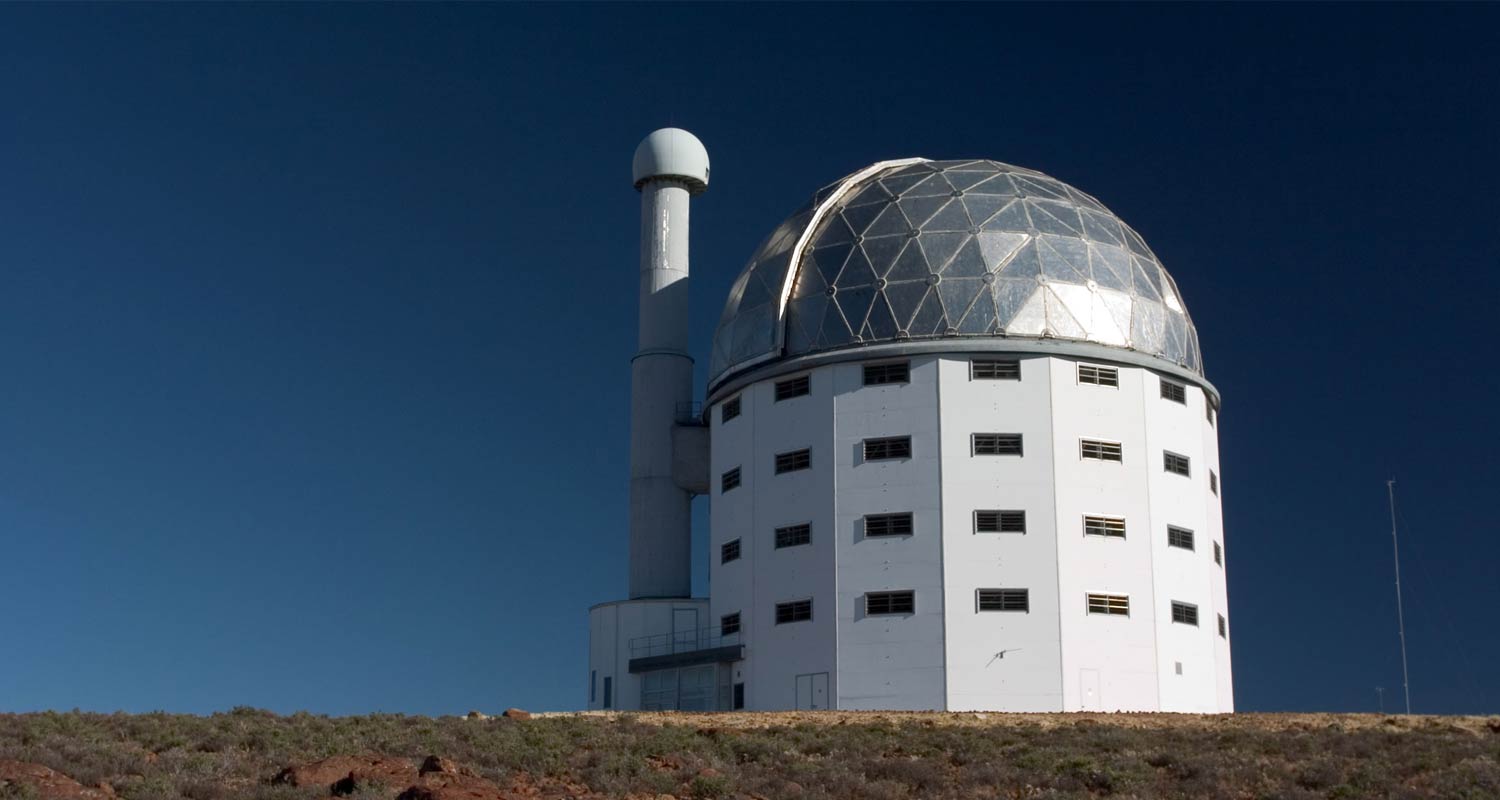
    The Salt observatory near Sutherland
    The Salt observatory near Sutherland

    The Southern African Large Telescope sits in between. Its science field of view is about eight arcminutes across, under 1% of MeerLicht’s by area, and much of its work is spectroscopy, so its odds of catching a satellite are low. But as a 10m-class telescope its far greater light-collecting area makes even CubeSat-sized objects detectable, and a satellite crossing a spectrograph slit can contaminate a spectrum without leaving an obvious streak.

    Mirrors

    The proposal that worries Erasmus most is not a conventional satellite. Reflect Orbital has floated a constellation of 50 000 mirror satellites by 2035, designed to bounce sunlight onto ground targets such as solar farms. The US Federal Communications Commission approved a single demonstration satellite, Earendil-1, in July, carrying an 18m by 18m reflector – and ruled that the light pollution and telescope interference objections raised by astronomers fell outside its authority to consider.

    If any target zones sat near Sutherland the effect “would be particularly bad”, Erasmus said, because the site is rated among the three darkest observatories in the world. Space mirrors used near it “would ruin a first-class dark site”.

    South Africa’s Sutherland astronomy regulations control artificial outdoor lighting inside a declared Astronomy Advantage Area, but they “help greatly, mainly against activities on the ground”, Erasmus said. “Those regulations cannot prevent a satellite licensed in another country from passing overhead.”

    …article continues below…
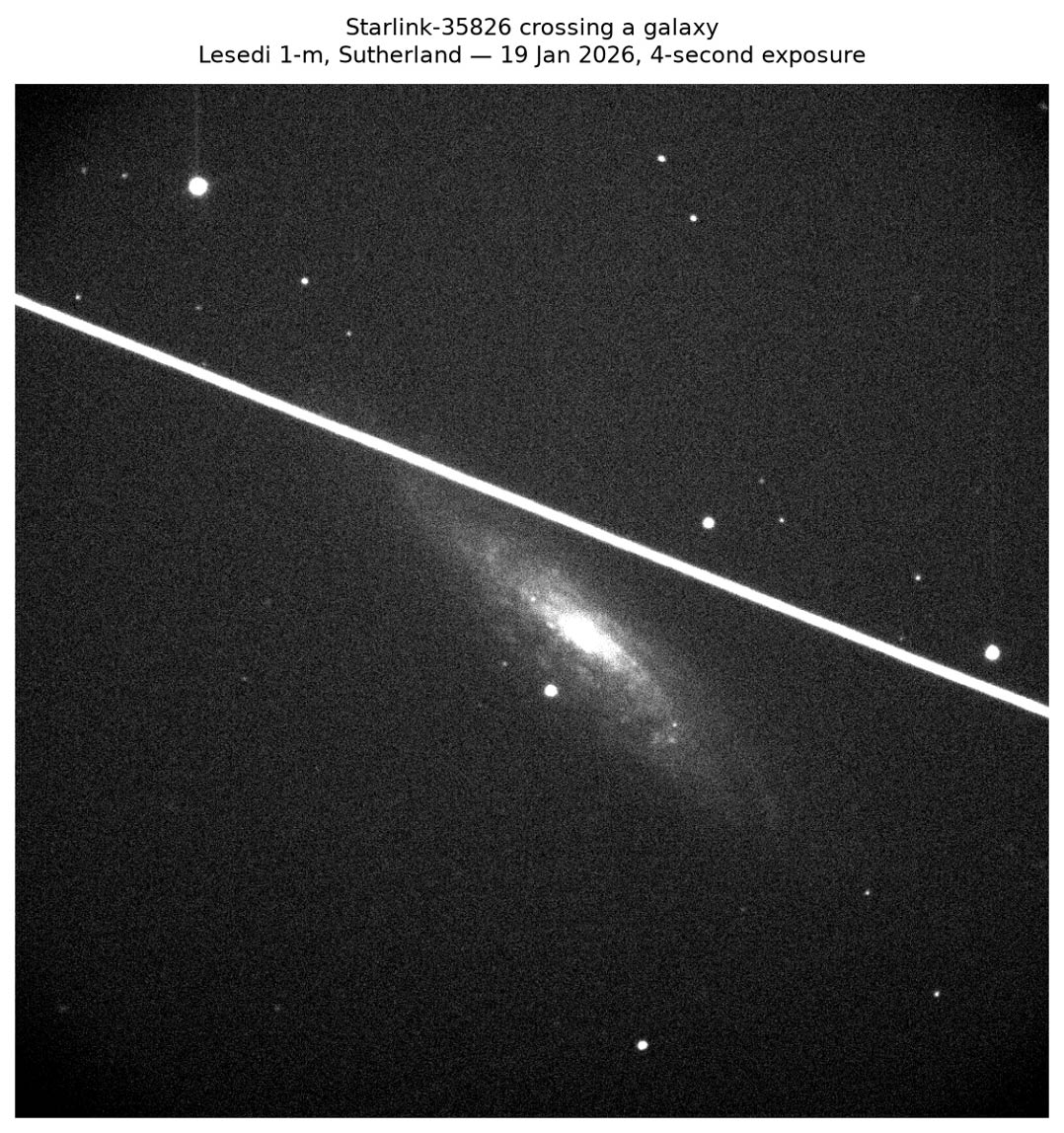
    A Starlink satellite, catalogued as Starlink-35826, cuts a bright trail across a Lesedi frame at Sutherland in a four-second exposure on 19 January 2026. This time the supernova being observed in the galaxy below lay clear of the streak, so the science survived. Credit: SAAO
    A Starlink satellite, catalogued as Starlink-35826, cuts a bright trail across a Lesedi frame at Sutherland in a four-second exposure on 19 January 2026. This time the supernova being observed in the galaxy below lay clear of the streak, so the science survived. Credit: SAAO

    The most effective mitigation is at source: licensing authorities requiring cumulative impact assessments, brightness limits and accurate public orbital data. The ESO study recommends the total satellite population stay below about 100 000, all faint enough to be invisible to the naked eye. Operators have tried. SpaceX darkened an experimental Starlink, DarkSat, and later added sun visors, but a peer-reviewed study found the coating roughly halved its brightness, not enough for large telescopes.

    None of this is an argument against satellite internet, which is extending broadband to places fibre and cellular towers never reached. The ESO researchers stressed that those benefits should not be minimised, and that the task is balancing them against scientific discovery.  – © 2026 NewsCentral Media

    • Subscribe to TechCentral’s daily newsletter
    • Get breaking news alerts on WhatsApp

    Add TechCentral as a preferred source on GoogleFollow TechCentral on Google NewsGet breaking news on WhatsApp


    Adrian Tiplady ESO FCC Icasa ITU MeerKAT Nicolas Erasmus Olivier Hainaut Reflect Orbital SAAO Sarao SKAO SpaceX Starlink
    WhatsApp YouTube
    Share. Facebook Twitter LinkedIn WhatsApp Telegram Email Copy Link
    Previous ArticleBlu Label says MTN is coming for its Capitec business
    Next Article Regulated systems need more automation, not less

    Related Posts

    Bookmakers to ISPs: stop debating, start blocking

    Malatsi can’t use telecoms rules to curb lawful gambling, lawyer warns

    12 October 2026
    SpaceX takes aim at US wireless carriers with spectrum acquisition

    Starlink is coming for your mobile operator

    9 October 2026
    SpaceX to borrow $40-billion to buy Nvidia chips

    SpaceX to borrow $40-billion to buy Nvidia chips

    7 October 2026
    Company News
    Why fintechs need an insurance partner they can trust - Hollard Insurance

    Why fintechs need an insurance partner they can trust

    8 October 2026
    Reusable KYC means the end of 'please upload your ID' - Contactable

    Reusable KYC means the end of ‘please upload your ID’

    8 October 2026
    Eliminating the 'toggle tax': how CRM integration changes customer experience - Martie de Beer

    Eliminating the ‘toggle tax’: how CRM integration changes customer experience

    8 October 2026
    Opinion
    When a machine can choose, who does it become? Fanie van Rooyen

    When a machine can choose, who does it become?

    9 October 2026
    Let South Africans jailbreak their way to digital sovereignty - Dirk de Vos

    Let South Africans jailbreak their way to digital sovereignty

    5 October 2026
    South Africa's next energy crisis is in the accounts department - Craig Holmes

    South Africa’s next energy crisis is in the accounts department

    29 September 2026

    Subscribe to Updates

    Get the best South African technology news and analysis delivered to your e-mail inbox every morning.

    Latest Posts
    Africa Bitcoin Corporation board quits in shareholder clash - Stafford Masie

    Africa Bitcoin Corporation board quits in shareholder clash

    12 October 2026
    Capitec is setting traps for scammers' mule accounts - Andrew Baker

    Capitec is setting traps for scammers’ mule accounts

    12 October 2026
    Sars to pay Microsoft and IBM R2.75-billion in sole-source deals

    Sars to pay Microsoft and IBM R2.75-billion in sole-source deals

    12 October 2026
    Microsoft president says milk faces more regulation than AI - President Cyril Ramaphosa with Microsoft president and vice chairman Brad Smith

    Microsoft president says milk faces more regulation than AI

    12 October 2026
    © 2009 - 2026 NewsCentral Media
    Built and maintained by Chronon
    • Cookie policy (ZA)
    • TechCentral – privacy and Popia

    Type above and press Enter to search. Press Esc to cancel.

    Manage consent

    TechCentral uses cookies to enhance its offerings. Consenting to these technologies allows us to serve you better. Not consenting or withdrawing consent may adversely affect certain features and functions of the website.

    Functional Always active
    The technical storage or access is strictly necessary for the legitimate purpose of enabling the use of a specific service explicitly requested by the subscriber or user, or for the sole purpose of carrying out the transmission of a communication over an electronic communications network.
    Preferences
    The technical storage or access is necessary for the legitimate purpose of storing preferences that are not requested by the subscriber or user.
    Statistics
    The technical storage or access that is used exclusively for statistical purposes. The technical storage or access that is used exclusively for anonymous statistical purposes. Without a subpoena, voluntary compliance on the part of your Internet Service Provider, or additional records from a third party, information stored or retrieved for this purpose alone cannot usually be used to identify you.
    Marketing
    The technical storage or access is required to create user profiles to send advertising, or to track the user on a website or across several websites for similar marketing purposes.
    • Manage options
    • Manage services
    • Manage {vendor_count} vendors
    • Read more about these purposes
    View preferences
    • {title}
    • {title}
    • {title}
    🇿🇦 Sign up to the TechCentral newsletter