

Close Menu
TechCentralTechCentral

    Subscribe to the newsletter

    Get the best South African technology news and analysis delivered to your e-mail inbox every morning.

    Facebook X (Twitter) YouTube LinkedIn
    WhatsApp Facebook X (Twitter) LinkedIn YouTube
    TechCentralTechCentral
    • News
      Nedbank hires MTN's former tech chief as group CIO - Nikos Angelopoulos

      Nedbank hires MTN’s former tech chief as group CIO

      31 July 2026
      Eskom's diesel bill falls 86% as breakdowns hit eight-year low

      Eskom’s diesel bill falls 86% as breakdowns hit eight-year low

      31 July 2026
      Ramaphosa signs off on taking the grid away from Eskom

      Ramaphosa signs off on taking the grid away from Eskom

      31 July 2026
      Microsoft just had the biggest day in stock market history

      Microsoft just had the biggest day in stock market history

      31 July 2026
      MTN Nigeria's growth engine stalled in second quarter - Karl Toriola

      MTN Nigeria’s growth engine stalled in second quarter

      31 July 2026
    • World
      Meta AI will now tell parents if their teen is in crisis

      Meta AI will now tell parents if their teen is in crisis

      17 July 2026
      IBM shares crash 25% as AI upends software spending - Arvind Krishna

      IBM shares crash 25% as AI upends software spending

      15 July 2026
      Jony Ive's first OpenAI device: an AI smart speaker - Jony Ive and Sam Altman

      Jony Ive’s first OpenAI device: an AI smart speaker

      15 July 2026
      Stripe, Advent in talks to buy PayPal for $53-billion

      Stripe, Advent in talks to buy PayPal for $53-billion

      15 July 2026
      Memory crisis sends smartphone market into steep decline

      Memory crisis sends smartphone market into steep decline

      13 July 2026
    • In-depth
      The plan to stop AI from breaking the world - Google DeepMind CEO Demis Hassabis. Image: John Sears

      The plan to stop AI from breaking the world

      16 July 2026
      The internet has a Strait of Hormuz problem

      The internet has a Strait of Hormuz problem

      15 July 2026
      AI boom sparks rally, frenzy and fear

      AI boom sparks rally, frenzy and fear

      11 June 2026
      Every plug-in hybrid on sale in South Africa, ranked by price - Lamborghini Temerario

      Every plug-in hybrid on sale in South Africa, ranked by price

      7 June 2026
      What Wi-Fi 8 will mean for wireless networks

      What Wi-Fi 8 will mean for wireless networks

      1 June 2026
    • TCS
      TCS+ | Why South African workers must become supervisors of digital labour - Accelera Digital Group Cliff de Wit

      TCS+ | Why South African workers must become supervisors of digital labour

      31 July 2026
      TCS | Rapid deployment rules can't work without municipalities: ACT - Nomvuyiso Batyi

      TCS | Icasa’s rules skip the real bottleneck: ACT

      30 July 2026
      TCS+ | iStore Business on why Apple makes sense for SMEs - Sudesh Pillay and Tamia Nontsikelelo

      TCS+ | iStore Business on why Apple makes sense for SMEs

      30 July 2026
      TCS+ | A smarter approach to cloud for South African businesses - Joel Chacko and Jonathan Oaker

      TCS+ | A smarter approach to cloud for South African businesses

      28 July 2026
      TCS | How Optasia lends billions to people banks can't see - Salvador Anglada

      TCS | How Optasia lends billions to people banks can’t see

      23 July 2026
    • Opinion
      The author, Jannie van Zyl

      Selling vapour is corporate suicide in slow motion

      16 July 2026
      Brazil's online gambling crackdown is a lesson for South Africa

      How Amazon outmanoeuvred Starlink in South Africa

      15 July 2026
      The Popia problem with agentic AI - Herman Haasbroek

      The Popia problem with agentic AI

      14 July 2026
      The author, Fanie van Rooyen

      South Africa can still catch the AI wave – here’s how

      7 July 2026
      The author, Fanie van Rooyen

      The AI utopia South Africa can’t afford

      1 July 2026
    • Company Hubs
      • 1Stream
      • Africa Data Centres
      • AfriGIS
      • Altron Digital Business
      • Altron Document Solutions
      • Altron Group
      • Arctic Wolf
      • Ascent Technology
      • AvertITD
      • BBD
      • Braintree
      • CallMiner
      • CambriLearn
      • CM Telecom
      • Contactable
      • CYBER1 Solutions
      • Digicloud Africa
      • Digimune
      • Domains.co.za
      • ESET
      • Euphoria Telecom
      • HOSTAFRICA
      • Incredible Business
      • iONLINE
      • IQbusiness
      • Iris Network Systems
      • Kaspersky
      • LSD Open
      • Mitel
      • NEC XON
      • Netstar
      • Network Platforms
      • Next DLP
      • Ovations
      • Paracon
      • Paratus
      • Q-KON
      • SevenC
      • SkyWire
      • Solid8 Technologies
      • Telit Cinterion
      • Telviva
      • Tenable
      • Vertiv
      • Videri Digital
      • Vodacom Business
      • Vox
      • Wipro
      • Workday
      • XLink
    • Sections
      • AI and machine learning
      • Banking
      • Broadcasting and Media
      • Cloud services
      • Contact centres and CX
      • Cryptocurrencies
      • Education and skills
      • Electronics and hardware
      • Energy and sustainability
      • Enterprise software
      • Financial services
      • HealthTech
      • Information security
      • Internet and connectivity
      • Internet of Things
      • Investment
      • IT services
      • Lifestyle
      • Policy and regulation
      • Public sector
      • Retail and e-commerce
      • Satellite communications
      • Science
      • SMEs and start-ups
      • Social media
      • Talent and leadership
      • Telecoms
      • Watts & Wheels
    • Events
    • Advertise
    TechCentralTechCentral
    Home » In-depth » A beautiful mind and its exquisite mathematics

    A beautiful mind and its exquisite mathematics

    By Editor29 May 2015
    Twitter LinkedIn Facebook WhatsApp Email Telegram Copy Link
    News Alerts
    WhatsApp
    John Nash
    John Nash

    John Nash, mathematician and Nobel laureate in economics, died in a taxi accident on 23 May. He was 86. His wife, Alicia, was with him and also did not survive the crash. The Nashes were on their way home to Princeton from Norway, where John was honoured as a recipient (along with Louis Nirenberg) of this year’s Abel Prize in mathematics.

    Thanks to A Beautiful Mind, Sylvia Nasar’s chronicle of Nash’s life, and its film adaptation starring Russell Crowe, Nash was one of the few mathematicians well known outside the halls of academia. The general public may remember the story of Nash’s mental illness and eventual recovery from paranoid schizophrenia. But Nash’s influence goes far beyond the Hollywood version of his biography. His colleagues count his mathematical innovations, particularly on non-cooperative games (the work that would earn him his Nobel Prize), among the great economic ideas of the 20th century.

    Nash is best known for his work in game theory. In mathematics, a game involves two or more “players” who earn rewards or penalties depending on the actions of all the participants. Some games are called zero-sum, which means that one player’s gain is another player’s loss. Nash’s work applied to non-cooperative games. In these situations, players may unilaterally change strategy to improve (or worsen) their own outcome without affecting the other players.

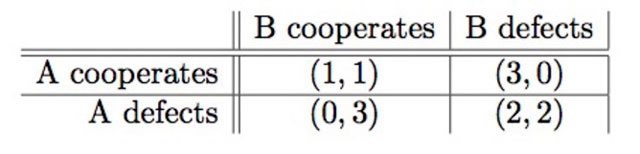
    The prototypical example of such a game is the basic Prisoner’s Dilemma. Two criminals have been captured and detained in separate cells, unable to communicate with each other. The prosecutors do not have sufficient evidence to convict them on the primary charge, but they can convict them on a lesser charge which comes with a one-year sentence. The prisoners are offered a deal: testify against the other defendant (that is, defect) and go free while he serves three years. However, if both defendants betray each other, both will serve two years. If neither betrays the other (that is, they cooperate), then they will both be convicted of the lesser charge and serve the one year. The outcomes may be summarised in a payoff matrix.
    nash-640

    What Nash discovered is that any such game has a strategy, now called a Nash equilibrium, where any unilateral change in strategy by a player results in a worse outcome for that player. In the case of the Prisoner’s Dilemma, there are two such equilibria, the upper-left and lower-right squares in the payoff matrix. Indeed, in the situation in the lower-right corner, if either player changes his strategy unilaterally and decides not to defect, he will increase his sentence and thereby end up with a worse outcome. This example is particularly vexing because the upper-left strategy is clearly the best way to go for the prisoners (they should remain silent), but purely rational players will end up at the lower-right position.

    Game theory has applications in many fields, including economics and political science. Many scenarios in international relations may be modelled as non-cooperative games. For example, the development of nuclear programmes during World War 2 can be modelled as a sort of Prisoner’s Dilemma, in which the two sides each decide to pursue a bomb for fear the other side will do so. This, of course, led to the less-desirable outcome of nuclear proliferation, analogous to both prisoners defecting.

    Embedding theorems
    While Nash is best known globally for his work on game theory, most mathematicians think of his results on embeddings of Riemannian manifolds as his most innovative and important. In this subspecialty of geometry, an n-manifold is a space which locally looks like n-dimensional Euclidean space (the typical three spatial dimensions we’re used to form a three-dimensional Euclidean space). For example, a surface, such as a sphere or hollow donut, is a 2-manifold since any point on the surface has a small disc around it; to a small bug standing at the point, the surface looks like a flat two-dimensional plane (hence the ancient belief that the Earth is flat).

    nash2

    A manifold is Riemannian if there is a globally consistent way to define angles between vectors tangent to the manifold at a point. In particular, this allows us to define distances between points on the manifold and to find the lengths of curves embedded in the manifold. Euclidean space with its usual notion of angle and distance is the simplest example.

    Now imagine trying to put an abstract Riemannian manifold inside Euclidean space. You might twist it up and do all sorts of strange things that end up distorting the angles between tangent vectors on your manifold. The Nash-Kuiper Embedding Theorem asserts that we can always fix this problem; that is, we can find a realisation of a Riemannian manifold of dimension n into a Euclidean space of dimension n+1 such that the angles are preserved. Then you can compute distances between points on the manifold more easily using the Riemannian structure inherited from Euclidean space.

    This may not sound earth-shattering, but the problem had vexed mathematicians for more than a century. That the dimension of the Euclidean space cannot be made smaller than n+1 is familiar to anyone who has studied a map — the surface of a sphere cannot be flattened onto a plane without distorting angles.

    A Beautiful Mind trailer:

    There are many counterintuitive implications of Nash’s theorem. For example, it implies that any closed surface may be realized inside an arbitrarily small ball in three-dimensional space.

    Nash is also credited with inventing a game, eventually marketed by Parker Brothers as a board game called Hex. This game, played on a parallelogram-shaped field of hexagonal cells, was discovered independently in Denmark around the same time. In Princeton it was called Nash, after its creator, or John, a double entendre involving the fact that it was played on the tiles in the mathematics department’s men’s room floor. There are two players, each of whom has tokens of a single colour (red and blue, say). The object is to form an unbroken path from one side of the board to the other before one’s opponent does the same in the opposite direction.

    There are online versions of the game. The first player always has a winning strategy; that is, the player who makes the first move can always win, provided he executes the proper sequence of moves.

    A life’s work remembered
    In any given century there are a handful of mathematicians who stand out, whose work is so original and ground breaking that it becomes a part of the language. As journalist Erica Klarreich pointed out, no one cites Nash’s papers any longer because “Nash equilibrium” is standard vocabulary; every mathematician knows what it means. While he published only a small handful of papers, John Nash will be remembered as one of the most original and influential mathematicians of the 20th century, whose work continues to inspire new results and research directions.The Conversation

    • Kevin Knudson is professor of mathematics at the University of Florida
    • This article was originally published on The Conversation

    Follow TechCentral on Google News Add TechCentral as your preferred source on Google


    A Beautiful Mind John Nash Kevin Knudson
    WhatsApp YouTube
    Share. Facebook Twitter LinkedIn WhatsApp Telegram Email Copy Link
    Previous ArticleBig fight looming over sports rights
    Next Article Bulls fans get Loftus Wi-Fi
    Company News
    Domains.co.za launches self-hosted n8n VPS hosting

    Domains.co.za launches self-hosted n8n VPS hosting

    31 July 2026
    Smarter.tech '26 shows why smarter technology begins with context - Obsidian Systems

    Context is the missing piece in enterprise AI: Obsidian

    31 July 2026
    Huawei launches 12 intelligent transport solutions in South Africa - Sam Tang

    Huawei launches 12 intelligent transport solutions in South Africa

    30 July 2026
    Opinion
    The author, Jannie van Zyl

    Selling vapour is corporate suicide in slow motion

    16 July 2026
    Brazil's online gambling crackdown is a lesson for South Africa

    How Amazon outmanoeuvred Starlink in South Africa

    15 July 2026
    The Popia problem with agentic AI - Herman Haasbroek

    The Popia problem with agentic AI

    14 July 2026

    Subscribe to Updates

    Get the best South African technology news and analysis delivered to your e-mail inbox every morning.

    Latest Posts
    Nedbank hires MTN's former tech chief as group CIO - Nikos Angelopoulos

    Nedbank hires MTN’s former tech chief as group CIO

    31 July 2026
    Eskom's diesel bill falls 86% as breakdowns hit eight-year low

    Eskom’s diesel bill falls 86% as breakdowns hit eight-year low

    31 July 2026
    Ramaphosa signs off on taking the grid away from Eskom

    Ramaphosa signs off on taking the grid away from Eskom

    31 July 2026
    TCS+ | Why South African workers must become supervisors of digital labour - Accelera Digital Group Cliff de Wit

    TCS+ | Why South African workers must become supervisors of digital labour

    31 July 2026
    © 2009 - 2026 NewsCentral Media
    Built and maintained by Chronon
    • Cookie policy (ZA)
    • TechCentral – privacy and Popia

    Type above and press Enter to search. Press Esc to cancel.

    Manage consent

    TechCentral uses cookies to enhance its offerings. Consenting to these technologies allows us to serve you better. Not consenting or withdrawing consent may adversely affect certain features and functions of the website.

    Functional Always active
    The technical storage or access is strictly necessary for the legitimate purpose of enabling the use of a specific service explicitly requested by the subscriber or user, or for the sole purpose of carrying out the transmission of a communication over an electronic communications network.
    Preferences
    The technical storage or access is necessary for the legitimate purpose of storing preferences that are not requested by the subscriber or user.
    Statistics
    The technical storage or access that is used exclusively for statistical purposes. The technical storage or access that is used exclusively for anonymous statistical purposes. Without a subpoena, voluntary compliance on the part of your Internet Service Provider, or additional records from a third party, information stored or retrieved for this purpose alone cannot usually be used to identify you.
    Marketing
    The technical storage or access is required to create user profiles to send advertising, or to track the user on a website or across several websites for similar marketing purposes.
    • Manage options
    • Manage services
    • Manage {vendor_count} vendors
    • Read more about these purposes
    View preferences
    • {title}
    • {title}
    • {title}

