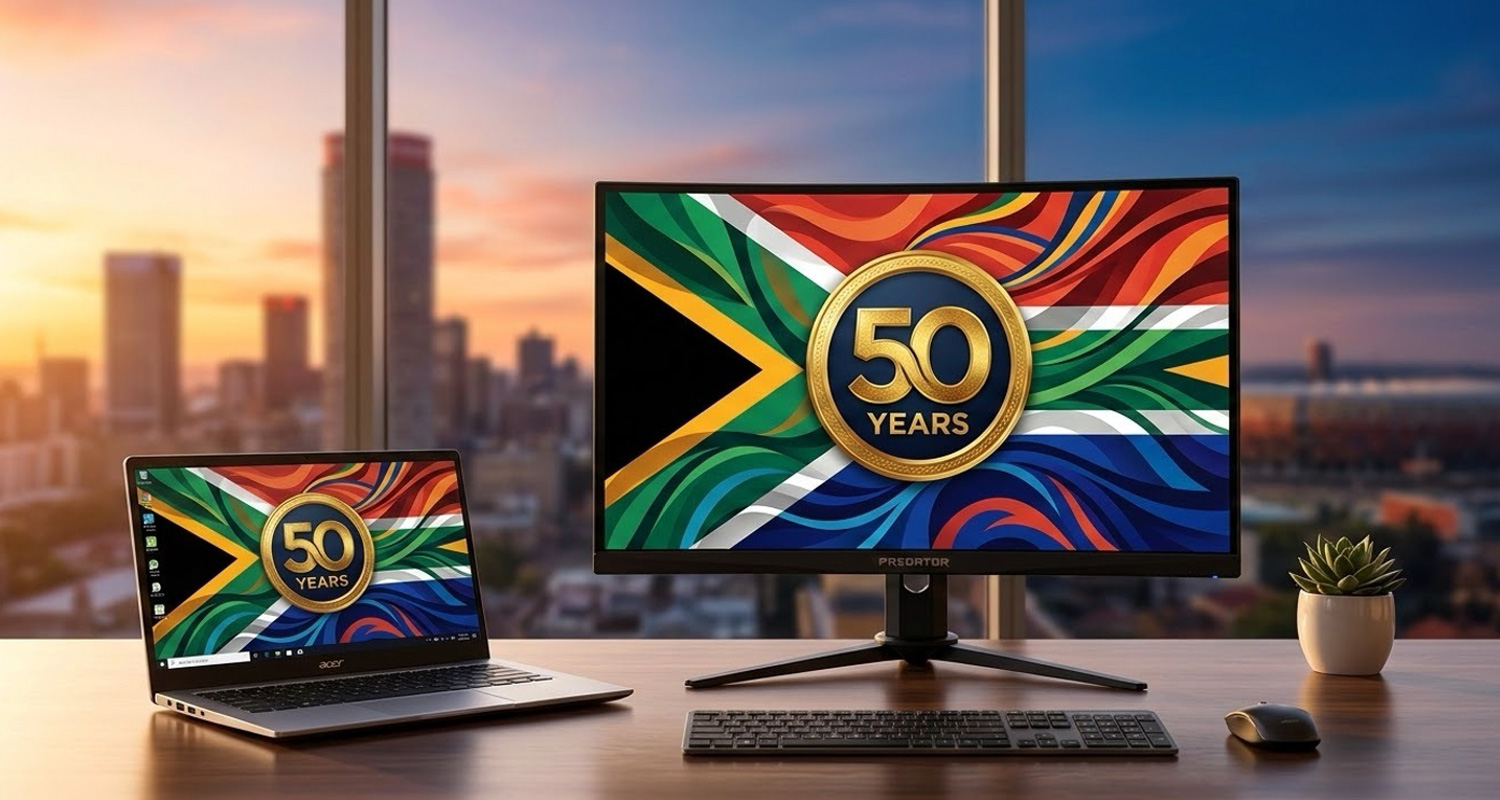
As global technology pioneer Acer marks half a century under its “50 Years of Breaking Barriers” campaign, its South African operation – established in 1994 – is proving that the answer to global hardware bottlenecks lies in local strategy and architectural innovation. By evolving from a hardware importer into a domestic manufacturer and a testing ground for new global product categories, Acer is redefining how technology stays accessible during a punishing inflationary cycle.
Acer’s journey began with NT$1-million in start-up capital and an early bet on microprocessor technology. The company went on to launch Taiwan’s first 8-bit home computer, beat IBM to market with 32-bit PCs and pioneered the world’s thinnest laptops.
Today, under its 2026 “The Next Breaking Barriers” strategy, the brand is actively transitioning into a broader digital lifestyle and solutions provider.
Acer’s presence in South Africa dates back to 1994 when it identified the region as a high-growth market for international expansion. By 1998, it had secured the number-one PC brand spot in the country, establishing deep commercial roots alongside long-standing local channel partners including Tarsus, Mustek, Rectron and more recently Prima Interactive, Syntech and TVR, which all play a unique, targeted role in Acer’s curated distribution into Southern Africa.
Rather than relying purely on fully built imports, Acer has consolidated its local footprint through several key infrastructure wins:
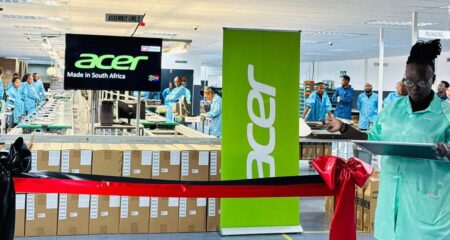
- The Boksburg assembly facility: With an official partnership established in 2024 in Gauteng, this purpose-built plant handles the local physical assembly of consumer, commercial and high-end gaming (Nitro and Predator) monitors. The facility employs more than 350 people (scaling to 550 during peak periods), with about 80% of the workforce drawn from women in the surrounding communities. This local manufacturing baseline has successfully insulated regional pricing from volatile shipping costs and import tariffs.
- Johannesburg as a global launchpad: In a major departure from traditional tech rollout patterns, South Africa became the primary global launch market for the Acer AiTV device. The 4K UHD Google TV streaming device was unveiled in Johannesburg a full week before its international debut at IFA Berlin, signalling the group’s confidence in local consumer tech adoption.
- Pioneering the channel ecosystem: To streamline distribution, Acer rolled out its unified Channel Partner Portal. Operating alongside the local “Acer-X” marketplace solution, these platforms give resellers real-time visibility of shared stock-on-hand, breaking down distributor silos and driving an impressive 34% growth in Acer’s local channel business.
- Breaking the AI barrier in South African education: In 2025, with the growth of generative AI, Acer identified the need to support the establishment of a secure sovereign generative AI platform giving teachers, learners and parents a grounded curriculum in all 11 official South African languages, covering 80% of the subjects on offer under the Caps curriculum. In March 2026, in partnership with CapsGPT, Acer for Education launched www.cappi.co.za, a curriculum intelligence LLM platform that allows teachers to plan lessons, build assessments and launch AI-assessed quizzes. Cappi allows learners access to a grounded LLM that eliminates hallucinations and gives parents the ability to assist their young learners without deviating from the official school curriculum in South Africa. With plans to expand and include additional curricula throughout Africa, Acer’s AI innovation in education firmly places it not just as a thought leader in education but as an executor of practical, affordable solutions too.
Navigating the silicon squeeze
The 50-year milestone arrives amid a challenging global hardware landscape, characterised by soaring factory-level DRAM and NAND flash memory costs. While these supply chain constraints apply significant upward pressure on final retail costs across the industry – affecting everything from laptops to Android TV boxes – Acer Africa is routing around these bottlenecks.
“We are living through one of the most exciting, transformative eras in personal computing, where the very definition of what a computer needs to be is being rewritten,” says Glenn du Toit, country manager at Acer Africa. “For a long time, the industry assumed that the dawn of the AI PC would require massive, power-hungry and aggressively expensive hardware. That paradigm is now officially dead.”
Acer’s forward-looking strategy highlights how software agility and smarter silicon are driving down entry-level price points:
- Mainstream AI integration: Microsoft’s optimised Windows 11 updates have shifted local AI operations to run on Small Language Models (SLMs) without requiring high-end hardware. This allows standard, highly efficient silicon like Intel’s Wildcat Lake Series 3 (Core 3, 5 and 7) processors to deliver robust NPU capabilities without the premium price tag, bypassing the high-end component shortage.
- The mobile and tablet evolution: Consumer behaviour is rapidly shifting towards alternative form factors. For the vast majority of everyday users and students, the rapid adoption of Google Chromebooks and large-screen Android 16 tablets equipped with dedicated desktop modes offers a smarter, lighter and vastly more affordable way to work.
- The e10 portfolio: To protect the entry-level market, Acer has launched the e10 ET-Book range. Fully serviced and supported by Acer directly, these devices use highly reliable, value-based architectures to secure consistent product availability. This will culminate in the upcoming launch of the e10-Ai Air that uses Intel’s latest Series 3 Wildcat Lake processors, bringing integrated AI and NPU processing to everyday South African users at a highly accessible price point.
“Breaking barriers between people and technology over the past 50 years through innovation is the core of who we at Acer are. For us, breaking barriers, especially in a market like Africa, requires local solutions to local adoption challenges. One of those challenges is, and will more often remain, affordability. As we see skyrocketing component prices, ensuring Africa has ongoing access to the Acer brand and our technology means our local teams have had to show a very different type of innovation – be that through the launch of the e10 sub-branded Acer product range, locally manufactured PCs and monitors, or the drive to enhance the evolution of the connected home through the Acer AiTV product ranges,” Du Toit says.

“When a raw memory module surges, no hardware vendor can simply fund that gap out of pocket. But the solution to a hardware bottleneck is almost always a combination of a software, hardware and operational triumph,” he concludes. “By understanding our customers and our market, an adjustment on how we do things – supported by a slight adjustment of the technology under the hood, mixed in with a dash of smarter AI into mainstream silicon, and embracing agile platforms – Acer is ensuring that the digital future belongs to everyone, not just those who can afford the highest specs.”
About Acer
Acer is a global technology company that designs, manufactures and sells a broad range of innovative products, including laptops, desktops, monitors and projectors. The company is committed to delivering high-quality products that enhance people’s lives and productivity. For more information about Acer Africa and its range of products, please visit www.acer.com/za-en.
- Read more articles by Acer Africa on TechCentral
- This promoted content was paid for by the party concerned