Close Menu
TechCentralTechCentral

    Subscribe to the newsletter

    Get the best South African technology news and analysis delivered to your e-mail inbox every morning.

    Facebook X (Twitter) YouTube LinkedIn
    WhatsApp Facebook X (Twitter) LinkedIn YouTube
    TechCentralTechCentral
    • News
      Africa's most popular phones have a tracking problem

      Africa’s most popular phones have a tracking problem

      24 July 2026
      Vodacom taps UJ, AWS to build its AI talent pipeline - Vodacom Group CEO Shameel Joosub

      Vodacom taps UJ, AWS to build its AI talent pipeline

      24 July 2026
      Intel is back in the game - Intel CEO Lip-Bu Tan. Laure Andrillon/Reuters

      Intel is back in the game

      24 July 2026
      Fat bonuses at Telkom despite group missing own targets - Serame Taukobong

      Fat bonuses at Telkom despite group missing own targets

      23 July 2026
      Massive changes coming to Amazon Prime Video - Jeff Bezos

      Massive changes coming to Amazon Prime Video

      23 July 2026
    • World
      Meta AI will now tell parents if their teen is in crisis

      Meta AI will now tell parents if their teen is in crisis

      17 July 2026
      IBM shares crash 25% as AI upends software spending - Arvind Krishna

      IBM shares crash 25% as AI upends software spending

      15 July 2026
      Jony Ive's first OpenAI device: an AI smart speaker - Jony Ive and Sam Altman

      Jony Ive’s first OpenAI device: an AI smart speaker

      15 July 2026
      Stripe, Advent in talks to buy PayPal for $53-billion

      Stripe, Advent in talks to buy PayPal for $53-billion

      15 July 2026
      Memory crisis sends smartphone market into steep decline

      Memory crisis sends smartphone market into steep decline

      13 July 2026
    • In-depth
      The plan to stop AI from breaking the world - Google DeepMind CEO Demis Hassabis. Image: John Sears

      The plan to stop AI from breaking the world

      16 July 2026
      The internet has a Strait of Hormuz problem

      The internet has a Strait of Hormuz problem

      15 July 2026
      AI boom sparks rally, frenzy and fear

      AI boom sparks rally, frenzy and fear

      11 June 2026
      Every plug-in hybrid on sale in South Africa, ranked by price - Lamborghini Temerario

      Every plug-in hybrid on sale in South Africa, ranked by price

      7 June 2026
      What Wi-Fi 8 will mean for wireless networks

      What Wi-Fi 8 will mean for wireless networks

      1 June 2026
    • TCS
      TCS | How Optasia lends billions to people banks can't see - Salvador Anglada

      TCS | How Optasia lends billions to people banks can’t see

      23 July 2026
      The rands-and-cents case for electric trucks - William Kelly Watts & Wheels with Wills

      The rands-and-cents case for electric trucks

      20 July 2026
      Watts & Wheels S1E7: 'Ferrari's EV breaks the internet'

      Watts & Wheels S1E7: ‘Ferrari’s EV breaks the internet’

      8 July 2026
      TCS | Pick n Pay's Enrico Ferigolli on Penny, the AI that shops for you

      TCS | Pick n Pay’s Enrico Ferigolli on Penny, the AI that shops for you

      2 July 2026
      TCS+ | How Tracker is turning vehicle data into business strategy - Silvia Schollenberger

      TCS+ | How Tracker is turning vehicle data into business strategy

      1 July 2026
    • Opinion
      Selling vapour is corporate suicide in slow motion - Jannie van Zyl

      Selling vapour is corporate suicide in slow motion

      16 July 2026
      Brazil's online gambling crackdown is a lesson for South Africa

      How Amazon outmanoeuvred Starlink in South Africa

      15 July 2026
      The Popia problem with agentic AI - Herman Haasbroek

      The Popia problem with agentic AI

      14 July 2026
      The author, Fanie van Rooyen

      South Africa can still catch the AI wave – here’s how

      7 July 2026
      The author, Fanie van Rooyen

      The AI utopia South Africa can’t afford

      1 July 2026
    • Company Hubs
      • 1Stream
      • Africa Data Centres
      • AfriGIS
      • Altron Digital Business
      • Altron Document Solutions
      • Altron Group
      • Arctic Wolf
      • Ascent Technology
      • AvertITD
      • BBD
      • Braintree
      • CallMiner
      • CambriLearn
      • CM Telecom
      • Contactable
      • CYBER1 Solutions
      • Digicloud Africa
      • Digimune
      • Domains.co.za
      • ESET
      • Euphoria Telecom
      • HOSTAFRICA
      • Incredible Business
      • iONLINE
      • IQbusiness
      • Iris Network Systems
      • Kaspersky
      • LSD Open
      • Mitel
      • NEC XON
      • Netstar
      • Network Platforms
      • Next DLP
      • Ovations
      • Paracon
      • Paratus
      • Q-KON
      • SevenC
      • SkyWire
      • Solid8 Technologies
      • Telit Cinterion
      • Telviva
      • Tenable
      • Vertiv
      • Videri Digital
      • Vodacom Business
      • Vox
      • Wipro
      • Workday
      • XLink
    • Sections
      • AI and machine learning
      • Banking
      • Broadcasting and Media
      • Cloud services
      • Contact centres and CX
      • Cryptocurrencies
      • Education and skills
      • Electronics and hardware
      • Energy and sustainability
      • Enterprise software
      • Financial services
      • HealthTech
      • Information security
      • Internet and connectivity
      • Internet of Things
      • Investment
      • IT services
      • Lifestyle
      • Policy and regulation
      • Public sector
      • Retail and e-commerce
      • Satellite communications
      • Science
      • SMEs and start-ups
      • Social media
      • Talent and leadership
      • Telecoms
      • Watts & Wheels
    • Events
    • Advertise
    TechCentralTechCentral
    Home » Sections » Energy and sustainability » Anatomy of a crisis: why SA is on the brink of rolling blackouts

    Anatomy of a crisis: why SA is on the brink of rolling blackouts

    By Antoinette Slabbert16 November 2018
    Twitter LinkedIn Facebook WhatsApp Email Telegram Copy Link
    News Alerts
    WhatsApp

    Eskom has shut down 11 power station units due for major maintenance because it lacks the funds to fix them.

    This comes as the embattled power utility struggles to find coal to feed its coal-fired power stations — the bulk of its fleet.

    Moneyweb earlier reported that 11 of Eskom’s 15 coal-fired power stations have less than the required 20 days’ coal stock — and of those, five have less than 10 days’ stock.

    The power stations that do have adequate supply are being run extremely hard, which could lead to further breakdowns and plunge the utility in a further downward spiral.

    According to its latest published forecast covering the 14-week period from 5 November to 10 February, Eskom is likely to have inadequate electricity to meet the country’s demand for most of that time.
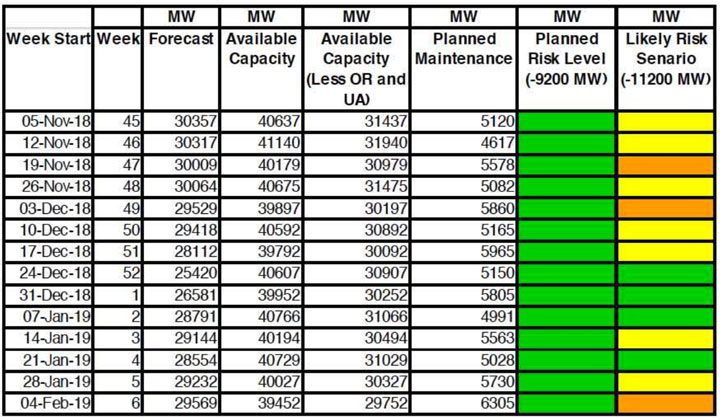
    Eskom’s three-month forecast of weekly demand versus available generating capacity. The coloured blocks indicate the absence or presence of a capacity constraint: green (adequate generation; no shortage), yellow (possibility of not being able to meet reserves) and orange (definitively too short to meet reserves and, possibly, demand). Note that OR refers to ‘operating reserve’ and UA to ‘unplanned outage assumption’. Source: Eskom weekly system status report, week 44 of 2018

    That means Eskom would be utilising expensive energy from the diesel-driven turbines owned by independent power producers, including the Avon and Dedisa peaking power facilities. When that is inadequate to plug the supply hole, South Africa will face load shedding.

    The extensive use of diesel generators is set to increase Eskom’s financial headaches and give further momentum to the downward spiral.

    The developments come as national energy regulator Nersa awaits written submissions on an Eskom application for a 15% tariff increase on 1 April next year and another 15% for each of the two following years. The deadline for submissions is 30 November.

    The extensive use of diesel generators is set to increase Eskom’s financial headaches and give further momentum to the downward spiral

    If Nersa approves the full revenue amount Eskom applies for, the 15% increase will be on top of a 4.41% increase already approved for 1 April next year as part of a four-year recovery plan for amounts under-recovered in previous years.

    Eskom has submitted a further application to recover R21.6-billion to compensate it for under-recoveries in 2017/2018. If approved, any part of this tabled for recovery in the next financial year will add to the percentage increase consumers face in April.

    During a media workshop about its current tariff applications this week, Eskom Generation Group middle manager Brad Ross-Jones revealed that Eskom has closed 11 of the 25 generation units at three of its power stations — Grootvlei, Komati and Hendrina. That’s almost half the generation capacity of these three.

    The 11 units have been placed in reserve storage, which means they can be restored to working order within a year provided there is money to buy the spares and the spares are available. He confirmed that some of the spares could have long lead times between placing the order and taking delivery.

    Reserve storage

    Ross-Jones explained that when units reach a stage where the operational cost is high and they need major capital intervention, Eskom places them in reserve storage since it does not have the money to do the required maintenance.

    At the same time Eskom told journalists that it is not feasible to decommission (or “permanently dismantle”) power stations — a move suggested by many commentators when Eskom said it had excess generation capacity.

    Nersa seemed to share this view and based its tariff determination for the current year on its view that Eskom should decommission its Arnot and Hendrina coal-fired power stations.

    Eskom is taking the Nersa decision on review in the high court. No date has been set for the hearing.
    Eskom told journalists that according to its operational analysis it cannot decommission any of its commercial units unless: it maintains an energy availability factor (EAF) of 78%; new build projects are completed within current deadlines; renewable energy projects up to bid round 4.5 of the Renewable Energy Independent Power Procurement Programme start delivering power commercially as planned; and assuming realistic demand growth and a 50-year life for coal stations.

    So far this year, the Eskom fleet’s EAF has been on average 72.99%. In the past weeks, it has deteriorated to well below 70%. (This would have been even worse if the units in reserve storage had been included in the calculation, but Eskom confirmed that they weren’t.)

    In light of this and the possibility that other assumptions may play out differently, Eskom believes that Grootvlei, Komati and Hendrina should be retained in reserve storage as “insurance”.

    The question, however, remains whether such “insurance” would pay off unless Eskom has the money to pay for spares and the capacity to plan ahead and order the necessary components in time.

    • This article was originally published on Moneyweb and is used here with permission

    Follow TechCentral on Google News Add TechCentral as your preferred source on Google


    Eskom top
    WhatsApp YouTube
    Share. Facebook Twitter LinkedIn WhatsApp Telegram Email Copy Link
    Previous ArticleReport urges Eskom, Transnet criminal probes
    Next Article Google’s high-flying balloons to provide Internet in Africa

    Related Posts

    Load shedding is over - and that's exposing a new energy crisis

    Load shedding is over – and that’s exposing a new energy crisis

    23 July 2026
    Eskom quashes Koeberg contamination reports

    Eskom scrambles to quash Koeberg contamination reports

    19 July 2026
    Eskom appoints group executive for renewable energy - Rivoningo Mnisi

    Eskom Green cleared for take-off

    16 July 2026
    Company News
    Why Europe is turning to South Africa for cross-border innovation - BBD Software

    Why Europe is turning to South Africa for cross-border innovation

    24 July 2026
    Green dashboards, stalled change: the CIO's blind spot - Change Logic Marchant van den Heever

    Green dashboards, stalled change: the CIO’s blind spot

    24 July 2026
    Why Africa's cloud needs more than one path - Africa Data Centres

    Why Africa’s cloud needs more than one path

    23 July 2026
    Opinion
    Selling vapour is corporate suicide in slow motion - Jannie van Zyl

    Selling vapour is corporate suicide in slow motion

    16 July 2026
    Brazil's online gambling crackdown is a lesson for South Africa

    How Amazon outmanoeuvred Starlink in South Africa

    15 July 2026
    The Popia problem with agentic AI - Herman Haasbroek

    The Popia problem with agentic AI

    14 July 2026

    Subscribe to Updates

    Get the best South African technology news and analysis delivered to your e-mail inbox every morning.

    Latest Posts
    Africa's most popular phones have a tracking problem

    Africa’s most popular phones have a tracking problem

    24 July 2026
    Vodacom taps UJ, AWS to build its AI talent pipeline - Vodacom Group CEO Shameel Joosub

    Vodacom taps UJ, AWS to build its AI talent pipeline

    24 July 2026
    Intel is back in the game - Intel CEO Lip-Bu Tan. Laure Andrillon/Reuters

    Intel is back in the game

    24 July 2026
    Why Europe is turning to South Africa for cross-border innovation - BBD Software

    Why Europe is turning to South Africa for cross-border innovation

    24 July 2026
    © 2009 - 2026 NewsCentral Media
    Built and maintained by Chronon
    • Cookie policy (ZA)
    • TechCentral – privacy and Popia

    Type above and press Enter to search. Press Esc to cancel.

    Manage consent

    TechCentral uses cookies to enhance its offerings. Consenting to these technologies allows us to serve you better. Not consenting or withdrawing consent may adversely affect certain features and functions of the website.

    Functional Always active
    The technical storage or access is strictly necessary for the legitimate purpose of enabling the use of a specific service explicitly requested by the subscriber or user, or for the sole purpose of carrying out the transmission of a communication over an electronic communications network.
    Preferences
    The technical storage or access is necessary for the legitimate purpose of storing preferences that are not requested by the subscriber or user.
    Statistics
    The technical storage or access that is used exclusively for statistical purposes. The technical storage or access that is used exclusively for anonymous statistical purposes. Without a subpoena, voluntary compliance on the part of your Internet Service Provider, or additional records from a third party, information stored or retrieved for this purpose alone cannot usually be used to identify you.
    Marketing
    The technical storage or access is required to create user profiles to send advertising, or to track the user on a website or across several websites for similar marketing purposes.
    • Manage options
    • Manage services
    • Manage {vendor_count} vendors
    • Read more about these purposes
    View preferences
    • {title}
    • {title}
    • {title}