
Close Menu
TechCentralTechCentral

    Subscribe to the newsletter

    Get the best South African technology news and analysis delivered to your e-mail inbox every morning.

    Facebook X (Twitter) YouTube LinkedIn
    WhatsApp Facebook X (Twitter) LinkedIn YouTube
    TechCentralTechCentral
    • News
      The last generation of coders

      The last generation of coders

      18 February 2026
      The AI fraud crisis your bank is not ready for - Andries Maritz

      The AI fraud crisis your bank is not ready for

      18 February 2026
      Vibe coding is transforming development - but at what cost to open source? - Julian Gericke

      Vibe coding is transforming development – but at what cost to open source?

      18 February 2026
      SA film industry to get funding boost and digital overhaul after outcry

      SA film industry to get funding boost and digital overhaul after outcry

      18 February 2026
      MTN to buy back its own towers in R35-billion deal - Ralph Mupita

      MTN to buy back its own cellular towers in R35-billion deal

      17 February 2026
    • World
      Prominent Southern African journalist targeted with Predator spyware

      Prominent Southern African journalist targeted with Predator spyware

      18 February 2026
      More drama in Warner Bros tug of war

      More drama in Warner Bros tug of war

      17 February 2026
      Russia bans WhatsApp

      Russia bans WhatsApp

      12 February 2026
      EU regulators take aim at WhatsApp

      EU regulators take aim at WhatsApp

      9 February 2026
      Musk hits brakes on Mars mission

      Musk hits brakes on Mars mission

      9 February 2026
    • In-depth
      How liberalisation is rewiring South Africa's power sector

      How liberalisation is rewiring South Africa’s power sector

      21 January 2026
      The top-performing South African tech shares of 2025

      The top-performing South African tech shares of 2025

      12 January 2026
      Digital authoritarianism grows as African states normalise internet blackouts

      Digital authoritarianism grows as African states normalise internet blackouts

      19 December 2025
      TechCentral's South African Newsmakers of 2025

      TechCentral’s South African Newsmakers of 2025

      18 December 2025
      Black Friday goes digital in South Africa as online spending surges to record high

      Black Friday goes digital in South Africa as online spending surges to record high

      4 December 2025
    • TCS
      Watts & Wheels S1E4: 'We drive an electric Uber'

      Watts & Wheels S1E4: ‘We drive an electric Uber’

      10 February 2026
      TCS+ | How Cloud On Demand is helping SA businesses succeed in the cloud - Xhenia Rhode, Dion Kalicharan

      TCS+ | Cloud On Demand and Consnet: inside a real-world AWS partner success story

      30 January 2026
      Watts & Wheels S1E4: 'We drive an electric Uber'

      Watts & Wheels S1E3: ‘BYD’s Corolla Cross challenger’

      30 January 2026
      Watts & Wheels S1E4: 'We drive an electric Uber'

      Watts & Wheels S1E2: ‘China attacks, BMW digs in, Toyota’s sublime supercar’

      23 January 2026

      TCS+ | Why cybersecurity is becoming a competitive advantage for SA businesses

      20 January 2026
    • Opinion
      A million reasons monopolies don't work - Duncan McLeod

      A million reasons monopolies don’t work

      10 February 2026
      The author, Business Leadership South Africa CEO Busi Mavuso

      Eskom unbundling U-turn threatens to undo hard-won electricity gains

      9 February 2026
      South Africa's skills advantage is being overlooked at home - Richard Firth

      South Africa’s skills advantage is being overlooked at home

      29 January 2026
      Why Elon Musk's Starlink is a 'hard no' for me - Songezo Zibi

      Why Elon Musk’s Starlink is a ‘hard no’ for me

      26 January 2026
      A million reasons monopolies don't work - Duncan McLeod

      South Africa’s new fibre broadband battle

      20 January 2026
    • Company Hubs
      • Africa Data Centres
      • AfriGIS
      • Altron Digital Business
      • Altron Document Solutions
      • Altron Group
      • Arctic Wolf
      • AvertITD
      • Braintree
      • CallMiner
      • CambriLearn
      • CYBER1 Solutions
      • Digicloud Africa
      • Digimune
      • Domains.co.za
      • ESET
      • Euphoria Telecom
      • Incredible Business
      • iONLINE
      • IQbusiness
      • Iris Network Systems
      • LSD Open
      • Mitel
      • NEC XON
      • Netstar
      • Network Platforms
      • Next DLP
      • Ovations
      • Paracon
      • Paratus
      • Q-KON
      • SevenC
      • SkyWire
      • Solid8 Technologies
      • Telit Cinterion
      • Tenable
      • Vertiv
      • Videri Digital
      • Vodacom Business
      • Wipro
      • Workday
      • XLink
    • Sections
      • AI and machine learning
      • Banking
      • Broadcasting and Media
      • Cloud services
      • Contact centres and CX
      • Cryptocurrencies
      • Education and skills
      • Electronics and hardware
      • Energy and sustainability
      • Enterprise software
      • Financial services
      • Information security
      • Internet and connectivity
      • Internet of Things
      • Investment
      • IT services
      • Lifestyle
      • Motoring
      • Public sector
      • Retail and e-commerce
      • Satellite communications
      • Science
      • SMEs and start-ups
      • Social media
      • Talent and leadership
      • Telecoms
    • Events
    • Advertise
    TechCentralTechCentral
    Home » Top » Apple sues Qualcomm in antitrust case

    Apple sues Qualcomm in antitrust case

    By Agency Staff23 January 2017
    Twitter LinkedIn Facebook WhatsApp Email Telegram Copy Link
    News Alerts
    WhatsApp

    Apple has sued Qualcomm, accusing it of monopolising the market for chips for wireless devices and withholding US$1bn in retaliation for cooperating with South Korean antitrust authorities.

    Apple is demanding Qualcomm hand over money that was supposed to be a rebate for licensing fees. Qualcomm is holding back the money as punishment for Apple cooperating with Korean antitrust regulators, according to the complaint filed in San Diego, California where Qualcomm is based.

    Apple also wants back some of the billions of dollars it claims it was overcharged in “Qualcomm’s illegal scheme” to control the market for mobile phone chips. It wants a court to change how Qualcomm charges for its technology in the future.

    Qualcomm, the largest maker of mobile phone chips, has been under fire by regulators around the world for its patent licensing practices. The lawsuit filed on Friday is the first direct challenge by one of its biggest customers and threatens to upend how royalties are calculated by any owner of a patent on technology that underlies modern electronics.

    Apple is facing pressure to squeeze more profit out of every iPhone after revenue declined last year for the first time since 2001, dragged down by lower handset sales. It typically sources the same component from several suppliers, which helps secure lower prices by forcing the manufacturers to compete on price.

    “It is quite clear that Apple’s claims are baseless,” Qualcomm general counsel Don Rosenberg said in a statement. “Apple has intentionally mischaracterised our agreements and negotiations, as well as the enormity and value of the technology we have invented, contributed and shared with all mobile device makers through our licensing programme.”

    Qualcomm also accused Apple of encouraging regulators to attack it in “various jurisdictions around the world” by “misrepresenting facts and withholding information”.

    “Qualcomm built its business on older, legacy, standards but reinforces its dominance through exclusionary tactics and excessive royalties,” Apple said in a statement. “Despite being just one of over a dozen companies which contributed to basic cellular standards, Qualcomm insists on charging Apple at least five times more in payments than all the other cellular patent licensors we have agreements with combined.”

    The complaint also challenges the validity of some key Qualcomm patents for wireless technologies. Apple asks the court to rule that, if the patents are upheld, that the royalty amount is significantly lower than what Qualcomm charges now.

    In December, South Korea, home to two of Qualcomm’s largest customers, fined the company 1,03 trillion won ($890m) and described its practices as monopolistic. Qualcomm has said it will appeal the decision.

    Under the agreement with Qualcomm, Apple said it was forced to refrain from taking any steps to challenge Qualcomm’s business model.
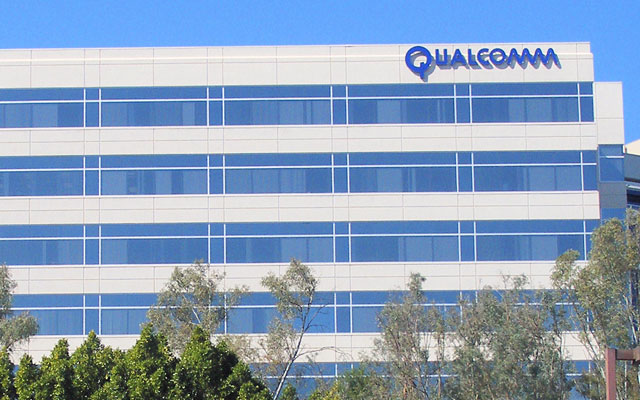
    Qualcomm’s head office in San Diego, California

    Apple complied with investigation demands from Korean regulators, an action Qualcomm claimed was in violation of the agreement. In retaliation, Qualcomm withheld money that it was due to pay Apple in royalty rebates, the iPhone maker said.

    Qualcomm offered to pay the money “if Apple retracted and corrected its statements to government agencies”, according to the complaint.

    More trouble

    South Korean regulators aren’t the only authorities investigating Qualcomm.

    The US Federal Trade Commission on 17 January filed its own antitrust suit against Qualcomm. The chip maker is also being investigated by the European Union and Taiwanese authorities.

    At the heart of the dispute between Apple and Qualcomm is a push by phone makers with the support of regulators to reduce the patent royalties Qualcomm charges.

    Qualcomm gets the bulk of its revenue from selling chips, but more than half of its profit from the separate licensing business. Its patents cover the fundamentals of cellular technology, allowing it to rake in billions in licensing fees. In other words, the chip maker gets paid regardless of whether its chips are used in mobile phones or not.

    One common thread in all of the cases is the contention that royalty rates should be calculated as a percentage of the price of the components in the phone that Qualcomm invents and sells — measured in tens of dollars. Currently licensing is a percentage of the price of the entire phone, which is usually in the hundreds of dollars.

    Companies collaborate to develop industry standards so that the devices can communicate with each other. Since they have the ability to ensure their inventions get included in the standards, they pledge to license on “fair, reasonable and non-discriminatory” terms.

    Qualcomm has breached that pledge by refusing to license its patents to Intel, a rival chip maker that’s been providing some chips to Apple for the past year, according to the complaint.

    Bullying accusations

    Apple accused Qualcomm of bullying it, threatening to withhold chip supply, forcing it to agree not to challenge Qualcomm’s patents and using Apple innovations to help its competitors.

    Much of the money Qualcomm collects on the iPhone or iPad is paid by third-party manufacturers who pass along the cost, according to the complaint. Apple said Qualcomm can demand higher royalties because those manufacturers “have no incentive to negotiate”.

    Apple said it’s not allowed to see those agreements, and believes Qualcomm gets paid multiple times on the same device. Since Qualcomm won’t give Apple a direct licence, it instead agreed to give Apple a rebate — money that it’s now withholding.  — (c) 2017 Bloomberg LP



    Apple Qualcomm Samsung
    WhatsApp YouTube Follow on Google News Add as preferred source on Google
    Share. Facebook Twitter LinkedIn WhatsApp Telegram Email Copy Link
    Previous ArticleRevealed: why the Note7 caught fire
    Next Article Apple’s Qualcomm assault is margin grab

    Related Posts

    AI chatbots are coming to Apple CarPlay

    AI chatbots are coming to Apple CarPlay

    8 February 2026
    Smartphone market hit by deepening memory crisis

    Smartphone market hit by deepening memory crisis

    5 February 2026
    Google goes from laggard to leader in AI

    Google goes from laggard to leader in AI

    5 February 2026
    Company News
    The quiet infrastructure powering AI: why long-life IOT networks matter more than ever - Sigfox South Africa

    The quiet infrastructure powering AI: why long-life IoT networks matter more than ever

    18 February 2026
    Scaling modern, data-driven farming across Africa - Chris Duvenage

    Scaling modern, data-driven farming across Africa

    17 February 2026
    Why getting your small business online costs less than you think

    Why getting your small business online costs less than you think

    17 February 2026
    Opinion
    A million reasons monopolies don't work - Duncan McLeod

    A million reasons monopolies don’t work

    10 February 2026
    The author, Business Leadership South Africa CEO Busi Mavuso

    Eskom unbundling U-turn threatens to undo hard-won electricity gains

    9 February 2026
    South Africa's skills advantage is being overlooked at home - Richard Firth

    South Africa’s skills advantage is being overlooked at home

    29 January 2026

    Subscribe to Updates

    Get the best South African technology news and analysis delivered to your e-mail inbox every morning.

    Latest Posts
    The last generation of coders

    The last generation of coders

    18 February 2026
    The AI fraud crisis your bank is not ready for - Andries Maritz

    The AI fraud crisis your bank is not ready for

    18 February 2026
    Vibe coding is transforming development - but at what cost to open source? - Julian Gericke

    Vibe coding is transforming development – but at what cost to open source?

    18 February 2026
    SA film industry to get funding boost and digital overhaul after outcry

    SA film industry to get funding boost and digital overhaul after outcry

    18 February 2026
    © 2009 - 2026 NewsCentral Media
    • Cookie policy (ZA)
    • TechCentral – privacy and Popia

    Type above and press Enter to search. Press Esc to cancel.

    Manage consent

    TechCentral uses cookies to enhance its offerings. Consenting to these technologies allows us to serve you better. Not consenting or withdrawing consent may adversely affect certain features and functions of the website.

    Functional Always active
    The technical storage or access is strictly necessary for the legitimate purpose of enabling the use of a specific service explicitly requested by the subscriber or user, or for the sole purpose of carrying out the transmission of a communication over an electronic communications network.
    Preferences
    The technical storage or access is necessary for the legitimate purpose of storing preferences that are not requested by the subscriber or user.
    Statistics
    The technical storage or access that is used exclusively for statistical purposes. The technical storage or access that is used exclusively for anonymous statistical purposes. Without a subpoena, voluntary compliance on the part of your Internet Service Provider, or additional records from a third party, information stored or retrieved for this purpose alone cannot usually be used to identify you.
    Marketing
    The technical storage or access is required to create user profiles to send advertising, or to track the user on a website or across several websites for similar marketing purposes.
    • Manage options
    • Manage services
    • Manage {vendor_count} vendors
    • Read more about these purposes
    View preferences
    • {title}
    • {title}
    • {title}