
Close Menu
TechCentralTechCentral

    Subscribe to the newsletter

    Get the best South African technology news and analysis delivered to your e-mail inbox every morning.

    Facebook X (Twitter) YouTube LinkedIn
    WhatsApp Facebook X (Twitter) LinkedIn YouTube
    TechCentralTechCentral
    • News
      Hyperscalers ate my next computer

      Hyperscalers ate my next computer

      8 May 2026
      Major African telco postpones mobile money listing

      Major African telco postpones mobile money listing

      8 May 2026
      Cabinet approves new permanent Sita board, ending years of turmoil - State IT Agency

      Cabinet approves new permanent Sita board, ending years of turmoil

      8 May 2026
      A 12-year-old competition case lands on Canal+'s desk - Altech Node

      A 12-year-old competition case lands on Canal+’s desk

      8 May 2026
      Why South Africa is Zoho's third-fastest-growing market - Andrew Bourne

      Why South Africa is Zoho’s third-fastest-growing market

      8 May 2026
    • World
      OpenAI's new audio APIs aim for conversational voice agents

      OpenAI’s new audio APIs aim for conversational voice agents

      8 May 2026
      'It was my idea': Musk claims paternity of OpenAI - Elon Musk

      ‘It was my idea’: Musk claims paternity of OpenAI

      29 April 2026
      Pivotal week for US tech stocks

      Pivotal week for US tech stocks

      28 April 2026
      Worries over OpenAI's growth as Anthropic gains ground - Sam Altman. Shelby Tauber/Reuters

      Worries over OpenAI’s growth as Anthropic gains ground

      28 April 2026
      Taylor Swift trademarks her voice to fight AI fakes

      Taylor Swift trademarks her voice to fight AI fakes

      28 April 2026
    • In-depth
      Alfa's electric rebel - Alfa Romeo Junior Elettrica Veloce

      Alfa’s electric rebel

      29 April 2026
      Africa switches on as Europe dims the lights

      Africa switches on as Europe dims the lights

      9 April 2026
      The biggest untapped EV market on Earth is hiding in plain sight

      The biggest untapped EV market on Earth is hiding in plain sight

      1 April 2026
      Datatec is firing on all cylinders - Jens Montanana

      The R16-billion tech giant hiding in plain sight

      26 March 2026
      The last generation of coders

      The last generation of coders

      18 February 2026
    • TCS
      Michael Rossouw

      TCS+ | The retirement decision most South Africans get wrong

      6 May 2026
      TCS | The Cape Town start-up listening for TB with AI - Braden van Breda

      TCS | The Cape Town start-up listening for TB with AI

      4 May 2026

      TCS+ | ‘The ISP for ISPs’: Vox’s shift to wholesale aggregator

      20 April 2026
      TCS | Werner Lindemann on how AI is rewriting the infosec rulebook

      TCS | Werner Lindemann on how AI is rewriting the infosec rulebook

      15 April 2026
      TCS | Donovan Marsh on AI and the future of filmmaking

      TCS | Donovan Marsh on AI and the future of filmmaking

      7 April 2026
    • Opinion
      Free calls, dead voice and Shameel Joosub's Spanish ghost - Duncan McLeod

      Free calls, dead voice and Shameel Joosub’s Spanish ghost

      22 April 2026
      The conflict of interest at the heart of PayShap's slow adoption - Cheslyn Jacobs

      The conflict of interest at the heart of PayShap’s slow adoption

      26 March 2026
      South Africa's energy future hinges on getting wheeling right - Aishah Gire

      South Africa’s energy future hinges on getting wheeling right

      10 March 2026
      Free calls, dead voice and Shameel Joosub's Spanish ghost - Duncan McLeod

      Apple just dropped a bomb on the Windows world

      5 March 2026
      R230-million in the bag for Endeavor's third Harvest Fund - Alison Collier

      VC’s centre of gravity is shifting – and South Africa is in the frame

      3 March 2026
    • Company Hubs
      • 1Stream
      • Africa Data Centres
      • AfriGIS
      • Altron Digital Business
      • Altron Document Solutions
      • Altron Group
      • Arctic Wolf
      • Ascent Technology
      • AvertITD
      • BBD
      • Braintree
      • CallMiner
      • CambriLearn
      • Contactable
      • CYBER1 Solutions
      • Digicloud Africa
      • Digimune
      • Domains.co.za
      • ESET
      • Euphoria Telecom
      • HOSTAFRICA
      • Incredible Business
      • iONLINE
      • IQbusiness
      • Iris Network Systems
      • Kaspersky
      • LSD Open
      • Mitel
      • NEC XON
      • Netstar
      • Network Platforms
      • Next DLP
      • Ovations
      • Paracon
      • Paratus
      • Q-KON
      • SevenC
      • SkyWire
      • Solid8 Technologies
      • Telit Cinterion
      • Telviva
      • Tenable
      • Vertiv
      • Videri Digital
      • Vodacom Business
      • Wipro
      • Workday
      • XLink
    • Sections
      • AI and machine learning
      • Banking
      • Broadcasting and Media
      • Cloud services
      • Contact centres and CX
      • Cryptocurrencies
      • Education and skills
      • Electronics and hardware
      • Energy and sustainability
      • Enterprise software
      • Financial services
      • HealthTech
      • Information security
      • Internet and connectivity
      • Internet of Things
      • Investment
      • IT services
      • Lifestyle
      • Motoring
      • Policy and regulation
      • Public sector
      • Retail and e-commerce
      • Satellite communications
      • Science
      • SMEs and start-ups
      • Social media
      • Talent and leadership
      • Telecoms
    • Events
    • Advertise
    TechCentralTechCentral
    Home » In-depth » Bitcoin for beginners

    Bitcoin for beginners

    By Editor17 June 2011
    Twitter LinkedIn Facebook WhatsApp Email Telegram Copy Link
    News Alerts
    WhatsApp

    All currencies are based on trust. In the days of the gold standard, that meant trusting that paper money was backed by bullion in a reserve. Centralisation was necessary in order to prevent counterfeiting and ensure money wasn’t simply printed on a whim.

    Of course, experience has shown that centralisation isn’t failsafe. Hence, economists have long theorised about the possibility of a decentralised currency. Bitcoin may be the currency they’ve been waiting for.

    Bitcoin was created in 2009 by a programmer known as Satoshi Nakomoto (no doubt a pseudonym) and describes itself as a decentralised digital currency. It’s an open peer-to-peer currency, so there is no central issuing authority — a distributed network collectively manages both new money entering the market and all transactions within it.

    Because a central authority doesn’t control “Bitcoins”, they can’t be artificially inflated or deflated. The network controls the rate at which Bitcoins are created, cryptography means only the owner of any given Bitcoin can spend it, and the network’s record of every transaction ensures that users cannot duplicate their Bitcoins or spend them more than once.

    This system of recording transactions is called the “blockchain”. It verifies all transactions and performs the necessary encryption on the network via the processing power of individual peer’s processors and graphics cards. This process is called “mining”, and miners are rewarded with Bitcoins for letting the network utilise their machines’ processing power through a complicated algorithm-based allocation system.

    Being a peer-to-peer network with no central network server — similar to other peer-to-peer networks like BitTorrent — the Bitcoin network can’t be shut down. As a result, some have dubbed it the “Napster of banking”.

    Also, there are no middlemen as there are in traditional banking — anyone with a digital Bitcoin wallet (another requirement for those looking to accept or trade in the currency) can pay anyone else with one, directly. Bitcoins can be split to eight decimal points, which also makes them far more flexible than traditional currencies.

    The question is: can you actually use them like cash? The short answer is yes. Users can earn Bitcoins by mining, or by accepting them as payment for goods and services. Similarly, Bitcoins can be spent on goods or services with vendors who accept them, or sold for traditional currency to those who want them on open markets like Mt Gox.

    Bitcoin transactions are deliberately irreversible — like cash, they can be given back to you, but you can’t reverse a Bitcoin transaction like you can a card transaction.
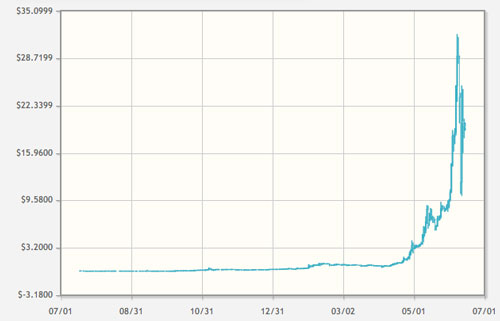
    Bitcoin exchange rate against the US dollar since 2009

    Bitcoin is a finite currency because, by design, the system will only ever allow for the creation of 21m BTC (Bitcoin’s equivalent of USD or ZAR) of which approximately 6,5m — worth around US$100m at the rate of around $16,80 to BTC1 – are currently in circulation.

    The supply of Bitcoins increases at a declining rate (for example, the supply increases by 50% in the second year, 30% in the third, and so on), so one of the worries is that the sudden boom in media coverage will result in greater demand than supply, and thus deflation – even if the people behind Bitcoin would have you believe it’s inflation and deflation proof.

    Also, there are concerns that a very small part of the Bitcoin economy’s activity comes from users actually using Bitcoins. It seems many people are mining Bitcoins — with some even building dedicated, custom, electricity-devouring mining machines — and promptly sitting on them, hoping their value will increase massively so that they can sell them for a sizeable profit (minus their electricity costs, of course).

    One of the few sites seeing lively Bitcoin trade is online marketplace Silk Road. Silk Road is a digital black market for drugs, complete with an Amazon or eBay-style feedback system for buyers and sellers. One can’t, however, simply log on. To get to Silk Road you have to use the TOR network, which essentially hides your IP address making you digitally anonymous and thus making it almost impossible for anyone, like say pesky law enforcement officers, to track you down.

    However, those looking to use Bitcoins on sites like Silk Road should remember that all Bitcoin transactions are recorded and that a sufficiently motivated party with the requisite forensic computing skills could trace the transaction’s source.

    Silk Road is only one example of the possibilities afforded by a digital currency like Bitcoin and, understandably, it’s one that has been getting a hard time from conservatives and Bitcoin users alike. Many users don’t want the currency seen as nothing more than tokens for black-market trade.

    Currently, one of the greatest obstacles facing Bitcoin is its complexity. Setting up a digital wallet isn’t overly complicated, but ensuring it’s suitably secure and backed up is more so. Actually mining Bitcoins, meanwhile, is tricky for the moderately technologically savvy, and probably nearly impossible for those who think Napster is some sort of sleeping pill.

    However, many now widespread technologies started off complicated and gradually became simpler. Remember how limited sites like Blogger or WordPress were in their early days, and thus how few blogs there were? Nevertheless, there was clearly a market for sites that made blogging easy, and now there are millions of blogs.

    Similarly, there’s certainly a demand for simpler, lower-cost banking services that aren’t subject to political borders, state interference, or reserve bank whims. Bitcoin may not prove to be the answer; it may instead prove to be the forerunner of the answer in much the same way that Napster was a precursor for services like BitTorrent.

    From a government and regulatory perspective, Bitcoin is terrifying. If governments aren’t privy to individual’s personal economies, they can’t tax, collect debts, seize assets or otherwise interfere with individuals’ finances. For libertarians, anarchists and their ilk, that’s an incredibly exciting prospect.

    The most important thing for Bitcoin users to remember, and for newcomers to learn, is that the weakest point in the network is your digital wallet. It’s your responsibility to keep it secure, encrypted and backed up. If you lose access to it, your Bitcoins are gone forever. If you fail to protect it sufficiently, your Bitcoins could get stolen like this guy’s did.

    Mike Schussler of Economists.co.za says a currency is “only what people believe it is”.

    “For a while, people used seashells, then coins, then paper money, and now, increasingly, electronic numbers,” he says. “The only rule with currency is that people have to trust it. If they do, it works. Any currency is only meaningful if you can exchange it for tangible goods or services.”

    Bitcoin can be exchanged for goods and services, but whether or not it will manage to tick the requisite trust box remains to be seen. For now, it isn’t for the fainthearted or technologically challenged.

    Some argue it’s going to change the world, others argue it’s going to die with a whimper and a blood-curdling howl from heavily invested users. Either way, it’s an intriguing concept and one that technophiles and economists alike are going to be watching closely.  — Craig Wilson, TechCentral

    • Subscribe to our free daily newsletter
    • Follow us on Twitter or on Facebook

    Follow TechCentral on Google News Add TechCentral as your preferred source on Google


    Bitcoin BitTorrent Mike Schussler Satoshi Nakomoto
    WhatsApp YouTube
    Share. Facebook Twitter LinkedIn WhatsApp Telegram Email Copy Link
    Previous ArticleTelkom’s #EpicFail
    Next Article TalkCentral: Episode 42 – ‘Eclipsed’

    Related Posts

    Treasury moves to bring crypto under exchange-control rules

    Treasury moves to bring crypto under exchange-control rules

    25 February 2026
    Bitcoin faces another reckoning

    Bitcoin faces another reckoning

    6 February 2026
    Crypto markets reel as bitcoin slides

    Crypto markets reel as bitcoin slides

    5 February 2026
    Company News
    Your databases are being watched - just not by you - Ascent Technology Johan Lambert

    Your databases are being watched – just not by you

    8 May 2026
    Hexion deploys 30 petabyte sovereign data archive in South Africa

    Hexion deploys 30 petabyte sovereign data archive in South Africa

    7 May 2026
    We're hiring: TechCentral is looking for technology journalists

    We’re hiring: TechCentral is looking for technology journalists

    6 May 2026
    Opinion
    Free calls, dead voice and Shameel Joosub's Spanish ghost - Duncan McLeod

    Free calls, dead voice and Shameel Joosub’s Spanish ghost

    22 April 2026
    The conflict of interest at the heart of PayShap's slow adoption - Cheslyn Jacobs

    The conflict of interest at the heart of PayShap’s slow adoption

    26 March 2026
    South Africa's energy future hinges on getting wheeling right - Aishah Gire

    South Africa’s energy future hinges on getting wheeling right

    10 March 2026

    Subscribe to Updates

    Get the best South African technology news and analysis delivered to your e-mail inbox every morning.

    Latest Posts
    Hyperscalers ate my next computer

    Hyperscalers ate my next computer

    8 May 2026
    Major African telco postpones mobile money listing

    Major African telco postpones mobile money listing

    8 May 2026
    Cabinet approves new permanent Sita board, ending years of turmoil - State IT Agency

    Cabinet approves new permanent Sita board, ending years of turmoil

    8 May 2026
    Your databases are being watched - just not by you - Ascent Technology Johan Lambert

    Your databases are being watched – just not by you

    8 May 2026
    © 2009 - 2026 NewsCentral Media
    • Cookie policy (ZA)
    • TechCentral – privacy and Popia

    Type above and press Enter to search. Press Esc to cancel.

    Manage consent

    TechCentral uses cookies to enhance its offerings. Consenting to these technologies allows us to serve you better. Not consenting or withdrawing consent may adversely affect certain features and functions of the website.

    Functional Always active
    The technical storage or access is strictly necessary for the legitimate purpose of enabling the use of a specific service explicitly requested by the subscriber or user, or for the sole purpose of carrying out the transmission of a communication over an electronic communications network.
    Preferences
    The technical storage or access is necessary for the legitimate purpose of storing preferences that are not requested by the subscriber or user.
    Statistics
    The technical storage or access that is used exclusively for statistical purposes. The technical storage or access that is used exclusively for anonymous statistical purposes. Without a subpoena, voluntary compliance on the part of your Internet Service Provider, or additional records from a third party, information stored or retrieved for this purpose alone cannot usually be used to identify you.
    Marketing
    The technical storage or access is required to create user profiles to send advertising, or to track the user on a website or across several websites for similar marketing purposes.
    • Manage options
    • Manage services
    • Manage {vendor_count} vendors
    • Read more about these purposes
    View preferences
    • {title}
    • {title}
    • {title}