Close Menu
TechCentralTechCentral

    Subscribe to the newsletter

    Get the best South African technology news and analysis delivered to your e-mail inbox every morning.

    Facebook X (Twitter) YouTube LinkedIn
    WhatsApp Facebook X (Twitter) LinkedIn YouTube
    TechCentralTechCentral
    • News
      Eskom fixed the fleet and the customers left

      Eskom fixed the fleet and the customers left

      7 August 2026
      DStv chops channels as Canal+ leans harder on sport

      DStv chops channels as Canal+ leans harder on sport

      7 August 2026
      Starlink LEO rival gaining momentum

      Starlink LEO rival gaining momentum

      7 August 2026
      ByteDance goes big - very big - on AI

      ByteDance goes big – very big – on AI

      7 August 2026
      ICT is becoming the centre of gravity at Reunert - Anthonie de Beer and Rob Godlonton

      ICT is becoming the centre of gravity at Reunert

      6 August 2026
    • World
      Meta AI will now tell parents if their teen is in crisis

      Meta AI will now tell parents if their teen is in crisis

      17 July 2026
      IBM shares crash 25% as AI upends software spending - Arvind Krishna

      IBM shares crash 25% as AI upends software spending

      15 July 2026
      Jony Ive's first OpenAI device: an AI smart speaker - Jony Ive and Sam Altman

      Jony Ive’s first OpenAI device: an AI smart speaker

      15 July 2026
      Stripe, Advent in talks to buy PayPal for $53-billion

      Stripe, Advent in talks to buy PayPal for $53-billion

      15 July 2026
      Memory crisis sends smartphone market into steep decline

      Memory crisis sends smartphone market into steep decline

      13 July 2026
    • In-depth
      The plan to stop AI from breaking the world - Google DeepMind CEO Demis Hassabis. Image: John Sears

      The plan to stop AI from breaking the world

      16 July 2026
      The internet has a Strait of Hormuz problem

      The internet has a Strait of Hormuz problem

      15 July 2026
      AI boom sparks rally, frenzy and fear

      AI boom sparks rally, frenzy and fear

      11 June 2026
      Every plug-in hybrid on sale in South Africa, ranked by price - Lamborghini Temerario

      Every plug-in hybrid on sale in South Africa, ranked by price

      7 June 2026
      What Wi-Fi 8 will mean for wireless networks

      What Wi-Fi 8 will mean for wireless networks

      1 June 2026
    • TCS
      TCS+ | Specops' Darren James on continuous trust in an AI world

      TCS+ | Specops’ Darren James on continuous trust in an AI world

      7 August 2026
      TCS+ | How AI is turning hardware into a subscription service - Shane van der Merwe Merchant West

      TCS+ | How AI is turning hardware into a subscription service

      6 August 2026
      TCS+ | Why South African workers must become supervisors of digital labour - Accelera Digital Group Cliff de Wit

      TCS+ | Why South African workers must become supervisors of digital labour

      31 July 2026
      TCS | Rapid deployment rules can't work without municipalities: ACT - Nomvuyiso Batyi

      TCS | Icasa’s rules skip the real bottleneck: ACT

      30 July 2026
      TCS+ | iStore Business on why Apple makes sense for SMEs - Sudesh Pillay and Tamia Nontsikelelo

      TCS+ | iStore Business on why Apple makes sense for SMEs

      30 July 2026
    • Opinion
      The author, Jannie van Zyl

      Selling vapour is corporate suicide in slow motion

      16 July 2026
      Brazil's online gambling crackdown is a lesson for South Africa

      How Amazon outmanoeuvred Starlink in South Africa

      15 July 2026
      The Popia problem with agentic AI - Herman Haasbroek

      The Popia problem with agentic AI

      14 July 2026
      The author, Fanie van Rooyen

      South Africa can still catch the AI wave – here’s how

      7 July 2026
      The author, Fanie van Rooyen

      The AI utopia South Africa can’t afford

      1 July 2026
    • Company Hubs
      • 1Stream
      • Africa Data Centres
      • AfriGIS
      • Altron Digital Business
      • Altron Document Solutions
      • Altron Group
      • Arctic Wolf
      • Ascent Technology
      • AvertITD
      • BBD
      • Braintree
      • CallMiner
      • CambriLearn
      • CM Telecom
      • Contactable
      • CYBER1 Solutions
      • Digicloud Africa
      • Digimune
      • Domains.co.za
      • ESET
      • Euphoria Telecom
      • HOSTAFRICA
      • Incredible Business
      • iONLINE
      • IQbusiness
      • Iris Network Systems
      • Kaspersky
      • LSD Open
      • Mitel
      • NEC XON
      • Netstar
      • Network Platforms
      • Next DLP
      • Ovations
      • Paracon
      • Paratus
      • Q-KON
      • SevenC
      • SkyWire
      • Solid8 Technologies
      • Telit Cinterion
      • Telviva
      • Tenable
      • Vertiv
      • Videri Digital
      • Vodacom Business
      • Vox
      • Wipro
      • Workday
      • XLink
    • Sections
      • AI and machine learning
      • Banking
      • Broadcasting and Media
      • Cloud services
      • Contact centres and CX
      • Cryptocurrencies
      • Education and skills
      • Electronics and hardware
      • Energy and sustainability
      • Enterprise software
      • Financial services
      • HealthTech
      • Information security
      • Internet and connectivity
      • Internet of Things
      • Investment
      • IT services
      • Lifestyle
      • Policy and regulation
      • Public sector
      • Retail and e-commerce
      • Satellite communications
      • Science
      • SMEs and start-ups
      • Social media
      • Talent and leadership
      • Telecoms
      • Watts & Wheels
    • Events
    • Advertise
    TechCentralTechCentral
    Home » Top » E-waste creating a ‘geology of media’

    E-waste creating a ‘geology of media’

    By The Conversation5 February 2015
    Twitter LinkedIn Facebook WhatsApp Email Telegram Copy Link
    News Alerts
    WhatsApp

    phones-640

    The Earth recently entered a new epoch — the Anthropocene. Since the dawn of modern mechanised industry and the use of fossil fuels, the story goes that human beings have become the dominant force for change in our atmosphere, seas and land.

    It is a compelling idea — and the Anthropocene has generated public interest as well as academic debate. For instance, academics still aren’t agreed on a start date for the epoch. A recent article published by the Anthropocene Working Group suggests that the first nuclear test at Los Alamos in 1945 should be used as the milestone.

    Geologists are now beginning to consider the knock-on global effect that the economy, government, and even news and arts media may have on our planet. Donna Haraway, a philosopher at University of California at Santa Cruz, uses the term “Capitalocene” to emphasise the link to global economies.

    When future generations dig into the earth, they will find huge seams of media — books, hard disks, DVDs — a fossil record which can be playfully referred to as the “geology of media”.

    Politics, architecture and design can have a direct effect on geology. In Singapore, the demand for the expansion of their border is so great that huge volumes of sand, used for coastal earthworks, are bought and traded from foreign countries. Sand has been called the “most wanted raw material on the planet” and is now a matter of national security for Singapore.

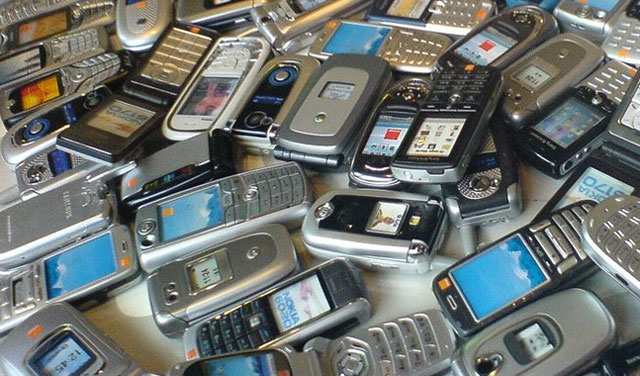
    In addition to media waste and artificial islands, future geologists will encounter a vast amount of electronic waste. In January, Apple reported its one billionth iOS device sold, a symbol of the sheer quantity of electronic devices in the world. Indeed, several major corporations, including Apple, have been criticised for adopting design strategies which fail to take into account their environmental impact. The Internet of things is expected to further accelerate this growing problem of technological junk.

    Cultural and media studies scholar Toby Miller argues:

    We have neglected the dirty, material origins and processes that characterise communications technologies like tablets, phones and laptops. We have forgotten the real story of Cold War militarism, undersea cables, conflict minerals, slave labour, toxic exposure and illegal recycling.

    The picture is even worse when we consider the final resting place of most digital hardware. The environmental impact of media technology is not fairly distributed between nations. While you may curse the occasional discarded TV on your way to work, the amount of electronic residue in Pakistan is measured in millions of tons, because a lot of waste from developed countries ends up there.

    Besides NGO and scholarly work on e-waste, the Anthropocene has given new inspiration to contemporary artists. Exhibitions such as Rare Earth — showing in February at the Thyssen-Bornemisza Art Contemporary in Vienna — consider the relationship between technology, culture and the planet. In Berlin, the Haus der Kulturen der Welt recently finished a massive multi-year project on the Anthropocene that curated exhibitions, talks, publications and a public visibility for a concept that has unified the humanities, earth and climate science.

    Shaped by its time
    In The Last Pictures, American artist Trevor Paglen sent images into orbit aboard a satellite. The project addresses technological waste in space and the memory embedded in the images — which may outlast human life on this planet.

    Katie Paterson’s practice touches on the way in which natural processes can participate in our cultural life. Her Future Library project focuses less on the content than the source of her paper, which is grown in a forest in Norway. In 100 years’ time, timber from this forest will provide the raw material for a library of books written by a variety of authors.

    While the modern concept of the Anthropocene is undoubtedly very young, existing as it does in the context of anthropogenic climate change, similar ideas have been proposed in the past. In 1873, geologist Antonio Stoppani proposed the idea of an “Anthropozoic period”, emphasising the impact of human life on the globe. Stoppani pointed out science and technology were creating a new order of nature. A future alien intelligence would investigate relics of this progress as the fossils of our age. Stoppani was ahead of his time; his ideas were deemed unscientific, and he was ignored.

    Now the revival of the Anthropocene is creating new ways of considering art history and cinematic culture. These ideas will shape the way in which we think about design, architecture and art.

    This is the other side of the story concerning the media of the Anthropocene. It is not merely the publicity of the concept but how under this umbrella, media studies, design, art and humanities consider their relation to the planetary and geographical scales.The Conversation

    • Jussi Parikka is professor in technological culture and aesthetics at the University of Southampton
    • This article was originally published on The Conversation

    Follow TechCentral on Google News Add TechCentral as your preferred source on Google


    Anthropocene Jussi Parikka Katie Paterson Trevor Paglen
    WhatsApp YouTube
    Share. Facebook Twitter LinkedIn WhatsApp Telegram Email Copy Link
    Previous ArticleMajor power disruptions expected
    Next Article Suren Sooklal named as MTN risk officer

    Related Posts

    Computer viruses as an art form

    19 February 2016
    Company News
    African Bank signs on as GEC+Africa 2026 partner

    African Bank signs on as GEC+Africa 2026 partner

    7 August 2026
    What a cloud review reveals about how a company actually runs - LSD Open

    What a cloud review reveals about how a company actually runs

    6 August 2026
    Manufacturing from a garage is now a realistic business plan - MaxLaser

    Manufacturing from a garage is now a realistic business plan

    6 August 2026
    Opinion
    The author, Jannie van Zyl

    Selling vapour is corporate suicide in slow motion

    16 July 2026
    Brazil's online gambling crackdown is a lesson for South Africa

    How Amazon outmanoeuvred Starlink in South Africa

    15 July 2026
    The Popia problem with agentic AI - Herman Haasbroek

    The Popia problem with agentic AI

    14 July 2026

    Subscribe to Updates

    Get the best South African technology news and analysis delivered to your e-mail inbox every morning.

    Latest Posts
    Eskom fixed the fleet and the customers left

    Eskom fixed the fleet and the customers left

    7 August 2026
    DStv chops channels as Canal+ leans harder on sport

    DStv chops channels as Canal+ leans harder on sport

    7 August 2026
    TCS+ | Specops' Darren James on continuous trust in an AI world

    TCS+ | Specops’ Darren James on continuous trust in an AI world

    7 August 2026
    Starlink LEO rival gaining momentum

    Starlink LEO rival gaining momentum

    7 August 2026
    © 2009 - 2026 NewsCentral Media
    Built and maintained by Chronon
    • Cookie policy (ZA)
    • TechCentral – privacy and Popia

    Type above and press Enter to search. Press Esc to cancel.

    Manage consent

    TechCentral uses cookies to enhance its offerings. Consenting to these technologies allows us to serve you better. Not consenting or withdrawing consent may adversely affect certain features and functions of the website.

    Functional Always active
    The technical storage or access is strictly necessary for the legitimate purpose of enabling the use of a specific service explicitly requested by the subscriber or user, or for the sole purpose of carrying out the transmission of a communication over an electronic communications network.
    Preferences
    The technical storage or access is necessary for the legitimate purpose of storing preferences that are not requested by the subscriber or user.
    Statistics
    The technical storage or access that is used exclusively for statistical purposes. The technical storage or access that is used exclusively for anonymous statistical purposes. Without a subpoena, voluntary compliance on the part of your Internet Service Provider, or additional records from a third party, information stored or retrieved for this purpose alone cannot usually be used to identify you.
    Marketing
    The technical storage or access is required to create user profiles to send advertising, or to track the user on a website or across several websites for similar marketing purposes.
    • Manage options
    • Manage services
    • Manage {vendor_count} vendors
    • Read more about these purposes
    View preferences
    • {title}
    • {title}
    • {title}