Close Menu
TechCentralTechCentral

    Subscribe to the newsletter

    Get the best South African technology news and analysis delivered to your e-mail inbox every morning.

    Facebook X (Twitter) YouTube LinkedIn
    WhatsApp Facebook X (Twitter) LinkedIn YouTube
    TechCentralTechCentral
    • News
      Discovery Bank opens its doors to cryptocurrency trading - Hylton Kallner

      Discovery Bank opens its doors to cryptocurrency trading

      13 November 2025
      Spotify goes 'lossless' in South Africa, hikes prices again

      Spotify goes ‘lossless’ in South Africa, hikes prices again

      13 November 2025
      Markets signal a turning tide for South Africa as rand hits two-year high

      Markets signal a turning tide for South Africa as rand hits two-year high

      13 November 2025
      Cell C targets up to R12.1-billion valuation in JSE listing

      Cell C targets up to R12.1-billion valuation in JSE debut

      13 November 2025
      Google agrees to major funding package for South African media

      Google agrees to major funding package for South African media

      13 November 2025
    • World
      EU moves to ring-fence 6GHz band for 6G, squeezing out Wi-Fi

      EU moves to ring-fence 6GHz band for 6G, squeezing out Wi-Fi

      13 November 2025
      The billionaire battle to put America back on the moon

      The billionaire battle to put America back on the moon

      12 November 2025
      DeepSeek warns of social upheaval from AI - Chen Deli

      China’s DeepSeek warns of social upheaval from AI

      7 November 2025
      Tesla investors hand Elon Musk the biggest pay deal in history

      Tesla investors hand Elon Musk the biggest pay deal in history

      7 November 2025
      Jensen Huang: 'China is going to win the AI race' - Nvidia

      Jensen Huang: ‘China is going to win the AI race’

      6 November 2025
    • In-depth
      Valve's Linux console takes aim at Microsoft's gaming empire

      Valve’s Linux console takes aim at Microsoft’s gaming empire

      13 November 2025
      iOCO's extraordinary comeback plan - Rhys Summerton

      iOCO’s extraordinary comeback plan

      28 October 2025
      Why smart glasses keep failing - no, it's not the tech - Mark Zuckerberg

      Why smart glasses keep failing – it’s not the tech

      19 October 2025
      BYD to blanket South Africa with megawatt-scale EV charging network - Stella Li

      BYD to blanket South Africa with megawatt-scale EV charging network

      16 October 2025
      DStv woos customers with free upgrades

      As DStv turns 30, it faces its toughest test yet

      6 October 2025
    • TCS
      TCS | Why Altron is building an AI factory - Bongani Andy Mabaso

      TCS | Why Altron is building an AI factory in Johannesburg

      28 October 2025

      TCS+ | Videsha Proothveerajh on Vodacom Business’s new approach to enterprise technology

      28 October 2025
      TCS | The company building a 'living computer' with human cells - Fred Jordan FinalSpark

      TCS | The company building a ‘living computer’ with human cells

      23 October 2025
      TCS | Why South Africans are starting to spend crypto, not just trade it

      TCS | Why South Africans are starting to spend crypto, not just trade it

      22 October 2025
      TCS+ | Managing Sims, saving money: how MSB Micro keeps businesses connected

      TCS+ | Managing Sims, saving money: how MSB Micro keeps businesses connected

      22 October 2025
    • Opinion
      How South Africa's broken Rica system fuels murder and mayhem - Farhad Khan

      How South Africa’s broken Rica system fuels murder and mayhem

      10 November 2025
      South Africa's AI data centre boom risks overloading a fragile grid - Paul Colmer

      South Africa’s AI data centre boom risks overloading a fragile grid

      30 October 2025
      How Eskom clawed its way back from the brink - Busi Mavuso

      How Eskom clawed its way back from the brink

      13 October 2025
      AI takes the throne - Brian Hungwe

      AI takes the throne

      6 October 2025
      How Eskom clawed its way back from the brink - Busi Mavuso

      Trump tariffs and diplomatic missteps push Agoa off the cliff

      6 October 2025
    • Company Hubs
      • Africa Data Centres
      • AfriGIS
      • Altron Digital Business
      • Altron Document Solutions
      • Altron Group
      • Arctic Wolf
      • AvertITD
      • Braintree
      • CallMiner
      • CambriLearn
      • CYBER1 Solutions
      • Digicloud Africa
      • Digimune
      • Domains.co.za
      • ESET
      • Euphoria Telecom
      • Incredible Business
      • iONLINE
      • Iris Network Systems
      • LSD Open
      • NEC XON
      • Netstar
      • Network Platforms
      • Next DLP
      • Ovations
      • Paracon
      • Paratus
      • Q-KON
      • SevenC
      • SkyWire
      • Solid8 Technologies
      • Telit Cinterion
      • Tenable
      • Vertiv
      • Videri Digital
      • Vodacom Business
      • Wipro
      • Workday
      • XLink
    • Sections
      • AI and machine learning
      • Banking
      • Broadcasting and Media
      • Cloud services
      • Contact centres and CX
      • Cryptocurrencies
      • Education and skills
      • Electronics and hardware
      • Energy and sustainability
      • Enterprise software
      • Financial services
      • Information security
      • Internet and connectivity
      • Internet of Things
      • Investment
      • IT services
      • Lifestyle
      • Motoring
      • Public sector
      • Retail and e-commerce
      • Satellite communications
      • Science
      • SMEs and start-ups
      • Social media
      • Talent and leadership
      • Telecoms
    • Events
    • Advertise
    TechCentralTechCentral
    Home » Sections » AI and machine learning » How Beijing’s army of robot dogs and AI drones could redefine warfare

    How Beijing’s army of robot dogs and AI drones could redefine warfare

    China’s DeepSeek is driving a new military era - powering autonomous vehicles, drones and decision systems in Beijing’s escalating arms race.
    By Agency Staff27 October 2025
    Twitter LinkedIn Facebook WhatsApp Email Telegram Copy Link
    News Alerts
    WhatsApp

    How Beijing’s army of robot dogs and AI drones could redefine warfareChina’s state-owned defence giant Norinco in February unveiled a military vehicle capable of autonomously conducting combat-support operations at 50km/h. It was powered by DeepSeek, the company whose artificial intelligence model is the pride of China’s tech sector.

    The Norinco P60’s release was touted by Communist Party officials in press statements as an early showcase of how Beijing is using DeepSeek and AI to catch up in its arms race with the US, at a time when leaders in both countries have urged their militaries to prepare for conflict.

    A Reuters review of hundreds of research papers, patents and procurement records gives a snapshot of the systematic effort by Beijing to harness AI for military advantage.

    The People’s Liberation Army continues to use and look for Nvidia chips, including models under US export controls

    Specifics of how the systems behind China’s next-generation weapons work and the extent to which it has deployed them are a state secret, but procurement records and patents offer clues into Beijing’s progress towards capabilities like autonomous target recognition and real-time battlefield decision support in a way that mirrors US efforts.

    Reuters couldn’t establish if all the products had been built and patents don’t necessarily indicate operational technology.

    The People’s Liberation Army (PLA) and affiliates continue to use and look for Nvidia chips, including models under US export controls, according to the papers, tenders and patents.

    Reuters could not determine if those chips were stockpiled before Washington imposed restrictions as the documents do not detail when the hardware used was exported. Patents filed as recently as June show their use by military-linked research institutes. In September 2022, the US commerce department banned exports to China of Nvidia’s popular A100 and H100 chips.

    Contractors

    Nvidia spokesman John Rizzo said in a statement that while the firm can’t track individual resales of previously sold products, “recycling small quantities of old, second-hand products doesn’t enable anything new or raise any national security concern. Using restricted products for military applications would be a non-starter, without support, software or maintenance.”

    The US treasury and commerce department did not respond to questions about Reuters’ findings.

    The Chinese military has also in 2025 increased its use of contractors that claim to exclusively use domestically made hardware like Huawei AI chips, said Sunny Cheung, a fellow at the Washington-based Jamestown Foundation defence policy think-tank, who analysed several hundred tenders issued from the PLA Procurement Network over six months this year.

    Read: China flaunts the future of war

    Reuters couldn’t independently confirm his assertion but the shift would coincide with a public pressure campaign by Beijing on domestic firms to use China-made technology.

    The news agency’s review of procurement notices and patents filed to China’s patent office found demand for and use of Huawei chips by PLA affiliates, but it was not able to verify all the tenders seen by Jamestown, which is releasing a report this week that it provided early to Reuters.

    Huawei declined to comment when asked about military deployment of its chips. The Chinese defence ministry, DeepSeek and Norinco did not return requests for comment about their use of AI for military applications. The universities and defence firms that filed the patents and research papers seen by Reuters also did not respond to similar questions.
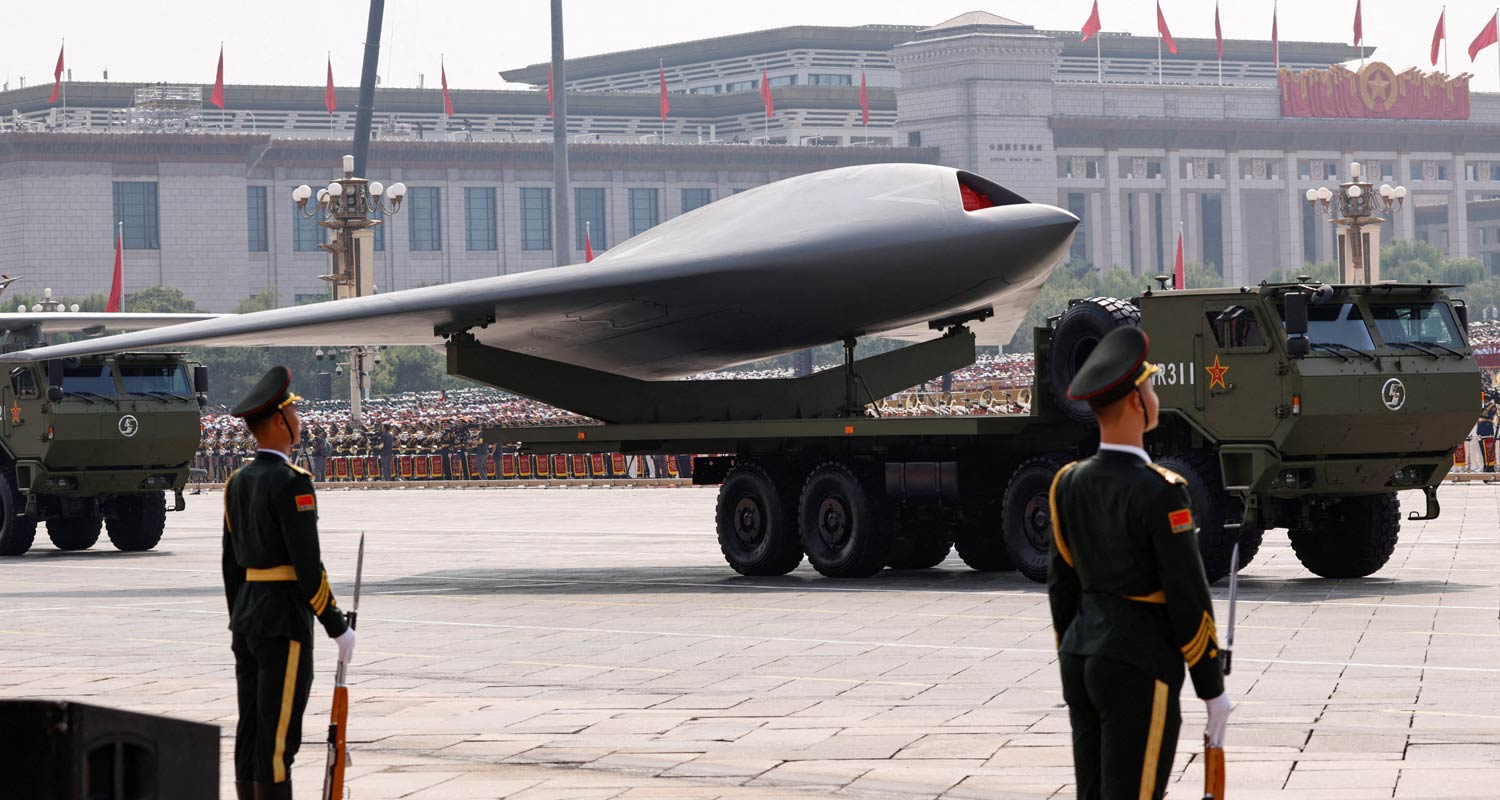
    Members of the People's Liberation Army stand as unmanned operations group display a drone during a military parade to mark the 80th anniversary of the end of World War 2, in Beijing, China, 3 September 2025. Tingshu Wang/Reuters
    Members of the People’s Liberation Army stand as unmanned operations group display a drone during a military parade to mark the 80th anniversary of the end of World War 2, in Beijing, China, 3 September 2025. Tingshu Wang/Reuters

    Usage of DeepSeek models was indicated in a dozen tenders from PLA entities filed this year and seen by Reuters, while just one referenced Alibaba’s Qwen, a major domestic rival. Alibaba didn’t return a request for comment about military use of Qwen.

    DeepSeek-related procurement notices have accelerated throughout 2025, with new military applications appearing regularly on the PLA network, according to Jamestown.

    DeepSeek’s popularity with the PLA also reflects China’s pursuit of what Beijing calls “algorithmic sovereignty” – reducing dependence on Western technology while strengthening control over critical digital infrastructure.

    The time taken to shift from finding and identifying a target to executing an operation has also been shortened by AI

    The US department of defence declined to comment about the PLA’s use of AI.

    A state department spokesman said in response to Reuters’ questions that “DeepSeek has willingly provided, and will likely continue to provide, support to China’s military and intelligence operations”. Washington will “pursue a bold, inclusive strategy to American AI technology with trusted foreign countries around the world, while keeping the technology out of the hands of our adversaries”, the spokesman added.

    China is looking at AI-powered robot dogs that scout in packs and drone swarms that autonomously track targets, as well as visually immersive command centres and advanced war game simulations, according to the documents.

    In November 2024, the PLA issued a sci-fi-esque tender for AI-powered robot dogs that would scout together for threats and clear explosive hazards. Reuters couldn’t identify if the tender was fulfilled. China has previously deployed armed robot dogs from AI robotics manufacturer Unitree in military drills, according to images released in state media. Unitree didn’t respond to queries about its PLA work.

    AI warfare

    The review of patents, tenders and research papers published in the past two years shows how PLA and affiliated entities are looking to AI to improve military planning, including developing technology to quickly analyse images taken by satellites and drones.

    Researchers at Landship Information Technology, a Chinese company that integrates AI systems into military vehicles including Norinco’s, said in a February white paper released to promote their services that its technology built on Huawei chips can rapidly identify targets from satellite imagery, while coordinating with radars and aircraft to execute operations.

    The time taken for military planners to shift from finding and identifying a target to executing an operation has also been shortened by AI, according to Xi’an Technological University.

    Read: China pushes US to loosen AI chip curbs

    Researchers at that institute said in a summary of their findings released in May that their DeepSeek-powered system was able to assess 10 000 battlefield scenarios — each with different variables, terrain and force deployments — in 48 seconds. Such a task would have taken a conventional team of military planners 48 hours to complete, they said. Reuters could not independently verify the researchers’ claims.

    Chinese military entities are investing in increasingly autonomous battlefield technology, the documents suggest. Two dozen of the tenders and patents seen by Reuters show the military attempting to integrate AI into drones so they can recognise and track targets, as well as work together in formations with little human intervention.
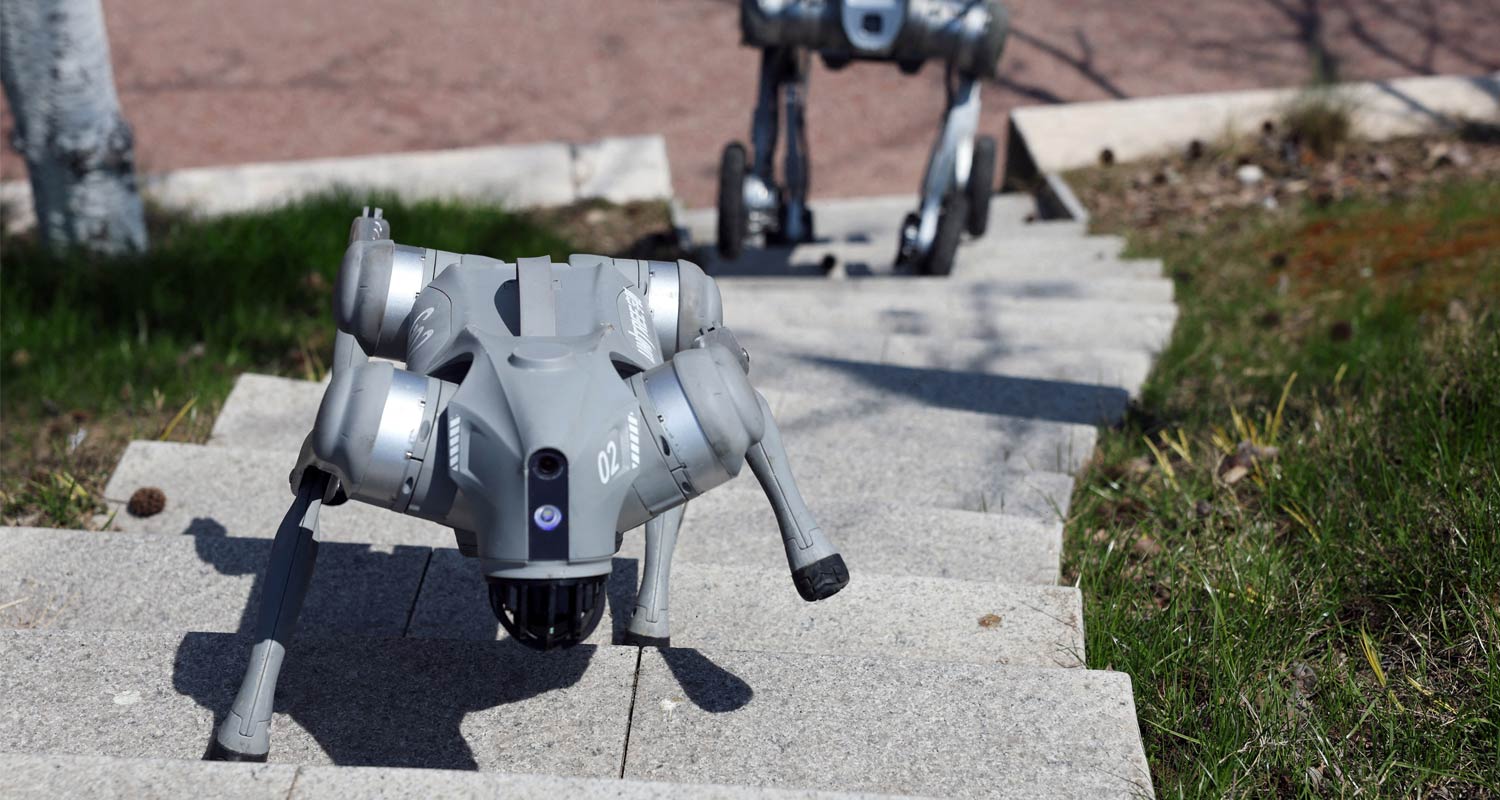
    Unitree robot dogs climb a flight of stairs during a demonstration at a park in Hangzhou, Zhejiang province, China. Florence Lo/Reuters
    Unitree robot dogs climb a flight of stairs during a demonstration at a park in Hangzhou, Zhejiang province, China. Florence Lo/Reuters

    Beihang University, known for its military aviation research, is using DeepSeek to improve drone swarm decision-making when targeting “low, slow, small” threats — military shorthand for drones and light aircraft — according to a patent filing this year.

    Chinese defence leaders have publicly committed to maintaining human control over weapons systems amid growing concern that a conflict between Beijing and Washington could lead to the unchecked deployment of AI-powered munitions.

    The US military, which is also investing in AI, is aiming to deploy thousands of autonomous drones by the end of 2025 in what officials say is an attempt to counter China’s numerical advantage in unmanned aerial vehicles.

    Nvidia hardware continues to be frequently cited in research by military-affiliated academics

    Chinese defence contractors like Shanxi 100 Trust Information Technology have touted in marketing materials their reliance on domestically produced components like Huawei’s Ascend chips, which allow AI models to operate. The firm didn’t respond to questions about its relationship with Huawei and the PLA.

    Despite the move to domestic processors, Nvidia hardware continues to be frequently cited in research by military-affiliated academics, according to a review of patent filings from the past two years.

    Reuters identified 35 applications referencing use of Nvidia’s A100 chips by academics at the PLA’s National University of Defence Technology (NUDT) and at the “Seven Sons” — a group of Chinese universities under US sanctions and with a history of conducting defence-related research for Beijing.

    Those entities in the same time period filed 15 patents related to AI applications that cited Huawei Ascend hardware, which was designed as a substitute to Nvidia chips.

    ‘More than enough’

    As recently as June, the PLA Rocket Force University of Engineering separately filed a patent for a remote-sensing target detection system, which it said used A100 chips for model training.

    Senior Col Zhu Qichao, who leads a NUDT research centre, told Reuters last year that US restrictions have impacted their AI research “to some degree”, though they are determined to narrow the technological gap.

    Read: How Chinese EV tech is reshaping the global car industry

    Nvidia’s Rizzo played down PLA demand for Nvidia’s hardware, saying that China “has more than enough domestic chips for all of its military applications”.  — Eduardo Baptista and Fanny Potkin, (c) 2025 Reuters

    Get breaking news from TechCentral on WhatsApp. Sign up here.



    Subscribe to TechCentral Subscribe to TechCentral
    Share. Facebook Twitter LinkedIn WhatsApp Telegram Email Copy Link
    Previous ArticleSouth Africa’s biggest data centres, ranked
    Next Article Pick n Pay still bringing the fight to Checkers Sixty60

    Related Posts

    Discovery Bank opens its doors to cryptocurrency trading - Hylton Kallner

    Discovery Bank opens its doors to cryptocurrency trading

    13 November 2025
    Spotify goes 'lossless' in South Africa, hikes prices again

    Spotify goes ‘lossless’ in South Africa, hikes prices again

    13 November 2025
    Markets signal a turning tide for South Africa as rand hits two-year high

    Markets signal a turning tide for South Africa as rand hits two-year high

    13 November 2025
    Company News
    Stop chasing busy: why marketing leaders must make strategic choices - Change Logic Natania Pio

    Stop chasing busy: why marketing leaders must make strategic choices

    13 November 2025
    Lesaka's Lincoln Mali wins top African leadership award for fintech innovation

    Lesaka’s Lincoln Mali wins top African leadership award for fintech innovation

    13 November 2025
    XLink's Blended APN (TitanX) redefines business connectivity

    XLink’s Blended APN (TitanX) redefines business connectivity

    13 November 2025
    Opinion
    How South Africa's broken Rica system fuels murder and mayhem - Farhad Khan

    How South Africa’s broken Rica system fuels murder and mayhem

    10 November 2025
    South Africa's AI data centre boom risks overloading a fragile grid - Paul Colmer

    South Africa’s AI data centre boom risks overloading a fragile grid

    30 October 2025
    How Eskom clawed its way back from the brink - Busi Mavuso

    How Eskom clawed its way back from the brink

    13 October 2025

    Subscribe to Updates

    Get the best South African technology news and analysis delivered to your e-mail inbox every morning.

    Latest Posts
    Discovery Bank opens its doors to cryptocurrency trading - Hylton Kallner

    Discovery Bank opens its doors to cryptocurrency trading

    13 November 2025
    Spotify goes 'lossless' in South Africa, hikes prices again

    Spotify goes ‘lossless’ in South Africa, hikes prices again

    13 November 2025
    Markets signal a turning tide for South Africa as rand hits two-year high

    Markets signal a turning tide for South Africa as rand hits two-year high

    13 November 2025
    Cell C targets up to R12.1-billion valuation in JSE listing

    Cell C targets up to R12.1-billion valuation in JSE debut

    13 November 2025
    © 2009 - 2025 NewsCentral Media
    • Cookie policy (ZA)
    • TechCentral – privacy and Popia

    Type above and press Enter to search. Press Esc to cancel.

    Manage consent

    TechCentral uses cookies to enhance its offerings. Consenting to these technologies allows us to serve you better. Not consenting or withdrawing consent may adversely affect certain features and functions of the website.

    Functional Always active
    The technical storage or access is strictly necessary for the legitimate purpose of enabling the use of a specific service explicitly requested by the subscriber or user, or for the sole purpose of carrying out the transmission of a communication over an electronic communications network.
    Preferences
    The technical storage or access is necessary for the legitimate purpose of storing preferences that are not requested by the subscriber or user.
    Statistics
    The technical storage or access that is used exclusively for statistical purposes. The technical storage or access that is used exclusively for anonymous statistical purposes. Without a subpoena, voluntary compliance on the part of your Internet Service Provider, or additional records from a third party, information stored or retrieved for this purpose alone cannot usually be used to identify you.
    Marketing
    The technical storage or access is required to create user profiles to send advertising, or to track the user on a website or across several websites for similar marketing purposes.
    • Manage options
    • Manage services
    • Manage {vendor_count} vendors
    • Read more about these purposes
    View preferences
    • {title}
    • {title}
    • {title}