Close Menu
TechCentralTechCentral

    Subscribe to the newsletter

    Get the best South African technology news and analysis delivered to your e-mail inbox every morning.

    Facebook X (Twitter) YouTube LinkedIn
    WhatsApp Facebook X (Twitter) LinkedIn YouTube
    TechCentralTechCentral
    • News
      Cell C cleans up its balance sheet but faces tough trading reality

      Cell C cleans up its balance sheet but faces tough trading reality

      13 February 2026
      MVNO business shines in Cell C's first post-listing results - Jorges Mendes

      MVNO business shines in Cell C’s first post-listing results

      13 February 2026
      Ramaphosa presses ahead with Eskom break-up - Cyril Ramaphosa

      Ramaphosa presses ahead with Eskom break-up

      13 February 2026
      The key technology takeaways from Ramaphosa's 2026 Sona - Cyril Ramaphosa

      The key technology takeaways from Ramaphosa’s 2026 Sona

      13 February 2026
      Toyota SA CEO: NEV inaction will cost South Africa its motoring industry - Andrew Kirby

      Toyota SA CEO: NEV inaction will cost South Africa its motoring industry

      12 February 2026
    • World
      Russia bans WhatsApp

      Russia bans WhatsApp

      12 February 2026
      EU regulators take aim at WhatsApp

      EU regulators take aim at WhatsApp

      9 February 2026
      Musk hits brakes on Mars mission

      Musk hits brakes on Mars mission

      9 February 2026
      Crypto firm accidentally sends R700-billion in bitcoin to its users

      Crypto firm accidentally sends R700-billion in bitcoin to its users

      8 February 2026
      AI won't replace software, says Nvidia CEO amid market rout - Jensen Huang

      AI won’t replace software, says Nvidia CEO amid market rout

      4 February 2026
    • In-depth
      How liberalisation is rewiring South Africa's power sector

      How liberalisation is rewiring South Africa’s power sector

      21 January 2026
      The top-performing South African tech shares of 2025

      The top-performing South African tech shares of 2025

      12 January 2026
      Digital authoritarianism grows as African states normalise internet blackouts

      Digital authoritarianism grows as African states normalise internet blackouts

      19 December 2025
      TechCentral's South African Newsmakers of 2025

      TechCentral’s South African Newsmakers of 2025

      18 December 2025
      Black Friday goes digital in South Africa as online spending surges to record high

      Black Friday goes digital in South Africa as online spending surges to record high

      4 December 2025
    • TCS
      Watts & Wheels S1E4: 'We drive an electric Uber'

      Watts & Wheels S1E4: ‘We drive an electric Uber’

      10 February 2026
      TCS+ | How Cloud On Demand is helping SA businesses succeed in the cloud - Xhenia Rhode, Dion Kalicharan

      TCS+ | Cloud On Demand and Consnet: inside a real-world AWS partner success story

      30 January 2026
      Watts & Wheels S1E4: 'We drive an electric Uber'

      Watts & Wheels S1E3: ‘BYD’s Corolla Cross challenger’

      30 January 2026
      Watts & Wheels S1E4: 'We drive an electric Uber'

      Watts & Wheels S1E2: ‘China attacks, BMW digs in, Toyota’s sublime supercar’

      23 January 2026

      TCS+ | Why cybersecurity is becoming a competitive advantage for SA businesses

      20 January 2026
    • Opinion
      A million reasons monopolies don't work - Duncan McLeod

      A million reasons monopolies don’t work

      10 February 2026
      Eskom unbundling U-turn threatens to undo hard-won electricity gains - Busi Mavuso

      Eskom unbundling U-turn threatens to undo hard-won electricity gains

      9 February 2026
      South Africa's skills advantage is being overlooked at home - Richard Firth

      South Africa’s skills advantage is being overlooked at home

      29 January 2026
      Why Elon Musk's Starlink is a 'hard no' for me - Songezo Zibi

      Why Elon Musk’s Starlink is a ‘hard no’ for me

      26 January 2026
      A million reasons monopolies don't work - Duncan McLeod

      South Africa’s new fibre broadband battle

      20 January 2026
    • Company Hubs
      • Africa Data Centres
      • AfriGIS
      • Altron Digital Business
      • Altron Document Solutions
      • Altron Group
      • Arctic Wolf
      • AvertITD
      • Braintree
      • CallMiner
      • CambriLearn
      • CYBER1 Solutions
      • Digicloud Africa
      • Digimune
      • Domains.co.za
      • ESET
      • Euphoria Telecom
      • Incredible Business
      • iONLINE
      • IQbusiness
      • Iris Network Systems
      • LSD Open
      • Mitel
      • NEC XON
      • Netstar
      • Network Platforms
      • Next DLP
      • Ovations
      • Paracon
      • Paratus
      • Q-KON
      • SevenC
      • SkyWire
      • Solid8 Technologies
      • Telit Cinterion
      • Tenable
      • Vertiv
      • Videri Digital
      • Vodacom Business
      • Wipro
      • Workday
      • XLink
    • Sections
      • AI and machine learning
      • Banking
      • Broadcasting and Media
      • Cloud services
      • Contact centres and CX
      • Cryptocurrencies
      • Education and skills
      • Electronics and hardware
      • Energy and sustainability
      • Enterprise software
      • Financial services
      • Information security
      • Internet and connectivity
      • Internet of Things
      • Investment
      • IT services
      • Lifestyle
      • Motoring
      • Public sector
      • Retail and e-commerce
      • Satellite communications
      • Science
      • SMEs and start-ups
      • Social media
      • Talent and leadership
      • Telecoms
    • Events
    • Advertise
    TechCentralTechCentral
    Home » In-depth » Interview: Andy Rubin on the future of smartphones

    Interview: Andy Rubin on the future of smartphones

    By Agency Staff21 August 2017
    Twitter LinkedIn Facebook WhatsApp Email Telegram Copy Link
    News Alerts
    WhatsApp
    Andy Rubin

    During a recent outing to a fancy restaurant, Andy Rubin spotted an all-too-familiar tableau: a couple on what seemed to be a first date taking pictures of their food and then losing themselves in their smartphones for the next 10 minutes. Rubin is partly responsible for this antisocial behaviour: he helped create Android, which powers 85% of the world’s smartphones.

    Rubin acknowledges the downside to the smartphone revolution he helped unleash and says his new hardware company, Essential, is working on ways to solve the tendency to check one’s phone every five minutes. “We all lived happy lives before we had always-on Internet,” he says in an exclusive interview at Playground Global, his Palo Alto, California, incubator.

    This week marks the debut of Essential’s first gadget. The Essential Phone is an anomaly: a sleek, premium smartphone not designed by Apple, Samsung or a discount Chinese brand. It has a mirrored ceramic back, titanium edges, a display that covers most of the phone’s front and a magnetic connector for a new world of accessories and hardware upgrades that he says will let people hang onto their phones longer.

    If I can get to the point where your phone is a virtual version of you, you can be off enjoying your life, having that dinner, without touching your phone, and you can trust your phone to do things on your behalf

    Rubin recognises that Essential confronts formidable competition, especially from Apple and Samsung. But while he applauds the former’s brand power and the latter’s vertical integration, he said “every saturated market needs a disruption. When there’s a duopoly, that’s the time to do it.”

    He says it’s best to view Essential’s first phone as a starting point — it runs the same Android OS as Google’s Pixel — not a radical departure. That will come later, he says, and will involve using artificial intelligence to change the way people interact with their devices, in part by outsourcing some of the more tedious tasks to an algorithm.

    “If I can get to the point where your phone is a virtual version of you, you can be off enjoying your life, having that dinner, without touching your phone, and you can trust your phone to do things on your behalf,” he says. “I think I can solve part of the addictive behaviour.”

    Essential

    Rubin, 54, has been in the phone game for almost 20 years. In the early 2000s, he spearheaded development of a handset called the Hiptop (later known as the Sidekick) that featured a big screen, full physical keyboard and ran apps. It heralded the coming of the smartphone juggernaut. Rubin left in 2003 to start again, creating a mobile software start-up called Android that he sold to Google in 2005. After turning Android into the world’s preeminent operating system, he left three years ago to start work on his third act: Essential.

    Playground Global comes by its name honestly; the sprawling incubator is filled with jungle-gym-style slides and his personal arcade game collection. Essential is just one of several start-ups. The first phone was designed and tested here.
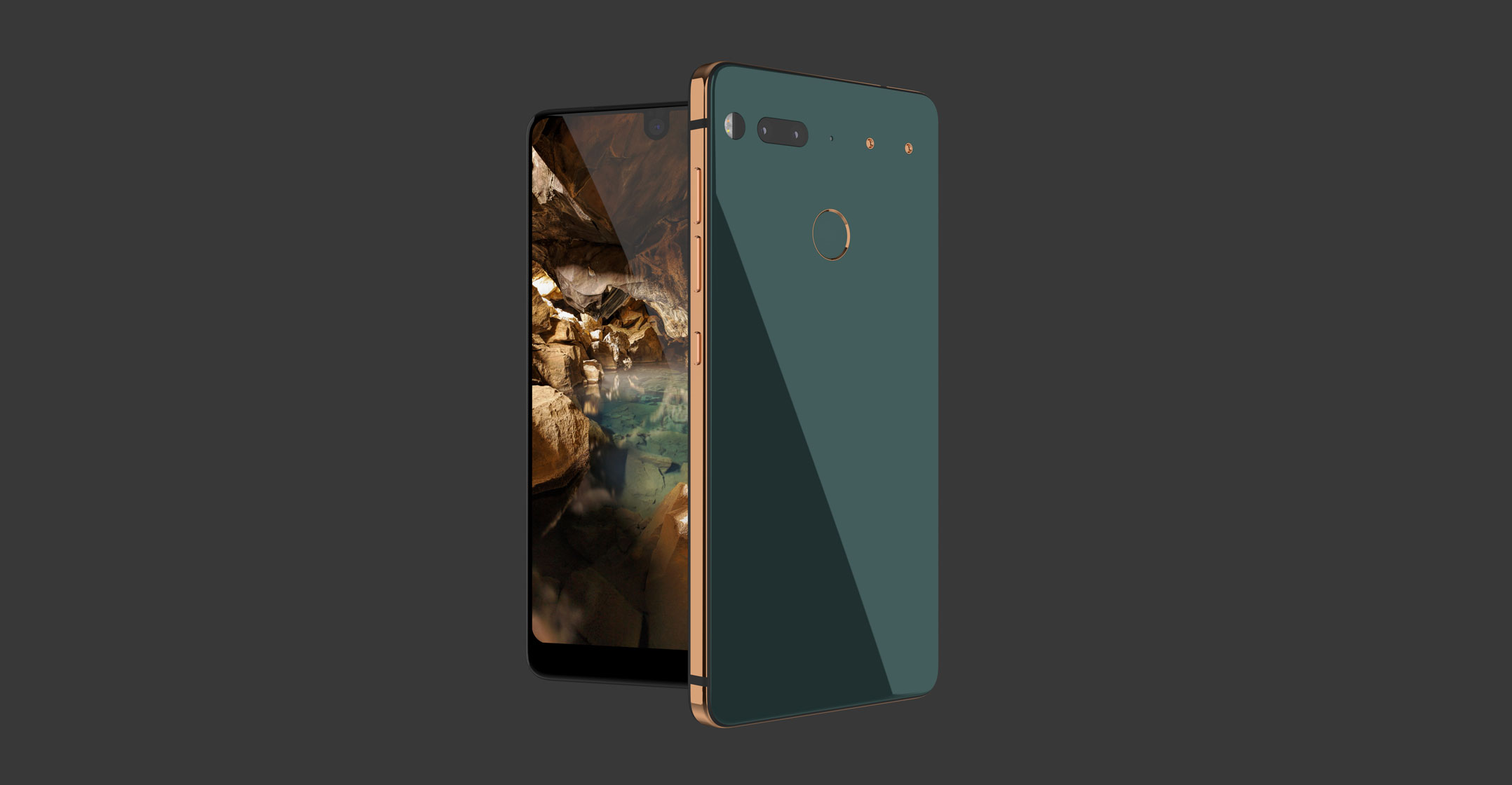
    The Essential Phone

    It’s being manufactured in China by Foxconn (which also builds iPhones). Foxconn is an investor and partner, meaning it has a measure of control over the Essential Phone’s future. Rubin views the relationship with the giant contract manufacturer as a two-way street, with each side providing important insights. There are disadvantages. Rubin cites a Sharp phone manufactured by Foxconn with a striking resemblance to Essential’s almost all-screen design. “You should have seen that e-mail!” to Foxconn chairman Terry Gou, he says.

    One of the most distinctive features of the new phone is the two magnetic pins on the back that can attach to accessories made both by Essential and third-party manufacturers. Essential plans to ship the first six accessories, starting with a 360-degree 4K video camera and an inductive charging dock.

    The distraction is something that’s solvable if you have a virtual version of you doing stuff while you’re doing more important stuff

    For the first time, Rubin reveals two more under development: a gadget that can feed high-quality audio from the phone into a car’s stereo while the phone charges through its main port and what Rubin says is the world’s smallest 3D laser scanner. He won’t reveal what the laser is for, but alludes to the lasers used in self-driving cars to measure the distance between objects. During the interview, Rubin was so excited about the two new accessories, he ran to his office to fetch prototype circuit boards.

    Rubin says he has a “talented software team that will make the software do what I need it to do to bring some of those AI things to life”. And he may break with the current mania for Siri- or Alexa-style digital assistants; Rubin calls them “yesterday’s idea” but wouldn’t be drawn on what a futuristic user interface might look like. He says AI advances that handle certain tasks for users will show up in Essential’s second main product, a circular Home device. He says owners of the new phone may eventually get some of these innovations.

    Before long, Rubin says, phones and other gadgets will be able to predict what the user needs, sorting through notifications, by ignoring some and highlighting others depending on time of day or where the person is. “If somebody texts you ‘do you want to get sushi tonight?’, it’s going to come up with six responses, and you’re going to pick the best response. And over time, you’re reinforcing it by giving it the right response, and it becomes aware of your taste and your preferences, and probably the nth time, it’s not going to ask you anymore.”

    AI

    The Essential chief recalls being rear-ended recently by someone texting — a growing problem he says could be solved with artificial intelligence. “The distraction is something that’s solvable if you have a virtual version of you doing stuff while you’re doing more important stuff,” he says.

    Hardware is a notoriously tough business. The Essential Phone is a month late due to software bugs that needed fixing and the lengthy testing process carriers conduct before certifying the phone for their networks, Rubin says. He appears pleased with his Sprint partnership in the US, but acknowledges carriers are not always receptive to carrying phones from niche players. Still, he doesn’t seem concerned. “If the carriers are blind to innovation,” he says, “I’ll go and create my own distribution channel.”

    Rubin’s phone is also arriving weeks before Apple and Samsung debut upgrades to their blockbuster products. His former comrades at Google launched their own Pixel phone last year. Moreover, others who left a major company to start their own hardware shops, have struggled. Tony Fadell, Apple’s former iPhone and iPod hardware chief, led smart thermostat company Nest to a US$3bn merger with Google before stepping down last year amid internal turmoil. Jon Rubinstein, another iPod alum, brought the innovative Palm Pre to market in 2009. His company was then shuttered by parent Hewlett-Packard less than three years after a splashy Las Vegas debut. Even Microsoft and BlackBerry, two of the most resourceful companies of recent times, both exited the phone business in recent years.

    Rubin compares Essential’s push into consumer gadgets to Tesla’s move into a car market filled by entrenched players. He recalls pitching start-up ideas to venture capitalists and them saying, yeah, but someone else is already doing this. “So?!” he recalls saying. “We’ve identified a business opportunity. We think there’s room for two of us.”  — Reported by Mark Gurman and Brad Stone, (c) 2017 Bloomberg LP



    Android Andy Rubin Apple Essential Essential Phone Google top
    WhatsApp YouTube Follow on Google News Add as preferred source on Google
    Share. Facebook Twitter LinkedIn WhatsApp Telegram Email Copy Link
    Previous ArticleHow women were crowded out of the computing revolution
    Next Article Fintech start-up targets insurance mass market

    Related Posts

    Dr Google, meet Dr Chatbot - neither is ready to see you now

    Dr Google, meet Dr Chatbot – neither is ready to see you now

    10 February 2026
    AI chatbots are coming to Apple CarPlay

    AI chatbots are coming to Apple CarPlay

    8 February 2026
    From stocks to crypto, markets reel as AI doubts grow

    From stocks to crypto, markets reel as AI doubts grow

    6 February 2026
    Company News
    Cell C delivers maiden results with growth momentum, financial flexibility - Jorges Mendes

    Cell C delivers maiden results with growth momentum, financial flexibility

    13 February 2026
    Start-up king joins Paratus Rwanda - Innocent Mutimura

    Start-up king joins Paratus Rwanda

    13 February 2026
    How NEC XON tackled identity risk for a major telco - Michael de Neuilly Rice

    How NEC XON tackled identity risk for a major telco

    11 February 2026
    Opinion
    A million reasons monopolies don't work - Duncan McLeod

    A million reasons monopolies don’t work

    10 February 2026
    Eskom unbundling U-turn threatens to undo hard-won electricity gains - Busi Mavuso

    Eskom unbundling U-turn threatens to undo hard-won electricity gains

    9 February 2026
    South Africa's skills advantage is being overlooked at home - Richard Firth

    South Africa’s skills advantage is being overlooked at home

    29 January 2026

    Subscribe to Updates

    Get the best South African technology news and analysis delivered to your e-mail inbox every morning.

    Latest Posts
    Cell C cleans up its balance sheet but faces tough trading reality

    Cell C cleans up its balance sheet but faces tough trading reality

    13 February 2026
    MVNO business shines in Cell C's first post-listing results - Jorges Mendes

    MVNO business shines in Cell C’s first post-listing results

    13 February 2026
    Ramaphosa presses ahead with Eskom break-up - Cyril Ramaphosa

    Ramaphosa presses ahead with Eskom break-up

    13 February 2026
    The key technology takeaways from Ramaphosa's 2026 Sona - Cyril Ramaphosa

    The key technology takeaways from Ramaphosa’s 2026 Sona

    13 February 2026
    © 2009 - 2026 NewsCentral Media
    • Cookie policy (ZA)
    • TechCentral – privacy and Popia

    Type above and press Enter to search. Press Esc to cancel.

    Manage consent

    TechCentral uses cookies to enhance its offerings. Consenting to these technologies allows us to serve you better. Not consenting or withdrawing consent may adversely affect certain features and functions of the website.

    Functional Always active
    The technical storage or access is strictly necessary for the legitimate purpose of enabling the use of a specific service explicitly requested by the subscriber or user, or for the sole purpose of carrying out the transmission of a communication over an electronic communications network.
    Preferences
    The technical storage or access is necessary for the legitimate purpose of storing preferences that are not requested by the subscriber or user.
    Statistics
    The technical storage or access that is used exclusively for statistical purposes. The technical storage or access that is used exclusively for anonymous statistical purposes. Without a subpoena, voluntary compliance on the part of your Internet Service Provider, or additional records from a third party, information stored or retrieved for this purpose alone cannot usually be used to identify you.
    Marketing
    The technical storage or access is required to create user profiles to send advertising, or to track the user on a website or across several websites for similar marketing purposes.
    • Manage options
    • Manage services
    • Manage {vendor_count} vendors
    • Read more about these purposes
    View preferences
    • {title}
    • {title}
    • {title}