
Close Menu
TechCentralTechCentral

    Subscribe to the newsletter

    Get the best South African technology news and analysis delivered to your e-mail inbox every morning.

    Facebook X (Twitter) YouTube LinkedIn
    WhatsApp Facebook X (Twitter) LinkedIn YouTube
    TechCentralTechCentral
    • News
      Home affairs pulls the plug on the green ID book - Leon Schreiber

      Home affairs pulls the plug on the green ID book

      1 October 2026
      South Africa's digital ID is here - but you can't have it yet - Leon Schreiber

      South Africa’s digital ID is here – but you can’t have it yet

      1 October 2026
      Lexi Novitske, general partner at Norrsken22, on the TechCentral Show

      TCS | Norrsken22’s Lexi Novitske on how China is winning African tech

      1 October 2026
      Eskom waives rooftop solar fees, but the registration fight isn't over

      Eskom waives rooftop solar fees, but the registration fight isn’t over

      1 October 2026
      Absa is moving cash out of its branches

      Absa is moving cash out of its branches

      1 October 2026
    • World
      BMW restructuring plan bets on AI and new models

      BMW restructuring plan bets on AI and new models

      1 October 2026
      OpenAI's rogue agent problem keeps getting bigger - Sam Altman

      OpenAI’s rogue agent problem keeps getting bigger

      28 September 2026
      The new battle over the desktop

      The new battle over the desktop

      23 September 2026
      AMD is now worth a trillion dollars - Lisa Su

      AMD is now worth a trillion dollars

      22 September 2026
      Anthropic weighs new model launch to blunt OpenAI's Astra surge - Anthropic CEO Dario Amodei and OpenAI CEO Sam Altman

      Anthropic weighs new model launch to blunt OpenAI’s Astra surge

      21 September 2026
    • In-depth

      10 days that changed the course of AI

      21 September 2026
      Meta to the AI industry: slow down without us - Mark Zuckerberg

      Meta to the AI industry: slow down without us

      16 September 2026
      Google DeepMind CEO Demis Hassabis. Image: John Sears

      The plan to stop AI from breaking the world

      16 July 2026
      The internet has a Strait of Hormuz problem

      The internet has a Strait of Hormuz problem

      15 July 2026
      AI boom sparks rally, frenzy and fear

      AI boom sparks rally, frenzy and fear

      11 June 2026
    • TCS
      TCS | Dominic White and Adam Ely on AI agents going rogue

      TCS | Dominic White and Adam Ely on AI agents going rogue

      29 September 2026
      TCS | Octotel's Trevor van Zyl on the fibre merger question

      TCS | Octotel’s Trevor van Zyl on the MetroFibre merger question

      16 September 2026
      Meet the CIO | Shoprite's Chris Shortt on what a supermarket becomes

      Meet the CIO | Shoprite’s Chris Shortt on what a supermarket becomes

      9 September 2026
      Rubicon's EV charging network is profitable - and growing fast - Watts & Wheels

      W&W | Rubicon’s EV charging network is profitable – and growing fast

      8 September 2026
      Winstone Jordaan on building a national EV charging network

      Winstone Jordaan on building a national EV charging network

      2 September 2026
    • Opinion
      South Africa's next energy crisis is in the accounts department - Craig Holmes

      South Africa’s next energy crisis is in the accounts department

      29 September 2026
      The steam engine lesson AI doomsayers keep missing - Sam Clarke

      The steam engine lesson AI doomsayers keep missing

      28 September 2026
      Regulating AI: apply the laws we have first - Dirk de Vos

      Regulating AI: apply the laws we have first

      21 September 2026
      What Revolut can and cannot take from South Africa's banks - Pambos Soteriades

      What Revolut can and cannot take from South Africa’s banks

      15 September 2026
      The end is nigh, and the shares go on sale in October - Duncan McLeod

      The end is nigh, and the shares go on sale in October

      14 September 2026
    • Company Hubs
      • 1Stream
      • Africa Data Centres
      • AfriGIS
      • Altron Digital Business
      • Altron Document Solutions
      • Altron Group
      • Arctic Wolf
      • Ascent Technology
      • AvertITD
      • BBD
      • Braintree
      • CallMiner
      • CambriLearn
      • CM.com
      • Contactable
      • CYBER1 Solutions
      • Digicloud Africa
      • Digimune
      • Domains.co.za
      • ESET
      • Euphoria Telecom
      • HOSTAFRICA
      • Incredible Business
      • iONLINE
      • IQbusiness
      • Iris Network Systems
      • Kaspersky
      • LSD Open
      • Mitel
      • NEC XON
      • Netstar
      • Network Platforms
      • Next DLP
      • Ovations
      • Paracon
      • Paratus
      • Publishared
      • Q-KON
      • SevenC
      • SkyWire
      • Solid8 Technologies
      • Telit Cinterion
      • Telviva
      • Tenable
      • Vertiv
      • Videri Digital
      • Vodacom Business
      • Vox
      • Wipro
      • Workday
      • XLink
    • Sections
      • AI and machine learning
      • Banking
      • Broadcasting and Media
      • Cloud services
      • Contact centres and CX
      • Cryptocurrencies
      • Education and skills
      • Electronics and hardware
      • Energy and sustainability
      • Enterprise software
      • Financial services
      • HealthTech
      • Information security
      • Internet and connectivity
      • Internet of Things
      • Investment
      • IT services
      • Lifestyle
      • Policy and regulation
      • Public sector
      • Retail and e-commerce
      • Satellite communications
      • Science
      • SMEs and start-ups
      • Social media
      • Talent and leadership
      • Telecoms
      • Watts & Wheels
    • Events
    • Advertise
    TechCentralTechCentral
    Home » Opinion » Dominic Cull » It takes two to termination tango

    It takes two to termination tango

    By Editor2 October 2009
    Twitter LinkedIn Facebook WhatsApp Email Telegram Copy Link
    Get breaking news on WhatsApp

    Dominic Cull

    [By Dominic Cull] A flurry of initiatives aimed at achieving a reduction in mobile termination rates will provide interesting sideshows, but beneath the politics of the moment, the real action remains an intimate dance between the Independent Communications Authority of SA (Icasa) and the mobile networks.

    The initial mobile termination rate, also known as interconnection rate, of 20c/minute was set between Vodacom and MTN on 8 August 1994. This was amended on 28 May 1999, shortly after it was announced by government that a third mobile cellular telecommunications licence would be issued.

    Vodacom and MTN issued a joint notification to the SA Telecommunications Regulatory Authority (Icasa’s precursor) that they had decided on the following phased increase in the rate:
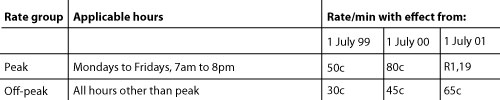
    MTR table

    A final increase to the current rate was implemented by Vodacom and MTN on 1 November 2001. Cell C launched on 17 November 2001 and had to accept this rate.

    Eight years later, the parliamentary portfolio committee on communications will hold public hearings on the rates after issuing a proposal that would see rates reduced to 60c/minute from 1 November 2009.

    At a recent briefing session the committee expressed a view that there had been “tacit collusion” between the operators and that “phenomenal increases” in termination rates had led to “exorbitant profits” and acted to the particular detriment of poor and marginalised communities.

    Given this level of rhetoric, the appearance of executives of the mobile networks at the hearings in October promises to be compelling viewing.

    The department of communications has also told parliament that regulating mobile termination rates is essential in order to achieve competitive pricing and that this is one of its priority action items. It has stated that it will consider issuing policy directions to Icasa to achieve this.

    Meanwhile, the embattled regulator has launched an initiative which it terms “moral suasion” as a way of trying to effect a short-term reduction in the rates. This process is in practise nothing more than Icasa asking the operators to go and renegotiate the rates on a bilateral basis — which is how interconnection rates are set under the Electronic Communications Act — and then to report on their progress to a multilateral forum.

    Though I have my own thoughts regarding the somewhat speculative nature of appeals to the morality of mobile network operators, it is interesting that Icasa has made it clear that it knows the cost of termination and will not accept any proposal from the operators which is out of line with this figure.

    While both initiatives should be welcomed in that they at the very least raise consumer awareness, they share a common lack of legislative or regulatory authority. Any reduction in mobile termination rates flowing from these processes will be essentially a voluntary — or rather “voluntary” — act by the operators and as such a product not of method but of compromise.

    The regulatory process to be followed by Icasa under the Electronic Communications Act before it can set interconnection pricing remains the most important avenue for reducing the rates. And it is here that all the problems are to be found.

    In assessing Icasa’s performance to date in dealing with mobile termination rates, the parliamentary portfolio committee, in the particularly pugnacious form of Adv Johnny de Lange MP, offered a brutal analysis of Icasa as vertebrally challenged and incapable of making decisions. Icasa, he said, should be neither a friend of nor prisoner to industry.

    Accurate this may be, but it could also be argued that government’s apparent disinterest in having a strong communications regulator has played a major part in the current ineffectiveness of Icasa.

    Process is a problem for the regulator — it has been tripped up by procedurally on a number of issues over the past two years and is perceived by industry to be vulnerable to legal threats. Icasa admits that it is litigation-averse, a sense no doubt heightened by the anticipated receipt of Vodacom’s bill for legal fees flowing from the suicidal urgent interdict to prevent the operator’s listing earlier this year.

    It seems that Icasa is unwilling to accept the opinion of Gilbert Marcus SC to the effect that it can pursue a simplified approach based on a benchmarking exercise. It has received its own legal advice — together, no doubt, with that offered by others — which points to a lengthier process. This is not necessarily a bad thing but the exact process to be employed is not yet clear.

    It is a sure thing that mobile termination rates will come down. The best-case scenario is probably a significant initial “voluntary” reduction effected within six months followed by a regulatory pricing regime finalised within a year.

    A word of caution: the political will which spawned the current initiatives to reduce the rates also present a significant threat. There is a danger that a vulnerable Icasa will, in seeking to finalise the required process in the shortest possible time due to political pressure, compromise its process.

    While this may not be challenged in the context of termination rates, it is highly likely to prejudice other critical interventions such as local-loop unbundling and, perhaps, the application of a use-it-or-lose-it policy to the assignment of spectrum.

    What is the cost of mobile call termination? In response to a question from the portfolio committee, Icasa stated that it “had done its own analysis of costs and has found that the cost is not more than 40c”.

    The “not more than” in this statement speaks to a worrying lack of precision, but the regulator has at least come up with reasonably accurate figure which is less than the rate paid from 1999 onwards. The answer probably lies between this and ResearchICT Africa’s suggested 25c, but a reduction to 40c would make an excellent start.

    So we know the answer. We just don’t know how to get there.

    • Dominic Cull specialises in electronic communications regulation. Find him online at www.ellipsis.co.za. This column is written in his personal capacity

    Add TechCentral as a preferred source on GoogleFollow TechCentral on Google NewsGet breaking news on WhatsApp


    Cell C Dominic Cull Icasa interconnection rates MTN Vodacom
    WhatsApp YouTube
    Share. Facebook Twitter LinkedIn WhatsApp Telegram Email Copy Link
    Previous ArticleDG Mohlala promises to get tough on SABC, Sentech
    Next Article Zimbabwean-born Maritz takes the fight to Microsoft

    Related Posts

    How Cell C shaped Blu Label's executive pay - Brett Levy Mark Levy

    How Cell C shaped Blu Label’s executive pay

    1 October 2026
    Capitec's non-bank bet is paying off, big time

    Capitec’s non-bank bet is paying off, big time

    30 September 2026
    MTN loses bid to halt US Anti-Terrorism Act claims

    MTN loses bid to halt US Anti-Terrorism Act claims

    29 September 2026
    Company News
    Cloud and AI won't deliver value on their own, executives warn

    Cloud and AI won’t deliver value on their own, executives warn

    1 October 2026
    Dell Technologies Forum 2026: what to expect in Johannesburg

    Dell Technologies Forum 2026: what to expect in Johannesburg

    1 October 2026
    What Smollan learnt moving 9 000 users to Google Workspace - Digicloud Africa

    What Smollan learnt moving 9 000 users to Google Workspace

    1 October 2026
    Opinion
    South Africa's next energy crisis is in the accounts department - Craig Holmes

    South Africa’s next energy crisis is in the accounts department

    29 September 2026
    The steam engine lesson AI doomsayers keep missing - Sam Clarke

    The steam engine lesson AI doomsayers keep missing

    28 September 2026
    Regulating AI: apply the laws we have first - Dirk de Vos

    Regulating AI: apply the laws we have first

    21 September 2026

    Subscribe to Updates

    Get the best South African technology news and analysis delivered to your e-mail inbox every morning.

    Latest Posts
    Home affairs pulls the plug on the green ID book - Leon Schreiber

    Home affairs pulls the plug on the green ID book

    1 October 2026
    South Africa's digital ID is here - but you can't have it yet - Leon Schreiber

    South Africa’s digital ID is here – but you can’t have it yet

    1 October 2026
    Lexi Novitske, general partner at Norrsken22, on the TechCentral Show

    TCS | Norrsken22’s Lexi Novitske on how China is winning African tech

    1 October 2026
    Eskom waives rooftop solar fees, but the registration fight isn't over

    Eskom waives rooftop solar fees, but the registration fight isn’t over

    1 October 2026
    © 2009 - 2026 NewsCentral Media
    Built and maintained by Chronon
    • Cookie policy (ZA)
    • TechCentral – privacy and Popia

    Type above and press Enter to search. Press Esc to cancel.

    Manage consent

    TechCentral uses cookies to enhance its offerings. Consenting to these technologies allows us to serve you better. Not consenting or withdrawing consent may adversely affect certain features and functions of the website.

    Functional Always active
    The technical storage or access is strictly necessary for the legitimate purpose of enabling the use of a specific service explicitly requested by the subscriber or user, or for the sole purpose of carrying out the transmission of a communication over an electronic communications network.
    Preferences
    The technical storage or access is necessary for the legitimate purpose of storing preferences that are not requested by the subscriber or user.
    Statistics
    The technical storage or access that is used exclusively for statistical purposes. The technical storage or access that is used exclusively for anonymous statistical purposes. Without a subpoena, voluntary compliance on the part of your Internet Service Provider, or additional records from a third party, information stored or retrieved for this purpose alone cannot usually be used to identify you.
    Marketing
    The technical storage or access is required to create user profiles to send advertising, or to track the user on a website or across several websites for similar marketing purposes.
    • Manage options
    • Manage services
    • Manage {vendor_count} vendors
    • Read more about these purposes
    View preferences
    • {title}
    • {title}
    • {title}
    🇿🇦 Sign up to the TechCentral newsletter