Close Menu
TechCentralTechCentral

    Subscribe to the newsletter

    Get the best South African technology news and analysis delivered to your e-mail inbox every morning.

    Facebook X (Twitter) YouTube LinkedIn
    WhatsApp Facebook X (Twitter) LinkedIn YouTube
    TechCentralTechCentral
    • News
      Rand breaks through R16/$ - and may have further to run

      Rand breaks through R16/$ – and may have further to run

      26 January 2026
      Mobile operators face tougher rules on data and billing

      Mobile operators face tougher rules on data and billing

      26 January 2026
      Why Elon Musk's Starlink is a 'hard no' for me - Songezo Zibi

      Why Elon Musk’s Starlink is a ‘hard no’ for me

      26 January 2026
      African bitcoin treasury firm hands 4% of equity to new adviser

      African bitcoin treasury firm hands 4% of equity to new adviser

      26 January 2026
      Debate erupts over value of in-flight Wi-Fi

      Debate erupts over value of in-flight Wi-Fi

      26 January 2026
    • World
      ByteDance clinches US TikTok deal

      ByteDance clinches US TikTok deal

      23 January 2026
      Taiwan, US strike strategic AI and chip supply-chain pact - TSMC

      Taiwan, US strike strategic AI and chip supply-chain pact

      20 January 2026
      Wikipedia moves to monetise AI giants' reliance on its content

      Wikipedia moves to monetise AI giants’ reliance on its content

      15 January 2026
      Visa moves to plug stablecoins into the global payments system

      Visa moves to plug stablecoins into the global payments system

      15 January 2026
      Oracle sued as bondholders allege AI debt plans were hidden - Larry Ellison

      Oracle sued as bondholders allege AI debt plans were hidden

      15 January 2026
    • In-depth
      The top-performing South African tech shares of 2025

      The top-performing South African tech shares of 2025

      12 January 2026
      Digital authoritarianism grows as African states normalise internet blackouts

      Digital authoritarianism grows as African states normalise internet blackouts

      19 December 2025
      TechCentral's South African Newsmakers of 2025

      TechCentral’s South African Newsmakers of 2025

      18 December 2025
      Black Friday goes digital in South Africa as online spending surges to record high

      Black Friday goes digital in South Africa as online spending surges to record high

      4 December 2025
      DStv dodges channel blackout in last-minute deal with Warner Bros

      Canal+ plays hardball – and DStv viewers feel the pain

      3 December 2025
    • TCS

      TCS+ | Why cybersecurity is becoming a competitive advantage for SA businesses

      20 January 2026
      Watts & Wheels S1E2: 'China attacks, BMW digs in, Toyota's sublime supercar'

      Watts & Wheels: S1E1 – ‘William, Prince of Wheels’

      8 January 2026
      TCS+ | Africa's digital transformation - unlocking AI through cloud and culture - Cliff de Wit Accelera Digital Group

      TCS+ | Cloud without culture won’t deliver AI: Accelera’s Cliff de Wit

      12 December 2025
      TCS+ | How Cloud on Demand helps partners thrive in the AWS ecosystem - Odwa Ndyaluvane and Xenia Rhode

      TCS+ | How Cloud On Demand helps partners thrive in the AWS ecosystem

      4 December 2025
      TCS | MTN Group CEO Ralph Mupita on competition, AI and the future of mobile

      TCS | Ralph Mupita on competition, AI and the future of mobile

      28 November 2025
    • Opinion
      AI moves from pilots to production in South African companies - Nazia Pillay SAP

      AI moves from pilots to production in South African companies

      20 January 2026
      ANC's attack on Solly Malatsi shows how BEE dogma trumps economic reality - Duncan McLeod

      ANC’s attack on Solly Malatsi shows how BEE dogma trumps economic reality

      14 December 2025
      Netflix, Warner Bros deal raises fresh headaches for MultiChoice - Duncan McLeod

      Netflix, Warner Bros deal raises fresh headaches for MultiChoice

      5 December 2025
      BIN scans, DDoS and the next cybercrime wave hitting South Africa's banks - Entersekt Gerhard Oosthuizen

      BIN scans, DDoS and the next cybercrime wave hitting South Africa’s banks

      3 December 2025
      ANC's attack on Solly Malatsi shows how BEE dogma trumps economic reality - Duncan McLeod

      Your data, your hardware: the DIY AI revolution is coming

      20 November 2025
    • Company Hubs
      • Africa Data Centres
      • AfriGIS
      • Altron Digital Business
      • Altron Document Solutions
      • Altron Group
      • Arctic Wolf
      • AvertITD
      • Braintree
      • CallMiner
      • CambriLearn
      • CYBER1 Solutions
      • Digicloud Africa
      • Digimune
      • Domains.co.za
      • ESET
      • Euphoria Telecom
      • Incredible Business
      • iONLINE
      • IQbusiness
      • Iris Network Systems
      • LSD Open
      • NEC XON
      • Netstar
      • Network Platforms
      • Next DLP
      • Ovations
      • Paracon
      • Paratus
      • Q-KON
      • SevenC
      • SkyWire
      • Solid8 Technologies
      • Telit Cinterion
      • Tenable
      • Vertiv
      • Videri Digital
      • Vodacom Business
      • Wipro
      • Workday
      • XLink
    • Sections
      • AI and machine learning
      • Banking
      • Broadcasting and Media
      • Cloud services
      • Contact centres and CX
      • Cryptocurrencies
      • Education and skills
      • Electronics and hardware
      • Energy and sustainability
      • Enterprise software
      • Financial services
      • Information security
      • Internet and connectivity
      • Internet of Things
      • Investment
      • IT services
      • Lifestyle
      • Motoring
      • Public sector
      • Retail and e-commerce
      • Satellite communications
      • Science
      • SMEs and start-ups
      • Social media
      • Talent and leadership
      • Telecoms
    • Events
    • Advertise
    TechCentralTechCentral
    Home » Sections » Science » Karoo collision: Starlink vs science in South African skies

    Karoo collision: Starlink vs science in South African skies

    There are mounting concerns about the impact of Starlink and other satellite services on radioastronomy in South Africa.
    By Nkosinathi Ndlovu9 June 2025
    Twitter LinkedIn Facebook WhatsApp Email Telegram Copy Link
    News Alerts
    WhatsApp
    Karoo collision: Starlink vs science in South African skies - Sarao Adrian Tiplady
    Sarao’s Adrian Tiplady

    The explosive growth in the number of low-Earth orbit (LEO) satellites, from providers like Elon Musk’s Starlink, poses a direct threat to astronomical research facilities the world over, including those in South Africa.

    The department of science, technology & innovation has already taken measures to protect South African radio astronomy facilities from terrestrial interference, including declaring the region of the Karoo in the Northern Cape where the South African portion of the Square Kilometre Array (SKA) is being built as a radio quiet zone where limited radio activity is permitted.

    According to Adrian Tiplady, MD for strategy and partnerships at the South African Radio Astronomy Observatory (Sarao), the regulations were not designed with interference from satellites in mind, so other steps must be taken to protect astronomy in South Africa because, he told TechCentral, it is one of the country’s most valuable contributions to the world.

    It just so happens that South Africa exhibits characteristics that support next-generation astronomical facilities

    “As the technology of astronomical facilities progresses and scientists begin to push the boundaries of this scientific endeavour, our instruments get more and more sensitive, and we try to identify locations on the surface of the planet that would maximise the scientific return of those facilities,” he said. “It just so happens that South Africa exhibits characteristics that support next-generation astronomical facilities.”

    South Africa’s location makes it an important location for the global astronomy community for two reasons.

    The first is that the bulk of astronomical research investment has historically gone to facilities in the northern hemisphere. South Africa’s position in the southern hemisphere, with the view to the centre of the Milky Way galaxy directly overhead, presents much better opportunities for new discoveries, said Tiplady.

    VLBI research

    The second reason making South Africa an important astronomical location is its participation in very long baseline interferometry (VLBI) research. VLBI is a radioastronomy technique that combines the telescopic power of multiple facilities across the world to form “one giant telescope”, allowing for the collection of data from a larger portion of the sky than individual facilities can do on their own.

    According to Tiplady, South Africa’s distance from other telescopes in the VLBI network aides in collecting data samples that are of very good quality.

    Read: SA scientists want Musk’s Starlink out of their space

    LEO satellites can interfere with radioastronomy ground stations to varying degrees. The signals radio astronomy equipment aim to observe are exceptionally faint as they have travelled for millions or even billions of years before reaching Earth. Any low-level frequencies from man-made objects could mimic cosmic signals and pollute the data collected for astronomy, potentially leading to false results that could support false theories. If detected, these signals can be masked out, but that has the disadvantage of reducing the quality of the data, said Tiplady.

    Strong disruptive signals, which typically occur in a narrow band, have the potential to saturate the sensitive receivers used for astronomy in the same way that too high a volume distorts the sound coming out of a speaker. These type of signals render the spectrum used for astronomy unusable.
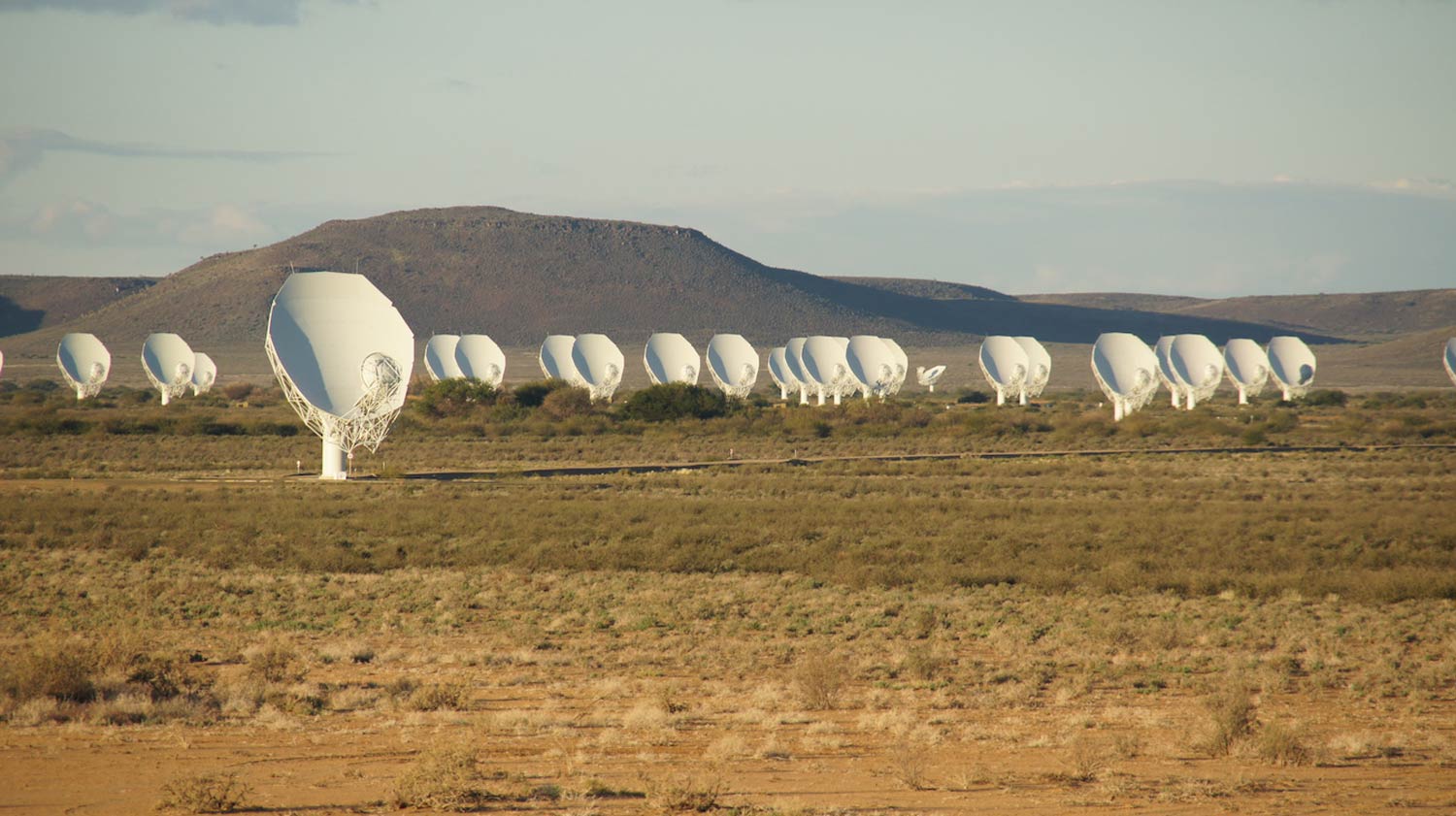
    Artist's impression of some of the planned SKA antennas
    Artist’s impression of some of the planned SKA antennas

    Signals that are even stronger pose a physical threat to radioastronomy equipment as they can cause permanent damage to the amplifiers and receivers used.

    The threat of interference from satellite sources is nothing new. In the past, however, satellite activity has been limited to a few geostationary satellites and an even smaller contingent of LEO spacecraft. “They were typically one or two, so you could undertake operational avoidance actions,” said Tiplady.

    Modern LEO mega-constellations are much, much larger, having at least a thousand satellites in the sky by definition. SpaceX subsidiary Starlink, by far the largest constellation, already has more than 7 600 satellites in orbit. Starlink already has permission from the US Federal Communications Commission to launch up to 12 000 satellites into orbit. In October 2024, SpaceX filed documents with the International Telecommunication Union, an agency of the United Nations, requesting permission to launch another 30 000 satellites, which could see its constellation grow to around 47 000 in next five years.

    South Africa has a critical, strategic and important asset with respect to radioastronomy for the global community

    Others are in the works (or have already started deploying LEO satellites), including OneWeb; Amazon’s Project Kuiper; Starshield; China’s Xingwang, Qianfan and Yinhe; Lynk Global; and E-space. Qianfan alone plans to have 14 000 satellites in its constellation, while Kuiper’s will be smaller, but significant, at around 3 200.

    “With the advent of mega constellations, it becomes practically impossible to constantly move dishes around to avoid those satellites, so there’s a significant amount more collaboration that needs to be undertaken with satellite operators to jointly develop and implement mitigation actions,” Tiplady explained.

    He said various technologies have been tested to try and minimise interference from LEO satellites. The most promising involves directing the beam, or signal, away from known radio astronomy sites until it has passed over. Having the satellite shift its frequency to spectrum not used by astronomy observatories is an additional measure that could be taken. According to Tiplady, satellite beam redirection stipulations can be included in the licensing agreement an operator agrees to before they are allowed to provide their services in the country.

    Regulation

    However, communications regulator Icasa’s hands are for the moment tied because LEO satellites are regulated internationally by the ITU, with the upcoming World Radiocommunication Conference in 2027 earmarked as the stage where LEO interference will be looked at in detail.

    Read: Low-frequency network gets around SKA’s need for radio silence

    “What is important is that Icasa ensures that any kind of licensing processes for satellite service providers takes note of and considers the various mechanisms coming out of those ITU study groups – in South Africa through the astronomy authority and Sarao, and the broader international community for dealing with satellite interference. South Africa has a critical, strategic and important asset with respect to radioastronomy for the global community and we need to protect that,” said Tiplady.  – © 2025 NewsCentral Media

    Get breaking news from TechCentral on WhatsApp. Sign up here.

    Don’t miss:

    Hidden South African observatory quietly shapes our view of space



    Adrian Tiplady Icasa Project Kuiper Sarao South African Radio Astronomy Observatory Starlink
    WhatsApp YouTube Follow on Google News Add as preferred source on Google
    Share. Facebook Twitter LinkedIn WhatsApp Telegram Email Copy Link
    Previous ArticleWhy AI could soon be managing your home solar system
    Next Article Home affairs faces backlash over ID database fee surge

    Related Posts

    Mobile operators face tougher rules on data and billing

    Mobile operators face tougher rules on data and billing

    26 January 2026
    Why Elon Musk's Starlink is a 'hard no' for me - Songezo Zibi

    Why Elon Musk’s Starlink is a ‘hard no’ for me

    26 January 2026
    Debate erupts over value of in-flight Wi-Fi

    Debate erupts over value of in-flight Wi-Fi

    26 January 2026
    Company News
    Your next team member might already be in Jira - Obsidian Systems Atlassian

    Your next team member might already be in Jira

    26 January 2026
    Iris vPoller: a new edge in network visibility for service providers

    Iris vPoller: a new edge in network visibility for service providers

    26 January 2026
    Jabra - a smarter way to sound, work and connect in the workplace

    Jabra – a smarter way to sound, work and connect in the workplace

    23 January 2026
    Opinion
    AI moves from pilots to production in South African companies - Nazia Pillay SAP

    AI moves from pilots to production in South African companies

    20 January 2026
    ANC's attack on Solly Malatsi shows how BEE dogma trumps economic reality - Duncan McLeod

    ANC’s attack on Solly Malatsi shows how BEE dogma trumps economic reality

    14 December 2025
    Netflix, Warner Bros deal raises fresh headaches for MultiChoice - Duncan McLeod

    Netflix, Warner Bros deal raises fresh headaches for MultiChoice

    5 December 2025

    Subscribe to Updates

    Get the best South African technology news and analysis delivered to your e-mail inbox every morning.

    Latest Posts
    Your next team member might already be in Jira - Obsidian Systems Atlassian

    Your next team member might already be in Jira

    26 January 2026
    Rand breaks through R16/$ - and may have further to run

    Rand breaks through R16/$ – and may have further to run

    26 January 2026
    Mobile operators face tougher rules on data and billing

    Mobile operators face tougher rules on data and billing

    26 January 2026
    Iris vPoller: a new edge in network visibility for service providers

    Iris vPoller: a new edge in network visibility for service providers

    26 January 2026
    © 2009 - 2026 NewsCentral Media
    • Cookie policy (ZA)
    • TechCentral – privacy and Popia

    Type above and press Enter to search. Press Esc to cancel.

    Manage consent

    TechCentral uses cookies to enhance its offerings. Consenting to these technologies allows us to serve you better. Not consenting or withdrawing consent may adversely affect certain features and functions of the website.

    Functional Always active
    The technical storage or access is strictly necessary for the legitimate purpose of enabling the use of a specific service explicitly requested by the subscriber or user, or for the sole purpose of carrying out the transmission of a communication over an electronic communications network.
    Preferences
    The technical storage or access is necessary for the legitimate purpose of storing preferences that are not requested by the subscriber or user.
    Statistics
    The technical storage or access that is used exclusively for statistical purposes. The technical storage or access that is used exclusively for anonymous statistical purposes. Without a subpoena, voluntary compliance on the part of your Internet Service Provider, or additional records from a third party, information stored or retrieved for this purpose alone cannot usually be used to identify you.
    Marketing
    The technical storage or access is required to create user profiles to send advertising, or to track the user on a website or across several websites for similar marketing purposes.
    • Manage options
    • Manage services
    • Manage {vendor_count} vendors
    • Read more about these purposes
    View preferences
    • {title}
    • {title}
    • {title}