
Close Menu
TechCentralTechCentral

    Subscribe to the newsletter

    Get the best South African technology news and analysis delivered to your e-mail inbox every morning.

    Facebook X (Twitter) YouTube LinkedIn
    WhatsApp Facebook X (Twitter) LinkedIn YouTube
    TechCentralTechCentral
    • News
      Big Microsoft 365 price increases coming next year

      Big Microsoft price increases coming next year

      5 December 2025
      Vodacom to take control of Safaricom in R36-billion deal - Shameel Joosub

      Vodacom to take control of Safaricom in R36-billion deal

      4 December 2025
      Black Friday goes digital in South Africa as online spending surges to record high

      Black Friday goes digital in South Africa as online spending surges to record high

      4 December 2025
      BYD takes direct aim at Toyota with launch of sub-R500 000 Sealion 5 PHEV

      BYD takes direct aim at Toyota with launch of sub-R500 000 Sealion 5 PHEV

      4 December 2025
      'Get it now': Takealot in new instant deliveries pilot

      ‘Get it now’: Takealot in new instant deliveries pilot

      4 December 2025
    • World
      Amazon and Google launch multi-cloud service for faster connectivity

      Amazon and Google launch multi-cloud service for faster connectivity

      1 December 2025
      Google makes final court plea to stop US breakup

      Google makes final court plea to stop US breakup

      21 November 2025
      Bezos unveils monster rocket: New Glenn 9x4 set to dwarf Saturn V

      Bezos unveils monster rocket: New Glenn 9×4 set to dwarf Saturn V

      21 November 2025
      Tech shares turbocharged by Nvidia's stellar earnings

      Tech shares turbocharged by stellar Nvidia earnings

      20 November 2025
      Config file blamed for Cloudflare meltdown that disrupted the web

      Config file blamed for Cloudflare meltdown that disrupted the web

      19 November 2025
    • In-depth
      Jensen Huang Nvidia

      So, will China really win the AI race?

      14 November 2025
      Valve's Linux console takes aim at Microsoft's gaming empire

      Valve’s Linux console takes aim at Microsoft’s gaming empire

      13 November 2025
      iOCO's extraordinary comeback plan - Rhys Summerton

      iOCO’s extraordinary comeback plan

      28 October 2025
      Why smart glasses keep failing - no, it's not the tech - Mark Zuckerberg

      Why smart glasses keep failing – it’s not the tech

      19 October 2025
      BYD to blanket South Africa with megawatt-scale EV charging network - Stella Li

      BYD to blanket South Africa with megawatt-scale EV charging network

      16 October 2025
    • TCS
      TCS+ | How Cloud on Demand helps partners thrive in the AWS ecosystem - Odwa Ndyaluvane and Xenia Rhode

      TCS+ | How Cloud On Demand helps partners thrive in the AWS ecosystem

      4 December 2025
      TCS | MTN Group CEO Ralph Mupita on competition, AI and the future of mobile

      TCS | Ralph Mupita on competition, AI and the future of mobile

      28 November 2025
      TCS | Dominic Cull on fixing South Africa's ICT policy bottlenecks

      TCS | Dominic Cull on fixing South Africa’s ICT policy bottlenecks

      21 November 2025
      TCS | BMW CEO Peter van Binsbergen on the future of South Africa's automotive industry

      TCS | BMW CEO Peter van Binsbergen on the future of South Africa’s automotive industry

      6 November 2025
      TCS | Why Altron is building an AI factory - Bongani Andy Mabaso

      TCS | Why Altron is building an AI factory in Johannesburg

      28 October 2025
    • Opinion
      Your data, your hardware: the DIY AI revolution is coming - Duncan McLeod

      Your data, your hardware: the DIY AI revolution is coming

      20 November 2025
      Zero Carbon Charge founder Joubert Roux

      The energy revolution South Africa can’t afford to miss

      20 November 2025
      It's time for a new approach to government IT spend in South Africa - Richard Firth

      It’s time for a new approach to government IT spend in South Africa

      19 November 2025
      How South Africa's broken Rica system fuels murder and mayhem - Farhad Khan

      How South Africa’s broken Rica system fuels murder and mayhem

      10 November 2025
      South Africa's AI data centre boom risks overloading a fragile grid - Paul Colmer

      South Africa’s AI data centre boom risks overloading a fragile grid

      30 October 2025
    • Company Hubs
      • Africa Data Centres
      • AfriGIS
      • Altron Digital Business
      • Altron Document Solutions
      • Altron Group
      • Arctic Wolf
      • AvertITD
      • Braintree
      • CallMiner
      • CambriLearn
      • CYBER1 Solutions
      • Digicloud Africa
      • Digimune
      • Domains.co.za
      • ESET
      • Euphoria Telecom
      • Incredible Business
      • iONLINE
      • IQbusiness
      • Iris Network Systems
      • LSD Open
      • NEC XON
      • Netstar
      • Network Platforms
      • Next DLP
      • Ovations
      • Paracon
      • Paratus
      • Q-KON
      • SevenC
      • SkyWire
      • Solid8 Technologies
      • Telit Cinterion
      • Tenable
      • Vertiv
      • Videri Digital
      • Vodacom Business
      • Wipro
      • Workday
      • XLink
    • Sections
      • AI and machine learning
      • Banking
      • Broadcasting and Media
      • Cloud services
      • Contact centres and CX
      • Cryptocurrencies
      • Education and skills
      • Electronics and hardware
      • Energy and sustainability
      • Enterprise software
      • Financial services
      • Information security
      • Internet and connectivity
      • Internet of Things
      • Investment
      • IT services
      • Lifestyle
      • Motoring
      • Public sector
      • Retail and e-commerce
      • Satellite communications
      • Science
      • SMEs and start-ups
      • Social media
      • Talent and leadership
      • Telecoms
    • Events
    • Advertise
    TechCentralTechCentral
    Home » Sections » Satellite communications » LEO satellite industry is on the horns of a dilemma

    LEO satellite industry is on the horns of a dilemma

    Promoted | Forecasts suggest that as many as 70 000 LEO satellites could be launched over the next five years. But how will all the prospective customers will be served?
    By Q-KON25 June 2025
    Twitter LinkedIn Facebook WhatsApp Email Telegram Copy Link
    News Alerts
    WhatsApp

    LEO satellite industry is on the horns of a dilemmaSince LEO services fall under the umbrella of the telecommunications industry, the logical expectation is that emerging LEO services will be deployed by current mobile network operators (MNOs) in their respective markets.

    For example, in 2024, sub-Saharan Africa had an estimated 950 million mobile subscriptions – a total that’s projected to grow to 1.2 billion by 2030. Adding a couple of extra million LEO subscribers to this mobile network service portfolio therefore looks to be a readily achievable task and a low-effort, go-to-market option for global LEO constellation operators. Yet, when you consider that satellite services require both a different architecture and deployment model, it becomes apparent that they might not fit so readily into established telco business models.

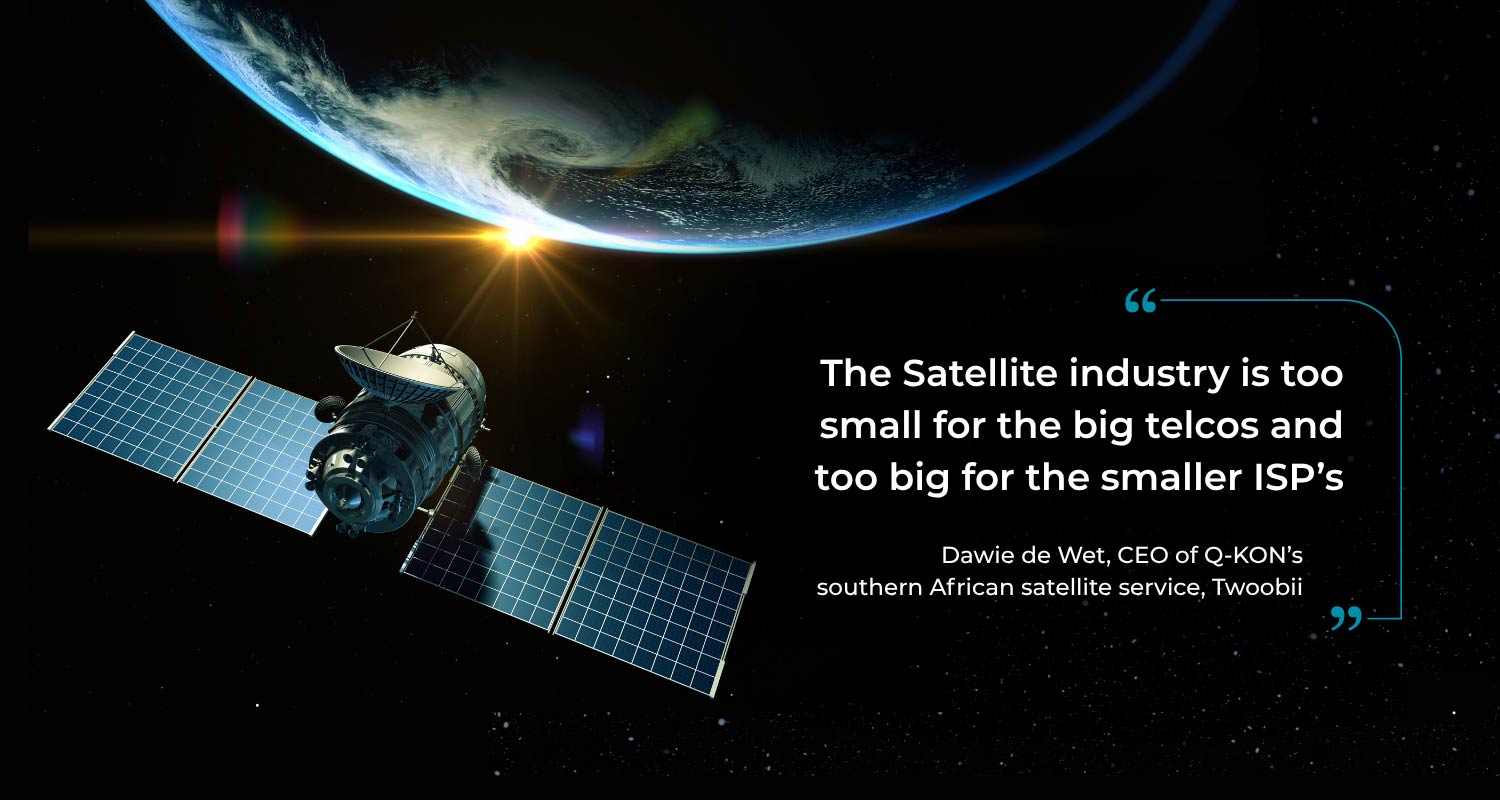
    This could lead to an interesting scenario, with LEO growth potentially stymied by the lack of a suitable industry structure within which to bring LEO services to market. Our contention is that LEO satellite services are currently too small to be of interest to the big telcos, yet too big for traditional geostationary satellite, wireless and other service providers. This creates something of a dilemma: which route to market LEO service providers should take.

    Commercial aspects

    Let’s begin by considering the commercial aspects of a LEO roll-out in an MNO context. For reference, we can consider Vodacom Group, whose revenue was R73.5-billion in the six months to 30 September 2024, with year-on-year growth of some 36.9%.

    It is estimated that Africa has around 336 000 Starlink subscribers, out of a global total of 5.4 million. Let us consider a possible pan-African LEO network scenario with one million subscribers at an average revenue per user (Arpu) per month of R400, for a total revenue of R4.8-billion/year. This is equivalent to just 3.2% of Vodacom’s R151-billion annual turnover. Even if we factor in Vodacom’s potential resale of LEO services at a possible 20% margin, this would only add a further R960 million or 0.64% of the company’s turnover.

    Will any telco be interested in onboarding a product – and assuming the associated risks – for revenue which, while substantial, would be minimal in the context of their overall business?

    Product positioning

    In some cases, telcos may onboard new services even without a compelling business case when these services bring additional strategic value or operational efficiencies to the organisation. Yet even this rationale doesn’t necessarily carry sufficient weight.

    LEO services offer the market only limited extra capacity (estimated to be a mere 4% of the overall demand per country), and they require a high-touch deployment programme with physical installations by professional teams backed by extensive equipment, logistics, warehousing and distribution spend.

    Added to this is the fact that mobile operators will effectively only be resellers with no easy means to control or determine service quality, product definition and differentiation. This adds up to a rather bleak and low-value proposition for mobile operators and telcos that might be considering adding a LEO service to their portfolios.
    Yes, the ubiquitous coverage offered by satellite services is an attractive product feature that might motivate mobile operators to adopt LEO services – even if only to respond to regulatory pressure to ensure 100% population coverage. In this scenario, the business case drivers for MNOs are more compliance-related than based strictly on ROI metrics, although this could still be considered a sufficient incentive. The flip side is of course that there is unlikely to be any real push of the product to market, which will in turn diminish its appeal to LEO operators.

    This leads us to believe that MNOs and telcos will conclude that the inherent commercial and business advantages of LEO services are not significant enough to justify their onboarding.

    Viable alternatives

    One possible alternative for LEO operators is to partner with established geostationary satellite (GEO) service providers as a go-to-market model. In this scenario, the product alliance is primarily positive, but could create competition issues between emerging LEO services and existing GEO offerings.

    The key issue, however, is that there are currently no established GEO service providers able to readily upscale to servicing a one million customer subscriber base. This is why we refer to LEO services being too big to handle for the smaller operators.

    Another option is for the LEO operators to adopt a direct-to-market model; in the context of this discussion, this may be almost the only logical choice open to them. However, this option is complicated by the fact that the African telecoms landscape is a highly regulated environment and that global LEO operators cannot easily achieve the necessary local approvals. Even if an operating licence is obtained, the market will expect tailored local support.

    Conclusions

    This dilemma facing the LEO industry – namely, that it is “too small for the big telcos and too big for the small telcos” is exactly why opportunities are currently opening up for a new generation of more agile, innovative telcos, whether as new businesses backed by venture capital or through current providers pivoting to take advantage of new opportunities.

    The author, Q-KON CEO Dawie de Wet
    The author, Q-KON CEO Dawie de Wet

    For example, Q-KON, with its Twoobii Smart Satellite Service, is a specialist satellite  provider already established as the “satellite services factory” for Africa. Q-KON has focused on mapping go-to-market models between global operators and the African market, and is now poised to play a leading role in unlocking the market for LEO services across Africa.

    For more info about Super Smart Twoobii-LEO Satellite Services, click here.

    About the author
    Dr Dawie de Wet (Pr Eng, MSc Eng) is group CEO of Q-KON, a leading satellite engineering company pioneering smart satellite services in Africa through its flagship service, Twoobii. Q-KON delivers resilient and innovative services by tailoring global satellite technology to the specific needs of the African enterprise landscape. With over 30 years of experience in designing, engineering, developing and implementing wireless, microwave and satellite communication systems in Africa, De Wet steers the company’s focus on developing telco solutions that meet the user requirements of emerging markets through the deployment of world-class technology.

    • Read more articles by Q-KON on TechCentral
    • This promoted content was paid for by the party concerned

    Don’t miss:

    Satellite communications – the gold standard of enterprise data security?



    Dawie de Wet Q-Kon Twoobii Vodacom
    Subscribe to TechCentral Subscribe to TechCentral
    Share. Facebook Twitter LinkedIn WhatsApp Telegram Email Copy Link
    Previous ArticleAfrica’s power industry bolsters digitalisation with Huawei
    Next Article MTN – the network for networks

    Related Posts

    Vodacom to take control of Safaricom in R36-billion deal - Shameel Joosub

    Vodacom to take control of Safaricom in R36-billion deal

    4 December 2025
    Building trust in a digital world: Vodacom Business's approach to security

    Building trust in a digital world – the Vodacom Business approach to security

    4 December 2025
    Four years later, Vodacom and Maziv have sealed their deal

    Four years later, Vodacom and Maziv have sealed their deal

    26 November 2025
    Add A Comment

    Comments are closed.

    Company News
    AI is not a technology problem - iqbusiness

    AI is not a technology problem – iqbusiness

    5 December 2025
    Telcos are sitting on a data gold mine - but few know what do with it - Phillip du Plessis

    Telcos are sitting on a data gold mine – but few know what do with it

    4 December 2025
    Unlock smarter computing with your surface Copilot+ PC

    Unlock smarter computing with your Surface Copilot+ PC

    4 December 2025
    Opinion
    Your data, your hardware: the DIY AI revolution is coming - Duncan McLeod

    Your data, your hardware: the DIY AI revolution is coming

    20 November 2025
    Zero Carbon Charge founder Joubert Roux

    The energy revolution South Africa can’t afford to miss

    20 November 2025
    It's time for a new approach to government IT spend in South Africa - Richard Firth

    It’s time for a new approach to government IT spend in South Africa

    19 November 2025

    Subscribe to Updates

    Get the best South African technology news and analysis delivered to your e-mail inbox every morning.

    Latest Posts
    Big Microsoft 365 price increases coming next year

    Big Microsoft price increases coming next year

    5 December 2025
    AI is not a technology problem - iqbusiness

    AI is not a technology problem – iqbusiness

    5 December 2025
    Vodacom to take control of Safaricom in R36-billion deal - Shameel Joosub

    Vodacom to take control of Safaricom in R36-billion deal

    4 December 2025
    Black Friday goes digital in South Africa as online spending surges to record high

    Black Friday goes digital in South Africa as online spending surges to record high

    4 December 2025
    © 2009 - 2025 NewsCentral Media
    • Cookie policy (ZA)
    • TechCentral – privacy and Popia

    Type above and press Enter to search. Press Esc to cancel.

    Manage consent

    TechCentral uses cookies to enhance its offerings. Consenting to these technologies allows us to serve you better. Not consenting or withdrawing consent may adversely affect certain features and functions of the website.

    Functional Always active
    The technical storage or access is strictly necessary for the legitimate purpose of enabling the use of a specific service explicitly requested by the subscriber or user, or for the sole purpose of carrying out the transmission of a communication over an electronic communications network.
    Preferences
    The technical storage or access is necessary for the legitimate purpose of storing preferences that are not requested by the subscriber or user.
    Statistics
    The technical storage or access that is used exclusively for statistical purposes. The technical storage or access that is used exclusively for anonymous statistical purposes. Without a subpoena, voluntary compliance on the part of your Internet Service Provider, or additional records from a third party, information stored or retrieved for this purpose alone cannot usually be used to identify you.
    Marketing
    The technical storage or access is required to create user profiles to send advertising, or to track the user on a website or across several websites for similar marketing purposes.
    • Manage options
    • Manage services
    • Manage {vendor_count} vendors
    • Read more about these purposes
    View preferences
    • {title}
    • {title}
    • {title}