Close Menu
TechCentralTechCentral

    Subscribe to the newsletter

    Get the best South African technology news and analysis delivered to your e-mail inbox every morning.

    Facebook X (Twitter) YouTube LinkedIn
    WhatsApp Facebook X (Twitter) LinkedIn YouTube
    TechCentralTechCentral
    • News
      Jensen Huang: 'China is going to win the AI race' - Nvidia

      Jensen Huang: ‘China is going to win the AI race’

      6 November 2025
      TCS | BMW CEO Peter van Binsbergen on the future of South Africa's automotive industry

      TCS | BMW CEO Peter van Binsbergen on the future of South Africa’s automotive industry

      6 November 2025
      Amazon seeking South African talent for Project Kuiper

      Amazon seeking South African talent for Project Kuiper

      6 November 2025

      Why Google is planning a powerful AI data centre on this tiny Indian Ocean island

      6 November 2025
      Agentic AI is a 'force multiplier' for small businesses - AWS - Rahul Pathak

      Agentic AI is a ‘force multiplier’ for small businesses – AWS

      6 November 2025
    • World
      Apple's new Siri will be powered by ... Google

      Apple’s new Siri will be powered by … Google

      6 November 2025
      WEF warns of bubbles in global economy

      WEF warns of bubbles in global economy

      5 November 2025
      Mastercard plots major push into stablecoins

      Mastercard plots major push into stablecoins

      30 October 2025
      Nvidia takes centre stage in US-China trade chess match - Jensen Huang

      Nvidia takes centre stage in US-China trade chess match

      29 October 2025
      Nvidia and Nokia set sights on 6G

      Nvidia and Nokia set sights on 6G

      29 October 2025
    • In-depth
      iOCO's extraordinary comeback plan - Rhys Summerton

      iOCO’s extraordinary comeback plan

      28 October 2025
      Why smart glasses keep failing - no, it's not the tech - Mark Zuckerberg

      Why smart glasses keep failing – it’s not the tech

      19 October 2025
      BYD to blanket South Africa with megawatt-scale EV charging network - Stella Li

      BYD to blanket South Africa with megawatt-scale EV charging network

      16 October 2025
      MultiChoice DStv

      As DStv turns 30, it faces its toughest test yet

      6 October 2025
      AMD, OpenAI alliance marks seismic shift in global AI chip race

      AMD, OpenAI alliance marks seismic shift in global AI chip race

      6 October 2025
    • TCS
      TCS | Why Altron is building an AI factory - Bongani Andy Mabaso

      TCS | Why Altron is building an AI factory in Johannesburg

      28 October 2025

      TCS+ | Videsha Proothveerajh on Vodacom Business’s new approach to enterprise technology

      28 October 2025
      TCS | The company building a 'living computer' with human cells - Fred Jordan FinalSpark

      TCS | The company building a ‘living computer’ with human cells

      23 October 2025
      TCS | Why South Africans are starting to spend crypto, not just trade it

      TCS | Why South Africans are starting to spend crypto, not just trade it

      22 October 2025
      TCS+ | Managing Sims, saving money: how MSB Micro keeps businesses connected

      TCS+ | Managing Sims, saving money: how MSB Micro keeps businesses connected

      22 October 2025
    • Opinion
      AI takes the throne - Brian Hungwe

      AI takes the throne

      6 October 2025
      The author, Business Leadership South Africa CEO Busi Mavuso

      Trump tariffs and diplomatic missteps push Agoa off the cliff

      6 October 2025
      Duncan McLeod

      Why Capitec should buy Blu Label

      1 October 2025
      AI takes the throne - Brian Hungwe

      AI boom puts Africa at a crossroads

      14 September 2025
      A smarter approach to digital transformation in ICT distribution - Andrew Harris

      A smarter approach to digital transformation in ICT distribution

      15 July 2025
    • Company Hubs
      • Africa Data Centres
      • AfriGIS
      • Altron Digital Business
      • Altron Document Solutions
      • Altron Group
      • Arctic Wolf
      • AvertITD
      • Braintree
      • CallMiner
      • CambriLearn
      • CYBER1 Solutions
      • Digicloud Africa
      • Digimune
      • Domains.co.za
      • ESET
      • Euphoria Telecom
      • Incredible Business
      • iONLINE
      • Iris Network Systems
      • LSD Open
      • NEC XON
      • Netstar
      • Network Platforms
      • Next DLP
      • Ovations
      • Paracon
      • Paratus
      • Q-KON
      • SevenC
      • SkyWire
      • Solid8 Technologies
      • Telit Cinterion
      • Tenable
      • Vertiv
      • Videri Digital
      • Vodacom Business
      • Wipro
      • Workday
      • XLink
    • Sections
      • AI and machine learning
      • Banking
      • Broadcasting and Media
      • Cloud services
      • Contact centres and CX
      • Cryptocurrencies
      • Education and skills
      • Electronics and hardware
      • Energy and sustainability
      • Enterprise software
      • Financial services
      • Information security
      • Internet and connectivity
      • Internet of Things
      • Investment
      • IT services
      • Lifestyle
      • Motoring
      • Public sector
      • Retail and e-commerce
      • Satellite communications
      • Science
      • SMEs and start-ups
      • Social media
      • Talent and leadership
      • Telecoms
    • Events
    • Advertise
    TechCentralTechCentral
    Home » In-depth » Next cyberattack could come from soundwaves

    Next cyberattack could come from soundwaves

    By The Conversation30 March 2017
    Twitter LinkedIn Facebook WhatsApp Email Telegram Copy Link
    News Alerts
    WhatsApp

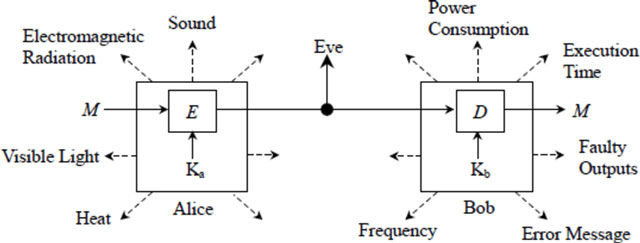
    You might think your smartphone or laptop is relatively safe from cyberattacks thanks to antivirus and encryption software. But your devices are increasingly at risk from “side-channel” attacks, where an intruder can bypass traditional network entry points and use another way to compromise them.

    These side channels can involve measuring several of the device’s characteristics, including its power consumption, the time it takes to perform certain functions, or the amount of light or other electromagnetic radiation it emits.

    These outputs have long been used as a way of spying on communications. But now there is an increasing risk that they could also be used to disrupt the operation of electronic devices. This is a particular worry as more and more objects are equipped with miniature computers to connect them to the Internet.
    In the latest example of this, researchers from the University of Michigan have found a new way of using sound to interfere with devices containing accelerometers, a device for measuring acceleration that is found in things such as navigation systems. Smartphones use them to detect movement and calculate things like which way up the phone is being held, and even how many steps it has been carried. The researchers found that the vibrations from music playing on a smartphone could affect its accelerometer in a way that made it seem as if the user was moving. Overall, they found the flaw in more than half of the devices they tested.
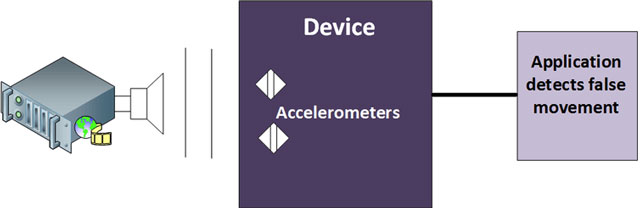
    Simply increasing the number of steps a user thinks they’ve taken isn’t likely to cause much damage other than to their exercise plan. But this flaw shows there is a more serious risk of intruders confusing the motion sensors within the control systems of other devices, such as the computers that run modern cars or drones. Previous research has also shown that accelerometers can be used for spying by effectively turning them into microphone or using them to monitor what keys a user is pressing on their smartphone.

    There is a general risk, too, around medical equipment, as accelerometers are often used to measure things such as the flow of medicine to a patient. So, if medical devices can be affected by music, they could lead to incorrect flow measurements and so incorrect doses. The Michigan researchers outline that accelerometers are also used in healthcare applications, such as in pacemakers, and which could be affected by external sounds.

    There is a similar potential problem in industrial plants, where accelerometers are again used to measure things like flow rates of chemicals or fuel. A high-powered soundwave could be used to confuse a plant’s control system and cause its equipment to shut down. If used against power plants, this could lead to the nightmare scenario of an attack on the energy supply network.

    Imagine if a drone army was flown over an area emitting high-powered soundwaves. This could interfere with all local accelerometers in a way that interrupted the equipment they were part of, effectively causing a mass denial of service attack. This is already a known risk for radio interference, and where high-powered electromagnetic (EM) radio waves can be used to compromise the operation of electronic equipment as part of military operations.

    Further research would be required to find out the exact frequencies that affect the device and if they could be heard by humans.

    The movie Ocean’s Eleven even outlined an attack using EM pulses to cause a black-out in Las Vegas. And while disaster planners have looked to the threats of EM blasts, little work has been done on the effects of soundwaves on modern electronic systems.

    Other risks

    Soundwaves can be used to do more than just disrupt equipment. By analysing the noise coming from an electronic device, it is possible to extract data from it. Researchers at the University of Alabama at Birmingham in the US also found that they could determine user passwords by listening to the sounds that the keyboard made.

    To the human ear, each keystroke sounds the same but it actually gives off a unique sound frequency pattern. By using a number of suitably placed microphones to measure time differences and amplitudes of the received sound pulses, and with knowledge of the geometry of the keyboard, the researchers could identify which keys were being pressed.

    Similarly, data can be obtained by analysing the radio signals or even the power variations from a device. A group of researchers recently demonstrated that it is possible to detect the movement of a user’s hand on their device and so reveal their password by examining how it alters the reflection of local Wi-Fi signals.

    Another researcher was able to analyse electrical power variations from eight of the most popular Sim cards for mobile phones and recover the keys that encrypt them within 40 minutes.

    It is possible to protect a device against these side-channel attacks, usually with a physical shield that protects them from leaking information or becoming compromised. A simple metal shield can stop radio signals, but to stop soundwaves affecting an accelerometer you would need a more complex acoustic shield to absorb the noise and minimise the vibrations causing the sensor to move. This would need to involve filtering out noise such as audio and speech signals, so the sensor only detected the movement it was designed to capture.

    The findings that accelerometers can be affected by sound will come as a shock to many instrumental manufacturers, especially within the devices used in critical national infrastructure. More sensitive devices, such as medical equipment and those used in critical infrastructure, also need more rigorous testing to see how they respond in the face of a range of side-channel attacks. The Conversation

    • Bill Buchanan is head of The Cyber Academy, Edinburgh Napier University
    • This article was originally published on The Conversation


    Subscribe to TechCentral Subscribe to TechCentral
    Share. Facebook Twitter LinkedIn WhatsApp Telegram Email Copy Link
    Previous ArticleJeff Bezos now world’s second richest person
    Next Article Ford hires 400 BlackBerry employees

    Related Posts

    Jensen Huang: 'China is going to win the AI race' - Nvidia

    Jensen Huang: ‘China is going to win the AI race’

    6 November 2025
    TCS | BMW CEO Peter van Binsbergen on the future of South Africa's automotive industry

    TCS | BMW CEO Peter van Binsbergen on the future of South Africa’s automotive industry

    6 November 2025
    Amazon seeking South African talent for Project Kuiper

    Amazon seeking South African talent for Project Kuiper

    6 November 2025
    Company News
    Oni-Tel launches inter-data centre fibre network with Digital Parks Africa

    Oni-Tel launches inter-data centre fibre network with Digital Parks Africa

    6 November 2025
    All-new Huawei nova 14 Series lands in South Africa

    All-new Huawei nova 14 Series lands in South Africa

    6 November 2025
    Smartz Solutions, Cloud On Demand showcase human-centric AI for modern contact centres - Vanda Dickson and Henry McCracken

    Smartz Solutions, Cloud On Demand showcase human-centric AI for modern contact centres

    6 November 2025
    Opinion
    AI takes the throne - Brian Hungwe

    AI takes the throne

    6 October 2025
    The author, Business Leadership South Africa CEO Busi Mavuso

    Trump tariffs and diplomatic missteps push Agoa off the cliff

    6 October 2025
    Duncan McLeod

    Why Capitec should buy Blu Label

    1 October 2025

    Subscribe to Updates

    Get the best South African technology news and analysis delivered to your e-mail inbox every morning.

    Latest Posts
    Jensen Huang: 'China is going to win the AI race' - Nvidia

    Jensen Huang: ‘China is going to win the AI race’

    6 November 2025
    TCS | BMW CEO Peter van Binsbergen on the future of South Africa's automotive industry

    TCS | BMW CEO Peter van Binsbergen on the future of South Africa’s automotive industry

    6 November 2025
    Amazon seeking South African talent for Project Kuiper

    Amazon seeking South African talent for Project Kuiper

    6 November 2025

    Why Google is planning a powerful AI data centre on this tiny Indian Ocean island

    6 November 2025
    © 2009 - 2025 NewsCentral Media
    • Cookie policy (ZA)
    • TechCentral – privacy and Popia

    Type above and press Enter to search. Press Esc to cancel.

    Manage consent

    TechCentral uses cookies to enhance its offerings. Consenting to these technologies allows us to serve you better. Not consenting or withdrawing consent may adversely affect certain features and functions of the website.

    Functional Always active
    The technical storage or access is strictly necessary for the legitimate purpose of enabling the use of a specific service explicitly requested by the subscriber or user, or for the sole purpose of carrying out the transmission of a communication over an electronic communications network.
    Preferences
    The technical storage or access is necessary for the legitimate purpose of storing preferences that are not requested by the subscriber or user.
    Statistics
    The technical storage or access that is used exclusively for statistical purposes. The technical storage or access that is used exclusively for anonymous statistical purposes. Without a subpoena, voluntary compliance on the part of your Internet Service Provider, or additional records from a third party, information stored or retrieved for this purpose alone cannot usually be used to identify you.
    Marketing
    The technical storage or access is required to create user profiles to send advertising, or to track the user on a website or across several websites for similar marketing purposes.
    • Manage options
    • Manage services
    • Manage {vendor_count} vendors
    • Read more about these purposes
    View preferences
    • {title}
    • {title}
    • {title}