
Close Menu
TechCentralTechCentral

    Subscribe to the newsletter

    Get the best South African technology news and analysis delivered to your e-mail inbox every morning.

    Facebook X (Twitter) YouTube LinkedIn
    WhatsApp Facebook X (Twitter) LinkedIn YouTube
    TechCentralTechCentral
    • News
      Big Microsoft 365 price increases coming next year

      Big Microsoft price increases coming next year

      5 December 2025
      Vodacom to take control of Safaricom in R36-billion deal - Shameel Joosub

      Vodacom to take control of Safaricom in R36-billion deal

      4 December 2025
      Black Friday goes digital in South Africa as online spending surges to record high

      Black Friday goes digital in South Africa as online spending surges to record high

      4 December 2025
      BYD takes direct aim at Toyota with launch of sub-R500 000 Sealion 5 PHEV

      BYD takes direct aim at Toyota with launch of sub-R500 000 Sealion 5 PHEV

      4 December 2025
      'Get it now': Takealot in new instant deliveries pilot

      ‘Get it now’: Takealot in new instant deliveries pilot

      4 December 2025
    • World
      Amazon and Google launch multi-cloud service for faster connectivity

      Amazon and Google launch multi-cloud service for faster connectivity

      1 December 2025
      Google makes final court plea to stop US breakup

      Google makes final court plea to stop US breakup

      21 November 2025
      Bezos unveils monster rocket: New Glenn 9x4 set to dwarf Saturn V

      Bezos unveils monster rocket: New Glenn 9×4 set to dwarf Saturn V

      21 November 2025
      Tech shares turbocharged by Nvidia's stellar earnings

      Tech shares turbocharged by stellar Nvidia earnings

      20 November 2025
      Config file blamed for Cloudflare meltdown that disrupted the web

      Config file blamed for Cloudflare meltdown that disrupted the web

      19 November 2025
    • In-depth
      Jensen Huang Nvidia

      So, will China really win the AI race?

      14 November 2025
      Valve's Linux console takes aim at Microsoft's gaming empire

      Valve’s Linux console takes aim at Microsoft’s gaming empire

      13 November 2025
      iOCO's extraordinary comeback plan - Rhys Summerton

      iOCO’s extraordinary comeback plan

      28 October 2025
      Why smart glasses keep failing - no, it's not the tech - Mark Zuckerberg

      Why smart glasses keep failing – it’s not the tech

      19 October 2025
      BYD to blanket South Africa with megawatt-scale EV charging network - Stella Li

      BYD to blanket South Africa with megawatt-scale EV charging network

      16 October 2025
    • TCS
      TCS+ | How Cloud on Demand helps partners thrive in the AWS ecosystem - Odwa Ndyaluvane and Xenia Rhode

      TCS+ | How Cloud On Demand helps partners thrive in the AWS ecosystem

      4 December 2025
      TCS | MTN Group CEO Ralph Mupita on competition, AI and the future of mobile

      TCS | Ralph Mupita on competition, AI and the future of mobile

      28 November 2025
      TCS | Dominic Cull on fixing South Africa's ICT policy bottlenecks

      TCS | Dominic Cull on fixing South Africa’s ICT policy bottlenecks

      21 November 2025
      TCS | BMW CEO Peter van Binsbergen on the future of South Africa's automotive industry

      TCS | BMW CEO Peter van Binsbergen on the future of South Africa’s automotive industry

      6 November 2025
      TCS | Why Altron is building an AI factory - Bongani Andy Mabaso

      TCS | Why Altron is building an AI factory in Johannesburg

      28 October 2025
    • Opinion
      Your data, your hardware: the DIY AI revolution is coming - Duncan McLeod

      Your data, your hardware: the DIY AI revolution is coming

      20 November 2025
      Zero Carbon Charge founder Joubert Roux

      The energy revolution South Africa can’t afford to miss

      20 November 2025
      It's time for a new approach to government IT spend in South Africa - Richard Firth

      It’s time for a new approach to government IT spend in South Africa

      19 November 2025
      How South Africa's broken Rica system fuels murder and mayhem - Farhad Khan

      How South Africa’s broken Rica system fuels murder and mayhem

      10 November 2025
      South Africa's AI data centre boom risks overloading a fragile grid - Paul Colmer

      South Africa’s AI data centre boom risks overloading a fragile grid

      30 October 2025
    • Company Hubs
      • Africa Data Centres
      • AfriGIS
      • Altron Digital Business
      • Altron Document Solutions
      • Altron Group
      • Arctic Wolf
      • AvertITD
      • Braintree
      • CallMiner
      • CambriLearn
      • CYBER1 Solutions
      • Digicloud Africa
      • Digimune
      • Domains.co.za
      • ESET
      • Euphoria Telecom
      • Incredible Business
      • iONLINE
      • IQbusiness
      • Iris Network Systems
      • LSD Open
      • NEC XON
      • Netstar
      • Network Platforms
      • Next DLP
      • Ovations
      • Paracon
      • Paratus
      • Q-KON
      • SevenC
      • SkyWire
      • Solid8 Technologies
      • Telit Cinterion
      • Tenable
      • Vertiv
      • Videri Digital
      • Vodacom Business
      • Wipro
      • Workday
      • XLink
    • Sections
      • AI and machine learning
      • Banking
      • Broadcasting and Media
      • Cloud services
      • Contact centres and CX
      • Cryptocurrencies
      • Education and skills
      • Electronics and hardware
      • Energy and sustainability
      • Enterprise software
      • Financial services
      • Information security
      • Internet and connectivity
      • Internet of Things
      • Investment
      • IT services
      • Lifestyle
      • Motoring
      • Public sector
      • Retail and e-commerce
      • Satellite communications
      • Science
      • SMEs and start-ups
      • Social media
      • Talent and leadership
      • Telecoms
    • Events
    • Advertise
    TechCentralTechCentral
    Home » Sections » Science » Quantum computers in 2023: what they do and where they’re heading

    Quantum computers in 2023: what they do and where they’re heading

    A stretch goal for the coming decade is the creation of a large-scale quantum computer free of errors.
    By The Conversation22 October 2023
    Twitter LinkedIn Facebook WhatsApp Email Telegram Copy Link
    News Alerts
    WhatsApp
    A quantum computer as “imagined” by the Midjourney image-generation AI

    In June, an IBM computing executive claimed quantum computers were entering the “utility” phase, in which high-tech experimental devices become useful.

    But what is a quantum computer? One way to think about computers is in terms of the kinds of numbers they work with.

    The digital computers we use every day rely on whole numbers (or integers), representing information as strings of zeroes and ones which they rearrange according to complicated rules. There are also analogue computers, which represent information as continuously varying numbers (or real numbers), manipulated via electrical circuits or spinning rotors or moving fluids.

    Provably secure cryptography and a fully quantum internet would use quantum computing technology

    In the 16th century, the Italian mathematician Girolamo Cardano invented another kind of number called complex numbers to solve seemingly impossible tasks such as finding the square root of a negative number. In the 20th century, with the advent of quantum physics, it turned out complex numbers also naturally describe the fine details of light and matter.

    In the 1990s, physics and computer science collided when it was discovered that some problems could be solved much faster with algorithms that work directly with complex numbers as encoded in quantum physics.

    The next logical step was to build devices that work with light and matter to do those calculations for us automatically. This was the birth of quantum computing.

    Why does quantum computing matter?

    We usually think of the things our computers do in terms that mean something to us — balance my spreadsheet, transmit my live video, find my ride to the airport. However, all of these are ultimately computational problems, phrased in mathematical language.

    As quantum computing is still a nascent field, most of the problems we know quantum computers will solve are phrased in abstract mathematics. Some of these will have “real world” applications we can’t yet foresee, but others will find a more immediate impact.

    Read: Nvidia in big push into quantum computing

    One early application will be cryptography. Quantum computers will be able to crack today’s internet encryption algorithms, so we will need quantum-resistant cryptographic technology. Provably secure cryptography and a fully quantum internet would use quantum computing technology.

    In materials science, quantum computers will be able to simulate molecular structures at the atomic scale, making it faster and easier to discover new and interesting materials. This may have significant applications in batteries, pharmaceuticals, fertilisers and other chemistry-based domains.
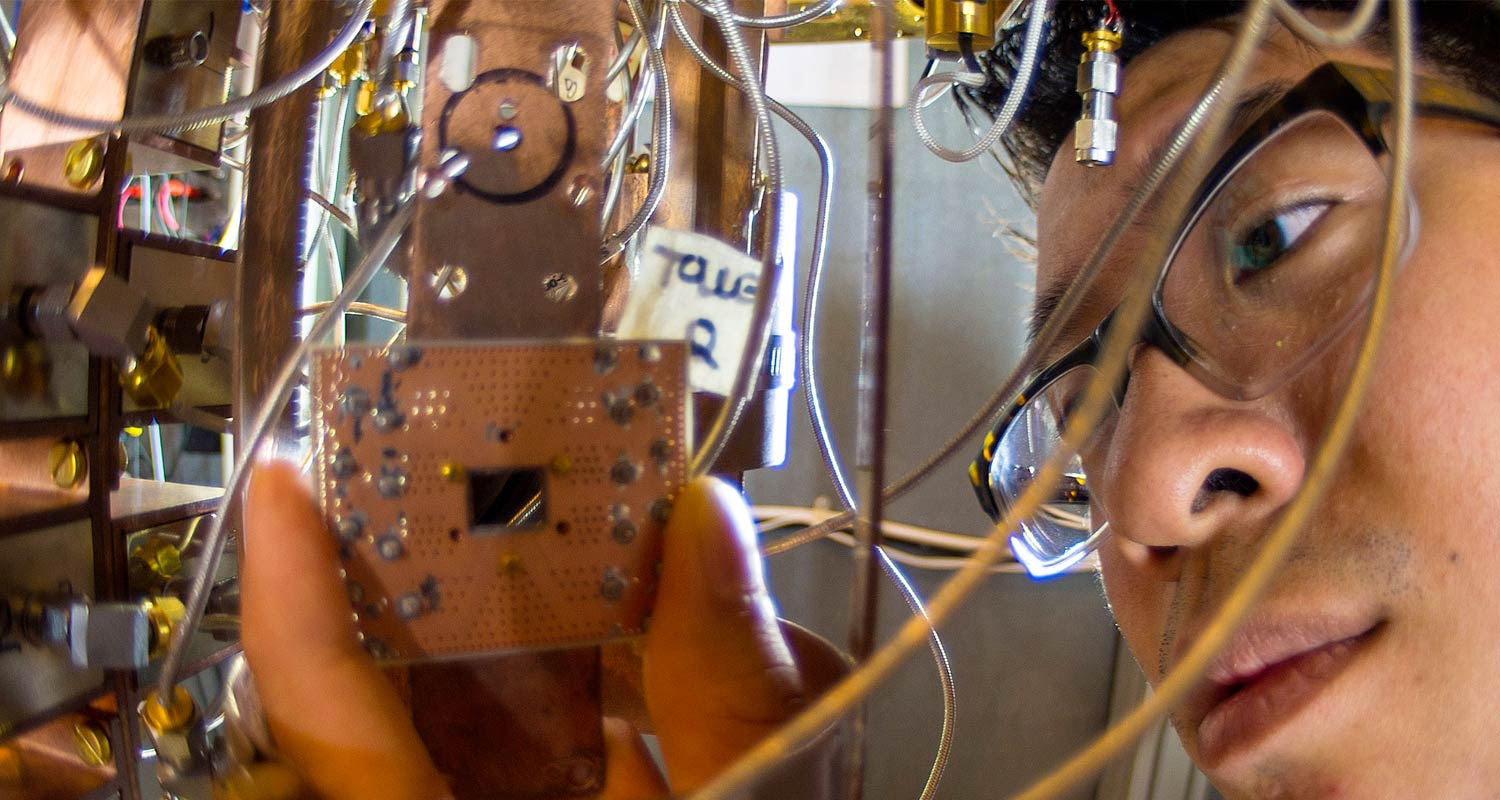
    IBM Research scientist Jerry Chow conducts a quantum computing experiment at IBM’s Thomas J Watson Research Centre

    Quantum computers will also speed up many difficult optimisation problems, where we want to find the “best” way to do something. This will allow us to tackle larger-scale problems in areas such as logistics, finance and weather forecasting.

    Machine learning is another area where quantum computers may accelerate progress. This could happen indirectly, by speeding up subroutines in digital computers, or directly if quantum computers can be reimagined as learning machines.

    What is the current landscape?

    In 2023, quantum computing is moving out of the basement laboratories of university physics departments and into industrial research and development facilities. The move is backed by the cheque books of multinational corporations and venture capitalists.

    Contemporary quantum computing prototypes – built by IBM, Google, IonQ, Rigetti and others – are still some way from perfection.

    Today’s machines are of modest size and susceptible to errors, in what has been called the “noisy intermediate-scale quantum” phase of development. The delicate nature of tiny quantum systems means they are prone to many sources of error, and correcting these errors is a major technical hurdle.

    The holy grail is a large-scale quantum computer which can correct its own errors. A whole ecosystem of research factions and commercial enterprises are pursuing this goal via diverse technological approaches.

    Superconductors, ions, silicon, photons

    The current leading approach uses loops of electric current inside superconducting circuits to store and manipulate information. This is the technology adopted by Google, IBM, Rigetti and others.

    Another method, the “trapped ion” technology, works with groups of electrically charged atomic particles, using the inherent stability of the particles to reduce errors. This approach has been spearheaded by IonQ and Honeywell.

    A third route of exploration is to confine electrons within tiny particles of semiconductor material, which could then be melded into the well-established silicon technology of classical computing. Silicon Quantum Computing is pursuing this angle.

    Yet another direction is to use individual particles of light (photons), which can be manipulated with high fidelity. A company called PsiQuantum is designing intricate “guided light” circuits to perform quantum computations.

    There is no clear winner yet from among these technologies, and it may well be a hybrid approach that ultimately prevails.

    Where will the quantum future take us?

    Attempting to forecast the future of quantum computing today is akin to predicting flying cars and ending up with cameras in our phones instead. Nevertheless, there are a few milestones that many researchers would agree are likely to be reached in the next decade.

    Better error correction is a big one. We expect to see a transition from the era of noisy devices to small devices that can sustain computation through active error correction.

    Another is the advent of post-quantum cryptography. This means the establishment and adoption of cryptographic standards that can’t easily be broken by quantum computers.

    When this has been achieved, we can be confident the 21st century will be the ‘quantum era’

    Commercial spin-offs of technology such as quantum sensing are also on the horizon.

    The demonstration of a genuine “quantum advantage” will also be a likely development. This means a compelling application where a quantum device is unarguably superior to the digital alternative.

    And a stretch goal for the coming decade is the creation of a large-scale quantum computer free of errors (with active error correction).

    When this has been achieved, we can be confident the 21st century will be the “quantum era”.The Conversation

    • The author, Christopher Ferrie, is senior lecturer, UTS chancellor’s postdoctoral research and Arc Decra fellow, University of Technology Sydney
    • This article is republished from The Conversation under a Creative Commons licence

    Get breaking news alerts from TechCentral on WhatsApp


    Girolamo Cardano Google IBM IonQ Rigetti
    Subscribe to TechCentral Subscribe to TechCentral
    Share. Facebook Twitter LinkedIn WhatsApp Telegram Email Copy Link
    Previous ArticleSpam robocall epidemic in South Africa
    Next Article Time for central bank digital currencies to prove their worth

    Related Posts

    What South Africans searched for most in 2025

    What South Africans searched for most in 2025, according to Google

    4 December 2025
    Amazon and Google launch multi-cloud service for faster connectivity

    Amazon and Google launch multi-cloud service for faster connectivity

    1 December 2025
    Alphabet races toward $4-trillion valuation - Google

    Alphabet races towards $4-trillion valuation

    25 November 2025
    Company News
    AI is not a technology problem - iqbusiness

    AI is not a technology problem – iqbusiness

    5 December 2025
    Telcos are sitting on a data gold mine - but few know what do with it - Phillip du Plessis

    Telcos are sitting on a data gold mine – but few know what do with it

    4 December 2025
    Unlock smarter computing with your surface Copilot+ PC

    Unlock smarter computing with your Surface Copilot+ PC

    4 December 2025
    Opinion
    Your data, your hardware: the DIY AI revolution is coming - Duncan McLeod

    Your data, your hardware: the DIY AI revolution is coming

    20 November 2025
    Zero Carbon Charge founder Joubert Roux

    The energy revolution South Africa can’t afford to miss

    20 November 2025
    It's time for a new approach to government IT spend in South Africa - Richard Firth

    It’s time for a new approach to government IT spend in South Africa

    19 November 2025

    Subscribe to Updates

    Get the best South African technology news and analysis delivered to your e-mail inbox every morning.

    Latest Posts
    Big Microsoft 365 price increases coming next year

    Big Microsoft price increases coming next year

    5 December 2025
    AI is not a technology problem - iqbusiness

    AI is not a technology problem – iqbusiness

    5 December 2025
    Vodacom to take control of Safaricom in R36-billion deal - Shameel Joosub

    Vodacom to take control of Safaricom in R36-billion deal

    4 December 2025
    Black Friday goes digital in South Africa as online spending surges to record high

    Black Friday goes digital in South Africa as online spending surges to record high

    4 December 2025
    © 2009 - 2025 NewsCentral Media
    • Cookie policy (ZA)
    • TechCentral – privacy and Popia

    Type above and press Enter to search. Press Esc to cancel.

    Manage consent

    TechCentral uses cookies to enhance its offerings. Consenting to these technologies allows us to serve you better. Not consenting or withdrawing consent may adversely affect certain features and functions of the website.

    Functional Always active
    The technical storage or access is strictly necessary for the legitimate purpose of enabling the use of a specific service explicitly requested by the subscriber or user, or for the sole purpose of carrying out the transmission of a communication over an electronic communications network.
    Preferences
    The technical storage or access is necessary for the legitimate purpose of storing preferences that are not requested by the subscriber or user.
    Statistics
    The technical storage or access that is used exclusively for statistical purposes. The technical storage or access that is used exclusively for anonymous statistical purposes. Without a subpoena, voluntary compliance on the part of your Internet Service Provider, or additional records from a third party, information stored or retrieved for this purpose alone cannot usually be used to identify you.
    Marketing
    The technical storage or access is required to create user profiles to send advertising, or to track the user on a website or across several websites for similar marketing purposes.
    • Manage options
    • Manage services
    • Manage {vendor_count} vendors
    • Read more about these purposes
    View preferences
    • {title}
    • {title}
    • {title}