
Close Menu
TechCentralTechCentral

    Subscribe to the newsletter

    Get the best South African technology news and analysis delivered to your e-mail inbox every morning.

    Facebook X (Twitter) YouTube LinkedIn
    WhatsApp Facebook X (Twitter) LinkedIn YouTube
    TechCentralTechCentral
    • News
      Starlink wait set to drag on as Icasa flags legal hurdle

      Starlink wait set to drag on as Icasa flags legal hurdle

      13 May 2026
      Malatsi opens door to 'some' partial privatisations of SOEs - communications minister Solly Malatsi

      Malatsi opens door to ‘some’ partial privatisations of SOEs

      13 May 2026
      Sam Altman denies betraying Elon Musk. Shelby Tauber/Reuters

      Sam Altman denies betraying Elon Musk

      13 May 2026
      Naked Insurance launches native app in ChatGPT - Alex Thomson

      Naked Insurance launches native app in ChatGPT

      13 May 2026
      Canal+ firms up 3 June JSE listing

      Canal+ firms up 3 June JSE listing

      13 May 2026
    • World
      Pop star sues Samsung for $15-million - Dua Lipa

      Pop star sues Samsung for $15-million

      11 May 2026
      OpenAI's new audio APIs aim for conversational voice agents

      OpenAI’s new audio APIs aim for conversational voice agents

      8 May 2026
      'It was my idea': Musk claims paternity of OpenAI - Elon Musk

      ‘It was my idea’: Musk claims paternity of OpenAI

      29 April 2026
      Pivotal week for US tech stocks

      Pivotal week for US tech stocks

      28 April 2026
      Sam Altman denies betraying Elon Musk. Shelby Tauber/Reuters

      Worries over OpenAI’s growth as Anthropic gains ground

      28 April 2026
    • In-depth
      Alfa's electric rebel - Alfa Romeo Junior Elettrica Veloce

      Alfa’s electric rebel

      29 April 2026
      Africa switches on as Europe dims the lights

      Africa switches on as Europe dims the lights

      9 April 2026
      The biggest untapped EV market on Earth is hiding in plain sight

      The biggest untapped EV market on Earth is hiding in plain sight

      1 April 2026
      Datatec is firing on all cylinders - Jens Montanana

      The R16-billion tech giant hiding in plain sight

      26 March 2026
      The last generation of coders

      The last generation of coders

      18 February 2026
    • TCS
      TCS+ | The Up&Up Group on the hidden cost of AI - Jason Harrison

      TCS+ | The Up&Up Group on the hidden cost of AI

      13 May 2026
      Michael Rossouw

      TCS+ | The retirement decision most South Africans get wrong

      6 May 2026
      TCS | The Cape Town start-up listening for TB with AI - Braden van Breda

      TCS | The Cape Town start-up listening for TB with AI

      4 May 2026

      TCS+ | ‘The ISP for ISPs’: Vox’s shift to wholesale aggregator

      20 April 2026
      TCS | Werner Lindemann on how AI is rewriting the infosec rulebook

      TCS | Werner Lindemann on how AI is rewriting the infosec rulebook

      15 April 2026
    • Opinion
      Free calls, dead voice and Shameel Joosub's Spanish ghost - Duncan McLeod

      Free calls, dead voice and Shameel Joosub’s Spanish ghost

      22 April 2026
      The conflict of interest at the heart of PayShap's slow adoption - Cheslyn Jacobs

      The conflict of interest at the heart of PayShap’s slow adoption

      26 March 2026
      South Africa's energy future hinges on getting wheeling right - Aishah Gire

      South Africa’s energy future hinges on getting wheeling right

      10 March 2026
      Free calls, dead voice and Shameel Joosub's Spanish ghost - Duncan McLeod

      Apple just dropped a bomb on the Windows world

      5 March 2026
      R230-million in the bag for Endeavor's third Harvest Fund - Alison Collier

      VC’s centre of gravity is shifting – and South Africa is in the frame

      3 March 2026
    • Company Hubs
      • 1Stream
      • Africa Data Centres
      • AfriGIS
      • Altron Digital Business
      • Altron Document Solutions
      • Altron Group
      • Arctic Wolf
      • Ascent Technology
      • AvertITD
      • BBD
      • Braintree
      • CallMiner
      • CambriLearn
      • Contactable
      • CYBER1 Solutions
      • Digicloud Africa
      • Digimune
      • Domains.co.za
      • ESET
      • Euphoria Telecom
      • HOSTAFRICA
      • Incredible Business
      • iONLINE
      • IQbusiness
      • Iris Network Systems
      • Kaspersky
      • LSD Open
      • Mitel
      • NEC XON
      • Netstar
      • Network Platforms
      • Next DLP
      • Ovations
      • Paracon
      • Paratus
      • Q-KON
      • SevenC
      • SkyWire
      • Solid8 Technologies
      • Telit Cinterion
      • Telviva
      • Tenable
      • Vertiv
      • Videri Digital
      • Vodacom Business
      • Wipro
      • Workday
      • XLink
    • Sections
      • AI and machine learning
      • Banking
      • Broadcasting and Media
      • Cloud services
      • Contact centres and CX
      • Cryptocurrencies
      • Education and skills
      • Electronics and hardware
      • Energy and sustainability
      • Enterprise software
      • Financial services
      • HealthTech
      • Information security
      • Internet and connectivity
      • Internet of Things
      • Investment
      • IT services
      • Lifestyle
      • Motoring
      • Policy and regulation
      • Public sector
      • Retail and e-commerce
      • Satellite communications
      • Science
      • SMEs and start-ups
      • Social media
      • Talent and leadership
      • Telecoms
    • Events
    • Advertise
    TechCentralTechCentral
    Home » Sections » Broadcasting and Media » The transatlantic race to create the first television
    The transatlantic race to create the first television
    Charles Francis Jenkins

    The transatlantic race to create the first television

    By The Conversation20 June 2025

    Number 1519 Connecticut Avenue lies just north of Dupont Circle, just over a 20-minute walk from the White House in Washington, DC. In 1921, the inventor Charles Francis Jenkins set up his laboratory and offices there, upstairs from a car dealership.

    Today there are no obvious external indications of this famous resident, nor of his exceptional achievements, awards and numerous patents. A hundred years ago at his laboratory, on 13 June 1925, Jenkins gave a demonstration of a televised film sent by radio waves from a building 10km away at what is now the US Naval Research Laboratory in Bellevue, DC.

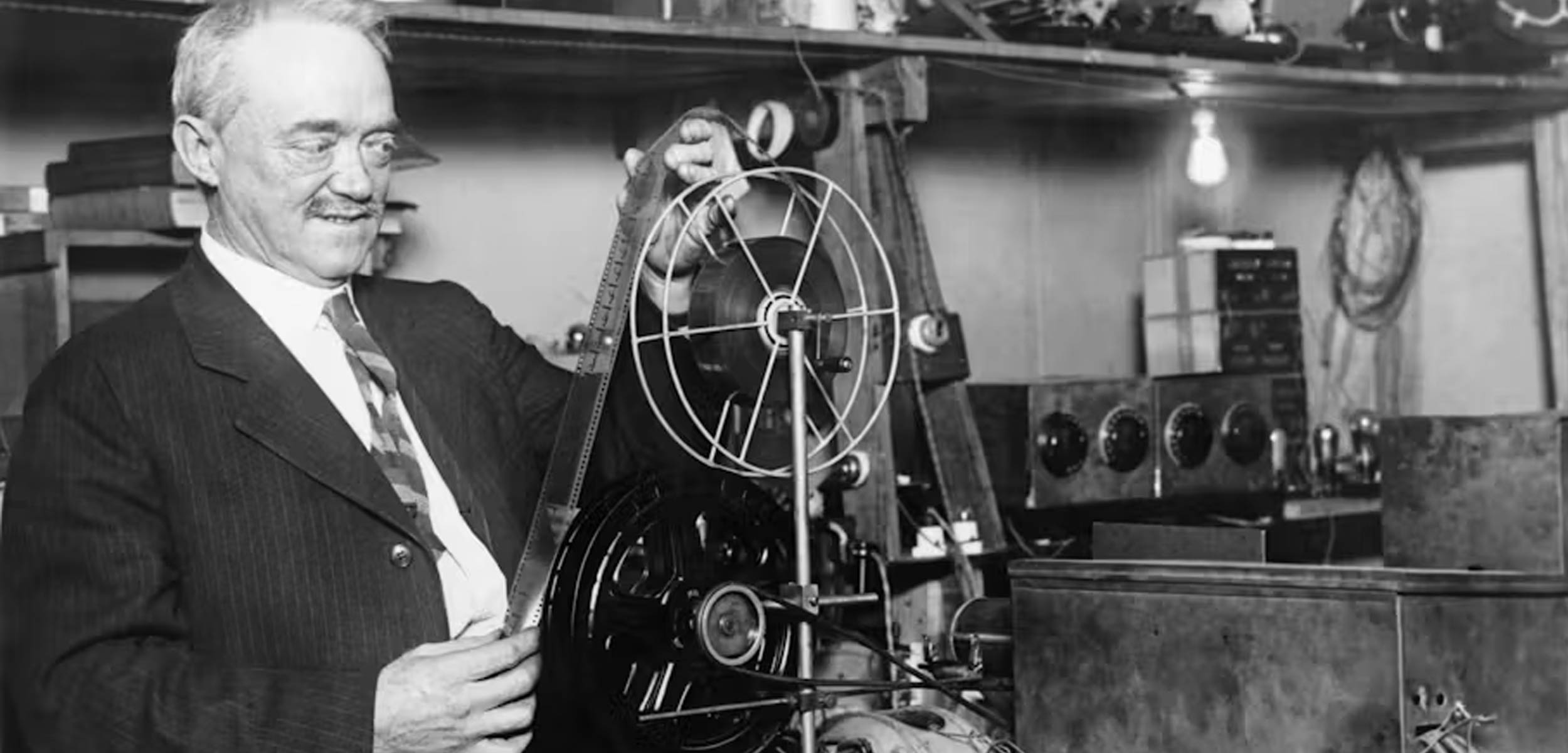
    Top image: Television pioneer Charles Francis Jenkins inspecting his broadcasting apparatus in 1928. Everett Collection Historical

    The invited group of mostly government officials included the secretary of the navy, Curtis D Wilbur. They watched with fascination a film that showed a silhouette of a toy windmill with its blades in motion. The television picture comprised 48 lines, refreshed at the silent-movie rate of 16 per second.

    The Washington newspaper headlines the following day hailed the demonstration as the “first motion pictures transmitted by radio”. Hobbyist magazines reported fervently that “television is here!”, calling Jenkins the “father of television”.

    Hobbyist magazines reported fervently that ‘television is here!’, calling Jenkins the ‘father of television’

    Today those announcements seem over-enthusiastic. Television as an operational service still had a long way to go to have the quality and range to make consumer devices feasible. All the same, they were right in anticipating where Jenkins’ demonstration might lead.

    By that July, Jenkins had demonstrated vision and sound transmitted together on a single shortwave radio frequency. The published technical details indicate a high degree of sophistication in his designs, as might be expected from someone with a background in precision phototelegraphy (transmitting images over wires).

    Parallel development

    Jenkins had an impressive track record as an inventor. He and his business partner, Thomas Armat, are generally accepted as the originators of the intermittent drive system for motion picture film projectors in the early 1910s. This made it possible to move films one frame at a time through a projector, enabling smooth playback without any flickering.

    For this landmark work, Jenkins won the prestigious Elliott Cresson Medal from the Franklin Institute and became the founder and first president of the Society of Motion Picture Engineers in 1916.

    Read: MultiChoice may unbundle SuperSport from DStv

    In the early 1920s he then developed a practical means of sending images of weather charts by radio to ships at sea. It was this phototelegraphy work that led him into experiments in televising silhouettes of live and filmed scenes.He claimed that he first demonstrated the technology to witnesses in June 1923.

    Nevertheless, the Scottish inventor John Logie Baird beat him to become the first to do a public demonstration, in London over three weeks in March and April 1925. Baird, who had been working on the technology since early 1923, showed live moving images in reflected light transmitted by radio to enthusiastic crowds in Selfridges department store. With only eight lines per picture, he carefully chose simple objects that would be easily identifiable.
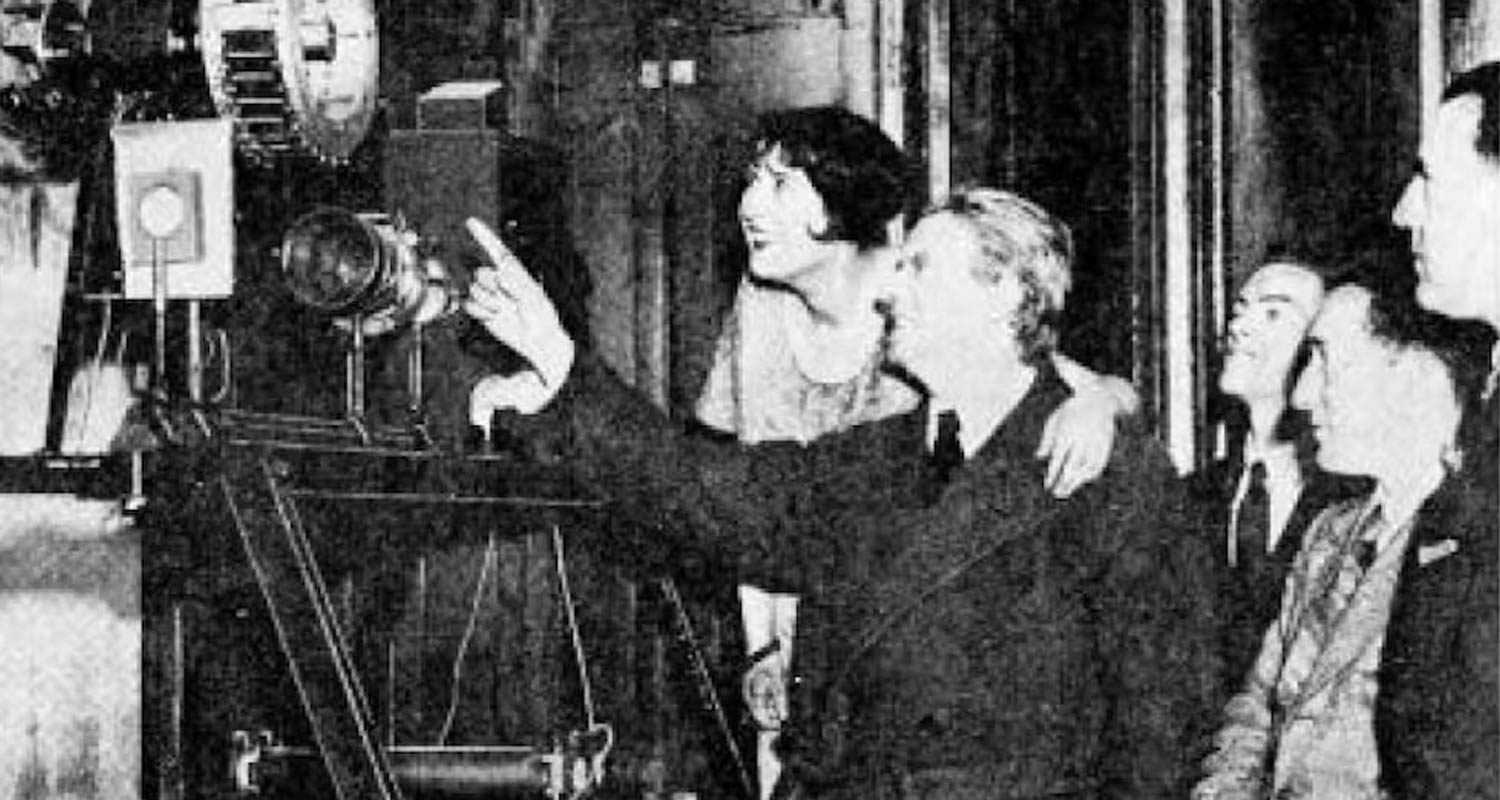
    John Logie Baird operating his mechanical television system in 1931. Wikimedia, CC BY-SA

    In the US, Jenkins had doubled down on improving the image quality for his demonstration. His persistence with back-lit silhouettes today seems odd considering most TV programmes would come to be televised in reflected light. Baird’s preference for showing recognisable facial features in reflected light gained him widespread recognition for his demonstration of 30-line television in January 1926.

    Jenkins nevertheless launched his silent silhouette video service for hobbyists on the radio station W3XK in July 1928, around the same time as similar offerings from companies that included General Electric and the Radio Corporation of America (RCA). By the end of that year, there were thought to have been as many as 15 television stations operating in the US.

    Read: Hiking TV licence fees won’t solve the SABC’s funding crisis

    Like Baird and Jenkins’ methods, many of these early stations relied on mechanically rotating disks with patterns of holes to scan images line by line. They were all very low on detail but were still heralded as proof of concept for television. A key factor in their acceptance was the uncanny ability of human vision to recognise facial expressions along with natural body motion in poor quality images.

    Later in 1928, Baird went on to demonstrate colour, early 3D (stereoscopic) and transatlantic television all for the first time, though more as a way of attracting financial backing than presenting prototypes of future offerings. Unlike Jenkins, who earned money from his earlier inventions and patents, Baird relied largely on funding from investors to grow his business, which aimed to develop and commercialise his mechanical television technology.

    What came next

    Mechanical television was short-lived. Around 1931, RCA and EMI (Electric and Musical Industries), soon to become the key players in broadcasting infrastructure in the US and UK, had independently predicted insufficient public interest in this technology. With its inherently limited image quality, they thought it couldn’t support a viable business.

    Swift advances in electronics continued unabated throughout the interwar years. This allowed successful development of alternative, superior television systems using ideas from scientists such as Boris Rosing in Russia and Alan Archibald Campbell-Swinton in the UK.

    RCA and EMI focused their respective resources on developing vastly superior electronic television systems. These scanned and reproduced images using electron beams that are fired inside a glass unit known as a cathode ray tube to capture and show the transmitted moving picture on the screens of people’s TV sets. Those pictures had around 100 times the information content of the earlier mechanical equivalents.

    Modern television bears little resemblance to the early TV sets

    This made the many early mechanical television services attain one more “first”: becoming obsolete. In just over 15 years from Jenkins’ 1925 demonstration, first the UK and then the US would launch new operational broadcast television services for the public that completely overshadowed the earlier pioneering work.

    Jenkins did not live to see those new systems. His health deteriorated from late 1930 and he died in 1934 aged 66, leaving behind a superb legacy of a full career in inventions.

    Baird continued to work as a TV pioneer in the 1930s and 1940s, dedicated to exploring colour television and cinema projection. He died in 1946 at the age of just 57.

    Read: What’s really at stake in the Canal+, MultiChoice merger

    Jenkins’ and Baird’s original pioneering efforts, and the excitement they generated, are still rightly heralded by many people today. We can now only imagine how it must have felt to see moving images transmitted from miles away for the first time. It’s incredible to reflect that what was once considered magic so quickly became mundane.The Conversation

    • The author, Donald McLean, is honorary lecturer in early television, University of Glasgow
    • This article is republished from The Conversation under a Creative Commons licence

    Don’t miss:

    Rising subscription costs creeping up on household finances

    Follow TechCentral on Google News Add TechCentral as your preferred source on Google


    Charles Francis Jenkins Donald McLean John Logie Baird
    WhatsApp YouTube
    Share. Facebook Twitter LinkedIn WhatsApp Telegram Email Copy Link
    Previous ArticleListed: All the MVNOs in South Africa – 2025 edition
    Next Article Making IT happen: how Trade Link gears up to enable SA retail strategies
    Company News
    In crypto, trust is the new currency - Binance South Africa's Sam Mkhize

    In crypto, trust is the new currency

    13 May 2026
    Don't miss the Telviva Tech Insights webinar

    Don’t miss the Telviva Tech Insights webinar

    13 May 2026

    Don’t miss the Pan African DataCentres Exhibition & Conference

    13 May 2026
    Opinion
    Free calls, dead voice and Shameel Joosub's Spanish ghost - Duncan McLeod

    Free calls, dead voice and Shameel Joosub’s Spanish ghost

    22 April 2026
    The conflict of interest at the heart of PayShap's slow adoption - Cheslyn Jacobs

    The conflict of interest at the heart of PayShap’s slow adoption

    26 March 2026
    South Africa's energy future hinges on getting wheeling right - Aishah Gire

    South Africa’s energy future hinges on getting wheeling right

    10 March 2026

    Subscribe to Updates

    Get the best South African technology news and analysis delivered to your e-mail inbox every morning.

    Latest Posts
    Starlink wait set to drag on as Icasa flags legal hurdle

    Starlink wait set to drag on as Icasa flags legal hurdle

    13 May 2026
    Malatsi opens door to 'some' partial privatisations of SOEs - communications minister Solly Malatsi

    Malatsi opens door to ‘some’ partial privatisations of SOEs

    13 May 2026
    Sam Altman denies betraying Elon Musk. Shelby Tauber/Reuters

    Sam Altman denies betraying Elon Musk

    13 May 2026
    Naked Insurance launches native app in ChatGPT - Alex Thomson

    Naked Insurance launches native app in ChatGPT

    13 May 2026
    © 2009 - 2026 NewsCentral Media
    • Cookie policy (ZA)
    • TechCentral – privacy and Popia

    Type above and press Enter to search. Press Esc to cancel.

    Manage consent

    TechCentral uses cookies to enhance its offerings. Consenting to these technologies allows us to serve you better. Not consenting or withdrawing consent may adversely affect certain features and functions of the website.

    Functional Always active
    The technical storage or access is strictly necessary for the legitimate purpose of enabling the use of a specific service explicitly requested by the subscriber or user, or for the sole purpose of carrying out the transmission of a communication over an electronic communications network.
    Preferences
    The technical storage or access is necessary for the legitimate purpose of storing preferences that are not requested by the subscriber or user.
    Statistics
    The technical storage or access that is used exclusively for statistical purposes. The technical storage or access that is used exclusively for anonymous statistical purposes. Without a subpoena, voluntary compliance on the part of your Internet Service Provider, or additional records from a third party, information stored or retrieved for this purpose alone cannot usually be used to identify you.
    Marketing
    The technical storage or access is required to create user profiles to send advertising, or to track the user on a website or across several websites for similar marketing purposes.
    • Manage options
    • Manage services
    • Manage {vendor_count} vendors
    • Read more about these purposes
    View preferences
    • {title}
    • {title}
    • {title}

