
Close Menu
TechCentralTechCentral

    Subscribe to the newsletter

    Get the best South African technology news and analysis delivered to your e-mail inbox every morning.

    Facebook X (Twitter) YouTube LinkedIn
    WhatsApp Facebook X (Twitter) LinkedIn YouTube
    TechCentralTechCentral
    • News
      South Africa's next broadband war may be won by a bank - Capitec

      South Africa’s next broadband war may be won by a bank

      14 August 2026
      Bank robberies, ATM bombings collapse as criminals go digital

      Bank robberies, ATM bombings collapse as criminals go digital

      14 August 2026
      TCS | Herotel CEO Van Zyl Botha on beating Starlink to South Africa

      TCS | Herotel CEO Van Zyl Botha on beating Starlink to South Africa

      14 August 2026
      Blu Label's earnings just fell off a cliff - on paper - Brett Levy Mark Levy

      Blu Label’s earnings just fell off a cliff – on paper

      14 August 2026
      AI fraud is outrunning South African banking defences

      AI fraud is outrunning South African banking defences

      14 August 2026
    • World
      Russia building its own Starlink - and faster than expected - Vadym Skibitskyi

      Russia building its own Starlink – and faster than expected

      11 August 2026
      Meta AI will now tell parents if their teen is in crisis

      Meta AI will now tell parents if their teen is in crisis

      17 July 2026
      IBM shares crash 25% as AI upends software spending - Arvind Krishna

      IBM shares crash 25% as AI upends software spending

      15 July 2026
      Jony Ive's first OpenAI device: an AI smart speaker - Jony Ive and Sam Altman

      Jony Ive’s first OpenAI device: an AI smart speaker

      15 July 2026
      Stripe, Advent in talks to buy PayPal for $53-billion

      Stripe, Advent in talks to buy PayPal for $53-billion

      15 July 2026
    • In-depth
      Google DeepMind CEO Demis Hassabis. Image: John Sears

      The plan to stop AI from breaking the world

      16 July 2026
      The internet has a Strait of Hormuz problem

      The internet has a Strait of Hormuz problem

      15 July 2026
      AI boom sparks rally, frenzy and fear

      AI boom sparks rally, frenzy and fear

      11 June 2026
      Every plug-in hybrid on sale in South Africa, ranked by price - Lamborghini Temerario

      Every plug-in hybrid on sale in South Africa, ranked by price

      7 June 2026
      What Wi-Fi 8 will mean for wireless networks

      What Wi-Fi 8 will mean for wireless networks

      1 June 2026
    • TCS
      Meet the CIO | Discovery's Derek Wilcocks on AI, guardrails and growth

      Meet the CIO | Derek Wilcocks on how AI personalised Vitality

      13 August 2026
      TCS | Money just became native to the internet - Steven Boykey Sidley

      TCS | Money just became native to the internet – Steven Boykey Sidley

      12 August 2026
      TCS+ | Specops' Darren James on continuous trust in an AI world

      TCS+ | Specops’ Darren James on continuous trust in an AI world

      7 August 2026
      TCS+ | How AI is turning hardware into a subscription service - Shane van der Merwe Merchant West

      TCS+ | How AI is turning hardware into a subscription service

      6 August 2026
      TCS+ | Why South African workers must become supervisors of digital labour - Accelera Digital Group Cliff de Wit

      TCS+ | Why South African workers must become supervisors of digital labour

      31 July 2026
    • Opinion
      The author, Jannie van Zyl

      Selling vapour is corporate suicide in slow motion

      16 July 2026
      Brazil's online gambling crackdown is a lesson for South Africa

      How Amazon outmanoeuvred Starlink in South Africa

      15 July 2026
      The Popia problem with agentic AI - Herman Haasbroek

      The Popia problem with agentic AI

      14 July 2026
      The author, Fanie van Rooyen

      South Africa can still catch the AI wave – here’s how

      7 July 2026
      The author, Fanie van Rooyen

      The AI utopia South Africa can’t afford

      1 July 2026
    • Company Hubs
      • 1Stream
      • Africa Data Centres
      • AfriGIS
      • Altron Digital Business
      • Altron Document Solutions
      • Altron Group
      • Arctic Wolf
      • Ascent Technology
      • AvertITD
      • BBD
      • Braintree
      • CallMiner
      • CambriLearn
      • CM Telecom
      • Contactable
      • CYBER1 Solutions
      • Digicloud Africa
      • Digimune
      • Domains.co.za
      • ESET
      • Euphoria Telecom
      • HOSTAFRICA
      • Incredible Business
      • iONLINE
      • IQbusiness
      • Iris Network Systems
      • Kaspersky
      • LSD Open
      • Mitel
      • NEC XON
      • Netstar
      • Network Platforms
      • Next DLP
      • Ovations
      • Paracon
      • Paratus
      • Q-KON
      • SevenC
      • SkyWire
      • Solid8 Technologies
      • Telit Cinterion
      • Telviva
      • Tenable
      • Vertiv
      • Videri Digital
      • Vodacom Business
      • Vox
      • Wipro
      • Workday
      • XLink
    • Sections
      • AI and machine learning
      • Banking
      • Broadcasting and Media
      • Cloud services
      • Contact centres and CX
      • Cryptocurrencies
      • Education and skills
      • Electronics and hardware
      • Energy and sustainability
      • Enterprise software
      • Financial services
      • HealthTech
      • Information security
      • Internet and connectivity
      • Internet of Things
      • Investment
      • IT services
      • Lifestyle
      • Policy and regulation
      • Public sector
      • Retail and e-commerce
      • Satellite communications
      • Science
      • SMEs and start-ups
      • Social media
      • Talent and leadership
      • Telecoms
      • Watts & Wheels
    • Events
    • Advertise
    TechCentralTechCentral
    Home » Sections » Broadcasting and Media » What’s really at stake in the Canal+, MultiChoice merger

    What’s really at stake in the Canal+, MultiChoice merger

    What the Canal+ takeover of MultiChoice could mean for competition in South Africa’s media ecosystem.
    By Michael Markovitz26 May 2025
    Twitter LinkedIn Facebook WhatsApp Email Telegram Copy Link
    News Alerts
    WhatsApp
    What's really at stake in the Canal+, MultiChoice merger
    Image: Canal+

    The Competition Commission has recommended the approval of Groupe Canal+’s proposed acquisition of MultiChoice Group, marking a significant development in the African media landscape. While this decision aligns with expectations, it’s important to note that final approval still rests with the Competition Tribunal.

    When fully accounted for – including the value of shares Canal+ already holds – the deal implies a total MultiChoice valuation of R55-billion, even though the actual purchase price for the shares Canal+ does not yet own is around R35-billion. This makes it the largest ever media deal in Africa’s history. However, for stakeholders concerned with media diversity, sustainability, and fair competition, the implications are more complex.

    Competition concerns and striking omissions

    The Competition Commission concluded that the transaction is “unlikely to substantially lessen or prevent competition in any market”. Consequently, it imposed no conditions on unbundling MultiChoice’s premium exclusive sports or content rights. This absence of stipulations on the concentration of these rights and fair sublicensing criteria is striking, especially considering MultiChoice’s dominant position in subscription television and live sports broadcasting in South Africa. Two prior complaints alleging anticompetitive conduct had been lodged against MultiChoice – one from e.tv, which was quietly settled, and another from the SABC, which appears to have disappeared without public explanation.

    This piece was originally published on Michael Markovitz’s Substack, Media Explorations – read the original article here

    Because Paris-headquartered Canal+ is foreign owned and controlled, the transaction triggers South Africa’s 20% foreign ownership cap1. To comply, MultiChoice will restructure its domestic operations through a layered ownership arrangement by creating a new entity, LicenceCo, which will hold the South African broadcasting licence and be majority-owned by historically disadvantaged persons (HDPs) and workers. While foreign voting control over the licence must remain under the 20% legal threshold, the cap does not apply to economic interest – meaning Canal+ can hold 49% of the financial stake in the broader MultiChoice Group without breaching foreign control limits over the licensed entity2.
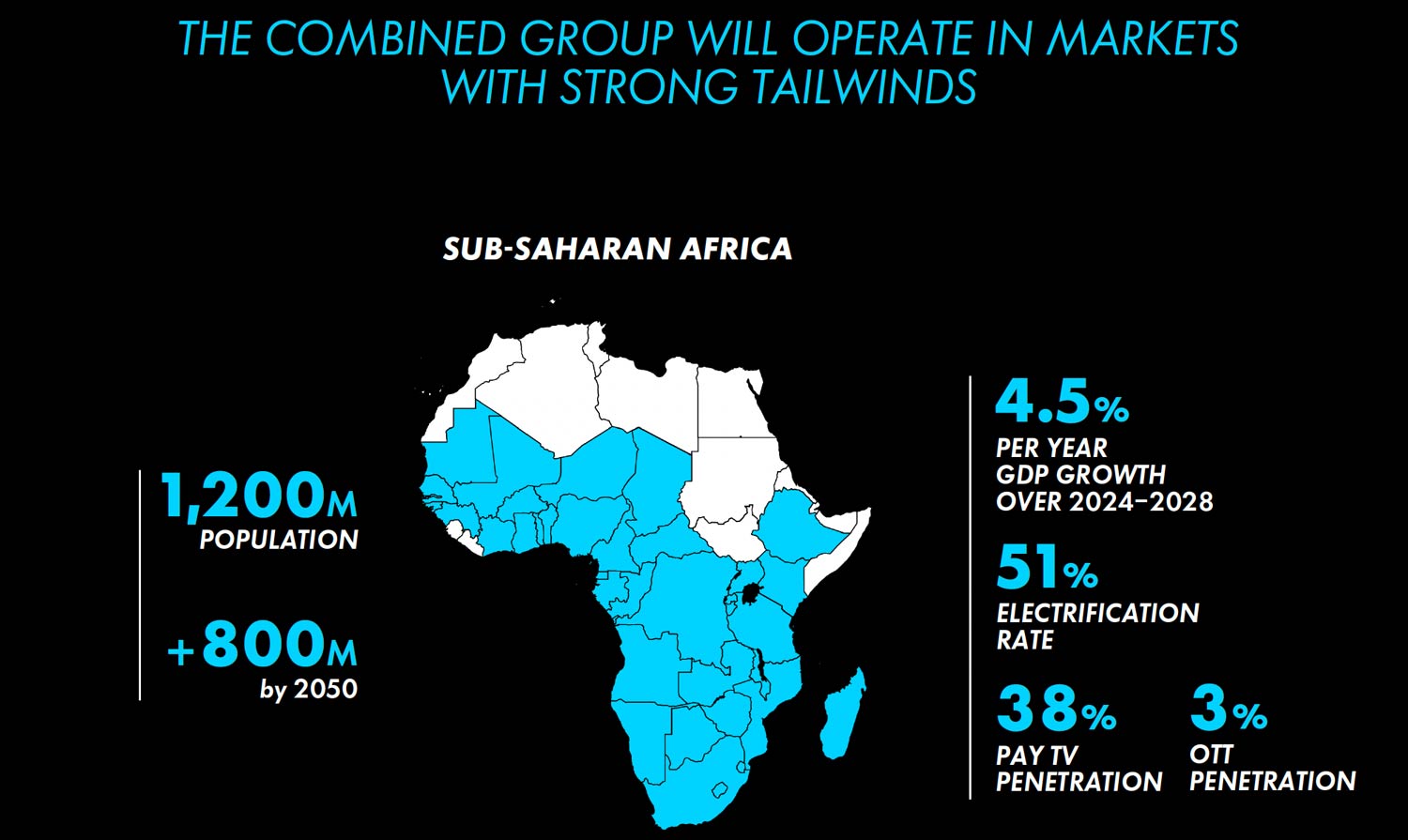
    Source: Canal+ 2024 annual results presentation

    Public interest commitments: promising, but lacking transparency

    Additionally, the merged entity has committed to a public interest package that includes R26-billion over three years for local content production, supplier development and skills training – alongside commitments on employment protections, increased HDP and worker ownership, export promotion, local news diversity, and continued South African incorporation. The commission explicitly framed these undertakings, based on past MultiChoice spend, as sufficient to address stakeholder concerns under South African law. The final decision now rests with the tribunal.

    While the package sounds substantial, a significant share likely overlaps with MultiChoice’s existing expenditure patterns – and the exact uplift or incremental increase is unclear due to limited financial disclosure.

    Canal+ CEO Maxime Saada expressed optimism about the merger, stating: “This is a major step forward in our ambition to create a global media and entertainment company with Africa at its heart.” He added: “We are committed to investing in local content and supporting South Africa’s creative and sports ecosystems.”

    MultiChoice Group CEO Calvo Mawela echoed this sentiment. “The recommendation from the Competition Commission is a key step forward towards the completion of the transaction and a recognition of the strong package of public interest commitments provided by the parties.”

    DStv remote controlDespite these assurances, concerns remain about the sustainability of South Africa’s three 24-hour television news channels – SABC News, eNCA and Newzroom Afrika. These channels rely heavily on carriage fees from MultiChoice, and advertising revenue alone does not suffice to sustain their operations. While the commission indicated that Canal+ has committed to procuring local news content and ensuring diversity, specifics regarding funding amounts, duration and conditions remain unclear.

    Who holds strategic control?

    Some may argue that MultiChoice isn’t really under foreign control, given that voting control over their broadcasting entity is retained by South African shareholders through LicenceCo. While this ownership structure appears to satisfy regulatory requirements, it does not necessarily equate to strategic control. Canal+ holds 49% of the economic interest, which encompasses capital, influence and cross-border decision-making power. Editorial outcomes are influenced not solely by voting shares but also by budgets, commissioning decisions, platform prioritisation and pricing models. These levers are increasingly shifting from Randburg to Paris.

    Therefore, while control of the broadcasting licence may remain South African on paper, the deeper influence over content funding, prioritisation and editorial direction is shifting. This transition could have future implications for the sustainability of South African television news.

    Media plurality and fair competition

    The commission’s decision stands in contrast to its recent assertive stance in the Competition Commission’s provisional Media and Digital Platforms Market Inquiry report, where it addressed concerns about Big Tech’s dominance and its impact on the news ecosystem. In this case, despite MultiChoice’s substantial market power and Canal+’s position as its only major competitor in African pay TV, the commission has approved the merger without robust competitive safeguards.

    MultiChoice’s acquisition by Canal+ is more than just a business deal; it marks a major structural shift in Africa’s media landscape. This shift calls for vigilance from regulators, policymakers and civil society to safeguard media plurality and address the concentration of sports rights and premium content under globalised ownership.

    Footnotes
    ¹As a South African regulator begins to review regulations that could eventually enable Elon Musk to secure a Starlink licence in South Africa, we now have two outspoken and interventionist right-wing billionaires — Vincent Bolloré and Elon Musk — who stand ready to extend their reach into the country’s audiovisual and telecommunications markets.
    ²These chronically outdated ownership and control provisions are easy to work around and have not progressed to take into account these structuring arrangements. As written before, our broadcasting legislation needs a fundamental overhaul.

    • The author, Michael Markovitz, is director of the Gibs Media Leadership Think Tank
    • Read more contributions from Michael Markovitz on TechCentral

    Don’t miss:

    SA targets Big Tech’s market power in media inquiry report

    Follow TechCentral on Google News Add TechCentral as your preferred source on Google


    Calvo Mawela Maxime Saada Michael Markovitz MultiChoice
    WhatsApp YouTube
    Share. Facebook Twitter LinkedIn WhatsApp Telegram Email Copy Link
    Previous ArticleAltron Nexus becomes Sentiv in high-profile MBO
    Next Article Starlink storm: BEE reforms fuel tensions in Ramaphosa’s GNU

    Related Posts

    DStv chops channels as Canal+ leans harder on sport

    DStv chops channels as Canal+ leans harder on sport

    7 August 2026
    Canal+ backs MultiChoice payments spin-out

    Canal+ backs MultiChoice payments spin-out

    4 August 2026
    Why Canal+ is betting DStv's future on live sport

    Why Canal+ is betting DStv’s future on live sport

    4 August 2026
    Company News
    Kaspersky on how to secure a supply chain you do not control

    Kaspersky on how to secure a supply chain you do not control

    13 August 2026
    Build or buy software? AI is rewriting the answer - BBD Software

    Build or buy software? AI is rewriting the answer

    12 August 2026
    Max zoom meets max speed with the new 5G Huawei Pura 90s series

    Max Zoom meets Max Speed with the 5G Huawei Pura 90s series

    11 August 2026
    Opinion
    The author, Jannie van Zyl

    Selling vapour is corporate suicide in slow motion

    16 July 2026
    Brazil's online gambling crackdown is a lesson for South Africa

    How Amazon outmanoeuvred Starlink in South Africa

    15 July 2026
    The Popia problem with agentic AI - Herman Haasbroek

    The Popia problem with agentic AI

    14 July 2026

    Subscribe to Updates

    Get the best South African technology news and analysis delivered to your e-mail inbox every morning.

    Latest Posts
    South Africa's next broadband war may be won by a bank - Capitec

    South Africa’s next broadband war may be won by a bank

    14 August 2026
    Bank robberies, ATM bombings collapse as criminals go digital

    Bank robberies, ATM bombings collapse as criminals go digital

    14 August 2026
    TCS | Herotel CEO Van Zyl Botha on beating Starlink to South Africa

    TCS | Herotel CEO Van Zyl Botha on beating Starlink to South Africa

    14 August 2026
    Blu Label's earnings just fell off a cliff - on paper - Brett Levy Mark Levy

    Blu Label’s earnings just fell off a cliff – on paper

    14 August 2026
    © 2009 - 2026 NewsCentral Media
    Built and maintained by Chronon
    • Cookie policy (ZA)
    • TechCentral – privacy and Popia

    Type above and press Enter to search. Press Esc to cancel.

    Manage consent

    TechCentral uses cookies to enhance its offerings. Consenting to these technologies allows us to serve you better. Not consenting or withdrawing consent may adversely affect certain features and functions of the website.

    Functional Always active
    The technical storage or access is strictly necessary for the legitimate purpose of enabling the use of a specific service explicitly requested by the subscriber or user, or for the sole purpose of carrying out the transmission of a communication over an electronic communications network.
    Preferences
    The technical storage or access is necessary for the legitimate purpose of storing preferences that are not requested by the subscriber or user.
    Statistics
    The technical storage or access that is used exclusively for statistical purposes. The technical storage or access that is used exclusively for anonymous statistical purposes. Without a subpoena, voluntary compliance on the part of your Internet Service Provider, or additional records from a third party, information stored or retrieved for this purpose alone cannot usually be used to identify you.
    Marketing
    The technical storage or access is required to create user profiles to send advertising, or to track the user on a website or across several websites for similar marketing purposes.
    • Manage options
    • Manage services
    • Manage {vendor_count} vendors
    • Read more about these purposes
    View preferences
    • {title}
    • {title}
    • {title}