Close Menu
TechCentralTechCentral

    Subscribe to the newsletter

    Get the best South African technology news and analysis delivered to your e-mail inbox every morning.

    Facebook X (Twitter) YouTube LinkedIn
    WhatsApp Facebook X (Twitter) LinkedIn YouTube
    TechCentralTechCentral
    • News
      Netflix, Warner Bros talks raise fresh headaches for MultiChoice

      Netflix, Warner Bros talks raise fresh headaches for MultiChoice

      5 December 2025
      Big Microsoft 365 price increases coming next year

      Big Microsoft price increases coming next year

      5 December 2025
      Vodacom to take control of Safaricom in R36-billion deal - Shameel Joosub

      Vodacom to take control of Safaricom in R36-billion deal

      4 December 2025
      Black Friday goes digital in South Africa as online spending surges to record high

      Black Friday goes digital in South Africa as online spending surges to record high

      4 December 2025
      BYD takes direct aim at Toyota with launch of sub-R500 000 Sealion 5 PHEV

      BYD takes direct aim at Toyota with launch of sub-R500 000 Sealion 5 PHEV

      4 December 2025
    • World
      Amazon and Google launch multi-cloud service for faster connectivity

      Amazon and Google launch multi-cloud service for faster connectivity

      1 December 2025
      Google makes final court plea to stop US breakup

      Google makes final court plea to stop US breakup

      21 November 2025
      Bezos unveils monster rocket: New Glenn 9x4 set to dwarf Saturn V

      Bezos unveils monster rocket: New Glenn 9×4 set to dwarf Saturn V

      21 November 2025
      Tech shares turbocharged by Nvidia's stellar earnings

      Tech shares turbocharged by stellar Nvidia earnings

      20 November 2025
      Config file blamed for Cloudflare meltdown that disrupted the web

      Config file blamed for Cloudflare meltdown that disrupted the web

      19 November 2025
    • In-depth
      Jensen Huang Nvidia

      So, will China really win the AI race?

      14 November 2025
      Valve's Linux console takes aim at Microsoft's gaming empire

      Valve’s Linux console takes aim at Microsoft’s gaming empire

      13 November 2025
      iOCO's extraordinary comeback plan - Rhys Summerton

      iOCO’s extraordinary comeback plan

      28 October 2025
      Why smart glasses keep failing - no, it's not the tech - Mark Zuckerberg

      Why smart glasses keep failing – it’s not the tech

      19 October 2025
      BYD to blanket South Africa with megawatt-scale EV charging network - Stella Li

      BYD to blanket South Africa with megawatt-scale EV charging network

      16 October 2025
    • TCS
      TCS+ | How Cloud on Demand helps partners thrive in the AWS ecosystem - Odwa Ndyaluvane and Xenia Rhode

      TCS+ | How Cloud On Demand helps partners thrive in the AWS ecosystem

      4 December 2025
      TCS | MTN Group CEO Ralph Mupita on competition, AI and the future of mobile

      TCS | Ralph Mupita on competition, AI and the future of mobile

      28 November 2025
      TCS | Dominic Cull on fixing South Africa's ICT policy bottlenecks

      TCS | Dominic Cull on fixing South Africa’s ICT policy bottlenecks

      21 November 2025
      TCS | BMW CEO Peter van Binsbergen on the future of South Africa's automotive industry

      TCS | BMW CEO Peter van Binsbergen on the future of South Africa’s automotive industry

      6 November 2025
      TCS | Why Altron is building an AI factory - Bongani Andy Mabaso

      TCS | Why Altron is building an AI factory in Johannesburg

      28 October 2025
    • Opinion
      Your data, your hardware: the DIY AI revolution is coming - Duncan McLeod

      Your data, your hardware: the DIY AI revolution is coming

      20 November 2025
      Zero Carbon Charge founder Joubert Roux

      The energy revolution South Africa can’t afford to miss

      20 November 2025
      It's time for a new approach to government IT spend in South Africa - Richard Firth

      It’s time for a new approach to government IT spend in South Africa

      19 November 2025
      How South Africa's broken Rica system fuels murder and mayhem - Farhad Khan

      How South Africa’s broken Rica system fuels murder and mayhem

      10 November 2025
      South Africa's AI data centre boom risks overloading a fragile grid - Paul Colmer

      South Africa’s AI data centre boom risks overloading a fragile grid

      30 October 2025
    • Company Hubs
      • Africa Data Centres
      • AfriGIS
      • Altron Digital Business
      • Altron Document Solutions
      • Altron Group
      • Arctic Wolf
      • AvertITD
      • Braintree
      • CallMiner
      • CambriLearn
      • CYBER1 Solutions
      • Digicloud Africa
      • Digimune
      • Domains.co.za
      • ESET
      • Euphoria Telecom
      • Incredible Business
      • iONLINE
      • IQbusiness
      • Iris Network Systems
      • LSD Open
      • NEC XON
      • Netstar
      • Network Platforms
      • Next DLP
      • Ovations
      • Paracon
      • Paratus
      • Q-KON
      • SevenC
      • SkyWire
      • Solid8 Technologies
      • Telit Cinterion
      • Tenable
      • Vertiv
      • Videri Digital
      • Vodacom Business
      • Wipro
      • Workday
      • XLink
    • Sections
      • AI and machine learning
      • Banking
      • Broadcasting and Media
      • Cloud services
      • Contact centres and CX
      • Cryptocurrencies
      • Education and skills
      • Electronics and hardware
      • Energy and sustainability
      • Enterprise software
      • Financial services
      • Information security
      • Internet and connectivity
      • Internet of Things
      • Investment
      • IT services
      • Lifestyle
      • Motoring
      • Public sector
      • Retail and e-commerce
      • Satellite communications
      • Science
      • SMEs and start-ups
      • Social media
      • Talent and leadership
      • Telecoms
    • Events
    • Advertise
    TechCentralTechCentral
    Home » In-depth » Remembering Edwin Land, the man who re-imagined photography

    Remembering Edwin Land, the man who re-imagined photography

    By The Conversation21 May 2018
    Twitter LinkedIn Facebook WhatsApp Email Telegram Copy Link
    News Alerts
    WhatsApp
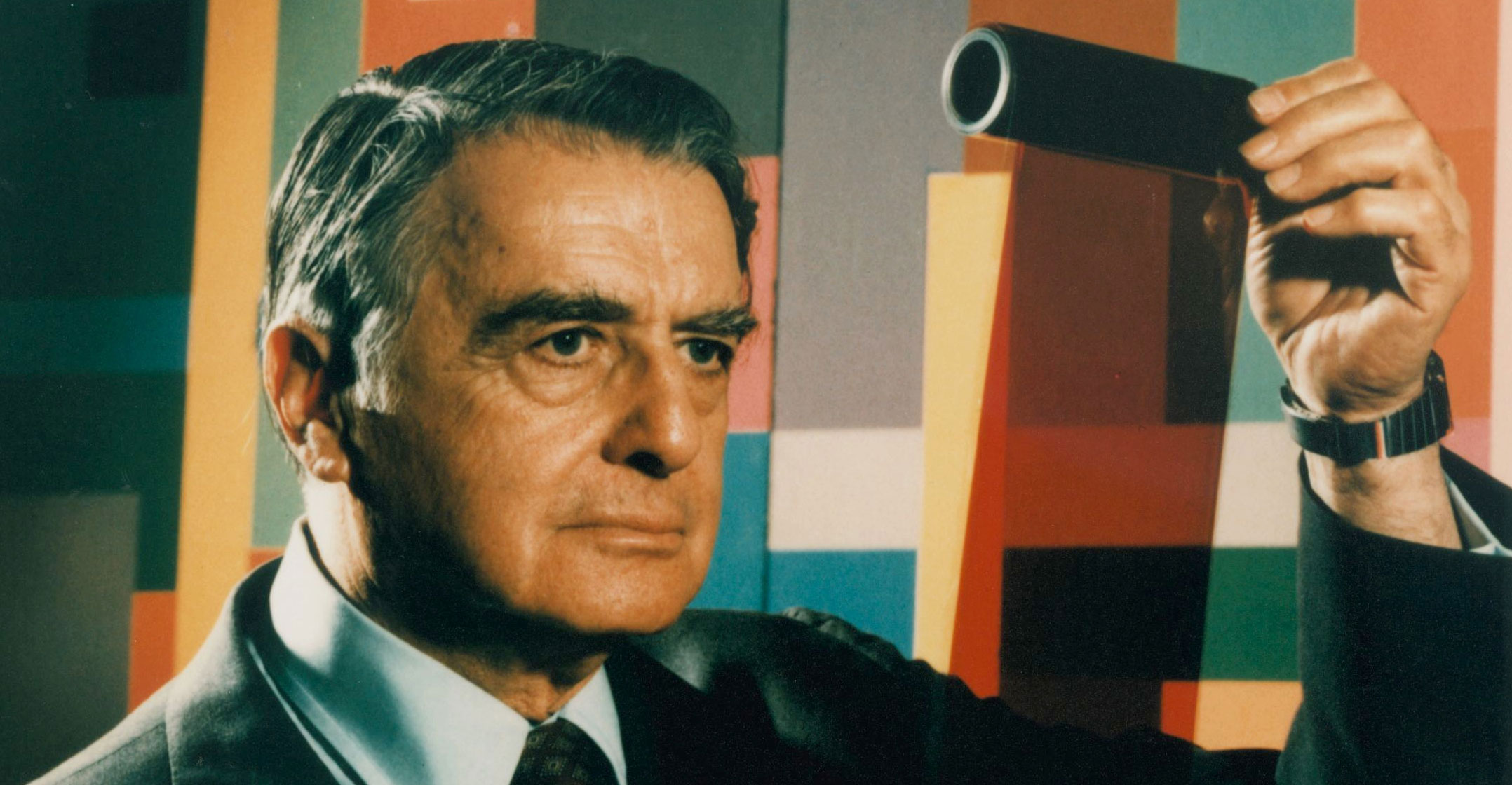
    Edwin Land. Photo by JJ Scarpetti, courtesy of The Rowland Institute at Harvard

    It probably happens every minute of the day: a little girl demands to see the photo her parent has just taken of her. Today, thanks to smartphones and other digital cameras, we can see snapshots immediately, whether we want to or not. But in 1944 when 3-year-old Jennifer Land asked to see the family holiday photo that her dad had just taken, the technology didn’t exist. So her dad, Edwin Land, invented it.

    Three years later, after plenty of scientific development, Land and his Polaroid company realised the miracle of nearly instant imaging. The film exposure and processing hardware are contained within the camera; there’s no muss or fuss for the photographer who just points and shoots and then watches the image materialize on the photo once it spools out of the camera.

    Land is probably best known for the “instant photo” — or the spiritual progenitor of today’s ubiquitous selfie. His Polaroid camera was first released commercially in 1948 at retail locations and prices aimed at the post-war middle class. But this is just one of a host of technological breakthroughs Land invented and commercialised, most of which centred on light and how it interacts with materials. The technology used to show a 3D movie and the goggles we wear in the cinema were made possible by Land and his colleagues. The camera aboard the U-2 spy plane, as featured in the movie Bridge of Spies, was a Land product, as were even some aspects of the plane’s mechanics. He also worked on theoretical problems, drawing on a deep understanding of both chemistry and physics.

    Land’s Polaroid camera was first released commercially in 1948 at retail locations and prices aimed at the post-war middle class

    I’m a vision scientist who has touched many of the fields in which Land made great advances, through my own work on new imaging methods, image processing techniques and human colour vision. As the 2018 recipient of the Edwin H. Land Medal, awarded by the Optical Society of America and the Society for Imaging Science and Technology, my own work relies on Land’s technological innovations that made modern imaging possible.

    Edwin Land’s first optics breakthrough came as a young man, when he figured out a convenient and affordable method to control one of the fundamental properties of light: polarisation.

    You can think of light as waves propagating from a source. Most light sources produce a mixture of waves with all different physical properties, such as wavelength and amplitude of vibration. Light is considered polarised if the amplitude varies in a consistent manner perpendicular to the direction the wave is travelling.

    Given the right material for the light waves to pass through, they may be rotated into another plane, slowed down or blocked. Modern 3D goggles work because one eye receives light waves vibrating along the horizontal plane while the other eye receives the light vibrating along the vertical plane.

    ‘Polarisers’

    Before Land, researchers built components to control polarisation from rock crystals, which were assigned almost magical names and properties, though they merely decreased the velocity or amplitude of light waves travelling at specific orientations. Land created “polarisers” by growing small crystals and embedding them in plastic sheets, altering the light passing through depending on its orientation in relation to the rows of crystals. His inexpensive polariser made it possible to reliably and practically filter light so only wavelengths with a particular orientation would pass through.

    Land founded Polaroid in 1937 to commercialise his new technology. His sheet polarisers found applications ranging from the identification of chemical compounds to adjustable sunglasses. Polarising filters became standard in photography to reduce glare. Today the principles of polarised light are used in most computer and cellphone screens, to enhance contrast, decrease glare and even turn on or off individual pixels.

    Polarizing filters help researchers visualise structures that might not be seen otherwise — from astronomical features to biological structures. In my own field of vision science, polarisation imaging localises classes of chemicals, such as protein molecules leaking from blood vessels in diseased eyes. Polarisation is also combined with high-resolution imaging techniques to detect cellular damage beneath the reflective retinal surface.

    Image c/o C Watts

    Before the days of high-speed digital capture of data and affordable high-resolution displays, or use of videotape, Polaroid photography was the method of choice to obtain output in many scientific labs. Experiments or medical tests needed graphical or pictorial output for interpretation, often from an analogue oscilloscope which plotted out a voltage or current change over time. The oscilloscope was fast enough to capture key features of the data — but recording the output for later analysis was a challenge before Land’s instant camera came along.

    A common example in vision science is the recording of eye movements. A research study reported in 1960 plotted light reflected from an observer’s moving eye on an oscilloscope screen, which was photographed with a mounted Polaroid camera — not unlike the consumer Polaroid camera a family might pull out at a birthday party.

    For decades, research labs and medical facilities have used setups consisting of a Polaroid camera and a mounting rig to collect electrical signals displayed on oscilloscope screens. The format sizes are less than dazzling compared to modern digital resolutions, but they were revolutionary at the time.

    Heavily invested in its film sales, Polaroid wasn’t prepared as all tiers of the imaging market went digital

    In 1987, with the founding of my new retinal imaging laboratory, there was no inexpensive method to provide sharable output of our novel images. After a few years of struggling to obtain high-quality output for conferences and publications, Polaroid came to our rescue with the donation of a printer, allowing our scientific contributions to reach an audience beyond our lab.

    Land’s contributions go beyond patenting over 500 innovations and inventing products that millions purchased. His understanding of the interaction of light and matter promoted novel ways of characterising chemicals with polarised light. And he provided insights into the workings of the human visual system that had seemed to defy the laws of physics, coming up with what he called the Retinex theory of colour vision to explain how people perceive a broad range of colour without the expected wavelengths being present in the room.

    Despite his brilliance, Land’s Polaroid eventually hit hard times in the decades after his death in 1991. Heavily invested in its film sales, Polaroid wasn’t prepared as all tiers of the imaging market went digital, with everyone from consumer photographers to high-end medical and optical imagers abandoning film and processing.

    But rather than sink with the film market, Polaroid reinvented itself with new products that could help output the new world of digital images. And in a case of history repeating itself, Polaroid and other manufacturers of instant cameras are enjoying renewed popularity with younger generations who had no exposure to the original versions. Just like little Jennifer Land, plenty of people today still want a tangible version of their pictures, right now.The Conversation

    • Written by Ann Elsner, professor of optometry at Indiana University
    • This article was originally published on The Conversation


    Ann Elsner Edwin Land Polaroid top
    Subscribe to TechCentral Subscribe to TechCentral
    Share. Facebook Twitter LinkedIn WhatsApp Telegram Email Copy Link
    Previous ArticleNetflix no threat to SA jobs, Cell C’s Black says
    Next Article IT sector growth to far outstrip SA’s GDP

    Related Posts

    18GW in unplanned breakdowns cripple Eskom

    2 November 2021

    Nersa kicks the Karpowership can down the road

    13 September 2021

    If you think South African load shedding is bad, try Zimbabwe’s

    13 September 2021
    Company News
    Beat the summer heat with Samsung's WindFree air conditioners

    Beat the summer heat with Samsung’s WindFree air conditioners

    5 December 2025
    AI is not a technology problem - iqbusiness

    AI is not a technology problem – iqbusiness

    5 December 2025
    Telcos are sitting on a data gold mine - but few know what do with it - Phillip du Plessis

    Telcos are sitting on a data gold mine – but few know what do with it

    4 December 2025
    Opinion
    Your data, your hardware: the DIY AI revolution is coming - Duncan McLeod

    Your data, your hardware: the DIY AI revolution is coming

    20 November 2025
    Zero Carbon Charge founder Joubert Roux

    The energy revolution South Africa can’t afford to miss

    20 November 2025
    It's time for a new approach to government IT spend in South Africa - Richard Firth

    It’s time for a new approach to government IT spend in South Africa

    19 November 2025

    Subscribe to Updates

    Get the best South African technology news and analysis delivered to your e-mail inbox every morning.

    Latest Posts
    Beat the summer heat with Samsung's WindFree air conditioners

    Beat the summer heat with Samsung’s WindFree air conditioners

    5 December 2025
    Netflix, Warner Bros talks raise fresh headaches for MultiChoice

    Netflix, Warner Bros talks raise fresh headaches for MultiChoice

    5 December 2025
    Big Microsoft 365 price increases coming next year

    Big Microsoft price increases coming next year

    5 December 2025
    AI is not a technology problem - iqbusiness

    AI is not a technology problem – iqbusiness

    5 December 2025
    © 2009 - 2025 NewsCentral Media
    • Cookie policy (ZA)
    • TechCentral – privacy and Popia

    Type above and press Enter to search. Press Esc to cancel.

    Manage consent

    TechCentral uses cookies to enhance its offerings. Consenting to these technologies allows us to serve you better. Not consenting or withdrawing consent may adversely affect certain features and functions of the website.

    Functional Always active
    The technical storage or access is strictly necessary for the legitimate purpose of enabling the use of a specific service explicitly requested by the subscriber or user, or for the sole purpose of carrying out the transmission of a communication over an electronic communications network.
    Preferences
    The technical storage or access is necessary for the legitimate purpose of storing preferences that are not requested by the subscriber or user.
    Statistics
    The technical storage or access that is used exclusively for statistical purposes. The technical storage or access that is used exclusively for anonymous statistical purposes. Without a subpoena, voluntary compliance on the part of your Internet Service Provider, or additional records from a third party, information stored or retrieved for this purpose alone cannot usually be used to identify you.
    Marketing
    The technical storage or access is required to create user profiles to send advertising, or to track the user on a website or across several websites for similar marketing purposes.
    • Manage options
    • Manage services
    • Manage {vendor_count} vendors
    • Read more about these purposes
    View preferences
    • {title}
    • {title}
    • {title}