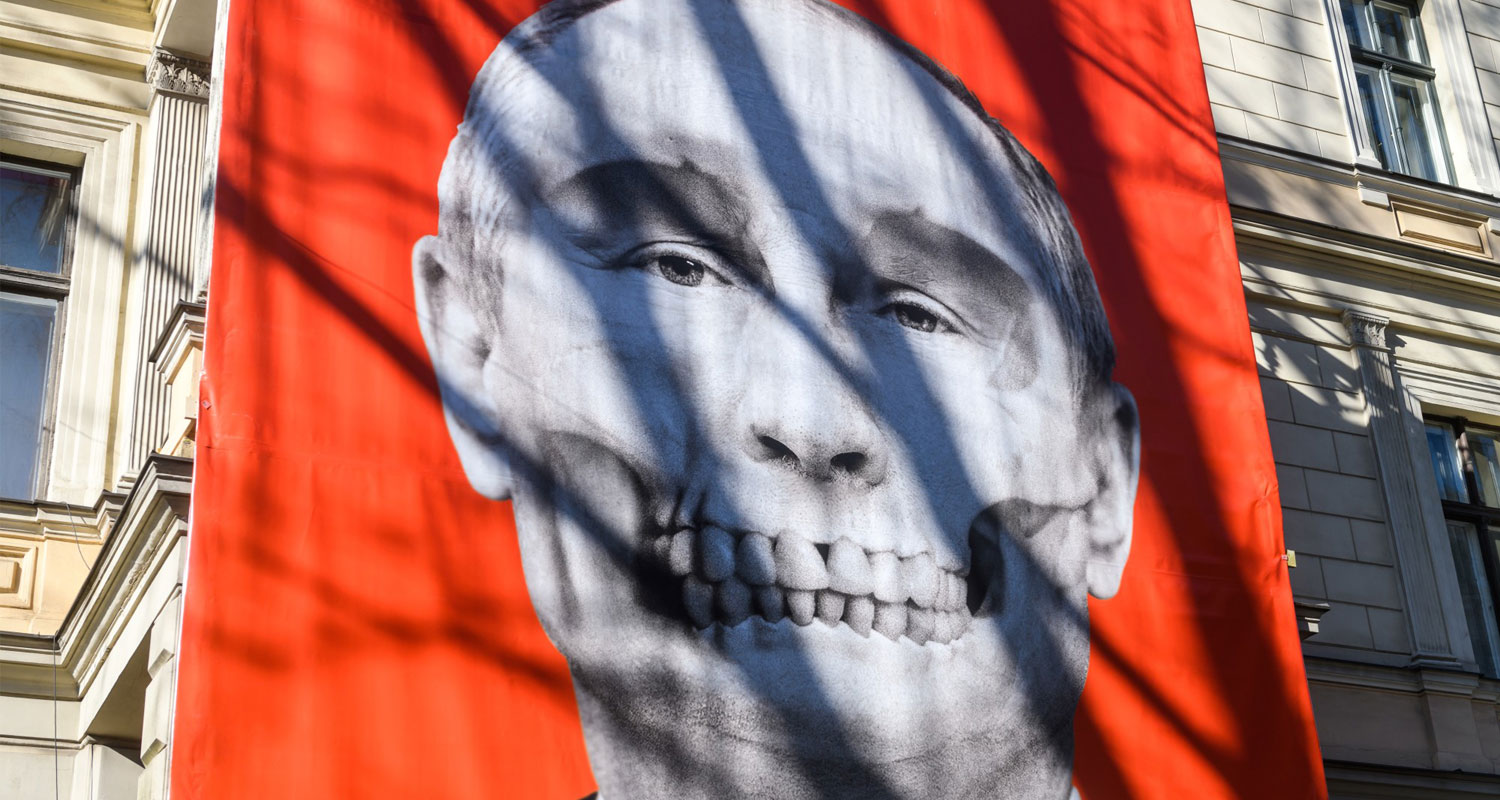
The campaign to starve Russia of technology — stripping the nation of everything from iPhones and Airbnb listings to defence electronics — is an unprecedented experiment that risks pushing Vladimir Putin further into China’s orbit.
Using export controls as a tool, the US is leading an effort to deprive Russia of components it needs for high-end industry and advanced weapons, with the hopes of ensuring that President Putin feels the pain of his decision to invade Ukraine. That has forced makers of computers, chips and sensors to halt shipments to Russia.
At the same time, many of the biggest US companies have gone further, effectively establishing a tech boycott of the nation. The idea, encouraged by Ukrainian leaders, is that depriving Russians of access to tech and digital platforms will spur popular protest and undermine Putin’s military campaign.
But no one has attempted modern technological isolation on this scale before, and it’s hard to say how Russia’s 145 million people will ultimately respond. Cutting Russians adrift from online services may undermine pro-democracy activists seeking to organise antiwar protests. And, perhaps most crucially, it threatens to drive Russia closer to America’s rivals, most notably China.
“It’s hard to think of a historic parallel,” said Peter Singer, a US military strategist and author whose techno-thrillers have depicted combat in the absence of communication and the weaponisation of social media.
Singer notes that the US has always attempted to control an enemy’s supply chain. That includes Washington’s efforts to cut off Japanese access to raw resources such as oil, rubber and tin following that country’s 1937 invasion of China.
‘The components’
“What’s different today in the digital era is you’re reaching into the components — the chips and other pieces of it,” he said.
Restricting online services brings a dilemma. It further carves up the Internet and threatens to make censorship and disinformation worse.
A senior Biden administration official acknowledged the experimental nature of the tech broadside. No one knows how the export-control move will “play out in terms of the details”, the official said. But the economic separation espoused by both the US government and tech companies feels like “exactly what is needed”, the official said.
The administration has said that its ban — together with efforts by allies — will cut off more than half of Russia’s high-tech imports. And the move will keep US$50-billion worth of US items out of the country over three years.
America’s allies, including the European Union, the UK, Japan, Australia and New Zealand, have agreed to adopt similar policies. South Korea, a key supplier of smartphones to Russia, also recently joined the effort. US companies that break the rules risk jail time, large fines and export bans, while foreign companies could be denied access to American components.
The policy bears similarities to the US effort to punish Chinese telecommunications giant Huawei Technologies. In 2020, as trade tensions with China flared, the Trump administration cut off Huawei’s access to critical chips the company needed for smartphone and 5G operations.
“You’re taking the Huawei rule and applying that to an entire country, an entire economy,” said Martijn Rasser, a former senior CIA officer who studies technology and national security.
The move to cut off Russia was conceived as part of a deterrent package months before the country invaded Ukraine. Don Graves, deputy US commerce secretary, said export controls aren’t expected to have an immediate impact. But in the coming weeks or months, the defence, aerospace and maritime sectors “will begin to feel real pain” as Russia’s stockpile of chips and other electronics dwindle, he said in an interview.
When you cut out the chip ecosystem, Putin loses his advanced military capabilities, Graves said. Russian consumers will feel the impact too, he added, citing difficulty getting computers and spare parts.
It’s ultimately Putin’s choice “if there is some type of long-term technology impact to the Russian economy and the Russian people”, Graves said. “It’s his choice to stop the war — withdraw his troops.”
It’s ultimately Putin’s choice if there is some type of long-term technology impact to the Russian economy and the Russian people
Taiwan Semiconductor Manufacturing Co, a top maker of advanced chips, has already agreed not to supply Russia with semiconductors, although China may offer other options. China is Russia’s biggest supplier of electronics, accounting for a third of its semiconductor imports and more than half of its computers and smartphones.
The Shanghai-based Semiconductor Manufacturing International Corp, or SMIC, is a key source of chips, but Washington will lean on that company to cut off supply as well.
In any case, China’s chip industry is smaller and less sophisticated than that of the US or other countries like South Korea.
“China alone can’t supply Russia with all of its critical needs,” Graves said. But the US “will follow back up with our enforcement teams” to encourage China to adopt export controls.
While the moves could ultimately set Russian tech back by decades, the country is still expected to fare better than North Korea, which is more isolated but has nevertheless set about building hypersonic missiles under extreme sanctions.
‘Careful’
“Companies are being very careful — they don’t want to be the poster child for having done something wrong,” said F Amanda DeBusk, a trade lawyer who formerly ran export enforcement at the US commerce department.
Mykhailo Fedorov, Ukraine’s vice prime minister, is helping spur the tech boycott of Russia by goading companies to act. In 2022, leveraging technology is perhaps “the best answer” to tanks, rocket launchers and missiles, he wrote in an open letter to Apple CEO Tim Cook.
Cook had initially responded to Russia’s invasion by tweeting that he was “deeply concerned with the situation in Ukraine”. He didn’t mention Russia by name, drawing criticism that he wasn’t responding forcefully enough.
Days later, Apple halted all product sales in Russia — despite exemptions available for US phones — and pledged support for humanitarian efforts. But the company stopped short of closing its App Store in the country, drawing another rebuke from Fedorov. In a memo to staff, Cook said the company was still evaluating the situation and that it was “united in our commitment to each other, to our users, and to being a force for good in the world”.
Fedorov’s campaign of social media “callouts” has targeted several other tech titans, including Amazon.com, Hitachi, Intel and Microsoft, demanding an end to all product support in Russia. “People’s lives depend on your choice,” he wrote to Hitachi.
For those who believe in the messianic power of technology to fix the future, the public pressure has come as a test. Tech companies’ instinct is to keep information flowing and services operating, even during a crisis. The experience of Apple serves as an example of the perils of its response to — and role in — the war.
Jesse Lehrich, co-founder of advocacy group Accountable Tech, said several actions by Big Tech felt “incredibly belated” after the invasion.
It’s also not much of a courageous choice to pull out of Russia now because it’s become a very difficult place to operate. Between the financial sanctions, currency fluctuations and general turmoil, it’s hard for businesses to get paid for products and services anyway.
And Russia is a much smaller market than, say, China. If the entire US tech industry were to pull the plug on Russia, the move would have only a revenue impact of 1-2% “in a worst-case scenario”, according to Wedbush Securities.
But even if the financial stakes are low, companies still have to struggle with the effect of isolating the Russian people. Cutting off social media and other online services could create a digital fortress around Russia, helping fulfil a goal of Putin’s government.
“For years, the Kremlin has sought to erect its own digital borders over the Internet,” said Allie Funk at Freedom House, which advocates for an open Internet.
In recent days, Moscow has taken unprecedented additional measures to censor the Internet. It closed down Meta Platforms’ Facebook and restricted access to Twitter’s service and other platforms, forcing Russians to rely more on state media. That’s made it harder for groups to organise antiwar protests and document human rights abuses, Funk said. TikTok also suspended livestreams in Russia.
Corynne McSherry, legal director at the free-speech advocacy group the Electronic Frontier Foundation, said no company should support the Russian government by keeping people within “a state-controlled information bubble”.
But service providers have already begun to reduce Internet and wide-area network traffic into Russia, potentially cutting off employees from information and additional aid, according to Krebs Stamos Group, a US cybersecurity company.
‘Unintended consequences’
“People should think hard about unintended consequences,” McSherry said. Closing down credit card and other payment processing services — as Visa, Mastercard, American Express and PayPal have done — also risks depriving Russians of access to virtual private networks and other encryption services that are critical for their safety, she said.
Ukraine has called for Russia to be cut off from the Internet altogether. Icann, a Californian nonprofit that supports Internet infrastructure, refused Kyiv’s request this month to shut down Russian domain names and effectively bring the Russian Internet to a halt. The group cited both the technical impossibility of doing so and the global importance of unimpeded Internet access.
Dmitri Alperovitch, a cybersecurity expert, said the software boycott may have a limited effect since Russia can find ways to pirate key programs.
As for hardware, Russia will likely continue turning inward there, too. Just as the Soviet Union made everything from cassette players to space rockets, the country will have to rebuild its domestic production — speeding up a process Russia started after the US and EU imposed sanctions in 2014 following its annexation of Crimea.
Russia does have some manufacturing capacity to replace imported chips, said Samuel Bendett, a researcher at the US security think tank CNA. “It’s just not going to be quite as good quality wise.”
Rostec, Russia’s state-owned defence conglomerate, already makes smartphones as well as combat weapons. Shifting to more homegrown products could take decades, however.
China also may be wary about filling Russia’s needs for another reason. If Beijing sells chips to Moscow for use in weaponry such as fighter jets, they might feasibly be passed on to India, China’s competitor, said James Lewis, technology strategist at the Centre for Strategic & International Studies.
Ultimately, though, China may be the biggest hurdle to cutting Russia out of the world’s tech economy, said Singer, the military strategist.
“We’re not going to see a complete tech isolation of Russia,” Singer said. “They have this massive strategic partner that’s sitting on the sideline waiting to make all these gains.” — Katrina Manson, (c) 2022 Bloomberg LP