Close Menu
TechCentralTechCentral

    Subscribe to the newsletter

    Get the best South African technology news and analysis delivered to your e-mail inbox every morning.

    Facebook X (Twitter) YouTube LinkedIn
    WhatsApp Facebook X (Twitter) LinkedIn YouTube
    TechCentralTechCentral
    • News
      Eskom lifts load reduction for 140 000 customers

      Eskom lifts load reduction for 140 000 customers

      8 February 2026
      AI chatbots are coming to Apple CarPlay

      AI chatbots are coming to Apple CarPlay

      8 February 2026
      South Africa's stablecoin silence is becoming a policy failure

      South Africa’s stablecoin silence is becoming a policy failure

      6 February 2026
      Every electric car you can buy in South Africa in early 2026, ranked by price

      Every electric car you can buy in South Africa in early 2026, ranked by price

      6 February 2026
      From stocks to crypto, markets reel as AI doubts grow

      From stocks to crypto, markets reel as AI doubts grow

      6 February 2026
    • World
      Crypto firm accidentally sends R700-billion in bitcoin to its users

      Crypto firm accidentally sends R700-billion in bitcoin to its users

      8 February 2026
      AI won't replace software, says Nvidia CEO amid market rout - Jensen Huang

      AI won’t replace software, says Nvidia CEO amid market rout

      4 February 2026
      Apple acquires audio AI start-up Q.ai

      Apple acquires audio AI start-up Q.ai

      30 January 2026
      SpaceX IPO may be largest in history

      SpaceX IPO may be largest in history

      28 January 2026
      Nvidia throws AI at the weather

      Nvidia throws AI at weather forecasting

      27 January 2026
    • In-depth
      How liberalisation is rewiring South Africa's power sector

      How liberalisation is rewiring South Africa’s power sector

      21 January 2026
      The top-performing South African tech shares of 2025

      The top-performing South African tech shares of 2025

      12 January 2026
      Digital authoritarianism grows as African states normalise internet blackouts

      Digital authoritarianism grows as African states normalise internet blackouts

      19 December 2025
      TechCentral's South African Newsmakers of 2025

      TechCentral’s South African Newsmakers of 2025

      18 December 2025
      Black Friday goes digital in South Africa as online spending surges to record high

      Black Friday goes digital in South Africa as online spending surges to record high

      4 December 2025
    • TCS
      TCS+ | How Cloud On Demand is helping SA businesses succeed in the cloud - Xhenia Rhode, Dion Kalicharan

      TCS+ | Cloud On Demand and Consnet: inside a real-world AWS partner success story

      30 January 2026
      Watts & Wheels S1E3: 'BYD's Corolla Cross challenger'

      Watts & Wheels S1E3: ‘BYD’s Corolla Cross challenger’

      30 January 2026
      Watts & Wheels S1E3: 'BYD's Corolla Cross challenger'

      Watts & Wheels S1E2: ‘China attacks, BMW digs in, Toyota’s sublime supercar’

      23 January 2026

      TCS+ | Why cybersecurity is becoming a competitive advantage for SA businesses

      20 January 2026
      Watts & Wheels S1E3: 'BYD's Corolla Cross challenger'

      Watts & Wheels: S1E1 – ‘William, Prince of Wheels’

      8 January 2026
    • Opinion
      South Africa's skills advantage is being overlooked at home - Richard Firth

      South Africa’s skills advantage is being overlooked at home

      29 January 2026
      Why Elon Musk's Starlink is a 'hard no' for me - Songezo Zibi

      Why Elon Musk’s Starlink is a ‘hard no’ for me

      26 January 2026
      South Africa's new fibre broadband battle - Duncan McLeod

      South Africa’s new fibre broadband battle

      20 January 2026
      AI moves from pilots to production in South African companies - Nazia Pillay SAP

      AI moves from pilots to production in South African companies

      20 January 2026
      South Africa's new fibre broadband battle - Duncan McLeod

      ANC’s attack on Solly Malatsi shows how BEE dogma trumps economic reality

      14 December 2025
    • Company Hubs
      • Africa Data Centres
      • AfriGIS
      • Altron Digital Business
      • Altron Document Solutions
      • Altron Group
      • Arctic Wolf
      • AvertITD
      • Braintree
      • CallMiner
      • CambriLearn
      • CYBER1 Solutions
      • Digicloud Africa
      • Digimune
      • Domains.co.za
      • ESET
      • Euphoria Telecom
      • Incredible Business
      • iONLINE
      • IQbusiness
      • Iris Network Systems
      • LSD Open
      • NEC XON
      • Netstar
      • Network Platforms
      • Next DLP
      • Ovations
      • Paracon
      • Paratus
      • Q-KON
      • SevenC
      • SkyWire
      • Solid8 Technologies
      • Telit Cinterion
      • Tenable
      • Vertiv
      • Videri Digital
      • Vodacom Business
      • Wipro
      • Workday
      • XLink
    • Sections
      • AI and machine learning
      • Banking
      • Broadcasting and Media
      • Cloud services
      • Contact centres and CX
      • Cryptocurrencies
      • Education and skills
      • Electronics and hardware
      • Energy and sustainability
      • Enterprise software
      • Financial services
      • Information security
      • Internet and connectivity
      • Internet of Things
      • Investment
      • IT services
      • Lifestyle
      • Motoring
      • Public sector
      • Retail and e-commerce
      • Satellite communications
      • Science
      • SMEs and start-ups
      • Social media
      • Talent and leadership
      • Telecoms
    • Events
    • Advertise
    TechCentralTechCentral
    Home » Editor's pick » SA Connect can’t be ‘business as usual’

    SA Connect can’t be ‘business as usual’

    By Duncan McLeod15 January 2016
    Twitter LinkedIn Facebook WhatsApp Email Telegram Copy Link
    News Alerts
    WhatsApp
    BMI-T MD Denis Smit
    BMI-T MD Denis Smit

    If government decides to get serious about SA Connect, its wide-ranging broadband policy published two years ago, it will result in one of the largest telecommunications projects ever embarked upon in South Africa’s history.

    But already the project has fallen behind, with South Africa set to miss milestone targets set for 2016, and 2020 targets already at risk.

    This is the view of specialist technology research firm and consultancy BMI-TechKnowledge, which has produced a 200-page report examining what will be needed to connect tens of thousands of government facilities, including schools and clinics, to the Internet at broadband speeds.

    BMI-T has developed two models — “two theoretical extremes”, it calls them — one predominantly based on the deployment of fibre infrastructure, and the other relying much more heavily on wireless technologies such as 4G/LTE.

    BMI-T MD Denis Smit says government’s hope of achieving its ultimate goal of connecting all South Africans to broadband by 2030 won’t be met “unless there are course corrections and the programme gathers momentum soon”.

    “BMI-T has calculated that we need to more than double the current national fibre-optic footprint, regardless of whether we adopt a fibre-centric or a wireless-centric approach,” the company says.

    Its report doesn’t make any judgments about whether SA Connect is desirable or even financially feasible, but is rather meant as an “independent review of the project, to contribute to the debate”, says Smit. “We have done a detailed technical and financial model and looked at different scenarios and provided some insight into the scale of the problem. You’re talking about a fibre project on a scale that this country has never seen.”

    BMI-T senior telecoms consultant Tim Parle says South Africa has about 25 000 public and private schools. It’s not known how many of these schools are connected, or how they’re connected. There are also about 4 000 health facilities, 1 100 police stations and 1 600 post offices. In all, there are about 39 000 government facilities that need to be connected under SA Connect, according to BMI-T.

    The challenge is that the relatively well-served urban and suburban areas make up only 7% of South Africa’s geographic area; the remaining 93% is rural and generally poorly served by telecoms infrastructure. More than two in five public sector facilities are located in rural areas. Yet, a central requirement of SA Connect is that all facilities and locations are treated equally.
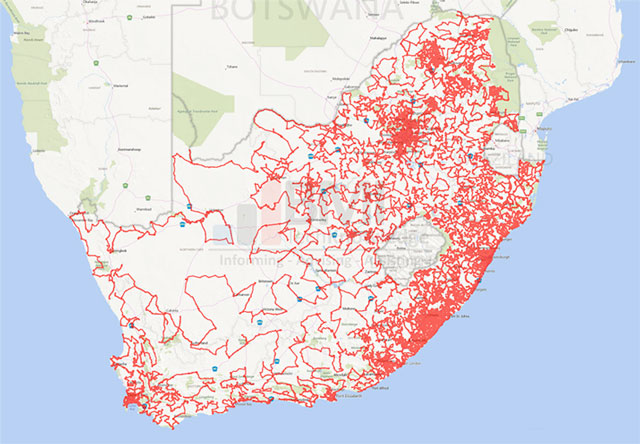
    Extent of fibre footprint required to provide fibre to public facilities in South Africa (required by 2030 to meet 1Gbit/s targets). Image: BMI-T
    Extent of fibre footprint required to provide fibre to public facilities in South Africa (required by 2030 to meet 1Gbit/s targets). Image: BMI-T
    Extent of fibre footprint required to provide 4G/LTE to public facilities and the population at large in South Africa. Image: BMI-T
    Extent of fibre footprint required to provide 4G/LTE to public facilities and the population at large in South Africa. Image: BMI-T

    It will be easier to connect facilities in provinces such as Gauteng and the Western Cape, which are heavily urbanised, than in the rural Eastern Cape or KwaZulu-Natal, says Parle.

    Although BMI-T has considered “two extremes” in its fibre-centric and wireless-centric models, it believes a mix of the two is the most practical solution. However, even if South Africa opts for a wireless-centric solution – which will be cheaper and quicker to deploy than laying fibre to every end point, and offer better returns on investment – the country will still need to more than double its existing fibre footprint to connect base stations.

    BMI-T estimates that Telkom’s national long-distance fibre amounts to about 30 000km. Telkom has been named as government’s preferred partner for the SA Connect project.

    In its fibre-centric model, BMI-T estimates that an additional 60 000km of national fibre would have to be deployed, in addition to what Telkom already has in service.

    However, even the company’s wireless-centric model calls for significant investment in fibre for backhaul. It estimates that South Africa will need an additional 41 000km of fibre under this model.

    “The big ‘lever’ is the involvement of Telkom and access to its fibre – is it the right fibre and is it in the right places?” says Parle. “Then, how much of the new fibre that gets built is aerial, and how much is buried? The costs are very different and there are pros and cons for every engineering solution.”

    The scale of the project is perhaps best illustrated when one considers that it took private telecoms operator FibreCo more than two years to secure the necessary permits to roll out 1 000km of fibre between Johannesburg and East London. Just building that link took the company 14 months.

    “Under the fibre-centric model, in a typical year we’d need to have six FibreCo-scale projects running in parallel,” says Parle. “Even under the wireless-centric model, it’d have to be at a rate of 3,5 FibreCos a year.”

    Tim Parle
    Tim Parle

    The biggest challenge, though, could be figuring out the return on investment and how the project will be funded.

    “The internal rate of return for wireless is clearly a lot higher than it is with the fibre-centric model,” says Parle. Even then, it’s a massive project that ultimately will deliver small returns. Ten years may be a best-case scenario for a return on investment, says Parle. Adds Smit: “The problem is not necessarily the scale of the investment; it’s funding it over 10 or 15 years. And this only takes into account the infrastructure, not e-government services, tablets that would need to be distributed into schools, and so on. You need to create demand.”

    So, can South Africa actually afford SA Connect? “I don’t know,” says Smit. “This is not a business-as-usual situation. If government can afford R1 trillion for nuclear power stations, maybe they can afford this. It depends on political will.”

    Though the capital requirements for SA Connect vary largely depending on prioritisation and choices made, the peak funding requirements and the time it will take for the project to become operationally profitable are significant challenges. The money required is “probably far beyond what the state with current funding models can afford”.

    However, Smit says it is not BMI-T’s intention with its report to “pass comment” on the feasibility of what is proposed, but rather to present the scale of the problem to government and other industry role players. “These are the facts, this is the scale of the problem, and unless someone addresses the reality of this, we might find things don’t proceed,” he says.

    “We want to stimulate debate about this. At this point, it’s fairly opaque as to what’s happening, and the scale of it. There is no formal process of measuring progress on SA Connect. Our attempt here, and it’s only at an infrastructure level, is to put some sort of reality testing into the discussion. Our conclusion is that if we continue as business as usual, SA Connect will be jeopardised.”  — © 2016 NewsCentral Media



    BMI-T BMI-TechKnowledge Denis Smit FibreCo SA Connect Telkom Tim Parle
    WhatsApp YouTube Follow on Google News Add as preferred source on Google
    Share. Facebook Twitter LinkedIn WhatsApp Telegram Email Copy Link
    Previous ArticleMTN, Vodacom market caps now matched
    Next Article #ZumaMustFall again dominates social media

    Related Posts

    Mobile operators face tougher rules on data and billing

    Mobile operators face tougher rules on data and billing

    26 January 2026
    South Africa's telecoms sector enters a new growth phase

    South Africa’s telecoms sector enters a new growth phase

    19 January 2026
    Vodacom, Maziv deal rewrites South Africa's open-access rulebook - Björn Menden and Thomas Switala

    Vodacom, Maziv deal rewrites South Africa’s open-access rulebook

    18 January 2026
    Company News
    The skills gap is a thinking gap: why South African employers can't find problem solvers

    The skills gap is a thinking gap: why SA employers can’t find problem solvers

    6 February 2026
    Vox Kiwi Wireless: fibre-like broadband for South African homes

    Vox Kiwi Wireless: fibre-like broadband for South African homes

    5 February 2026
    NEC XON achieves an African first with full Fortinet accreditation - Ian Kruger

    NEC XON achieves an African first with full Fortinet accreditation

    5 February 2026
    Opinion
    South Africa's skills advantage is being overlooked at home - Richard Firth

    South Africa’s skills advantage is being overlooked at home

    29 January 2026
    Why Elon Musk's Starlink is a 'hard no' for me - Songezo Zibi

    Why Elon Musk’s Starlink is a ‘hard no’ for me

    26 January 2026
    South Africa's new fibre broadband battle - Duncan McLeod

    South Africa’s new fibre broadband battle

    20 January 2026

    Subscribe to Updates

    Get the best South African technology news and analysis delivered to your e-mail inbox every morning.

    Latest Posts
    Eskom lifts load reduction for 140 000 customers

    Eskom lifts load reduction for 140 000 customers

    8 February 2026
    Crypto firm accidentally sends R700-billion in bitcoin to its users

    Crypto firm accidentally sends R700-billion in bitcoin to its users

    8 February 2026
    AI chatbots are coming to Apple CarPlay

    AI chatbots are coming to Apple CarPlay

    8 February 2026
    South Africa's stablecoin silence is becoming a policy failure

    South Africa’s stablecoin silence is becoming a policy failure

    6 February 2026
    © 2009 - 2026 NewsCentral Media
    • Cookie policy (ZA)
    • TechCentral – privacy and Popia

    Type above and press Enter to search. Press Esc to cancel.

    Manage consent

    TechCentral uses cookies to enhance its offerings. Consenting to these technologies allows us to serve you better. Not consenting or withdrawing consent may adversely affect certain features and functions of the website.

    Functional Always active
    The technical storage or access is strictly necessary for the legitimate purpose of enabling the use of a specific service explicitly requested by the subscriber or user, or for the sole purpose of carrying out the transmission of a communication over an electronic communications network.
    Preferences
    The technical storage or access is necessary for the legitimate purpose of storing preferences that are not requested by the subscriber or user.
    Statistics
    The technical storage or access that is used exclusively for statistical purposes. The technical storage or access that is used exclusively for anonymous statistical purposes. Without a subpoena, voluntary compliance on the part of your Internet Service Provider, or additional records from a third party, information stored or retrieved for this purpose alone cannot usually be used to identify you.
    Marketing
    The technical storage or access is required to create user profiles to send advertising, or to track the user on a website or across several websites for similar marketing purposes.
    • Manage options
    • Manage services
    • Manage {vendor_count} vendors
    • Read more about these purposes
    View preferences
    • {title}
    • {title}
    • {title}