Close Menu
TechCentralTechCentral

    Subscribe to the newsletter

    Get the best South African technology news and analysis delivered to your e-mail inbox every morning.

    Facebook X (Twitter) YouTube LinkedIn
    WhatsApp Facebook X (Twitter) LinkedIn YouTube
    TechCentralTechCentral
    • News
      Eskom's diesel bill falls 86% as breakdowns hit eight-year low

      Eskom’s diesel bill falls 86% as breakdowns hit eight-year low

      31 July 2026
      Ramaphosa signs off on taking the grid away from Eskom

      Ramaphosa signs off on taking the grid away from Eskom

      31 July 2026
      Nedbank hires MTN's former tech chief as group CIO - Nikos Angelopoulos

      Nedbank hires MTN’s former tech chief as group CIO

      31 July 2026
      Microsoft just had the biggest day in stock market history

      Microsoft just had the biggest day in stock market history

      31 July 2026
      MTN Nigeria's growth engine stalled in second quarter - Karl Toriola

      MTN Nigeria’s growth engine stalled in second quarter

      31 July 2026
    • World
      Meta AI will now tell parents if their teen is in crisis

      Meta AI will now tell parents if their teen is in crisis

      17 July 2026
      IBM shares crash 25% as AI upends software spending - Arvind Krishna

      IBM shares crash 25% as AI upends software spending

      15 July 2026
      Jony Ive's first OpenAI device: an AI smart speaker - Jony Ive and Sam Altman

      Jony Ive’s first OpenAI device: an AI smart speaker

      15 July 2026
      Stripe, Advent in talks to buy PayPal for $53-billion

      Stripe, Advent in talks to buy PayPal for $53-billion

      15 July 2026
      Memory crisis sends smartphone market into steep decline

      Memory crisis sends smartphone market into steep decline

      13 July 2026
    • In-depth
      The plan to stop AI from breaking the world - Google DeepMind CEO Demis Hassabis. Image: John Sears

      The plan to stop AI from breaking the world

      16 July 2026
      The internet has a Strait of Hormuz problem

      The internet has a Strait of Hormuz problem

      15 July 2026
      AI boom sparks rally, frenzy and fear

      AI boom sparks rally, frenzy and fear

      11 June 2026
      Every plug-in hybrid on sale in South Africa, ranked by price - Lamborghini Temerario

      Every plug-in hybrid on sale in South Africa, ranked by price

      7 June 2026
      What Wi-Fi 8 will mean for wireless networks

      What Wi-Fi 8 will mean for wireless networks

      1 June 2026
    • TCS
      TCS+ | Why South African workers must become supervisors of digital labour - Accelera Digital Group Cliff de Wit

      TCS+ | Why South African workers must become supervisors of digital labour

      31 July 2026
      TCS | Rapid deployment rules can't work without municipalities: ACT - Nomvuyiso Batyi

      TCS | Icasa’s rules skip the real bottleneck: ACT

      30 July 2026
      TCS+ | iStore Business on why Apple makes sense for SMEs - Sudesh Pillay and Tamia Nontsikelelo

      TCS+ | iStore Business on why Apple makes sense for SMEs

      30 July 2026
      TCS+ | A smarter approach to cloud for South African businesses - Joel Chacko and Jonathan Oaker

      TCS+ | A smarter approach to cloud for South African businesses

      28 July 2026
      TCS | How Optasia lends billions to people banks can't see - Salvador Anglada

      TCS | How Optasia lends billions to people banks can’t see

      23 July 2026
    • Opinion
      The author, Jannie van Zyl

      Selling vapour is corporate suicide in slow motion

      16 July 2026
      Brazil's online gambling crackdown is a lesson for South Africa

      How Amazon outmanoeuvred Starlink in South Africa

      15 July 2026
      The Popia problem with agentic AI - Herman Haasbroek

      The Popia problem with agentic AI

      14 July 2026
      The author, Fanie van Rooyen

      South Africa can still catch the AI wave – here’s how

      7 July 2026
      The author, Fanie van Rooyen

      The AI utopia South Africa can’t afford

      1 July 2026
    • Company Hubs
      • 1Stream
      • Africa Data Centres
      • AfriGIS
      • Altron Digital Business
      • Altron Document Solutions
      • Altron Group
      • Arctic Wolf
      • Ascent Technology
      • AvertITD
      • BBD
      • Braintree
      • CallMiner
      • CambriLearn
      • CM Telecom
      • Contactable
      • CYBER1 Solutions
      • Digicloud Africa
      • Digimune
      • Domains.co.za
      • ESET
      • Euphoria Telecom
      • HOSTAFRICA
      • Incredible Business
      • iONLINE
      • IQbusiness
      • Iris Network Systems
      • Kaspersky
      • LSD Open
      • Mitel
      • NEC XON
      • Netstar
      • Network Platforms
      • Next DLP
      • Ovations
      • Paracon
      • Paratus
      • Q-KON
      • SevenC
      • SkyWire
      • Solid8 Technologies
      • Telit Cinterion
      • Telviva
      • Tenable
      • Vertiv
      • Videri Digital
      • Vodacom Business
      • Vox
      • Wipro
      • Workday
      • XLink
    • Sections
      • AI and machine learning
      • Banking
      • Broadcasting and Media
      • Cloud services
      • Contact centres and CX
      • Cryptocurrencies
      • Education and skills
      • Electronics and hardware
      • Energy and sustainability
      • Enterprise software
      • Financial services
      • HealthTech
      • Information security
      • Internet and connectivity
      • Internet of Things
      • Investment
      • IT services
      • Lifestyle
      • Policy and regulation
      • Public sector
      • Retail and e-commerce
      • Satellite communications
      • Science
      • SMEs and start-ups
      • Social media
      • Talent and leadership
      • Telecoms
      • Watts & Wheels
    • Events
    • Advertise
    TechCentralTechCentral
    Home » In-depth » SA science making its mark, bit by bit

    SA science making its mark, bit by bit

    By The Conversation7 May 2015
    Twitter LinkedIn Facebook WhatsApp Email Telegram Copy Link
    News Alerts
    WhatsApp

    South-African-flag

    “South Africa is fortunate to boast excellence in a large number of cutting-edge science and technology domains. Whether it is in nanotechnology or astronomy, laser technology or high-performance computing, South Africa has made an impact in the global science area.” — Science & technology minister Naledi Pandor, February 2015

    Pandor’s speech to the American Association for the Advancement of Science is helpful and honest, although perhaps a little one-sided. Science is not just about nanotechnology, medicine, astronomy and IT. It is about all of those research and discovery areas — and about climate change in the Antarctic, the diseases that kill forests and crops, and the study of the micro-organisms critical to life.

    But science, as knowing, and so about knowledge, also embraces the human and social sciences — psychology, economics, history and languages among others. In these areas, South African scientists and scholars make substantial contributions to local, regional and international knowledge that is important for both science and society.

    South African scientists are asking and helping answer critical questions. These include:

    • How has the use of space and architecture shaped South Africa’s cities and contributed to the serious challenge of xenophobia?
    • What is the role of capital cities in influencing local government and socioeconomic conditions?
    • Why are we still measuring economic well-being by using GDP statistics when they are clearly a mis-measure of well-being?

    South Africa is also undertaking pioneering work with regard to Mapungubwe’s history, and providing the world with data from the Southern African Large Telescope while developing, with fellow African countries, the massive Square Kilometre Array telescope — due to start producing information in 2020.

    South African scientists are also contributing to the means for dealing with Africa’s single greatest killer — malaria.

    South African scientists and scholars produce the most significant portion of Africa’s recognised research publications and, increasingly, doctoral students. More than 50 000 publications were produced between 2000 and 2010. This represents less than 1% of the world’s production of research papers — produced in South Africa’s case by just fewer than 20 000 researchers — but stands at 30% of Africa’s research output.

    An important new trend has begun to develop — the growth of postgraduate students from the rest of the continent. In 2012, 4 698 PhD students (34%) in South African universities came from outside South Africa — a figure that has grown by 14% over a 12-year period. This has led some researchers to suggest that South Africa has the potential to become a “doctoral” hub for the continent.

    South Africa has a long history of producing world-class research, especially in fields such as palaeontology and agriculture. During the academic boycott under apartheid, research contact with the rest of the world diminished. But steps taken since then have turned the situation around.

    Re-joining the global world of science has led to quite dramatic changes in the research landscape. Most importantly, research output measured in terms of research papers published, and masters and PhD graduates, increased almost three-fold between the mid-1990s and 2013.

    Data released in April highlight the areas of scientific research in which South Africa now excels when measured against the best institutions in the world.

    Across the spectrum of the natural, social and human sciences, South Africa is well represented among the world’s best regarded institutions. The higher points of the landscape are the 10 South African scholars who are rated as being in the top 1% of the researchers across the world in their fields. These include academics in the environmental, social, biological and paleo-anthropological sciences.

    Missing pieces of the puzzle
    Despite the critical role science plays in positioning South Africa in the world of research, department of higher education & training support for universities has been declining. The rand values of departmental funding for universities have been rising but at lower rates than inflation and the needs of students.

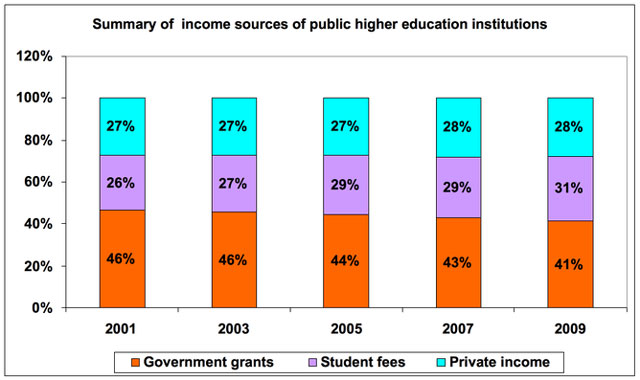
    As a result, the proportional share of public funding for universities has been shrinking. Based on the latest available comparable data (for 2009) the following pattern emerges:
    Ian Bunting, Centre for Higher Education Trust Seminar, February 2012
    Ian Bunting, Centre for Higher Education Trust Seminar, February 2012

    Over an eight-year period, public funding for universities dropped from 48% to 41% — and has continued to drop. Meanwhile, student fees have gone from a contribution of 26% to 31% of university income — which casts some light on student protests over fees.

    The National Research Foundation (NRF) has taken steps to support researchers and graduate students as they work to add to South Africa’s scientific and scholarly knowledge. The NRF’s major contributions have been through the South African Research Chair Initiative, the creation of Centres of Excellence and support for the Academy of Science of South Africa and the South African Journal of Science.

    Bear in mind that in the late 1980s, public funding for universities (and “technikons”, as they were then) constituted anything from slightly more than 50% to 70% of institutional income. This left some institutions in considerably constrained circumstances.

    It also remains true that research production is still dominated by (aging) white men. This is a problem not just of equity but of forward planning. Women and black scientists and scholars remain minorities, especially at the professorial and senior research levels.

    However, changes are beginning to take effect and most universities are deeply aware of the need for a socially equitable research landscape. This is certainly the case for major funding sources for research, which have been foregrounding the need for change that will secure South Africa’s growing productivity and stature in the wider world of science.The Conversation

    • John Butler-Adam is consultant, vice principal for research and graduate education at the University of Pretoria
    • This article was originally published on The Conversation

    Follow TechCentral on Google News Add TechCentral as your preferred source on Google


    John Butler-Adam Naledi Pandor
    WhatsApp YouTube
    Share. Facebook Twitter LinkedIn WhatsApp Telegram Email Copy Link
    Previous ArticleMedia moguls take copyright battle to court
    Next Article To prepay or not to prepay Eskom

    Related Posts

    Big win for South African innovation agency - Technology Innovation Agency CEO Titus Mathe

    R1.2-billion win for South African innovation agency

    9 June 2026

    SA firms facing ‘extortion’ in Africa: gov’t promises help

    13 July 2023

    Pandor calls on MTN, Ghana to resolve R13.3-billion tax dispute

    29 January 2023
    Company News
    Domains.co.za launches self-hosted n8n VPS hosting

    Domains.co.za launches self-hosted n8n VPS hosting

    31 July 2026
    Smarter.tech '26 shows why smarter technology begins with context - Obsidian Systems

    Context is the missing piece in enterprise AI: Obsidian

    31 July 2026
    Huawei launches 12 intelligent transport solutions in South Africa - Sam Tang

    Huawei launches 12 intelligent transport solutions in South Africa

    30 July 2026
    Opinion
    The author, Jannie van Zyl

    Selling vapour is corporate suicide in slow motion

    16 July 2026
    Brazil's online gambling crackdown is a lesson for South Africa

    How Amazon outmanoeuvred Starlink in South Africa

    15 July 2026
    The Popia problem with agentic AI - Herman Haasbroek

    The Popia problem with agentic AI

    14 July 2026

    Subscribe to Updates

    Get the best South African technology news and analysis delivered to your e-mail inbox every morning.

    Latest Posts
    Eskom's diesel bill falls 86% as breakdowns hit eight-year low

    Eskom’s diesel bill falls 86% as breakdowns hit eight-year low

    31 July 2026
    Ramaphosa signs off on taking the grid away from Eskom

    Ramaphosa signs off on taking the grid away from Eskom

    31 July 2026
    Domains.co.za launches self-hosted n8n VPS hosting

    Domains.co.za launches self-hosted n8n VPS hosting

    31 July 2026
    Smarter.tech '26 shows why smarter technology begins with context - Obsidian Systems

    Context is the missing piece in enterprise AI: Obsidian

    31 July 2026
    © 2009 - 2026 NewsCentral Media
    Built and maintained by Chronon
    • Cookie policy (ZA)
    • TechCentral – privacy and Popia

    Type above and press Enter to search. Press Esc to cancel.

    Manage consent

    TechCentral uses cookies to enhance its offerings. Consenting to these technologies allows us to serve you better. Not consenting or withdrawing consent may adversely affect certain features and functions of the website.

    Functional Always active
    The technical storage or access is strictly necessary for the legitimate purpose of enabling the use of a specific service explicitly requested by the subscriber or user, or for the sole purpose of carrying out the transmission of a communication over an electronic communications network.
    Preferences
    The technical storage or access is necessary for the legitimate purpose of storing preferences that are not requested by the subscriber or user.
    Statistics
    The technical storage or access that is used exclusively for statistical purposes. The technical storage or access that is used exclusively for anonymous statistical purposes. Without a subpoena, voluntary compliance on the part of your Internet Service Provider, or additional records from a third party, information stored or retrieved for this purpose alone cannot usually be used to identify you.
    Marketing
    The technical storage or access is required to create user profiles to send advertising, or to track the user on a website or across several websites for similar marketing purposes.
    • Manage options
    • Manage services
    • Manage {vendor_count} vendors
    • Read more about these purposes
    View preferences
    • {title}
    • {title}
    • {title}