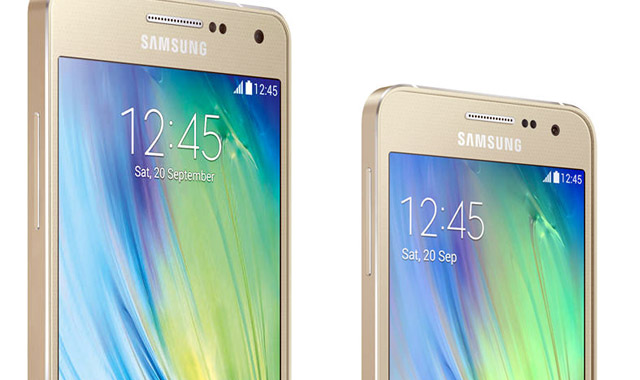
To find out what concessions Samsung had to make in order to produce metal smartphones for a relatively low price, I worked and played with both the Galaxy A3 and A5 for a full week.
I used both devices for typical home and light business related tasks such as browsing, e-mailing, handling documents, installing apps, listening to music, playing games and watching movies.
Their performance was determined by confronting them with two generic system benchmarks and one specific graphics test.
I measured their battery life by using two separate torture tests, while the quality of the screen was measured using dedicated equipment.
The camera quality was assessed by simply taking multiple pictures in various scenarios and settings.
Look and feel: slimline and lightweight
The Samsung Galaxy A3 and A5 smartphones are, at their core, one and the same device. The main difference between the two is screen size. The Galaxy A3 features a 4,5-inch screen with a resolution of 960×540 and 244ppi pixel density. The Galaxy A5, on the other hand, houses a slightly bigger 5-inch screen that displays 1 280×720 pixels at 293ppi.
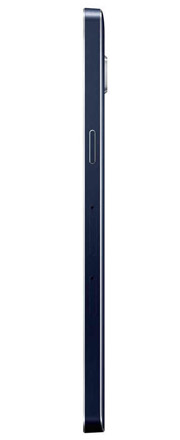
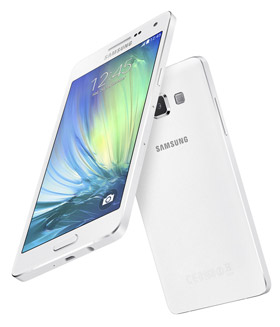
Both the A3 (6,9mm, 110g) and A5 (6,7mm, 123g) are thin and lightweight. The slimline design unfortunately also creates a minor issue: the camera lens protrudes slightly, preventing the phones from being used comfortably when flat on their back.
Except for the front side, the complete exterior of both devices is made of aluminium. Not only does this give them a premium look and feel, it also makes the phones feel sturdy and durable. However, for devices that are claimed to have a full metal body, the backs still look and feel a bit like plastic. I suspect Samsung used some sort combination of different materials for the back of the A3 and A5. The edges, on the other hand, do have that characteristic cold metal look and feel.
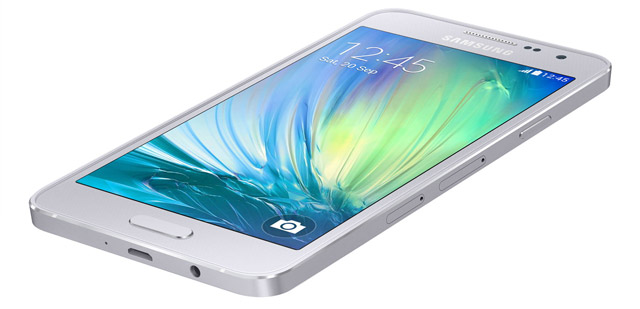
As opposed to previous Samsung smartphones, the backs of the A3 and A5 can’t be removed, making the battery non-removable. The microSD slot, which would normally be located behind the removable battery, has been relocated to the side, next to the nano-Sim slot.
Hardware: doesn’t bode well
Samsung’s Galaxy A3 and A5 share the exact same 64-bit Qualcomm Snapdragon 410 system on a chip. This chip houses four separate Cortex A53 cores, each running at a maximum of 1,2GHz. For graphics, the A3 and A5 depend on an Adreno 306 GPU.
Samsung’s choice of hardware at this point is questionable to say the least. The Snapdragon 410 chip has already been spotted in low-budget, low-end smartphones and is generally known to be lacking real horsepower. So what is it doing inside these two mid-range devices? The most obvious answer to that question: compensating for the production costs of the metal body.
The rest of the Galaxy A5’s internal hardware is in line with what you might expect from a midrange smartphone with an official retail price of R6 500. It features 2GB RAM and 16GB storage space, which is expandable by using an optional microSD card of maximum 64GB. Of those 16GB, 11GB remain available for user files and apps. The A5 supports 4G/LTE mobile networks, 802.11 a/b/g/n (2,4GHz and 5GHz) Wi-Fi networks, near-field communication, Bluetooth and GPS. Also, the microSD slot doubles as a second Sim slot, effectively transforming the Galaxy A5 into a dual-Sim phone. The slightly cheaper (official retail price: R5 000) Galaxy A3 shares most of those specs, but houses only 1GB of RAM.
Benchmarks: bottom dwellers
In order to determine the consequences of Samsung’s hardware choices, I ran both devices through two generic system benchmarks and one specific graphics test. I then compared the test results with those of competitive, similarly sized and similarly priced midrange Android smartphones.
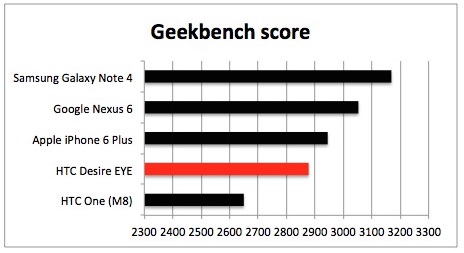 The first benchmark is Geekbench, which focuses mainly on the raw CPU and RAM performance and simulates real-world scenarios. Geekbench is multicore-aware and provides support for both 32-bit and 64-bit processors.
According to this benchmark, the A3 and A5 belong to the cluster of slowest midrange smartphones. Both Galaxy devices perform identically to the cheaper 5,5-inch Huawei Ascend G7 (R3 500) and 5-inch HTC Desire 620 (R3 500). That’s no coincidence, since they all use the exact same Snapdragon 410 system on a chip.
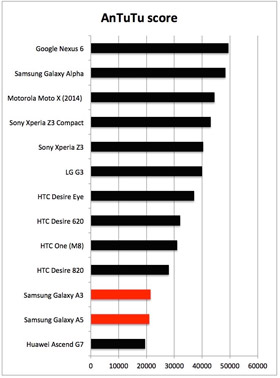
I then ran the AnTuTu benchmark to test the CPU, RAM, GPU and I/O performance. It showed similar disappointing results from the Galaxy A3 and A5. Again, the 5,9-inch Google Nexus 6 (R7 900) proved to be the fastest of all devices, while Motorola’s 2014 model of the 5,2-inch Moto X phone (R5 000) finished in the top three of best performing devices once more.
 To determine the A3/A5’s graphics capabilities, I ran the GFXBench tool. Its test results are presented in frames per second. The more frames, the faster the hardware. Unfortunately, both Galaxy devices were also unable to impress here. Almost all other smartphones proved to be better at handling complex 3D scenes. Sony’s 4,6-inch Xperia Z3 Compact (R5 100) is by far the best at graphics and therefore the ultimate midrange gaming smartphone money can buy.
As a result of these three benchmarks, it’s safe to say that both the A3 and A5 lack serious horsepower. If you are planning to use these devices for light home and business use only, that won’t pose a problem. The user interface is silky smooth and both phones have enough muscle to facilitate comfortable tasks like browsing and messaging.
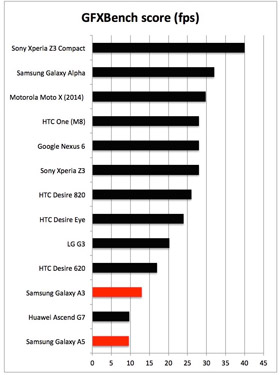 If you plan to use the A3/A5 for anything more than that, like heavy apps, games or even serious multitasking, you will discover that the device is simply unable to provide the necessary processing power. When playing games, the internal hardware falls short, resulting in disappointing graphics or choppy animation.
There is still a little bit of hope for slightly better performance, though. Both the A3 and A5 are preinstalled with Android 4.4. This version of Google’s mobile operating system doesn’t fully support the 64-bit hardware as featured in the A3/A5. Android 5.0 does, so there might be a boost in performance as a result. Just don’t get your hopes up too much.
Battery life: full day
The Galaxy A5 smartphone houses a 2 300mAh battery, which is not that bad for a device with these specifications and price tag. The A3, unfortunately, has a lower capacity battery (1 900mAh). Since battery life is not only dependent on the capacity, but also on how the hardware and screen handle the available energy, I was eager to know how long the A3/A5 would last on a fully charged battery.
To find that out, I used two torture tests that aim to drain the devices as quickly as possible. These tests effectively create a worst-case scenario: the minimum time you can expect the device to function. The first test plays a 1080p video until there is no energy left. The second simulates continuous home and business use.
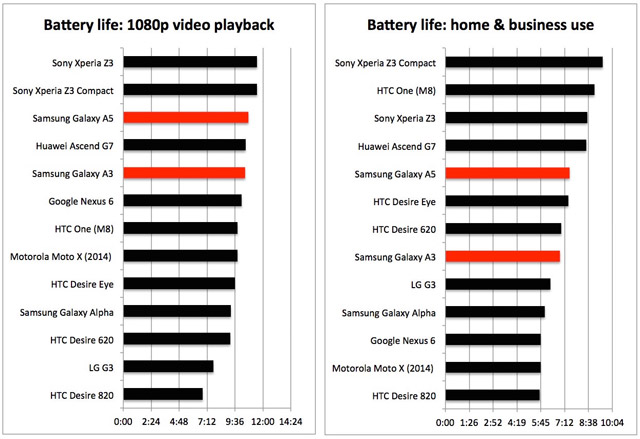
According to the test results, the Galaxy A3 can display nonstop full-HD video for 10 hours and 28 minutes, while the A5 lasts 10 hours and 45 minutes. These are good times, with only Sony’s Z3 phones able to survive considerably longer on a full battery.
When deployed for typical, continuous home and business use, the battery life of the A3 (six hours, 55 minutes) and A5 (seven hours, 30 minutes) is less impressive, but still more than sufficient to last a full day. Again, Sony’s Z3 devices last relatively long on a full charge when used solely for home and business tasks. Since a typical day at home or the office also includes at least one lunch break and some idle time, I expect the A3/A5 to have no problem reaching the end of the day. Don’t expect them to have much of energy left at bedtime, though.
Screen: excellent brightness and contrast
Both devices use a screen technology called PenTile Matrix, which unfortunately has a negative effect on the overall screen quality. If you have a keen eye, you can actually see that text isn’t always displayed as sharp as you might expect. This is especially the case with the Galaxy A3. Most other midrange smartphones in this price range are able to display a slightly sharper overall image than these two Galaxy devices.
Luckily, most other properties that define a screen’s quality are very good. I used a SpectraCal C6 colorimeter to measure the maximum display brightness, contrast levels and colour reproduction. It showed me that the A3’s screen displays a maximum brightness of 480cd/m2, while the A5 kicks it up a notch to 500cd/m2. As a result, you can comfortably use both devices on a sunny day and still easily see their screen content.
Their contrast values are extremely high. As a result, colours look intense, vivid and lively. Colour reproduction, on the other hand, is not exceptionally accurate. This is only an issue if you are really keen on perfectly realistic colours in photos and video fragments.
Camera: best in bright light
Both the Galaxy A3 and A5 feature a 5-megapixel front facing camera. The camera on the back of the A3 uses an 8-megapixel sensor, while the one on the back of the A5 is 13 megapixels.
Both rear cameras are accompanied by LED flash as well as auto-focus functionality. The front (“selfie”) cameras on the A3 and A5 lack a wide-angle lens, as seen on some other modern, midrange smartphones. The 5-megapixel front cameras also don’t perform very well in low-light conditions — just like most other smartphones, by the way. As a result, pictures that are taken indoors show a lot of digital noise.
Although the main cameras on both devices differ in sensor resolution, the picture quality is almost identical when there is ample light. In these instances, the cameras are able to shoot some great, detailed and sharp pictures. The A5, however, deals slightly better with low-light situations, has a marginally wider-angled lens and produces somewhat warmer colours. The A3 loses out mainly in dark environments.
Conclusion
Samsung clearly prioritised the exteriors of the Galaxy A3 and A5 over the phones’ internals. As a result, both devices look and feel more premium than any other smartphone that Samsung has ever launched (bar the upcoming Galaxy S6 models).

On top of that, the A3 and A5 feature screens with high brightness and contrast levels, good camera quality at ample light and more than acceptable battery life.
The biggest downside of the A3 and A5 is their lack of grunt, a painful concession given their luxurious metal bodies. This ultimately makes the Galaxy A3 and A5 good-looking smartphones that are not qualified to deal with anything other than light work. — (c) 2015 NewsCentral Media
- The Samsung Galaxy A3 has a recommended retail price of R4 999, while the A5’s recommended price is R6 499