Close Menu
TechCentralTechCentral

    Subscribe to the newsletter

    Get the best South African technology news and analysis delivered to your e-mail inbox every morning.

    Facebook X (Twitter) YouTube LinkedIn
    WhatsApp Facebook X (Twitter) LinkedIn YouTube
    TechCentralTechCentral
    • News
      Shoprite ranks cybersecurity as its number one risk - Pieter Engelbrecht

      Shoprite ranks cybersecurity as its number one risk

      9 October 2026
      Standard Bank to take up to $200-million stake in OPay - Sim Tshabalala

      Standard Bank to take up to $200-million stake in OPay

      9 October 2026
      Shoprite takes on the banking apps with airtime on Sixty60

      Shoprite takes on the banking apps with airtime on Sixty60

      9 October 2026
      How to tell telemarketers to get lost - officially

      How to tell telemarketers to get lost – officially

      9 October 2026
      Data centres are the new front line in the Russia-Ukraine war

      Data centres are the new front line in the Russia-Ukraine war

      9 October 2026
    • World
      SpaceX takes aim at US wireless carriers with spectrum acquisition

      Starlink is coming for your mobile operator

      9 October 2026
      The AI PC is finally here. It's just very expensive - Jensen Huang, Satya Nadella

      The AI PC is finally here. It’s just very expensive

      8 October 2026
      The memory crunch is making Samsung fabulously rich

      The memory crunch is making Samsung fabulously rich

      8 October 2026
      SpaceX to borrow $40-billion to buy Nvidia chips

      SpaceX to borrow $40-billion to buy Nvidia chips

      7 October 2026
      South Pole neutrino hunter wins Nobel Prize in Physics - Francis Halzen

      South Pole neutrino hunter wins Nobel Prize in Physics

      7 October 2026
    • In-depth

      10 days that changed the course of AI

      21 September 2026
      Meta to the AI industry: slow down without us - Mark Zuckerberg

      Meta to the AI industry: slow down without us

      16 September 2026
      Google DeepMind CEO Demis Hassabis. Image: John Sears

      The plan to stop AI from breaking the world

      16 July 2026
      The internet has a Strait of Hormuz problem

      The internet has a Strait of Hormuz problem

      15 July 2026
      AI boom sparks rally, frenzy and fear

      AI boom sparks rally, frenzy and fear

      11 June 2026
    • TCS
      W&W | LDV's Gerhard Moolman on electric bakkies, fleet orders and 'school fees'

      W&W | LDV’s Gerhard Moolman on electric bakkies and fleets

      9 October 2026
      TCS | Frogfoot sees bigger fibre deals coming - TechCentral Show guests Abraham van der Merwe and Shane Chorley

      TCS | Frogfoot sees bigger fibre deals coming

      8 October 2026
      Meet the CIO | Vodacom's Mohamed Sami on the agentic future

      Meet the CIO | Vodacom’s Mohamed Sami on the agentic future

      5 October 2026
      Lexi Novitske, general partner at Norrsken22, on the TechCentral Show

      TCS | Norrsken22’s Lexi Novitske on how China is winning African tech

      1 October 2026
      TCS | Dominic White and Adam Ely on AI agents going rogue

      TCS | Dominic White and Adam Ely on AI agents going rogue

      29 September 2026
    • Opinion
      When a machine can choose, who does it become? Fanie van Rooyen

      When a machine can choose, who does it become?

      9 October 2026
      Let South Africans jailbreak their way to digital sovereignty - Dirk de Vos

      Let South Africans jailbreak their way to digital sovereignty

      5 October 2026
      South Africa's next energy crisis is in the accounts department - Craig Holmes

      South Africa’s next energy crisis is in the accounts department

      29 September 2026
      The steam engine lesson AI doomsayers keep missing - Sam Clarke

      The steam engine lesson AI doomsayers keep missing

      28 September 2026
      Let South Africans jailbreak their way to digital sovereignty - Dirk de Vos

      Regulating AI: apply the laws we have first

      21 September 2026
    • Company News
      • 1Stream
      • Africa Data Centres
      • AfriGIS
      • Altron Digital Business
      • Altron Document Solutions
      • Altron Group
      • Arctic Wolf
      • Ascent Technology
      • AvertITD
      • BBD
      • Braintree
      • CallMiner
      • CambriLearn
      • CM.com
      • Contactable
      • CYBER1 Solutions
      • Digicloud Africa
      • Digimune
      • Domains.co.za
      • ESET
      • Euphoria Telecom
      • HOSTAFRICA
      • Incredible Business
      • iONLINE
      • IQbusiness
      • Iris Network Systems
      • Kaspersky
      • LSD Open
      • Mitel
      • NEC XON
      • Netstar
      • Network Platforms
      • Next DLP
      • Ovations
      • Paracon
      • Paratus
      • Publishared
      • Q-KON
      • SevenC
      • SkyWire
      • Solid8 Technologies
      • Telit Cinterion
      • Telviva
      • Tenable
      • Vertiv
      • Videri Digital
      • Vodacom Business
      • Vox
      • Wipro
      • Workday
      • XLink
    • Sections
      • AI and machine learning
      • Banking
      • Broadcasting and Media
      • Cloud services
      • Contact centres and CX
      • Cryptocurrencies
      • Education and skills
      • Electronics and hardware
      • Energy and sustainability
      • Enterprise software
      • Financial services
      • HealthTech
      • Information security
      • Internet and connectivity
      • Internet of Things
      • Investment
      • IT services
      • Lifestyle
      • Policy and regulation
      • Public sector
      • Retail and e-commerce
      • Satellite communications
      • Science
      • SMEs and start-ups
      • Social media
      • Talent and leadership
      • Telecoms
      • Watts & Wheels
    • Events
    • Advertise
    TechCentralTechCentral
    Home » In-depth » SA’s LifeQ breathes life into wearables

    SA’s LifeQ breathes life into wearables

    By Sunil Gopal27 March 2015
    Twitter LinkedIn Facebook WhatsApp Email Telegram Copy Link
    Get breaking news on WhatsApp

    LifeQ executive founder Riaan Conradie
    LifeQ executive founder Riaan Conradie

    You could be forgiven for thinking you’ve wandered onto the set of Star Trek when you visit the offices of HealthQ in Stellenbosch, near Cape Town.

    The start-up is working on a digital health technology, LifeQ, which pushes the limits of modern technology through its use of “computational systems biology” and “bio-mathematical modelling” to change the way human body functions are measured.

    To you and me, that means it’s taking wearable technology to the next frontier.

    LifeQ, which has been flying under the radar for the past five years, debuted the first of its products — an optical sensor — at International CES in Las Vegas in January, where it garnered a great deal of attention from the technology world.

    Led by CEO Laurie Olivier, executive founder Riaan Conradie, chief science officer Franco du Preez and vice-president Kora Holm, the start-up is made up of a 60-person strong multi-disciplinary team of engineers, biologists, scientists, industrial designers and commercial managers.

    Conradie completed his PhD in biochemistry with a focus on computational systems biology, which — to put it in simple terms — examines human physiology, using mathematics to describe it.

    LifeQ is backed by five Fortune 500 companies, with Olivier leading the global operations, with offices in Atlanta and a satellite operation on the US west coast.

    It’s already concluded partnership deals with three companies — including First Alert, which developed the first battery-powered smoke detector in the US — and is in talks with more than 100 more firms.

    Conradie says LifeQ anticipated the emergence of wearable fitness devices years ago. But these devices still have big shortcomings, providing only basic information such as calories burnt, he says.

    “The more sophisticated devices measure sleep, but can’t tell you why you’ve had five hours of bad sleep. This does not help to address lifestyle changes,” he explains.

    “Computational systems biology is able to develop personalised mathematical models to give individuals unique insight into their health status. It gets interesting when you start doing predictive stuff, like why your sleep is affected, or which elements are interacting — be it diet, physical activity or other factors.”
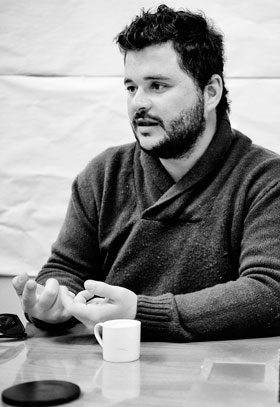
    Riaan Conradie
    Riaan Conradie

    Conradie says the LifeQ team realised early on that they did not want to be in the hardware space as they would find it difficult to compete with established brands. Instead, the company engaged with makers of wearable devices interested in using its technology.

    The company has three product offerings: LifeQ Lens, LifeQ Core and LifeQ Link.

    LifeQ Lens is a multi-wavelength optical sensor that can be integrated into almost any wearable device.

    Conradie says molecules in the blood absorb certain wavelengths. “By shining different wavelengths into the skin, the photosensor is able to measure different wavelengths and determine different statistics, like your heart rate.”

    The company provides this sensor to companies under licence. The Lens is being used to target the fitness market first, it says.

    “We are able accurately to measure heart rate, VO2 max (a measure of the maximum oxygen an athlete can use) and give accurate energy expenditure,” Conradie explains.

    “LifeQ Lens is also able to say whether the [body’s] aerobic or anaerobic system is activated during exercise.”

    LifeQ Core, meanwhile, takes this input to the next level. The data streams from Lens use mathematical modelling to create computer simulations of the wearer’s physiology. This is used to better understand the biochemical reactions occurring in the body and what drives them. Core measures calories worked off and can tell precisely the percentage of carbohydrates, fats and proteins burnt.

    Finally, LifeQ Link is an open-source platform that allows app developers, health insurance companies and others to integrate their devices or apps into the system to give users insight into the functioning of their bodies.

    “Apart from the immediate results available to those using wearable devices, we enable data gathering from all our partners,” says Conradie. This information can be used in a variety of ways to predict health trends.

    Apart from the exercise sector, LifeQ has uses in nutrition, medicine, sleep and stress management, and even population-level data research across large numbers of users.

    “The future of wearables is not wearables per se,” says Conradie. “Rather, it’s what we’re able to do with the information gathered. By using non-invasive devices, we can build on our main vision of giving people a true understanding of their health.”

    Dr McCoy would be impressed.

    • You can read more about LifeQ on the company’s website

    Add TechCentral as a preferred source on GoogleFollow TechCentral on Google NewsGet breaking news on WhatsApp


    First Alert Franco du Preez Kora Holm Laurie Olivier LifeQ LifeQ Core LifeQ Lens LifeQ Link Riaan Conradie
    WhatsApp YouTube
    Share. Facebook Twitter LinkedIn WhatsApp Telegram Email Copy Link
    Previous ArticleNo to encryption, says ex-Icasa chair
    Next Article Expect fireworks as WhatsApp allows calls

    Related Posts

    ESET SA adopts LifeQ’s Covid-19 early warning and disease-tracking solution

    3 September 2020

    Inside 4Di Capital’s new R256m fund

    19 June 2016

    TalkCentral: Ep 148 – ‘Ken sent me’

    17 June 2016
    Company News
    Why fintechs need an insurance partner they can trust - Hollard Insurance

    Why fintechs need an insurance partner they can trust

    8 October 2026
    Reusable KYC means the end of 'please upload your ID' - Contactable

    Reusable KYC means the end of ‘please upload your ID’

    8 October 2026
    Eliminating the 'toggle tax': how CRM integration changes customer experience - Martie de Beer

    Eliminating the ‘toggle tax’: how CRM integration changes customer experience

    8 October 2026
    Opinion
    When a machine can choose, who does it become? Fanie van Rooyen

    When a machine can choose, who does it become?

    9 October 2026
    Let South Africans jailbreak their way to digital sovereignty - Dirk de Vos

    Let South Africans jailbreak their way to digital sovereignty

    5 October 2026
    South Africa's next energy crisis is in the accounts department - Craig Holmes

    South Africa’s next energy crisis is in the accounts department

    29 September 2026

    Subscribe to Updates

    Get the best South African technology news and analysis delivered to your e-mail inbox every morning.

    Latest Posts
    Shoprite ranks cybersecurity as its number one risk - Pieter Engelbrecht

    Shoprite ranks cybersecurity as its number one risk

    9 October 2026
    Standard Bank to take up to $200-million stake in OPay - Sim Tshabalala

    Standard Bank to take up to $200-million stake in OPay

    9 October 2026
    Shoprite takes on the banking apps with airtime on Sixty60

    Shoprite takes on the banking apps with airtime on Sixty60

    9 October 2026
    How to tell telemarketers to get lost - officially

    How to tell telemarketers to get lost – officially

    9 October 2026
    © 2009 - 2026 NewsCentral Media
    Built and maintained by Chronon
    • Cookie policy (ZA)
    • TechCentral – privacy and Popia

    Type above and press Enter to search. Press Esc to cancel.

    Manage consent

    TechCentral uses cookies to enhance its offerings. Consenting to these technologies allows us to serve you better. Not consenting or withdrawing consent may adversely affect certain features and functions of the website.

    Functional Always active
    The technical storage or access is strictly necessary for the legitimate purpose of enabling the use of a specific service explicitly requested by the subscriber or user, or for the sole purpose of carrying out the transmission of a communication over an electronic communications network.
    Preferences
    The technical storage or access is necessary for the legitimate purpose of storing preferences that are not requested by the subscriber or user.
    Statistics
    The technical storage or access that is used exclusively for statistical purposes. The technical storage or access that is used exclusively for anonymous statistical purposes. Without a subpoena, voluntary compliance on the part of your Internet Service Provider, or additional records from a third party, information stored or retrieved for this purpose alone cannot usually be used to identify you.
    Marketing
    The technical storage or access is required to create user profiles to send advertising, or to track the user on a website or across several websites for similar marketing purposes.
    • Manage options
    • Manage services
    • Manage {vendor_count} vendors
    • Read more about these purposes
    View preferences
    • {title}
    • {title}
    • {title}
    🇿🇦 Sign up to the TechCentral newsletter