Close Menu
TechCentralTechCentral

    Subscribe to the newsletter

    Get the best South African technology news and analysis delivered to your e-mail inbox every morning.

    Facebook X (Twitter) YouTube LinkedIn
    WhatsApp Facebook X (Twitter) LinkedIn YouTube
    TechCentralTechCentral
    • News
      Vumatel tops a million subscribers in South African broadband milestone - Dietlof Mare

      Vumatel tops a million subscribers in South African broadband milestone

      9 February 2026

      Washington takes on Beijing in race for Africa’s critical minerals

      9 February 2026
      Vodacom drops R5.6-billion for spectrum in key market

      Vodacom dropping R5.6-billion for spectrum in key market

      9 February 2026
      Nersa blunder triggers sharper electricity tariff increases

      Nersa blunder triggers sharper electricity tariff increases

      9 February 2026
      Eskom unbundling U-turn threatens to undo hard-won electricity gains

      Eskom unbundling U-turn threatens to undo hard-won electricity gains

      9 February 2026
    • World
      Musk hits brakes on Mars mission

      Musk hits brakes on Mars mission

      9 February 2026
      Crypto firm accidentally sends R700-billion in bitcoin to its users

      Crypto firm accidentally sends R700-billion in bitcoin to its users

      8 February 2026
      AI won't replace software, says Nvidia CEO amid market rout - Jensen Huang

      AI won’t replace software, says Nvidia CEO amid market rout

      4 February 2026
      Apple acquires audio AI start-up Q.ai

      Apple acquires audio AI start-up Q.ai

      30 January 2026
      SpaceX IPO may be largest in history

      SpaceX IPO may be largest in history

      28 January 2026
    • In-depth
      How liberalisation is rewiring South Africa's power sector

      How liberalisation is rewiring South Africa’s power sector

      21 January 2026
      The top-performing South African tech shares of 2025

      The top-performing South African tech shares of 2025

      12 January 2026
      Digital authoritarianism grows as African states normalise internet blackouts

      Digital authoritarianism grows as African states normalise internet blackouts

      19 December 2025
      TechCentral's South African Newsmakers of 2025

      TechCentral’s South African Newsmakers of 2025

      18 December 2025
      Black Friday goes digital in South Africa as online spending surges to record high

      Black Friday goes digital in South Africa as online spending surges to record high

      4 December 2025
    • TCS
      TCS+ | How Cloud On Demand is helping SA businesses succeed in the cloud - Xhenia Rhode, Dion Kalicharan

      TCS+ | Cloud On Demand and Consnet: inside a real-world AWS partner success story

      30 January 2026
      Watts & Wheels S1E3: 'BYD's Corolla Cross challenger'

      Watts & Wheels S1E3: ‘BYD’s Corolla Cross challenger’

      30 January 2026
      Watts & Wheels S1E3: 'BYD's Corolla Cross challenger'

      Watts & Wheels S1E2: ‘China attacks, BMW digs in, Toyota’s sublime supercar’

      23 January 2026

      TCS+ | Why cybersecurity is becoming a competitive advantage for SA businesses

      20 January 2026
      Watts & Wheels S1E3: 'BYD's Corolla Cross challenger'

      Watts & Wheels: S1E1 – ‘William, Prince of Wheels’

      8 January 2026
    • Opinion
      South Africa's skills advantage is being overlooked at home - Richard Firth

      South Africa’s skills advantage is being overlooked at home

      29 January 2026
      Why Elon Musk's Starlink is a 'hard no' for me - Songezo Zibi

      Why Elon Musk’s Starlink is a ‘hard no’ for me

      26 January 2026
      South Africa's new fibre broadband battle - Duncan McLeod

      South Africa’s new fibre broadband battle

      20 January 2026
      AI moves from pilots to production in South African companies - Nazia Pillay SAP

      AI moves from pilots to production in South African companies

      20 January 2026
      South Africa's new fibre broadband battle - Duncan McLeod

      ANC’s attack on Solly Malatsi shows how BEE dogma trumps economic reality

      14 December 2025
    • Company Hubs
      • Africa Data Centres
      • AfriGIS
      • Altron Digital Business
      • Altron Document Solutions
      • Altron Group
      • Arctic Wolf
      • AvertITD
      • Braintree
      • CallMiner
      • CambriLearn
      • CYBER1 Solutions
      • Digicloud Africa
      • Digimune
      • Domains.co.za
      • ESET
      • Euphoria Telecom
      • Incredible Business
      • iONLINE
      • IQbusiness
      • Iris Network Systems
      • LSD Open
      • NEC XON
      • Netstar
      • Network Platforms
      • Next DLP
      • Ovations
      • Paracon
      • Paratus
      • Q-KON
      • SevenC
      • SkyWire
      • Solid8 Technologies
      • Telit Cinterion
      • Tenable
      • Vertiv
      • Videri Digital
      • Vodacom Business
      • Wipro
      • Workday
      • XLink
    • Sections
      • AI and machine learning
      • Banking
      • Broadcasting and Media
      • Cloud services
      • Contact centres and CX
      • Cryptocurrencies
      • Education and skills
      • Electronics and hardware
      • Energy and sustainability
      • Enterprise software
      • Financial services
      • Information security
      • Internet and connectivity
      • Internet of Things
      • Investment
      • IT services
      • Lifestyle
      • Motoring
      • Public sector
      • Retail and e-commerce
      • Satellite communications
      • Science
      • SMEs and start-ups
      • Social media
      • Talent and leadership
      • Telecoms
    • Events
    • Advertise
    TechCentralTechCentral
    Home » Gadgets & Reviews » Sub-R1 000 Kobo e-reader reviewed

    Sub-R1 000 Kobo e-reader reviewed

    By Craig Wilson31 October 2012
    Twitter LinkedIn Facebook WhatsApp Email Telegram Copy Link
    News Alerts
    WhatsApp

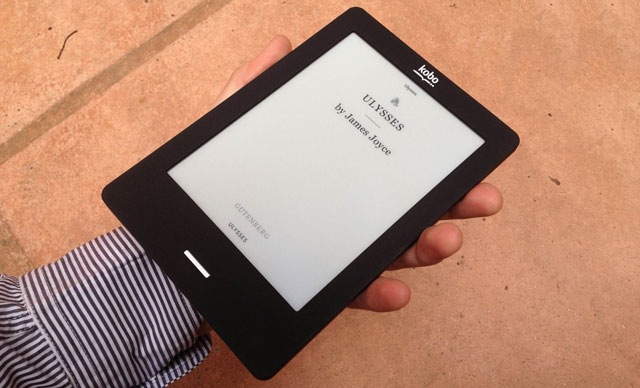
    E-readers have been a bit of niche product in the South African market and, until recently, usually made their way into the country by special order from online retailers or in jet-setting friends’ suitcases. Canada’s Kobo wants to change that, and its first foray into the market, the Kobo Touch, is an excellent contender, although it will have to battle the brand-recognition enjoyed by Amazon’s Kindle.

    The Kobo Touch is the company’s third-generation e-reader and features a 6-inch, 800×600-pixel e-ink display. It weighs 184g, includes 2GB of onboard storage — of which around 1,3GB is available to users — and a microSD card slot for further expansion. As most e-books are under 1MB, the additional storage is more of a luxury than a necessity, with the onboard memory able to carry a thousand books.

    The device is charged using a micro USB cable via a port in the centre of the bottom edge of the Kobo Touch, and battery life is rated for up to a month, depending on use. There’s no 3G version, so connectivity is limited to Wi-Fi, but this isn’t really a problem given that most users will load content at home.

    Controlling the device is incredibly simple. The power switch on the top of the reader is used to turn it on and off and to move it between sleep and active modes. When putting the device in sleep mode, the cover of the book being read is displayed on the sleep screen.

    Aside from the power switch, the only physical button on the Kobo is the home button in the centre of the bezel below the display. The on-screen menus are intuitively laid-out and the touch interface is responsive, more so than that of the Kindle Touch. The use of black-and-white e-ink also means the Kobo offers excellent contrast and reading on the device is a pleasure.

    When reading, tapping or swiping the right-hand third of the screen turns to the next page; likewise, doing the same on the left-hand third turns to the previous page. Tapping the middle third brings up options bars at the top and bottom of the screen, where users can change font styles, size, line-spacing and margins; navigate or search the document; view battery status; or go to the settings menu.

    In most respects, the Kobo Touch is very similar to the entry-level Kindle Touch, from its dimensions and weight through to its interface. One of the exceptions is that Amazon’s offering is available in 3G, and has advertising-supported versions that allow the giant of online retail to drop prices a little.

    Brand name aside, another difference between the Kobo and the Kindle is the range of file formats each supports. The Kindle supports Amazon’s proprietary e-book format, known as AZW, as well as Mobi and PRC files that aren’t protected by digital rights management software. It can also display other document types or images by means of conversion and supports the MP3 audio format.
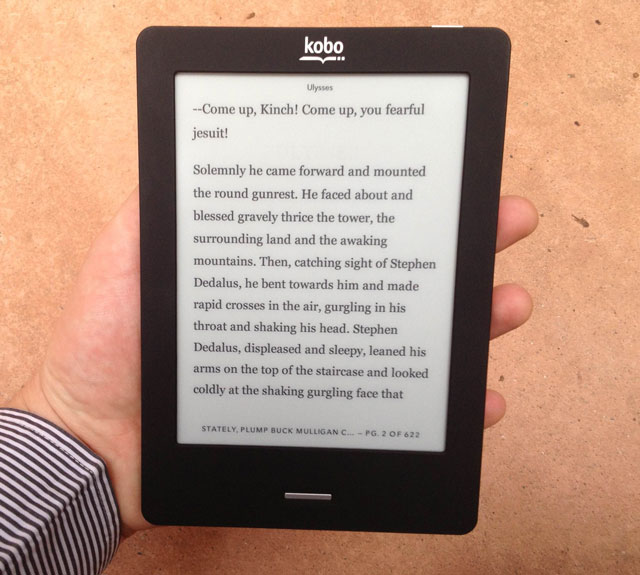
    The Kobo Touch supports a wide range of formats, including the popular open-source ePub standard, along with PDF, Mobi (though only raw markup text), Adobe DRM, RTF, HTML and TXT to image formats like JPG, PNG, Gif, Tiff and BMP. However, Kobo doesn’t offer audio support.

    Unless audio is essential, neither device will disappoint those who are willing to get to grips with the various e-book file types and third-party e-reader software programs such as Calibre or Adobe Digital Editions.

    Books, magazines and other content — whether free or paid for — can be downloaded from the Kobo store using the e-reader, or by means of any of the Kobo applications. Kobo makes apps for PC and Mac as well as for phones and tablets running either Google’s Android operating system or Apple’s iOS.

    Any purchases made from the Kobo store, and any reading done on any device, is synchronised across Kobo devices and apps, as one would expect. Kobo’s desktop software is minimalistic and intuitive to navigate, but when we connected the device to a Mac using the USB cable we weren’t able to see it as an external drive — despite being able to see it through Kobo’s own application — meaning we had to turn to Calibre to get existing ePub files onto the device because Kobo’s app doesn’t support this functionality.

    It’s a minor niggle, but one to be aware of if you have a large library of e-books you’d like to use with the device with a Mac. Thankfully, both Calibre and Adobe Digital Editions are free, intuitive and worth having anyway if you want to be able to use files other than those procured directly from the Kobo store.

    PC users, meanwhile, are able to drag and drop files onto the Kobo Touch from Windows Explorer. According to Kobo’s supplied documentation, the device is meant to offer the same functionality on the Mac, but in our experience it simply doesn’t work. Nevertheless, Calibre offers a simple workaround and ensured our frustration was short lived.

    One factor where Kobo wins over the Kindle is pricing, at least in South Africa. Supermarket chain Pick n Pay has signed a six-month exclusivity period with Kobo, with the retailer offering the e-reader for R995. That’s R200 less than the cost of buying a Kindle Touch straight from Amazon and as much as R1 000 cheaper than buying one from some local retailers.

    However, Amazon has a level of brand recognition that Kobo can only dream of outside of its homeland of Canada — where it outsells Amazon’s offerings. For many, the Kindle brand is synonymous with e-readers, and no doubt many consumers looking to pick up their first device will want to go with the brand they know and trust.

    Perhaps the biggest advantage Kobo has in South Africa is that it’s a relatively untapped market — and it’s a market that loves a bargain. The Kobo Touch offers excellent value for money and, most importantly, a reading experience which — thanks to the contrast of the screen and the speed at which pages refresh – is on a par with the entry-level Kindle. The company’s biggest disadvantage is that it’s the newcomer, and for some people that may still be the deciding factor.  — (c) 2012 NewsCentral Media

    • See also: Kobo to challenge Kindle in SA


    Amazon Amazon.com Kobo Kobo Touch Pick n Pay
    WhatsApp YouTube Follow on Google News Add as preferred source on Google
    Share. Facebook Twitter LinkedIn WhatsApp Telegram Email Copy Link
    Previous ArticleCell C cuts deep on data prices
    Next Article Cellphone jamming illegal – Icasa

    Related Posts

    From stocks to crypto, markets reel as AI doubts grow

    From stocks to crypto, markets reel as AI doubts grow

    6 February 2026
    AI replaces people as Amazon cuts 16 000 corporate jobs

    AI replaces people as Amazon cuts 16 000 corporate jobs

    28 January 2026
    Amazon brings image-based shopping to South Africa - Robert Koen

    Amazon brings image-based shopping to South Africa

    27 January 2026
    Company News
    The new way of working - an Mweb study

    The new way of working – an Mweb study

    9 February 2026
    Beyond the prompt: Why the future of enterprise AI is hybrid and agentic - LSD Open

    Beyond the prompt: Why the future of enterprise AI is hybrid and agentic

    9 February 2026
    The skills gap is a thinking gap: why South African employers can't find problem solvers

    The skills gap is a thinking gap: why SA employers can’t find problem solvers

    6 February 2026
    Opinion
    South Africa's skills advantage is being overlooked at home - Richard Firth

    South Africa’s skills advantage is being overlooked at home

    29 January 2026
    Why Elon Musk's Starlink is a 'hard no' for me - Songezo Zibi

    Why Elon Musk’s Starlink is a ‘hard no’ for me

    26 January 2026
    South Africa's new fibre broadband battle - Duncan McLeod

    South Africa’s new fibre broadband battle

    20 January 2026

    Subscribe to Updates

    Get the best South African technology news and analysis delivered to your e-mail inbox every morning.

    Latest Posts
    The new way of working - an Mweb study

    The new way of working – an Mweb study

    9 February 2026
    Vumatel tops a million subscribers in South African broadband milestone - Dietlof Mare

    Vumatel tops a million subscribers in South African broadband milestone

    9 February 2026

    Washington takes on Beijing in race for Africa’s critical minerals

    9 February 2026
    Beyond the prompt: Why the future of enterprise AI is hybrid and agentic - LSD Open

    Beyond the prompt: Why the future of enterprise AI is hybrid and agentic

    9 February 2026
    © 2009 - 2026 NewsCentral Media
    • Cookie policy (ZA)
    • TechCentral – privacy and Popia

    Type above and press Enter to search. Press Esc to cancel.

    Manage consent

    TechCentral uses cookies to enhance its offerings. Consenting to these technologies allows us to serve you better. Not consenting or withdrawing consent may adversely affect certain features and functions of the website.

    Functional Always active
    The technical storage or access is strictly necessary for the legitimate purpose of enabling the use of a specific service explicitly requested by the subscriber or user, or for the sole purpose of carrying out the transmission of a communication over an electronic communications network.
    Preferences
    The technical storage or access is necessary for the legitimate purpose of storing preferences that are not requested by the subscriber or user.
    Statistics
    The technical storage or access that is used exclusively for statistical purposes. The technical storage or access that is used exclusively for anonymous statistical purposes. Without a subpoena, voluntary compliance on the part of your Internet Service Provider, or additional records from a third party, information stored or retrieved for this purpose alone cannot usually be used to identify you.
    Marketing
    The technical storage or access is required to create user profiles to send advertising, or to track the user on a website or across several websites for similar marketing purposes.
    • Manage options
    • Manage services
    • Manage {vendor_count} vendors
    • Read more about these purposes
    View preferences
    • {title}
    • {title}
    • {title}