Close Menu
TechCentralTechCentral

    Subscribe to the newsletter

    Get the best South African technology news and analysis delivered to your e-mail inbox every morning.

    Facebook X (Twitter) YouTube LinkedIn
    WhatsApp Facebook X (Twitter) LinkedIn YouTube
    TechCentralTechCentral
    • News
      Big Microsoft 365 price increases coming next year

      Big Microsoft price increases coming next year

      5 December 2025
      Vodacom to take control of Safaricom in R36-billion deal - Shameel Joosub

      Vodacom to take control of Safaricom in R36-billion deal

      4 December 2025
      Black Friday goes digital in South Africa as online spending surges to record high

      Black Friday goes digital in South Africa as online spending surges to record high

      4 December 2025
      BYD takes direct aim at Toyota with launch of sub-R500 000 Sealion 5 PHEV

      BYD takes direct aim at Toyota with launch of sub-R500 000 Sealion 5 PHEV

      4 December 2025
      'Get it now': Takealot in new instant deliveries pilot

      ‘Get it now’: Takealot in new instant deliveries pilot

      4 December 2025
    • World
      Amazon and Google launch multi-cloud service for faster connectivity

      Amazon and Google launch multi-cloud service for faster connectivity

      1 December 2025
      Google makes final court plea to stop US breakup

      Google makes final court plea to stop US breakup

      21 November 2025
      Bezos unveils monster rocket: New Glenn 9x4 set to dwarf Saturn V

      Bezos unveils monster rocket: New Glenn 9×4 set to dwarf Saturn V

      21 November 2025
      Tech shares turbocharged by Nvidia's stellar earnings

      Tech shares turbocharged by stellar Nvidia earnings

      20 November 2025
      Config file blamed for Cloudflare meltdown that disrupted the web

      Config file blamed for Cloudflare meltdown that disrupted the web

      19 November 2025
    • In-depth
      Jensen Huang Nvidia

      So, will China really win the AI race?

      14 November 2025
      Valve's Linux console takes aim at Microsoft's gaming empire

      Valve’s Linux console takes aim at Microsoft’s gaming empire

      13 November 2025
      iOCO's extraordinary comeback plan - Rhys Summerton

      iOCO’s extraordinary comeback plan

      28 October 2025
      Why smart glasses keep failing - no, it's not the tech - Mark Zuckerberg

      Why smart glasses keep failing – it’s not the tech

      19 October 2025
      BYD to blanket South Africa with megawatt-scale EV charging network - Stella Li

      BYD to blanket South Africa with megawatt-scale EV charging network

      16 October 2025
    • TCS
      TCS+ | How Cloud on Demand helps partners thrive in the AWS ecosystem - Odwa Ndyaluvane and Xenia Rhode

      TCS+ | How Cloud On Demand helps partners thrive in the AWS ecosystem

      4 December 2025
      TCS | MTN Group CEO Ralph Mupita on competition, AI and the future of mobile

      TCS | Ralph Mupita on competition, AI and the future of mobile

      28 November 2025
      TCS | Dominic Cull on fixing South Africa's ICT policy bottlenecks

      TCS | Dominic Cull on fixing South Africa’s ICT policy bottlenecks

      21 November 2025
      TCS | BMW CEO Peter van Binsbergen on the future of South Africa's automotive industry

      TCS | BMW CEO Peter van Binsbergen on the future of South Africa’s automotive industry

      6 November 2025
      TCS | Why Altron is building an AI factory - Bongani Andy Mabaso

      TCS | Why Altron is building an AI factory in Johannesburg

      28 October 2025
    • Opinion
      Your data, your hardware: the DIY AI revolution is coming - Duncan McLeod

      Your data, your hardware: the DIY AI revolution is coming

      20 November 2025
      Zero Carbon Charge founder Joubert Roux

      The energy revolution South Africa can’t afford to miss

      20 November 2025
      It's time for a new approach to government IT spend in South Africa - Richard Firth

      It’s time for a new approach to government IT spend in South Africa

      19 November 2025
      How South Africa's broken Rica system fuels murder and mayhem - Farhad Khan

      How South Africa’s broken Rica system fuels murder and mayhem

      10 November 2025
      South Africa's AI data centre boom risks overloading a fragile grid - Paul Colmer

      South Africa’s AI data centre boom risks overloading a fragile grid

      30 October 2025
    • Company Hubs
      • Africa Data Centres
      • AfriGIS
      • Altron Digital Business
      • Altron Document Solutions
      • Altron Group
      • Arctic Wolf
      • AvertITD
      • Braintree
      • CallMiner
      • CambriLearn
      • CYBER1 Solutions
      • Digicloud Africa
      • Digimune
      • Domains.co.za
      • ESET
      • Euphoria Telecom
      • Incredible Business
      • iONLINE
      • IQbusiness
      • Iris Network Systems
      • LSD Open
      • NEC XON
      • Netstar
      • Network Platforms
      • Next DLP
      • Ovations
      • Paracon
      • Paratus
      • Q-KON
      • SevenC
      • SkyWire
      • Solid8 Technologies
      • Telit Cinterion
      • Tenable
      • Vertiv
      • Videri Digital
      • Vodacom Business
      • Wipro
      • Workday
      • XLink
    • Sections
      • AI and machine learning
      • Banking
      • Broadcasting and Media
      • Cloud services
      • Contact centres and CX
      • Cryptocurrencies
      • Education and skills
      • Electronics and hardware
      • Energy and sustainability
      • Enterprise software
      • Financial services
      • Information security
      • Internet and connectivity
      • Internet of Things
      • Investment
      • IT services
      • Lifestyle
      • Motoring
      • Public sector
      • Retail and e-commerce
      • Satellite communications
      • Science
      • SMEs and start-ups
      • Social media
      • Talent and leadership
      • Telecoms
    • Events
    • Advertise
    TechCentralTechCentral
    Home » In-depth » The amazing science behind SpaceX’s Falcon 9

    The amazing science behind SpaceX’s Falcon 9

    By The Conversation14 April 2016
    Twitter LinkedIn Facebook WhatsApp Email Telegram Copy Link
    News Alerts
    WhatsApp
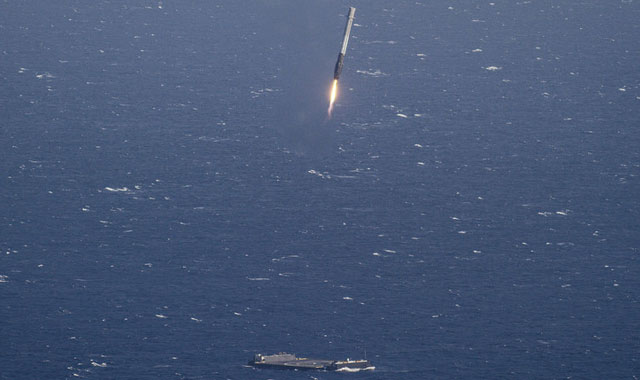
    The SpaceX rocket approaching the landing platform
    The SpaceX rocket approaching the landing platform

    On Friday, 8 April 2016, SpaceX’s Falcon 9 rocket launched a mission to deliver a spacecraft called Dragon with its payload of supplies and experiments into a trajectory towards the International Space Station (ISS). Most remarkably, the first-stage booster then landed on a ship (see video below).

    This is no easy task. Think back to 1969 when the Apollo 11 mission delivered three astronauts to the moon. Neil Armstrong and Buzz Aldrin walked on the moon while Michael Collins piloted the command module in lunar orbit. All three returned safely to Earth.

    The first stage of the huge Saturn V rocket that launched them into space burned for about three minutes and then crashed into the ocean. The second stage burned for a further six minutes, taking the craft into near-Earth orbit. It too was jettisoned and then burned up during its descent to Earth. The third stage burned for nine more minutes to send the astronauts towards the moon — again burning up on re-entry. The Saturn V rocket, at a cost of US$6bn in 1969, was completely lost.

    On the astronauts’ return, only the command module splashed down in the Pacific Ocean. Of the 140t of metal that was launched, only 5t returned to Earth. And at launch, the mission carried a staggering 3 000t of fuel … more on this later.

    Just imagine the cost saving if the Saturn V had been able to return to Earth almost intact — and then land itself to be used on another mission. Well, as the latest SpaceX landing proves — along with the reusable technology being developed by Blue Origin — that dream is becoming reality.

    Of course, there have been reusable spacecraft before. The space shuttle was intended as a reusable spacecraft. The orbiter returned to Earth landing like a conventional aircraft, and the two solid rocket boosters could be recovered from the sea. Only the huge orange external tank would burn up, but getting the spacecraft ready for the next flight was slow and expensive.

    The SpaceX philosophy is that the majority of the rocket can be rapidly recovered, refuelled and re-flown, making for significant cost savings. Fuel is less than half a percent of the cost of the mission, so there is potential to decrease the cost of getting to space dramatically.
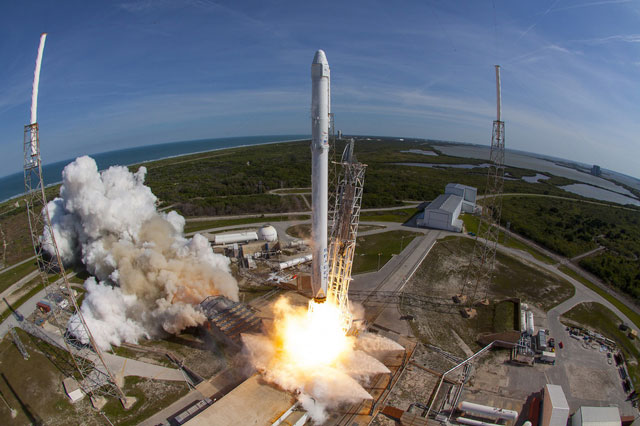
    SpaceX’s Falcon 9 rocket blasts off
    SpaceX’s Falcon 9 rocket blasts off

    The rocket science bit

    But what of the rocket science? Well, the ISS is in “near-Earth orbit”, at an altitude of about 400km. This is less than the distance from London to Paris, albeit straight up. It is orbiting at a speed of about 7,7km/s — it only takes about 90 minutes to go once around the Earth.

    So how much energy does it take to deliver 1kg of payload to the ISS? First, think of kinetic energy (KE) — yes, you learned this at school. At 7,7km/s, the KE per kilogram works out at about 30 megajoules (MJ). But you also need to consider gravitational potential energy (GPE) — yes, you did this at school, too. The force of the Earth’s gravity doesn’t change very much over this short distance upwards given that the Earth’s radius is 6 400km. So it’s easy to work out that the GPE needed to lift 1kg up to 400km is only about 4MJ. This is small compared with the 30MJ of KE required.

    But not only do you need to get your payload to 7,7km/s, you have to carry the fuel in your tanks as well. Thanks to Konstantin Tsiolkovsky’s “ideal rocket equation”, however, we know that liquid fuels, which have a faster gas jet speed, are more efficient than solid fuels. Essentially, by using liquid fuel, each 1kg of payload needs a minimum of 4,5kg of fuel to reach a speed of 7,7km/s, while with solid fuel, you’d need more than 20kg — and this is before taking the rocket mass into account. This is a very good reason why rocketeers, including SpaceX, prefer to use liquid fuels; with a high gas jet speed, the launch mass is much less.

    The secret of SpaceX

    So, how does SpaceX’s rocket work? The Falcon 9 is a two-stage launch vehicle. Each stage uses a liquid fuel with liquid oxygen (very similar to the kerosene and liquid oxygen fuel used in the Saturn V — chemistry hasn’t changed in 50 years). Falcon 9’s first-stage “booster” is by far the largest and most expensive component of the launch mass and it makes sense to try to recover it for re-use — it’s no good to have it splash into the sea because the resulting damage and corrosion would render it useless.

    On 8 April, SpaceX made history by landing the Falcon 9 on an automated barge. See the entire story of its development in this video created by Kinematic:

    And so SpaceX has developed the Falcon 9 booster so that it can land on a ship. The idea is that shortly after main engine cut-off and stage separation, the booster flips over and directs itself towards an unmanned drone ship that is waiting as a landing pad.

    During its descent, the booster reaches speeds of around 1 000m/s (double this after more adventurous geostationary missions) but its fins and engines control the speed and direction of the Falcon, slowing it down as it approaches the Earth. At the last minute, four legs then deploy — and it makes a soft landing at a speed of less than 6m/s. All of this delicate navigation is performed by on-board computers and inertial navigation systems.

    The landing is so fast that no human could react quickly enough to ensure a smooth touchdown.

    To make things trickier, the ship is pitching, rolling and heaving in the sea. It’s hard enough for pilots to land on an aircraft carrier — Falcon is a tall slender column some 20 storeys high. Once the Falcon has landed, the legs lock out rigidly. In one of the earlier Falcon missions, one of the legs failed so even though the landing was a success the Falcon fell over shortly after, resulting in a huge conflagration. But that’s why they use an unmanned drone ship as a landing platform — no one gets hurt. Of course, it’s easier to land on land — and the Falcon does this if the mission flies over land. But the ability to land at sea adds flexibility.

    What next?

    Falcon 9 and Dragon are paving the way for a new generation of low-cost reusable spacecraft — and SpaceX is already developing Dragon to launch and return up to seven astronauts into orbit and beyond. Perhaps next, there’ll be a refuelling base on the moon? Then Mars is an awful lot closer.

    The flexibility offered by reusable vehicles is the stuff of science fiction — the classic movie Star Wars and more recently The Martian and Interstellar are nothing without spaceships that launch at the push of a button. We’re not there yet, but with spacecraft that can hop around like aircraft, then anything is possible.

    The author wrote this piece with the assistance of one of his former Trinity students, Lars Blackmore, who now works for SpaceX as principal rocket landing engineer. Blackmore graduated with his MEng from Cambridge in 2003 and a PhD from MIT in 2007. He is now responsible for landing Falcon 9.The Conversation

    • Hugh Hunt is reader in engineering dynamics and vibration, University of Cambridge
    • This article was originally published on The Conversation


    Elon Musk Falcon 9 Hugh Hunt Lars Blackmore Nasa SpaceX
    Subscribe to TechCentral Subscribe to TechCentral
    Share. Facebook Twitter LinkedIn WhatsApp Telegram Email Copy Link
    Previous ArticleHumanity could reach the stars within a generation
    Next Article Union wants ANN7 bailout

    Related Posts

    Bezos unveils monster rocket: New Glenn 9x4 set to dwarf Saturn V

    Bezos unveils monster rocket: New Glenn 9×4 set to dwarf Saturn V

    21 November 2025
    Starlink risks ceding ground to rivals in South Africa amid licensing battle - Dominic Cull

    Starlink risks ceding ground to rivals in South Africa amid licensing battle

    17 November 2025
    Kuiper no more: Amazon Leo steps up to challenge to Musk's Starlink

    Kuiper no more: Amazon Leo steps up to challenge Musk’s Starlink

    14 November 2025
    Company News
    AI is not a technology problem - iqbusiness

    AI is not a technology problem – iqbusiness

    5 December 2025
    Telcos are sitting on a data gold mine - but few know what do with it - Phillip du Plessis

    Telcos are sitting on a data gold mine – but few know what do with it

    4 December 2025
    Unlock smarter computing with your surface Copilot+ PC

    Unlock smarter computing with your Surface Copilot+ PC

    4 December 2025
    Opinion
    Your data, your hardware: the DIY AI revolution is coming - Duncan McLeod

    Your data, your hardware: the DIY AI revolution is coming

    20 November 2025
    Zero Carbon Charge founder Joubert Roux

    The energy revolution South Africa can’t afford to miss

    20 November 2025
    It's time for a new approach to government IT spend in South Africa - Richard Firth

    It’s time for a new approach to government IT spend in South Africa

    19 November 2025

    Subscribe to Updates

    Get the best South African technology news and analysis delivered to your e-mail inbox every morning.

    Latest Posts
    Big Microsoft 365 price increases coming next year

    Big Microsoft price increases coming next year

    5 December 2025
    AI is not a technology problem - iqbusiness

    AI is not a technology problem – iqbusiness

    5 December 2025
    Vodacom to take control of Safaricom in R36-billion deal - Shameel Joosub

    Vodacom to take control of Safaricom in R36-billion deal

    4 December 2025
    Black Friday goes digital in South Africa as online spending surges to record high

    Black Friday goes digital in South Africa as online spending surges to record high

    4 December 2025
    © 2009 - 2025 NewsCentral Media
    • Cookie policy (ZA)
    • TechCentral – privacy and Popia

    Type above and press Enter to search. Press Esc to cancel.

    Manage consent

    TechCentral uses cookies to enhance its offerings. Consenting to these technologies allows us to serve you better. Not consenting or withdrawing consent may adversely affect certain features and functions of the website.

    Functional Always active
    The technical storage or access is strictly necessary for the legitimate purpose of enabling the use of a specific service explicitly requested by the subscriber or user, or for the sole purpose of carrying out the transmission of a communication over an electronic communications network.
    Preferences
    The technical storage or access is necessary for the legitimate purpose of storing preferences that are not requested by the subscriber or user.
    Statistics
    The technical storage or access that is used exclusively for statistical purposes. The technical storage or access that is used exclusively for anonymous statistical purposes. Without a subpoena, voluntary compliance on the part of your Internet Service Provider, or additional records from a third party, information stored or retrieved for this purpose alone cannot usually be used to identify you.
    Marketing
    The technical storage or access is required to create user profiles to send advertising, or to track the user on a website or across several websites for similar marketing purposes.
    • Manage options
    • Manage services
    • Manage {vendor_count} vendors
    • Read more about these purposes
    View preferences
    • {title}
    • {title}
    • {title}