
Close Menu
TechCentralTechCentral

    Subscribe to the newsletter

    Get the best South African technology news and analysis delivered to your e-mail inbox every morning.

    Facebook X (Twitter) YouTube LinkedIn
    WhatsApp Facebook X (Twitter) LinkedIn YouTube
    TechCentralTechCentral
    • News
      Icasa caught in the political crossfire over Starlink - Elon Musk

      Icasa caught in the political crossfire over Starlink

      24 April 2026
      Malatsi runs out of patience with Icasa on BEE reform - Solly Malatsi

      Malatsi runs out of patience with Icasa on BEE reform

      24 April 2026
      DeepSeek's long-awaited V4 model enters preview

      DeepSeek’s long-awaited V4 model enters preview

      24 April 2026
      South Africa planning big overhaul of public sector IT - State IT Agency Sita

      South Africa planning big overhaul of public sector IT

      23 April 2026
      Usaasa's 30-year run nears its end - Communications minister Solly Malatsi. Image c/o DCDT

      Usaasa’s 30-year run nears its end

      23 April 2026
    • World
      More organic compounds detected on Mars - Nasa Curiosity rover

      More organic compounds detected on Mars

      21 April 2026
      Adobe bets on AI agents to fend off cheaper rivals

      Adobe bets on AI agents to fend off cheaper rivals

      16 April 2026
      Google poised to lose ad crown to Meta

      Google poised to lose ad crown to Meta

      14 April 2026
      Grand Theft Data - hackers hit Rockstar Games - Grand Theft Auto

      Grand Theft Data – hackers hit Rockstar Games

      14 April 2026
      UK PM Keir Starmer declares war on doomscrolling

      UK PM Keir Starmer declares war on doomscrolling

      13 April 2026
    • In-depth
      Africa switches on as Europe dims the lights

      Africa switches on as Europe dims the lights

      9 April 2026
      The biggest untapped EV market on Earth is hiding in plain sight

      The biggest untapped EV market on Earth is hiding in plain sight

      1 April 2026
      The R18-billion tech giant hiding in plain sight - Jens Montanana

      The R16-billion tech giant hiding in plain sight

      26 March 2026
      The last generation of coders

      The last generation of coders

      18 February 2026
      Sentech is in dire straits

      Sentech is in dire straits

      10 February 2026
    • TCS

      TCS+ | ‘The ISP for ISPs’: Vox’s shift to wholesale aggregator

      20 April 2026
      TCS | Werner Lindemann on how AI is rewriting the infosec rulebook

      TCS | Werner Lindemann on how AI is rewriting the infosec rulebook

      15 April 2026
      TCS | Donovan Marsh on AI and the future of filmmaking

      TCS | Donovan Marsh on AI and the future of filmmaking

      7 April 2026
      TCS+ | Vodacom Business moves to crack the SME tech gap - Andrew Fulton, Sannesh Beharie

      TCS+ | Vodacom Business moves to crack the SME tech gap

      7 April 2026
      TCS | MTN's Divysh Joshi on the strategy behind Pi - Divyesh Joshi

      TCS | MTN’s Divyesh Joshi on the strategy behind Pi

      1 April 2026
    • Opinion
      The conflict of interest at the heart of PayShap's slow adoption - Cheslyn Jacobs

      The conflict of interest at the heart of PayShap’s slow adoption

      26 March 2026
      South Africa's energy future hinges on getting wheeling right - Aishah Gire

      South Africa’s energy future hinges on getting wheeling right

      10 March 2026
      Hold the doom: the case for a South African comeback - Duncan McLeod

      Apple just dropped a bomb on the Windows world

      5 March 2026
      R230-million in the bag for Endeavor's third Harvest Fund - Alison Collier

      VC’s centre of gravity is shifting – and South Africa is in the frame

      3 March 2026
      Hold the doom: the case for a South African comeback - Duncan McLeod

      Hold the doom: the case for a South African comeback

      26 February 2026
    • Company Hubs
      • 1Stream
      • Africa Data Centres
      • AfriGIS
      • Altron Digital Business
      • Altron Document Solutions
      • Altron Group
      • Arctic Wolf
      • Ascent Technology
      • AvertITD
      • BBD
      • Braintree
      • CallMiner
      • CambriLearn
      • CYBER1 Solutions
      • Digicloud Africa
      • Digimune
      • Domains.co.za
      • ESET
      • Euphoria Telecom
      • HOSTAFRICA
      • Incredible Business
      • iONLINE
      • IQbusiness
      • Iris Network Systems
      • Kaspersky
      • LSD Open
      • Mitel
      • NEC XON
      • Netstar
      • Network Platforms
      • Next DLP
      • Ovations
      • Paracon
      • Paratus
      • Q-KON
      • SevenC
      • SkyWire
      • Solid8 Technologies
      • Telit Cinterion
      • Telviva
      • Tenable
      • Vertiv
      • Videri Digital
      • Vodacom Business
      • Wipro
      • Workday
      • XLink
    • Sections
      • AI and machine learning
      • Banking
      • Broadcasting and Media
      • Cloud services
      • Contact centres and CX
      • Cryptocurrencies
      • Education and skills
      • Electronics and hardware
      • Energy and sustainability
      • Enterprise software
      • Financial services
      • HealthTech
      • Information security
      • Internet and connectivity
      • Internet of Things
      • Investment
      • IT services
      • Lifestyle
      • Motoring
      • Policy and regulation
      • Public sector
      • Retail and e-commerce
      • Satellite communications
      • Science
      • SMEs and start-ups
      • Social media
      • Talent and leadership
      • Telecoms
    • Events
    • Advertise
    TechCentralTechCentral
    Home » Sections » Internet and connectivity » The internet’s weakest link is under the ocean

    The internet’s weakest link is under the ocean

    The good news is that attacking and disrupting the network is not as easy as some reports might make it appear.
    By John Aitken17 July 2025
    Twitter LinkedIn Facebook WhatsApp Email Telegram Copy Link
    News Alerts
    WhatsApp

    The internet's weakest link is under the oceanCountries have come to rely on a network of cables and pipes under the sea for their energy and communications. So, it has been worrying to read headlines about communications cables being cut and, in one case, an undersea gas pipeline being blown up.

    Critical undersea infrastructure (CUI) as these connections are known, supports about US$9-trillion worth of trade per day. A coordinated attack on this network could undoubtedly have devastating consequences.

    But, as a former submarine commander who researches maritime security, I believe that attacking and disrupting the network is not as easy as some reports might make it appear. Deliberately snagging a pipeline with a dragging anchor in relatively shallow waters can cause a lot of damage, but it is a fairly indiscriminate trick with a shelf life, since the damage can be repaired, and deniability becomes increasingly difficult.

    A hostile state wishing to attack this network first needs to locate the cables they wish to target

    Targeting the cable networks in deeper waters require more sophisticated methods, which are much more challenging to carry out.

    A hostile state wishing to attack this network first needs to locate the cables they wish to target. Most of the newer commercial cables are very clearly charted, but their positions are not exact.

    Cables and pipelines, even the heaviest ones, will drift somewhat as they are laid, and the deeper the water they sit in, the greater the distance they may drift.

    Those newer cables are often buried in a shallow trench to protect them, which makes locating and accessing them more challenging. Older cables were laid in slightly less exact navigational times, some before the GPS network was available for civilian use. They are not in pristine or predictable patterns.

    Reconnaissance

    The positions of cables used by the military are generally not advertised at all, for reasons of security. Locating the target cable requires a detailed understanding of the topography and features of the seabed. That sort of picture can only be built up by survey and reconnaissance.

    Accurately surveying the seabed takes time and significant effort. And to get certainty of the picture, the survey or reconnaissance operation needs to be conducted in overlapping rows. This is painstaking work which is conditional upon the state of the sea.

    Identifying a cable against the seabed or in the trench in which it lies requires a sonar resolution of something in the order of one or two metres, requiring specialist equipment.

    Read: IDC to back major South African subsea cable project

    In 2024, several submarine telecommunications cables were disrupted in the Baltic Sea. Although there had been suspicions about ships dragging their anchors to damage the cables, authorities were not able to confirm this. The damage has not been conclusively attributed to a third party.

    There have been fears about “hybrid warfare”: deniable actions taken another nation that are enough to cause disruption, but are not enough to be an attributable act of war.
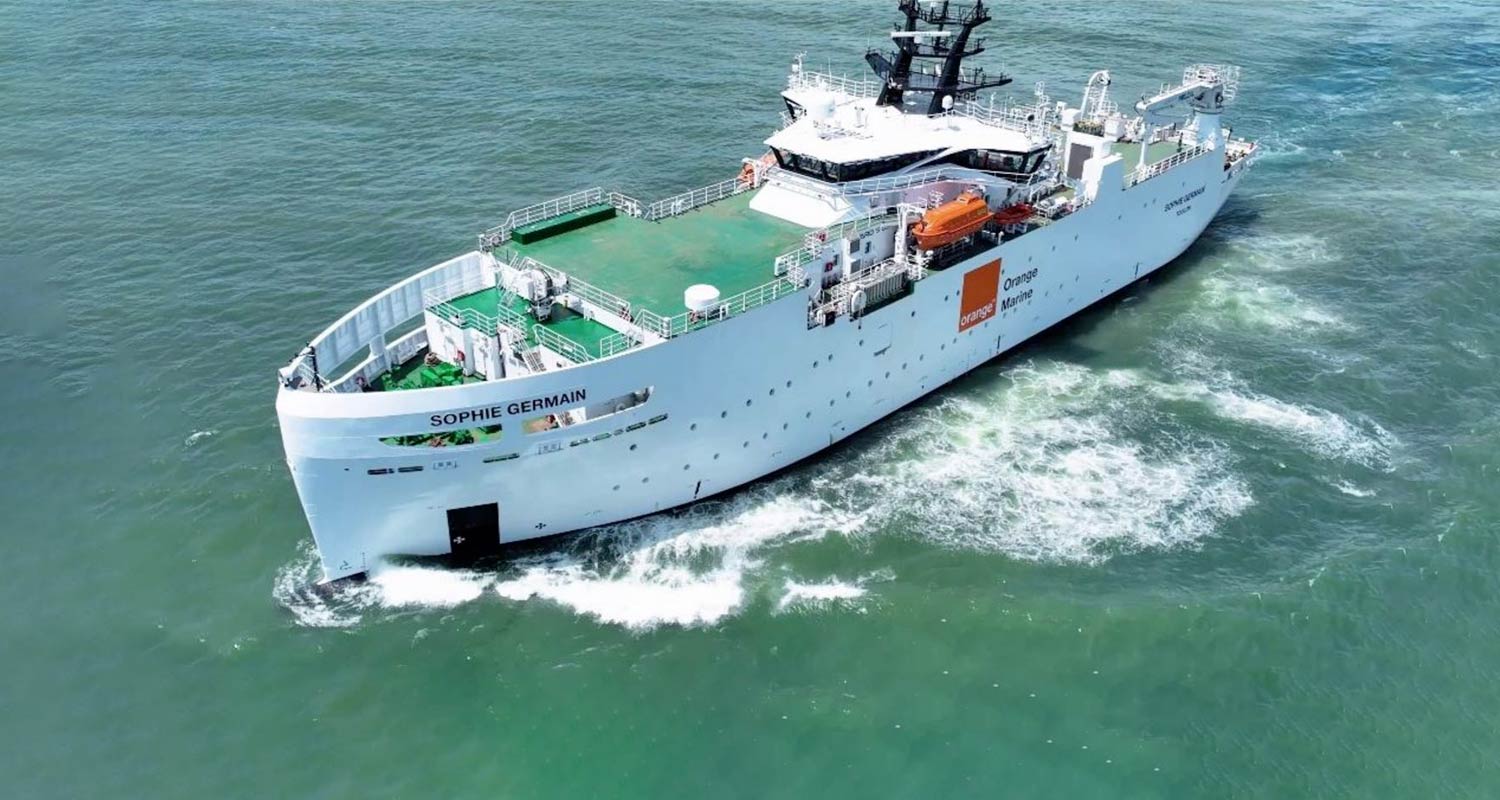
    Ships like Orange Marine's Sophie Germaine are sent out to repair cable breaks when they occur
    Ships like Orange Marine’s Sophie Germaine are sent out to repair cable breaks when they occur

    In 2017, the UK chief of the defence staff said that Russia posed a threat to undersea cables. Russia has spent considerable money, time and effort in developing the platforms and capabilities that could target undersea infrastructure, if the country so wished.

    An organisation called the Main Directorate of Deep-Sea Research (GUGI) operates deep-diving nuclear submarines, as well as a survey ship that is equipped with a deep diving submersible capable of operating at 6 000m.

    The Russian navy also operates survey vessels such as the Akademik Vladimirsky. The precise sensors that the ship is equipped with are unknown – but in a 2012 research expedition to the South Pole it deployed a proton magnetometer, which can be used to discover metallic objects on the seabed such as pipelines.

    The most acute threat is in the littoral, where cables make landfall, and in the shallows around those landing places

    However, there is no suggestion that these survey vessels have been involved in disrupting undersea infrastructure. Nevertheless, operations by such vessels do not go unobserved by the West. Indicators and warnings of their deployments can be gained from imagery, and Western submarines are capable of tracking and observing their patrols.

    The threat posed to Europe’s critical undersea infrastructure is real, and the consequences of a successful attack could be catastrophic. But this is a difficult business in a very challenging environment.

    The most acute threat is in the littoral (shore zone), where cables make landfall, and in the shallows around those landing places. Protecting these chokepoints should be a top priority.

    Read: Nigeria leads global summit to protect submarine cables from sabotage

    That, in turn, requires adequate numbers of attack submarines capable of monitoring and, if necessary, deterring or disrupting hostile activity. Vigilance, investment and realism – not alarmism – will be the foundation of a credible undersea defence.The Conversation

    Get breaking news from TechCentral on WhatsApp. Sign up here.

    • The author, John Aitken, is associate, Rand Europe
    • This article is republished from The Conversation under a Creative Commons licence. Read the original article

    Don’t miss:

    Meta to build world’s longest subsea broadband cable – and South Africa is included

    Follow TechCentral on Google News Add TechCentral as your preferred source on Google


    John Aitken
    WhatsApp YouTube
    Share. Facebook Twitter LinkedIn WhatsApp Telegram Email Copy Link
    Previous ArticleAI misuse shakes South African courtrooms
    Next Article MultiChoice: We can’t afford to compete without help
    Company News
    Cybersecurity in the age of AI: why speed and trust now define resilience - iqbusiness

    Cybersecurity in the AI age: speed and trust define resilience

    24 April 2026
    Security by design is the channel's strongest pitch - Othelo Vieira

    Security by design is the channel’s strongest pitch

    23 April 2026
    Your brand is invisible to the AI that's choosing your competitor - Michelle Losco

    Your brand is invisible to the AI that’s choosing your competitor

    23 April 2026
    Opinion
    The conflict of interest at the heart of PayShap's slow adoption - Cheslyn Jacobs

    The conflict of interest at the heart of PayShap’s slow adoption

    26 March 2026
    South Africa's energy future hinges on getting wheeling right - Aishah Gire

    South Africa’s energy future hinges on getting wheeling right

    10 March 2026
    Hold the doom: the case for a South African comeback - Duncan McLeod

    Apple just dropped a bomb on the Windows world

    5 March 2026

    Subscribe to Updates

    Get the best South African technology news and analysis delivered to your e-mail inbox every morning.

    Latest Posts
    Icasa caught in the political crossfire over Starlink - Elon Musk

    Icasa caught in the political crossfire over Starlink

    24 April 2026
    Cybersecurity in the age of AI: why speed and trust now define resilience - iqbusiness

    Cybersecurity in the AI age: speed and trust define resilience

    24 April 2026
    Malatsi runs out of patience with Icasa on BEE reform - Solly Malatsi

    Malatsi runs out of patience with Icasa on BEE reform

    24 April 2026
    DeepSeek's long-awaited V4 model enters preview

    DeepSeek’s long-awaited V4 model enters preview

    24 April 2026
    © 2009 - 2026 NewsCentral Media
    • Cookie policy (ZA)
    • TechCentral – privacy and Popia

    Type above and press Enter to search. Press Esc to cancel.

    Manage consent

    TechCentral uses cookies to enhance its offerings. Consenting to these technologies allows us to serve you better. Not consenting or withdrawing consent may adversely affect certain features and functions of the website.

    Functional Always active
    The technical storage or access is strictly necessary for the legitimate purpose of enabling the use of a specific service explicitly requested by the subscriber or user, or for the sole purpose of carrying out the transmission of a communication over an electronic communications network.
    Preferences
    The technical storage or access is necessary for the legitimate purpose of storing preferences that are not requested by the subscriber or user.
    Statistics
    The technical storage or access that is used exclusively for statistical purposes. The technical storage or access that is used exclusively for anonymous statistical purposes. Without a subpoena, voluntary compliance on the part of your Internet Service Provider, or additional records from a third party, information stored or retrieved for this purpose alone cannot usually be used to identify you.
    Marketing
    The technical storage or access is required to create user profiles to send advertising, or to track the user on a website or across several websites for similar marketing purposes.
    • Manage options
    • Manage services
    • Manage {vendor_count} vendors
    • Read more about these purposes
    View preferences
    • {title}
    • {title}
    • {title}

