Close Menu
TechCentralTechCentral

    Subscribe to the newsletter

    Get the best South African technology news and analysis delivered to your e-mail inbox every morning.

    Facebook X (Twitter) YouTube LinkedIn
    WhatsApp Facebook X (Twitter) LinkedIn YouTube
    TechCentralTechCentral
    • News

      Apple tops global smartphone rankings in 2025

      12 January 2026
      Eskom says SA power system strongest in five years

      Eskom says SA power system strongest in five years

      12 January 2026
      China is closing in on US tech lead despite constraints

      China is closing in on US tech lead despite constraints

      11 January 2026
      Silicon batteries are about to upend smartphone battery life

      Silicon batteries are about to upend smartphone battery life

      9 January 2026
      AI hardware booms at CES, but consumer adoption is uncertain

      AI hardware booms at CES, but consumer adoption is uncertain

      9 January 2026
    • World
      India seeks unprecedented access to smartphone software - Narendra Modi

      India seeks unprecedented access to smartphone software

      12 January 2026
      Samsung forecasts record operating profit as AI demand sends memory chip prices sharply higher worldwide - TM Roh

      Samsung cashes in on AI data centre boom as memory prices soar

      8 January 2026
      EU pressure mounts on Musk's X over AI 'undressing' images - Wolfram Weimer

      EU pressure mounts on Musk’s X over AI ‘undressing’ images

      7 January 2026
      Intel launches Panther Lake, its next-gen PC chip

      Intel launches Panther Lake, its next-gen PC chip

      6 January 2026
      Starlink plans to lower satellite orbit to enhance safety

      Starlink plans to lower satellite orbit to enhance safety

      4 January 2026
    • In-depth
      Digital authoritarianism grows as African states normalise internet blackouts

      Digital authoritarianism grows as African states normalise internet blackouts

      19 December 2025
      TechCentral's South African Newsmakers of 2025

      TechCentral’s South African Newsmakers of 2025

      18 December 2025
      Black Friday goes digital in South Africa as online spending surges to record high

      Black Friday goes digital in South Africa as online spending surges to record high

      4 December 2025
      DStv dodges channel blackout in last-minute deal with Warner Bros

      Canal+ plays hardball – and DStv viewers feel the pain

      3 December 2025
      Jensen Huang Nvidia

      So, will China really win the AI race?

      14 November 2025
    • TCS
      TCS+ | Africa's digital transformation - unlocking AI through cloud and culture - Cliff de Wit Accelera Digital Group

      TCS+ | Cloud without culture won’t deliver AI: Accelera’s Cliff de Wit

      12 December 2025
      TCS+ | How Cloud on Demand helps partners thrive in the AWS ecosystem - Odwa Ndyaluvane and Xenia Rhode

      TCS+ | How Cloud On Demand helps partners thrive in the AWS ecosystem

      4 December 2025
      TCS | MTN Group CEO Ralph Mupita on competition, AI and the future of mobile

      TCS | Ralph Mupita on competition, AI and the future of mobile

      28 November 2025
      TCS | Dominic Cull on fixing South Africa's ICT policy bottlenecks

      TCS | Dominic Cull on fixing South Africa’s ICT policy bottlenecks

      21 November 2025
      TCS | BMW CEO Peter van Binsbergen on the future of South Africa's automotive industry

      TCS | BMW CEO Peter van Binsbergen on the future of South Africa’s automotive industry

      6 November 2025
    • Opinion
      ANC's attack on Solly Malatsi shows how BEE dogma trumps economic reality - Duncan McLeod

      ANC’s attack on Solly Malatsi shows how BEE dogma trumps economic reality

      14 December 2025
      Netflix, Warner Bros deal raises fresh headaches for MultiChoice - Duncan McLeod

      Netflix, Warner Bros deal raises fresh headaches for MultiChoice

      5 December 2025
      BIN scans, DDoS and the next cybercrime wave hitting South Africa's banks - Entersekt Gerhard Oosthuizen

      BIN scans, DDoS and the next cybercrime wave hitting South Africa’s banks

      3 December 2025
      ANC's attack on Solly Malatsi shows how BEE dogma trumps economic reality - Duncan McLeod

      Your data, your hardware: the DIY AI revolution is coming

      20 November 2025
      Zero Carbon Charge founder Joubert Roux

      The energy revolution South Africa can’t afford to miss

      20 November 2025
    • Company Hubs
      • Africa Data Centres
      • AfriGIS
      • Altron Digital Business
      • Altron Document Solutions
      • Altron Group
      • Arctic Wolf
      • AvertITD
      • Braintree
      • CallMiner
      • CambriLearn
      • CYBER1 Solutions
      • Digicloud Africa
      • Digimune
      • Domains.co.za
      • ESET
      • Euphoria Telecom
      • Incredible Business
      • iONLINE
      • IQbusiness
      • Iris Network Systems
      • LSD Open
      • NEC XON
      • Netstar
      • Network Platforms
      • Next DLP
      • Ovations
      • Paracon
      • Paratus
      • Q-KON
      • SevenC
      • SkyWire
      • Solid8 Technologies
      • Telit Cinterion
      • Tenable
      • Vertiv
      • Videri Digital
      • Vodacom Business
      • Wipro
      • Workday
      • XLink
    • Sections
      • AI and machine learning
      • Banking
      • Broadcasting and Media
      • Cloud services
      • Contact centres and CX
      • Cryptocurrencies
      • Education and skills
      • Electronics and hardware
      • Energy and sustainability
      • Enterprise software
      • Financial services
      • Information security
      • Internet and connectivity
      • Internet of Things
      • Investment
      • IT services
      • Lifestyle
      • Motoring
      • Public sector
      • Retail and e-commerce
      • Satellite communications
      • Science
      • SMEs and start-ups
      • Social media
      • Talent and leadership
      • Telecoms
    • Events
    • Advertise
    TechCentralTechCentral
    Home » In-depth » The science behind the SKA project

    The science behind the SKA project

    By The Conversation8 May 2015
    Twitter LinkedIn Facebook WhatsApp Email Telegram Copy Link
    News Alerts
    WhatsApp
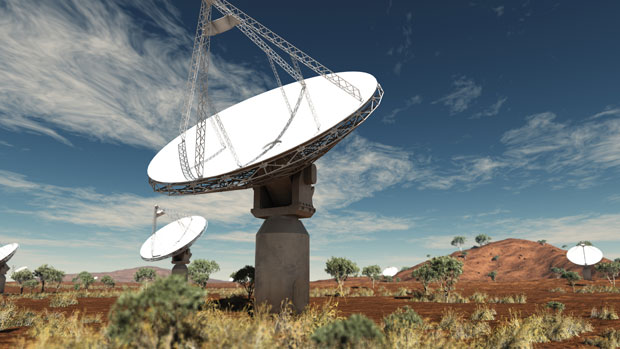
    Artist's impression of SKA dishes (image: SKA Organisation/Swinburne Astronomy Productions)
    Artist’s impression of SKA dishes (image: SKA Organisation/Swinburne Astronomy Productions)

    By now, most people with even a passing interest in science will have heard about the Square Kilometre Array (SKA). It is the world’s largest radio telescope, and will operate over sites in South Africa and Western Australia.

    But exactly what will this telescope do? And what are the scientific questions that it one day may be able to answer?

    The SKA will be 50 times more sensitive and 10 000 faster than the best radio telescopes we have today. It will have the capacity to produce images with resolution quality 50 times higher than the Hubble Space Telescope.

    The SKA’s greater sensitivity will expand the range of the observable universe and has the potential to answer profound questions in astrophysics, cosmology and fundamental physics.

    Modern radio telescopes are collections of antennae that are scattered over a large area. Using a technique called interferometry, they behave as a single dish, with a total collecting area of all the antennas combined — up to one square kilometre for the SKA.

    With this and other modern instruments, teams of astronomers will readily be able to see the universe in ever greater detail at all wavelengths of light.

    The SKA will detect hydrogen, the most abundant element in the universe. Neutral hydrogen is the basic building block for stars — stars form when hydrogen clouds collapse under their own gravity. Once galaxies form not all the hydrogen is in stars, and it is this remaining hydrogen that we see with radio telescopes.

    Five key questions SKA will address
    1. Through SKA, we will be able to go back to when the first stars and black holes formed an era known as the “Dark Ages”. It will provide a time lapse of the universe allowing astronomers to learn about the mechanisms by which the first structures were created.

    2. The SKA will also directly probe Einstein’s theory of general relativity using highly magnetised and rapidly spinning neutron stars known as pulsars. These pulsars are cosmic lighthouses, emitting a pulse of radiation at very precise intervals.

    Due to the exact timing of the pulses, they can be used as cosmic clocks. By locating pulsars that are orbiting black holes and timing them, we can study general relativity in extreme gravity conditions as well as testing the predictions that general relativity makes about the black hole itself.

    General relativity also predicts the existence of gravitational waves — literally waves in the space-time continuum. By monitoring an array of these clocks with the SKA, we can try to detect disturbances caused by a passing gravitational wave which would have a known signature.

    3. By mapping the hydrogen in a billion galaxies, the SKA will reveal the large-scale structure of the universe. This will allow us to study how galaxies form and evolve. Mapping the distribution of hydrogen across the cosmos will also shed light on the mystery of why the expansion of the universe is accelerating.

    Scientists detected this accelerated expansion in 1998 — a feat that won them the Nobel Prize in Physics in 2011 — and its cause is attributed to a mysterious and unknown “dark energy”.

    Understanding this dark energy is one of the SKA’s key science goals.

    4. Another important area is the study of dark matter. Astronomers have been aware of dark matter for some time, and believe that it makes up most of the matter density in the universe, yet its direct detection remains elusive. The SKA will provide ways to map the dark matter distribution across the universe as well as provide ways to probe it a fundamental physics level.

    5. We know that magnetic fields are ubiquitous in our universe and are present in planets, stars and galaxies not least our own earth and sun. Yet very little is known about their origin.

    The challenge in studying these magnetic fields is that while stars and galaxies can be seen because they emit light, magnetic fields can only be seen through their polarising effect on light.

    The SKA’s unique capabilities to detect polarised light will transform the study of magnetic fields and address topics such as the shape and strength of magnetic field in the Milky Way and how it compares to other galaxies.

    Is there anything out there?
    Perhaps the most important question the SKA will address is simply this: “Are we alone in the universe?” It will be able to probe the regions around stars where Earth-like planets are most likely to form and where the environments could potentially sustain life.

    Astrobiologists will be able to use the SKA to look for the building blocks of life — amino acids. We will be able to search much larger regions than ever before for signs of extraterrestrial life.

    The SKA’s extreme sensitivity makes it able to detect airport-strength radar signals on planets many tens of light years away. This means we could directly detect extraterrestrial signals, and perhaps one day listen to alien FM.The Conversation

    • Prina Patel is SKA postdoc in observational cosmology at the University of the Western Cape
    • This article was originally published on The Conversation

    Prina Patel SKA Square Kilometre Array
    Subscribe to TechCentral Subscribe to TechCentral
    Share. Facebook Twitter LinkedIn WhatsApp Telegram Email Copy Link
    Previous ArticleSA needs a better message: Koos Bekker
    Next Article Telecel Zim to continue operations

    Related Posts

    South Africa's giant SKA telescope clears major technical hurdle

    South Africa’s giant SKA telescope clears major technical hurdle

    8 January 2026
    SA scientists want Musk’s Starlink out of their space

    SA scientists want Musk’s Starlink out of their space

    2 June 2025
    Astronomy Olympics is being hosted in Africa for the first time

    Astronomy Olympics is being hosted in Africa for the first time

    7 August 2024
    Company News
    Owning the right data is the new competitive moat in AI - CallMiner

    Owning the right data is the new competitive moat in AI

    9 January 2026
    Why trust is the real currency in modern media

    Why trust is the real currency in modern media

    6 January 2026
    Why banks and insurers need a single decisioning brain as pressures collide - SAS

    Why banks and insurers need a single decisioning brain as pressures collide

    29 December 2025
    Opinion
    ANC's attack on Solly Malatsi shows how BEE dogma trumps economic reality - Duncan McLeod

    ANC’s attack on Solly Malatsi shows how BEE dogma trumps economic reality

    14 December 2025
    Netflix, Warner Bros deal raises fresh headaches for MultiChoice - Duncan McLeod

    Netflix, Warner Bros deal raises fresh headaches for MultiChoice

    5 December 2025
    BIN scans, DDoS and the next cybercrime wave hitting South Africa's banks - Entersekt Gerhard Oosthuizen

    BIN scans, DDoS and the next cybercrime wave hitting South Africa’s banks

    3 December 2025

    Subscribe to Updates

    Get the best South African technology news and analysis delivered to your e-mail inbox every morning.

    Latest Posts

    Apple tops global smartphone rankings in 2025

    12 January 2026
    India seeks unprecedented access to smartphone software - Narendra Modi

    India seeks unprecedented access to smartphone software

    12 January 2026
    Eskom says SA power system strongest in five years

    Eskom says SA power system strongest in five years

    12 January 2026
    China is closing in on US tech lead despite constraints

    China is closing in on US tech lead despite constraints

    11 January 2026
    © 2009 - 2026 NewsCentral Media
    • Cookie policy (ZA)
    • TechCentral – privacy and Popia

    Type above and press Enter to search. Press Esc to cancel.

    Manage consent

    TechCentral uses cookies to enhance its offerings. Consenting to these technologies allows us to serve you better. Not consenting or withdrawing consent may adversely affect certain features and functions of the website.

    Functional Always active
    The technical storage or access is strictly necessary for the legitimate purpose of enabling the use of a specific service explicitly requested by the subscriber or user, or for the sole purpose of carrying out the transmission of a communication over an electronic communications network.
    Preferences
    The technical storage or access is necessary for the legitimate purpose of storing preferences that are not requested by the subscriber or user.
    Statistics
    The technical storage or access that is used exclusively for statistical purposes. The technical storage or access that is used exclusively for anonymous statistical purposes. Without a subpoena, voluntary compliance on the part of your Internet Service Provider, or additional records from a third party, information stored or retrieved for this purpose alone cannot usually be used to identify you.
    Marketing
    The technical storage or access is required to create user profiles to send advertising, or to track the user on a website or across several websites for similar marketing purposes.
    • Manage options
    • Manage services
    • Manage {vendor_count} vendors
    • Read more about these purposes
    View preferences
    • {title}
    • {title}
    • {title}