Close Menu
TechCentralTechCentral

    Subscribe to the newsletter

    Get the best South African technology news and analysis delivered to your e-mail inbox every morning.

    Facebook X (Twitter) YouTube LinkedIn
    WhatsApp Facebook X (Twitter) LinkedIn YouTube
    TechCentralTechCentral
    • News
      South Africa planning big overhaul of public sector IT - State IT Agency Sita

      South Africa planning big overhaul of public sector IT

      23 April 2026
      Usaasa's 30-year run nears its end - Communications minister Solly Malatsi. Image c/o DCDT

      Usaasa’s 30-year run nears its end

      23 April 2026
      Charge to switch on first N3 off-grid EV stations in May - Joubert Roux

      Charge to switch on first N3 off-grid EV stations in May

      23 April 2026
      Middle-class South Africa is ditching streaming for AI

      Middle-class South Africa is ditching streaming for AI

      23 April 2026
      Mythos forces South African banks onto high alert - Graham Lee

      Mythos forces South African banks onto high alert

      23 April 2026
    • World
      More organic compounds detected on Mars - Nasa Curiosity rover

      More organic compounds detected on Mars

      21 April 2026
      Adobe bets on AI agents to fend off cheaper rivals

      Adobe bets on AI agents to fend off cheaper rivals

      16 April 2026
      Google poised to lose ad crown to Meta

      Google poised to lose ad crown to Meta

      14 April 2026
      Grand Theft Data - hackers hit Rockstar Games - Grand Theft Auto

      Grand Theft Data – hackers hit Rockstar Games

      14 April 2026
      UK PM Keir Starmer declares war on doomscrolling

      UK PM Keir Starmer declares war on doomscrolling

      13 April 2026
    • In-depth
      Africa switches on as Europe dims the lights

      Africa switches on as Europe dims the lights

      9 April 2026
      The biggest untapped EV market on Earth is hiding in plain sight

      The biggest untapped EV market on Earth is hiding in plain sight

      1 April 2026
      The R18-billion tech giant hiding in plain sight - Jens Montanana

      The R16-billion tech giant hiding in plain sight

      26 March 2026
      The last generation of coders

      The last generation of coders

      18 February 2026
      Sentech is in dire straits

      Sentech is in dire straits

      10 February 2026
    • TCS

      TCS+ | ‘The ISP for ISPs’: Vox’s shift to wholesale aggregator

      20 April 2026
      TCS | Werner Lindemann on how AI is rewriting the infosec rulebook

      TCS | Werner Lindemann on how AI is rewriting the infosec rulebook

      15 April 2026
      TCS | Donovan Marsh on AI and the future of filmmaking

      TCS | Donovan Marsh on AI and the future of filmmaking

      7 April 2026
      TCS+ | Vodacom Business moves to crack the SME tech gap - Andrew Fulton, Sannesh Beharie

      TCS+ | Vodacom Business moves to crack the SME tech gap

      7 April 2026
      TCS | MTN's Divysh Joshi on the strategy behind Pi - Divyesh Joshi

      TCS | MTN’s Divyesh Joshi on the strategy behind Pi

      1 April 2026
    • Opinion
      The conflict of interest at the heart of PayShap's slow adoption - Cheslyn Jacobs

      The conflict of interest at the heart of PayShap’s slow adoption

      26 March 2026
      South Africa's energy future hinges on getting wheeling right - Aishah Gire

      South Africa’s energy future hinges on getting wheeling right

      10 March 2026
      Hold the doom: the case for a South African comeback - Duncan McLeod

      Apple just dropped a bomb on the Windows world

      5 March 2026
      R230-million in the bag for Endeavor's third Harvest Fund - Alison Collier

      VC’s centre of gravity is shifting – and South Africa is in the frame

      3 March 2026
      Hold the doom: the case for a South African comeback - Duncan McLeod

      Hold the doom: the case for a South African comeback

      26 February 2026
    • Company Hubs
      • 1Stream
      • Africa Data Centres
      • AfriGIS
      • Altron Digital Business
      • Altron Document Solutions
      • Altron Group
      • Arctic Wolf
      • Ascent Technology
      • AvertITD
      • BBD
      • Braintree
      • CallMiner
      • CambriLearn
      • CYBER1 Solutions
      • Digicloud Africa
      • Digimune
      • Domains.co.za
      • ESET
      • Euphoria Telecom
      • HOSTAFRICA
      • Incredible Business
      • iONLINE
      • IQbusiness
      • Iris Network Systems
      • Kaspersky
      • LSD Open
      • Mitel
      • NEC XON
      • Netstar
      • Network Platforms
      • Next DLP
      • Ovations
      • Paracon
      • Paratus
      • Q-KON
      • SevenC
      • SkyWire
      • Solid8 Technologies
      • Telit Cinterion
      • Telviva
      • Tenable
      • Vertiv
      • Videri Digital
      • Vodacom Business
      • Wipro
      • Workday
      • XLink
    • Sections
      • AI and machine learning
      • Banking
      • Broadcasting and Media
      • Cloud services
      • Contact centres and CX
      • Cryptocurrencies
      • Education and skills
      • Electronics and hardware
      • Energy and sustainability
      • Enterprise software
      • Financial services
      • HealthTech
      • Information security
      • Internet and connectivity
      • Internet of Things
      • Investment
      • IT services
      • Lifestyle
      • Motoring
      • Policy and regulation
      • Public sector
      • Retail and e-commerce
      • Satellite communications
      • Science
      • SMEs and start-ups
      • Social media
      • Talent and leadership
      • Telecoms
    • Events
    • Advertise
    TechCentralTechCentral
    Home » Editor's pick » The vain dream of electronic immortality

    The vain dream of electronic immortality

    By The Conversation6 January 2016
    Twitter LinkedIn Facebook WhatsApp Email Telegram Copy Link
    News Alerts
    WhatsApp

    robotic-640

    “In just over 30 years, humans will be able to upload their entire minds to computers and become digitally immortal,” said computer scientist and futurist Ray Kurzweil at the Global Futures 2045 International Congress in 2013.

    Without even considering the ethical, philosophical, social or legal scope of such a statement, it’s important to consider if it actually makes any sense. To try to give an educated guess, we have to move away from computer science and look at what biology and neuroscience can teach us.

    In his book Being There: Putting Brain, Body and World Together Again, Andy Clark explains that:

    The biological mind is, first and foremost, an organ for controlling the biological body. Minds make motions, and they must make them fast — before the predator catches you, or before your prey gets away from you. Minds are not disembodied logical reasoning devices.

    To better understand this assertion, it’s essential to know that our bodies are literally covered with sensors — chemical, mechanical, visual, thermal, proprioceptive (perception of the body), noniceptive (perception of pain). All of them inform the brain about the outside world (exteroception) and the inner world (interoception), allowing it to regulate the body. The majority of our brain is actually dedicated to the processing of sensory information, and the largest part of that is devoted to visual information, occupying the entire occipital lobe and large parts of the temporal and parietal lobes. We are mostly visual beings who, incidentally, think.

    If someone wants to “upload his entire mind to a computer”, the problem of sensors must be solved. A quick and dirty solution could be to not worry about them and just pretend that all sensory neurons would remain silent forever. However, 50 years ago, Donald O Hebb conducted a series of experiments to study the effects of sensory deprivation. He generously paid students to recline 24/7, taking care to deprive them of most of their senses using glasses, helmets, gloves and so on. The majority of the students abandoned the experiment after two or three days because they were no longer able to develop coherent thoughts and began to suffer from auditory and visual hallucinations. The experiences evoked considerable interest from the CIA (which financed the original study) and they later “improved” the process up to the point where it was transformed into an instrument of psychological torture.

    The body electric
    Consequently, if we want to “upload our brain” without going insane, it’s imperative for the uploaded brain to be connected to an artificial body that can perceive the outside world and act on it. But what kind of artificial body do we have today? Robotic bodies where retinas are replaced by cameras and muscles by motors? To some extent, yes, but this solution would be only a pale replica, far from the complexity and intelligence of the human body, as nicely explained by Rolf Pfeiffer and Josh Bongard’s book How the Body Shapes the Way We Think.

    During childhood, a brain learns through experience to control its body and to leverage its specifics. For example, consider the fingertips, which are sufficiently soft and sensitive that we can easily grasp small objects. There’s no need for the brain to send a precise command — the intelligence is in the body itself. Imagine trying to do the same thing with thimbles over each finger, and you will understand how your body automatically solves a number of problems all by itself.
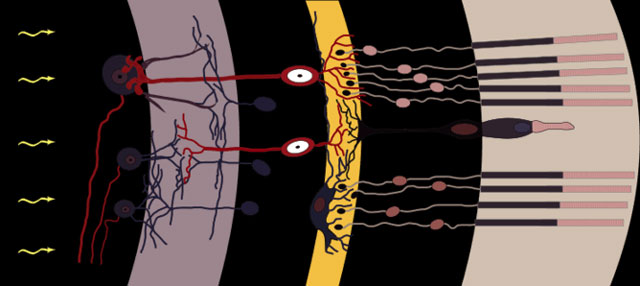
     Diagram of the retina, in its sensory complexity. Cajal, CC BY-SA
    Diagram of the retina, in its sensory complexity. Cajal, CC BY-SA

    What about the artificial eyes we’d need? Even though high-resolution cameras now exist, the eyes we’re born with each have approximately 5m cones and 100m rods, plus the various “preprocessing” stages, from the horizontal, bipolar, amacrine and ganglion cells. We are indeed very far from being able to reproduce a full artificial retina, even though some amazing research in Paris has succeeded in helping the vision-impaired see again.

    As a first step, we could therefore use those simplified robotic bodies with their reduced sensory and motor skills. Would it affect our minds? Yes. Our cognition depends on the interactions we have with the world, and this interaction is conveyed by both our perceptions and our actions. If you change them, you also change the sensory experience of the world as well as its underlying logic. Cognition is embodied.

    Look out for part two of this article tomorrow.The Conversation

    • Nicolas P Rougier is chargé de recherché at Inria, the French Institute for Research in Computer Science and Automation
    • This article was originally published on The Conversation

    Follow TechCentral on Google News Add TechCentral as your preferred source on Google


    Andy Clark Donald O Hebb Nicolas P Rougier Ray Kurzweil
    WhatsApp YouTube
    Share. Facebook Twitter LinkedIn WhatsApp Telegram Email Copy Link
    Previous ArticleFree data for overcharged Vodacom users
    Next Article Is SA too obsessed with matric?

    Related Posts

    AI hysteria could set the technology back by decades

    24 July 2019

    Could AI be mankind’s undoing?

    7 December 2014
    Company News
    Security by design is the channel's strongest pitch - Othelo Vieira

    Security by design is the channel’s strongest pitch

    23 April 2026
    Your brand is invisible to the AI that's choosing your competitor - Michelle Losco

    Your brand is invisible to the AI that’s choosing your competitor

    23 April 2026
    How AnyDesk is redefining remote access for African enterprises

    How AnyDesk is redefining remote access for African enterprises

    22 April 2026
    Opinion
    The conflict of interest at the heart of PayShap's slow adoption - Cheslyn Jacobs

    The conflict of interest at the heart of PayShap’s slow adoption

    26 March 2026
    South Africa's energy future hinges on getting wheeling right - Aishah Gire

    South Africa’s energy future hinges on getting wheeling right

    10 March 2026
    Hold the doom: the case for a South African comeback - Duncan McLeod

    Apple just dropped a bomb on the Windows world

    5 March 2026

    Subscribe to Updates

    Get the best South African technology news and analysis delivered to your e-mail inbox every morning.

    Latest Posts
    South Africa planning big overhaul of public sector IT - State IT Agency Sita

    South Africa planning big overhaul of public sector IT

    23 April 2026
    Usaasa's 30-year run nears its end - Communications minister Solly Malatsi. Image c/o DCDT

    Usaasa’s 30-year run nears its end

    23 April 2026
    Charge to switch on first N3 off-grid EV stations in May - Joubert Roux

    Charge to switch on first N3 off-grid EV stations in May

    23 April 2026
    Middle-class South Africa is ditching streaming for AI

    Middle-class South Africa is ditching streaming for AI

    23 April 2026
    © 2009 - 2026 NewsCentral Media
    • Cookie policy (ZA)
    • TechCentral – privacy and Popia

    Type above and press Enter to search. Press Esc to cancel.

    Manage consent

    TechCentral uses cookies to enhance its offerings. Consenting to these technologies allows us to serve you better. Not consenting or withdrawing consent may adversely affect certain features and functions of the website.

    Functional Always active
    The technical storage or access is strictly necessary for the legitimate purpose of enabling the use of a specific service explicitly requested by the subscriber or user, or for the sole purpose of carrying out the transmission of a communication over an electronic communications network.
    Preferences
    The technical storage or access is necessary for the legitimate purpose of storing preferences that are not requested by the subscriber or user.
    Statistics
    The technical storage or access that is used exclusively for statistical purposes. The technical storage or access that is used exclusively for anonymous statistical purposes. Without a subpoena, voluntary compliance on the part of your Internet Service Provider, or additional records from a third party, information stored or retrieved for this purpose alone cannot usually be used to identify you.
    Marketing
    The technical storage or access is required to create user profiles to send advertising, or to track the user on a website or across several websites for similar marketing purposes.
    • Manage options
    • Manage services
    • Manage {vendor_count} vendors
    • Read more about these purposes
    View preferences
    • {title}
    • {title}
    • {title}