Close Menu
TechCentralTechCentral

    Subscribe to the newsletter

    Get the best South African technology news and analysis delivered to your e-mail inbox every morning.

    Facebook X (Twitter) YouTube LinkedIn
    WhatsApp Facebook X (Twitter) LinkedIn YouTube
    TechCentralTechCentral
    • News
      Big Microsoft 365 price increases coming next year

      Big Microsoft price increases coming next year

      5 December 2025
      Vodacom to take control of Safaricom in R36-billion deal - Shameel Joosub

      Vodacom to take control of Safaricom in R36-billion deal

      4 December 2025
      Black Friday goes digital in South Africa as online spending surges to record high

      Black Friday goes digital in South Africa as online spending surges to record high

      4 December 2025
      BYD takes direct aim at Toyota with launch of sub-R500 000 Sealion 5 PHEV

      BYD takes direct aim at Toyota with launch of sub-R500 000 Sealion 5 PHEV

      4 December 2025
      'Get it now': Takealot in new instant deliveries pilot

      ‘Get it now’: Takealot in new instant deliveries pilot

      4 December 2025
    • World
      Amazon and Google launch multi-cloud service for faster connectivity

      Amazon and Google launch multi-cloud service for faster connectivity

      1 December 2025
      Google makes final court plea to stop US breakup

      Google makes final court plea to stop US breakup

      21 November 2025
      Bezos unveils monster rocket: New Glenn 9x4 set to dwarf Saturn V

      Bezos unveils monster rocket: New Glenn 9×4 set to dwarf Saturn V

      21 November 2025
      Tech shares turbocharged by Nvidia's stellar earnings

      Tech shares turbocharged by stellar Nvidia earnings

      20 November 2025
      Config file blamed for Cloudflare meltdown that disrupted the web

      Config file blamed for Cloudflare meltdown that disrupted the web

      19 November 2025
    • In-depth
      Jensen Huang Nvidia

      So, will China really win the AI race?

      14 November 2025
      Valve's Linux console takes aim at Microsoft's gaming empire

      Valve’s Linux console takes aim at Microsoft’s gaming empire

      13 November 2025
      iOCO's extraordinary comeback plan - Rhys Summerton

      iOCO’s extraordinary comeback plan

      28 October 2025
      Why smart glasses keep failing - no, it's not the tech - Mark Zuckerberg

      Why smart glasses keep failing – it’s not the tech

      19 October 2025
      BYD to blanket South Africa with megawatt-scale EV charging network - Stella Li

      BYD to blanket South Africa with megawatt-scale EV charging network

      16 October 2025
    • TCS
      TCS+ | How Cloud on Demand helps partners thrive in the AWS ecosystem - Odwa Ndyaluvane and Xenia Rhode

      TCS+ | How Cloud On Demand helps partners thrive in the AWS ecosystem

      4 December 2025
      TCS | MTN Group CEO Ralph Mupita on competition, AI and the future of mobile

      TCS | Ralph Mupita on competition, AI and the future of mobile

      28 November 2025
      TCS | Dominic Cull on fixing South Africa's ICT policy bottlenecks

      TCS | Dominic Cull on fixing South Africa’s ICT policy bottlenecks

      21 November 2025
      TCS | BMW CEO Peter van Binsbergen on the future of South Africa's automotive industry

      TCS | BMW CEO Peter van Binsbergen on the future of South Africa’s automotive industry

      6 November 2025
      TCS | Why Altron is building an AI factory - Bongani Andy Mabaso

      TCS | Why Altron is building an AI factory in Johannesburg

      28 October 2025
    • Opinion
      Your data, your hardware: the DIY AI revolution is coming - Duncan McLeod

      Your data, your hardware: the DIY AI revolution is coming

      20 November 2025
      Zero Carbon Charge founder Joubert Roux

      The energy revolution South Africa can’t afford to miss

      20 November 2025
      It's time for a new approach to government IT spend in South Africa - Richard Firth

      It’s time for a new approach to government IT spend in South Africa

      19 November 2025
      How South Africa's broken Rica system fuels murder and mayhem - Farhad Khan

      How South Africa’s broken Rica system fuels murder and mayhem

      10 November 2025
      South Africa's AI data centre boom risks overloading a fragile grid - Paul Colmer

      South Africa’s AI data centre boom risks overloading a fragile grid

      30 October 2025
    • Company Hubs
      • Africa Data Centres
      • AfriGIS
      • Altron Digital Business
      • Altron Document Solutions
      • Altron Group
      • Arctic Wolf
      • AvertITD
      • Braintree
      • CallMiner
      • CambriLearn
      • CYBER1 Solutions
      • Digicloud Africa
      • Digimune
      • Domains.co.za
      • ESET
      • Euphoria Telecom
      • Incredible Business
      • iONLINE
      • IQbusiness
      • Iris Network Systems
      • LSD Open
      • NEC XON
      • Netstar
      • Network Platforms
      • Next DLP
      • Ovations
      • Paracon
      • Paratus
      • Q-KON
      • SevenC
      • SkyWire
      • Solid8 Technologies
      • Telit Cinterion
      • Tenable
      • Vertiv
      • Videri Digital
      • Vodacom Business
      • Wipro
      • Workday
      • XLink
    • Sections
      • AI and machine learning
      • Banking
      • Broadcasting and Media
      • Cloud services
      • Contact centres and CX
      • Cryptocurrencies
      • Education and skills
      • Electronics and hardware
      • Energy and sustainability
      • Enterprise software
      • Financial services
      • Information security
      • Internet and connectivity
      • Internet of Things
      • Investment
      • IT services
      • Lifestyle
      • Motoring
      • Public sector
      • Retail and e-commerce
      • Satellite communications
      • Science
      • SMEs and start-ups
      • Social media
      • Talent and leadership
      • Telecoms
    • Events
    • Advertise
    TechCentralTechCentral
    Home » Sections » Electronics and hardware » The US lost its lead in semiconductors. It may never regain it
    The US lost its lead in semiconductors. It may never regain it

    The US lost its lead in semiconductors. It may never regain it

    By The Conversation16 December 2024

    US microchip giant Intel is looking for a new CEO following Pat Gelsinger’s shock resignation. This represents more than just a corporate shakeup. It’s the end of an era in which one company could totally control a strategically vital American technology.

    Under Intel’s roof is the entire process for making computer chips – from research to design to complex fabrication. For much of the late 20th century, this made the Californian company a paragon of American ingenuity.

    Gelsinger has been a lifer at Intel. He rose to chief technology officer in the 2000s before leaving for a decade to run Dell’s data storage to cloud computing business, EMC.

    Semiconductors remain the lifeblood of the military, from hypersonic missiles to AI-powered defence systems

    His return as CEO in 2021 was seen as messianic. He promised the return of America’s chipset manufacturing supremacy from rivals like Taiwan Semiconductor Manufacturing Company (TSMC).

    His vision involved funnelling billions of dollars into expanding chip-making factories in New Mexico and Oregon, and building plants in Ohio and Germany. To help enable this, the federal government committed US$7.9-billion in subsidies as part of President Joe Biden’s Chips Act 2022.

    Three years later, the company is in crisis. The board gave Gelsinger a choice: retire or be removed, so he chose the former.

    Intel’s strategic importance

    The US government has always nurtured the nation’s industry in semiconductors, the tiny chips found inside laptops and smartphones. As far back as the late 1950s it was paying 30 times the market rate for transistors for missile computers to California-based Fairchild Semiconductor, whose senior executives would later found Intel.

    Semiconductors remain the lifeblood of the military, from hypersonic missiles to AI-powered defence systems. Yet the most advanced ones are predominantly fabricated by TSMC in Taiwan, including for American F-35 fighter jets.

    China, of course, wants control of the island nation with which it used to be united. Whoever controls Taiwan’s semiconductor capabilities, according to a US congressional commission back in 2022, will have “the upper hand in every domain of warfare” – not to mention an industry at the heart of global commerce and society.

    Read: Intel board lost confidence in CEO Pat Gelsinger

    To complicate matters, major American semiconductor companies like Nvidia, AMD and Qualcomm own no factories, and all rely heavily for chip-making on TSMC/Taiwan, as well as Samsung/South Korea. The US has duly induced TSMC and Samsung to build plants respectively in Arizona and Texas. Yet as the last of the fully integrated US semiconductor manufacturers, no company has been more central than Intel to America’s strategy to bring chip-making back home.
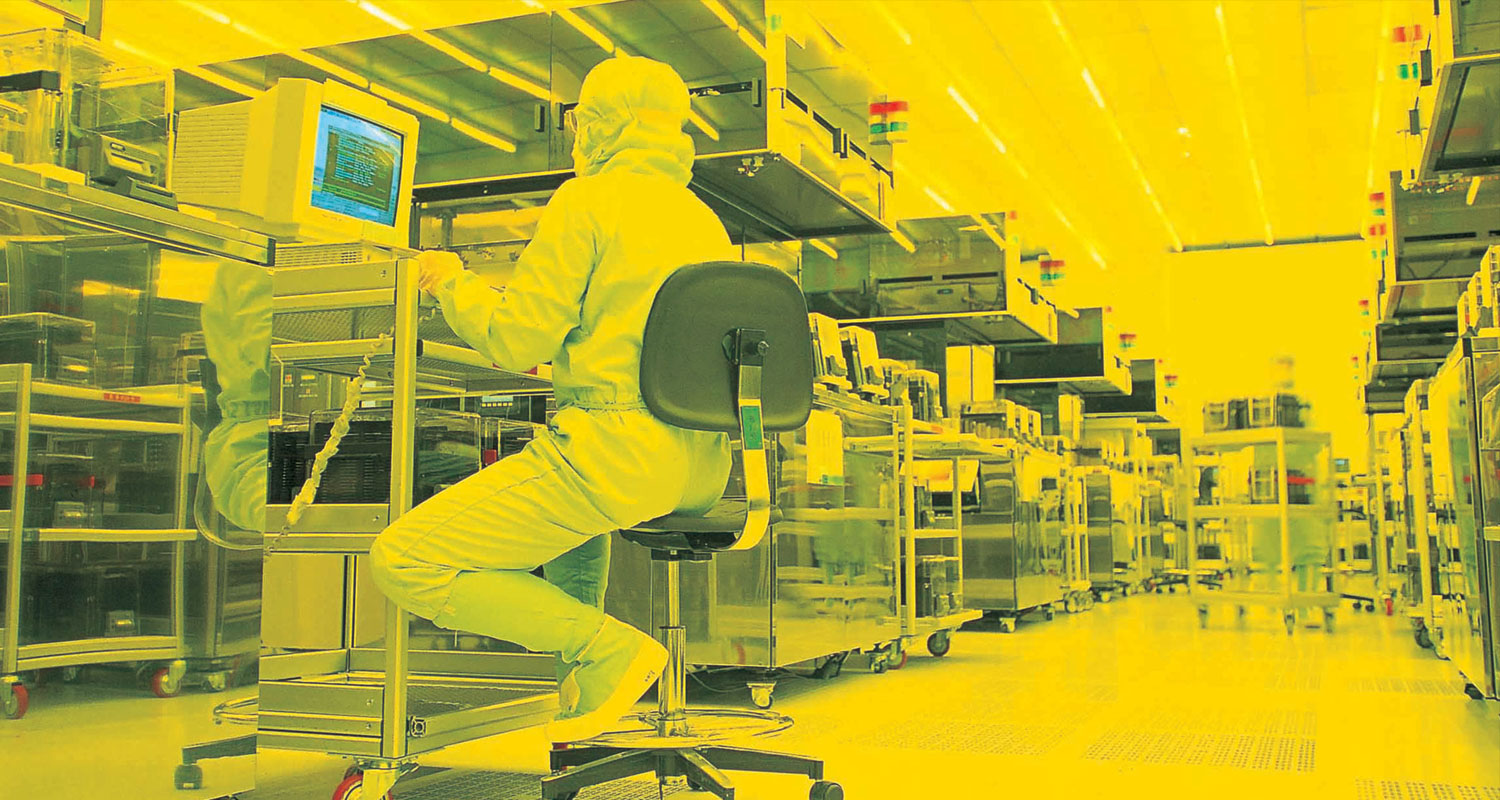
    Inside a TSMC chip fabrication plant in Taiwan. Image: TSMC

    The weight of history

    Intel’s integrated model long made it the king of Silicon Valley, but it missed a crucial opportunity in the wake of the mobile revolution. It continued focusing on expensive, power-hungry CPUs for PCs and servers, failing to prioritise the lighter, more energy-efficient processors used in smartphones. It neither brought out its own chips, nor followed the advice of industry observers to mirror the TSMC model of manufacturing them for other firms.

    This would have generated enough cash to be early in funding the brutally expensive research into the next generation of chip-making technologies. But Intel didn’t feel the need: its CPU manufacturing business relied on the previous state of the art, deep ultraviolet lithography (DUV). For years the company couldn’t resist the profit margins and free cashflow from continuing to focus on this older technology. Wall Street is always addicted to the cash machine, even amid diminishing technical momentum, so plenty investors supported the strategy.

    Read: The people who might be called on to rescue Intel

    Meanwhile, TSMC built up a formidable library of intellectual property to allow clients to design and order more chipsets easily. It mastered remote collaboration so that American chip designers didn’t even need to jump on Zoom calls with Taiwan. They could flesh out their latest technical requirements in TSMC’s virtual e-foundry, 24 hours a day.

    Making massive volumes of chips for mobile devices enabled TSMC in the mid-2010s to invest before any rivals in the extreme ultraviolet lithography (EUV) used to manufacture today’s most powerful semiconductors. This made TSMC even more efficient, while setting a new chip-making standard that Samsung and eventually Intel would be forced to follow.

    Former Intel CEO Pat Gelsinger

    The foundering of Intel’s foundry

    Gelsinger was keenly aware of the domino effect from Intel’s smartphone failure. In 2021 he launched Intel Foundry Services (IFS), a standalone unit offering TSMC-style manufacturing to third-party clients. Hence the investment in extra capacity.

    Unfortunately, Intel’s corporate culture has eaten this strategy for breakfast. A great example was Intel board member Lip-Bu Tan’s resignation in August. Formerly the CEO of US chip software firm Cadence Design Systems, he had only arrived two years ago to help implement Gelsinger’s strategy.

    In October 2023 he was even put in charge of manufacturing. Yet he soon quit in frustration at “the company’s lagging workforce, its approach to contract manufacturing and … risk-averse bureaucratic culture”.

    At bottom, this is a crisis for the US. The cherished notion of ‘design in America, build in America’ is fading

    His departure left a glaring gap in semiconductor expertise on the board. Intel’s stock is down 59% in 2024, and the company is cutting 15% of its workforce to save $10-billion as IFS has struggled to take off.

    Yet at bottom, this is a crisis for the US. The cherished notion of “design in America, build in America” is fading. Despite TSMC and Samsung creating US manufacturing capacity, both companies will still make the most of their products at home.

    Above all, TSMC holds unparalleled chip-making prowess and remains firmly rooted in Taiwan. Taiwan retains the key advantages in this industry: intellectual capital, skilled labour and decades of production know-how.

    Meanwhile, the Taiwanese-American CEO of Nvidia, Jensen Huang, whose company dominates the AI chips market, sees no reason to decouple from TSMC. And no matter how hawkish US political leaders become about overseas supply chains, economic facts persist: Tesla, for instance, relies on Nvidia’s chips, which depend on TSMC fabrication.

    Read: Intel hoofed off the Dow – to make way for Nvidia

    The global nature of chip-making will therefore not bow to American nostalgia. The US may persuade TSMC and Samsung to open more facilities in the States, but absolute sovereignty is gone. The departure of Intel’s last true believer underscores that sobering truth.The Conversation

    Get breaking news from TechCentral on WhatsApp. Sign up here

    • The author, Howard Yu, is professor of management and innovation, International Institute for Management Development
    • This article is republished from The Conversation under a Creative Commons licence. Read the original article


    Don’t miss:

    Can anyone save Intel?


    Intel Jensen Huang Nvidia Pat Gelgsinger Samsung TSMC
    Subscribe to TechCentral Subscribe to TechCentral
    Share. Facebook Twitter LinkedIn WhatsApp Telegram Email Copy Link
    Previous ArticleSouth Africa is falling behind in weather forecasting technology
    Next Article How the AI behind ChatGPT actually works

    Related Posts

    Smartphone prices set to jump as memory crunch hits consumer tech

    Smartphone prices set to jump as memory crunch hits consumer tech

    3 December 2025
    Samsung goes trifold while Apple folds its arms

    Samsung goes trifold while Apple folds its arms

    2 December 2025
    Samsung's first trifold smartphone is here

    Samsung’s first trifold smartphone is here

    2 December 2025
    Company News
    AI is not a technology problem - iqbusiness

    AI is not a technology problem – iqbusiness

    5 December 2025
    Telcos are sitting on a data gold mine - but few know what do with it - Phillip du Plessis

    Telcos are sitting on a data gold mine – but few know what do with it

    4 December 2025
    Unlock smarter computing with your surface Copilot+ PC

    Unlock smarter computing with your Surface Copilot+ PC

    4 December 2025
    Opinion
    Your data, your hardware: the DIY AI revolution is coming - Duncan McLeod

    Your data, your hardware: the DIY AI revolution is coming

    20 November 2025
    Zero Carbon Charge founder Joubert Roux

    The energy revolution South Africa can’t afford to miss

    20 November 2025
    It's time for a new approach to government IT spend in South Africa - Richard Firth

    It’s time for a new approach to government IT spend in South Africa

    19 November 2025

    Subscribe to Updates

    Get the best South African technology news and analysis delivered to your e-mail inbox every morning.

    Latest Posts
    Big Microsoft 365 price increases coming next year

    Big Microsoft price increases coming next year

    5 December 2025
    AI is not a technology problem - iqbusiness

    AI is not a technology problem – iqbusiness

    5 December 2025
    Vodacom to take control of Safaricom in R36-billion deal - Shameel Joosub

    Vodacom to take control of Safaricom in R36-billion deal

    4 December 2025
    Black Friday goes digital in South Africa as online spending surges to record high

    Black Friday goes digital in South Africa as online spending surges to record high

    4 December 2025
    © 2009 - 2025 NewsCentral Media
    • Cookie policy (ZA)
    • TechCentral – privacy and Popia

    Type above and press Enter to search. Press Esc to cancel.

    Manage consent

    TechCentral uses cookies to enhance its offerings. Consenting to these technologies allows us to serve you better. Not consenting or withdrawing consent may adversely affect certain features and functions of the website.

    Functional Always active
    The technical storage or access is strictly necessary for the legitimate purpose of enabling the use of a specific service explicitly requested by the subscriber or user, or for the sole purpose of carrying out the transmission of a communication over an electronic communications network.
    Preferences
    The technical storage or access is necessary for the legitimate purpose of storing preferences that are not requested by the subscriber or user.
    Statistics
    The technical storage or access that is used exclusively for statistical purposes. The technical storage or access that is used exclusively for anonymous statistical purposes. Without a subpoena, voluntary compliance on the part of your Internet Service Provider, or additional records from a third party, information stored or retrieved for this purpose alone cannot usually be used to identify you.
    Marketing
    The technical storage or access is required to create user profiles to send advertising, or to track the user on a website or across several websites for similar marketing purposes.
    • Manage options
    • Manage services
    • Manage {vendor_count} vendors
    • Read more about these purposes
    View preferences
    • {title}
    • {title}
    • {title}